The ₹150-a-Day Petrol Problem: Why India’s High-Mileage Riders Are Going Electric in 2026

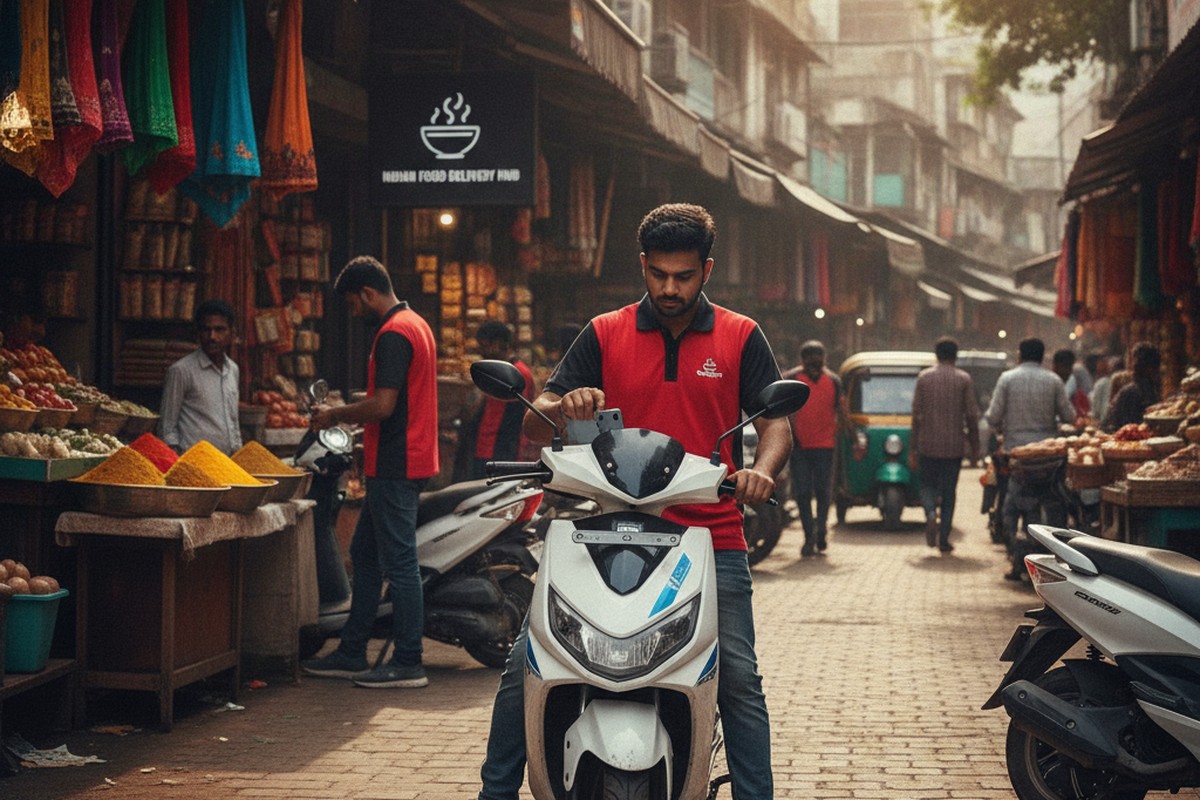
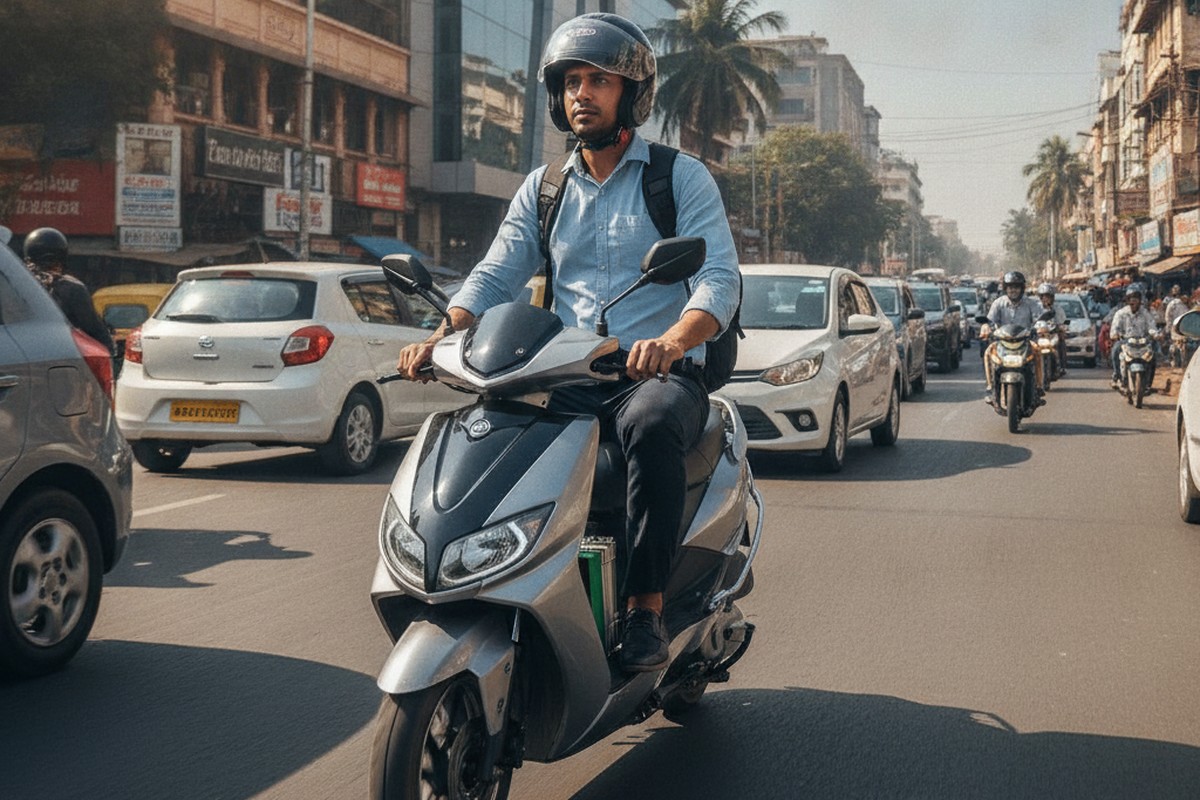
Indian delivery rider on an electric scooter in busy city traffic in India

Ask any delivery rider in India what eats into their income the most, and the answer is almost always the same: petrol. Not traffic. Not wear and tear. Petrol.

With pump prices sitting at ₹102 per litre in Delhi and touching ₹115 in Hyderabad as of September 2026, a delivery worker covering 80 to 100 kilometres a day on a Honda Activa is spending somewhere between ₹170 and ₹200 on fuel alone — every single working day. Run those numbers over a month and you’re looking at ₹4,400 to ₹5,200 disappearing into the tank, month after month. Over a year, that’s close to ₹60,000 that never becomes savings, never becomes an EMI payment, never becomes anything except exhaust.

This is the calculation that’s driving a quiet but significant shift among India’s high-mileage riders — delivery workers, field sales agents, neighbourhood businesspeople, and long-distance daily commuters — toward electric scooters. Not out of concern for the environment (though that’s a bonus), but because the numbers simply work out better. Dramatically better.

Let’s Do the Actual Math

A Honda Activa returns around 47 to 50 kilometres per litre in real-world city riding. At ₹110 per litre (a reasonable average across major cities in September 2026), you’re spending roughly ₹2.20 per kilometre. Across 80 km daily, that’s ₹176 every working day — approximately ₹4,600 per month.

On an electric scooter, the same 80-kilometre run costs one charge: roughly ₹15 to ₹25 depending on your electricity tariff, or about ₹0.20 to ₹0.25 per kilometre. Monthly electricity cost for your scooter: under ₹650.

The monthly gap between petrol and electric is close to ₹4,000 — every single month. Over a year, that’s roughly ₹48,000. Over three years, more than ₹1.4 lakh in fuel savings alone, before you count the money you stop spending on oil changes, spark plugs, filters, and the other regular consumables that electric motors simply don’t need.

What High-Mileage Riders Actually Need

Before jumping into which electric scooter to buy, it’s worth being clear about what daily high-mileage riding actually demands — because showroom specs often don’t tell the full story.

First is real-world range. Every manufacturer prints their best-case figure. In Indian conditions — stop-start traffic, variable loads, heat — the actual range is typically 15 to 25 per cent lower. If you cover 80 km per shift, you need a scooter that genuinely delivers 90-plus km in real-world use, not just on paper.

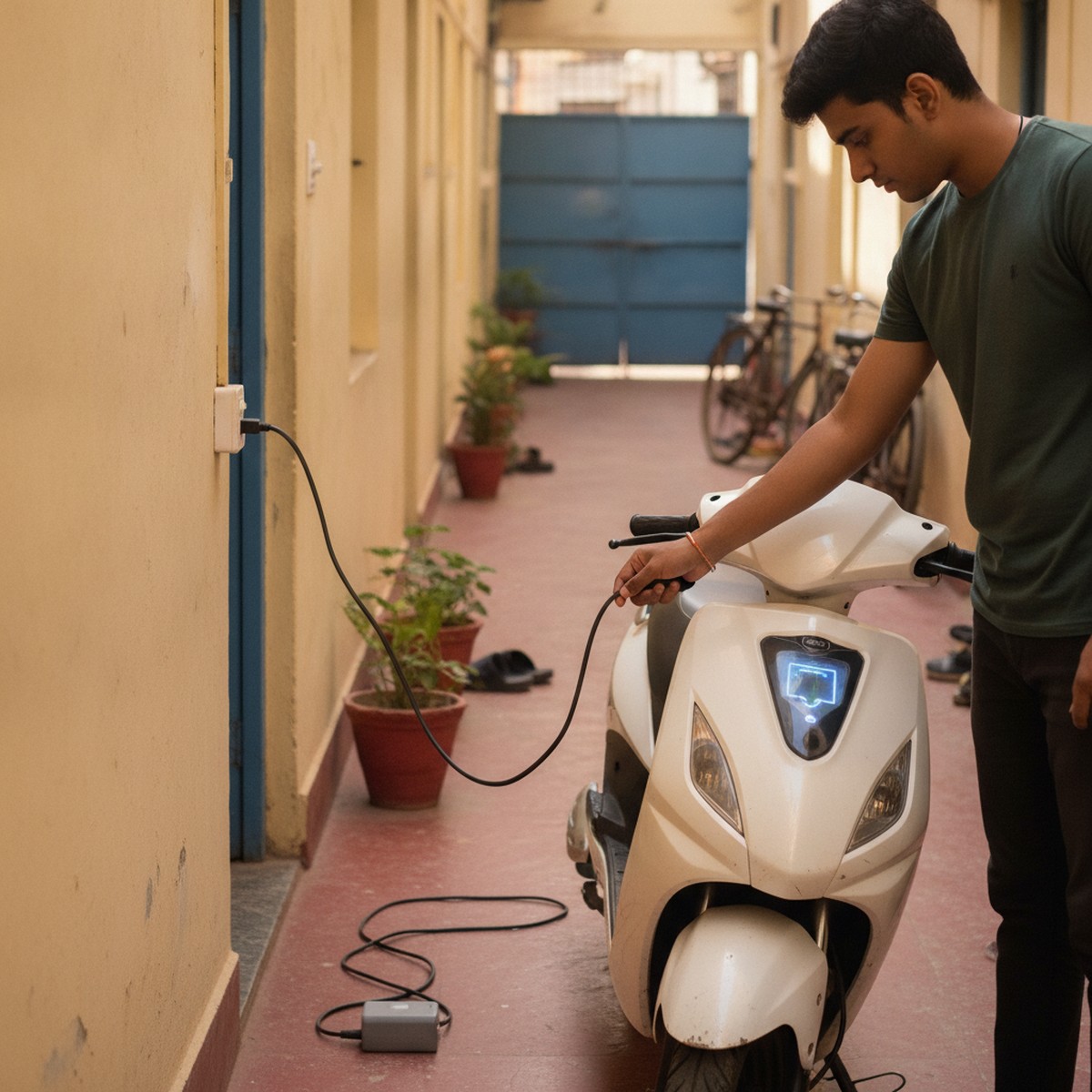
Second is charging access. For most riders covering 80 km daily, overnight home charging is enough — a standard 4- to 5-hour charge is sufficient. But if you live in a rented room without dedicated parking, you need to map public charging stations near your route before committing to a purchase.

Third is service proximity. For any rider whose income depends on their scooter, a vehicle that’s off the road for three days awaiting a service appointment is a real financial problem. Check how close the nearest authorised service point is before you sign anything.

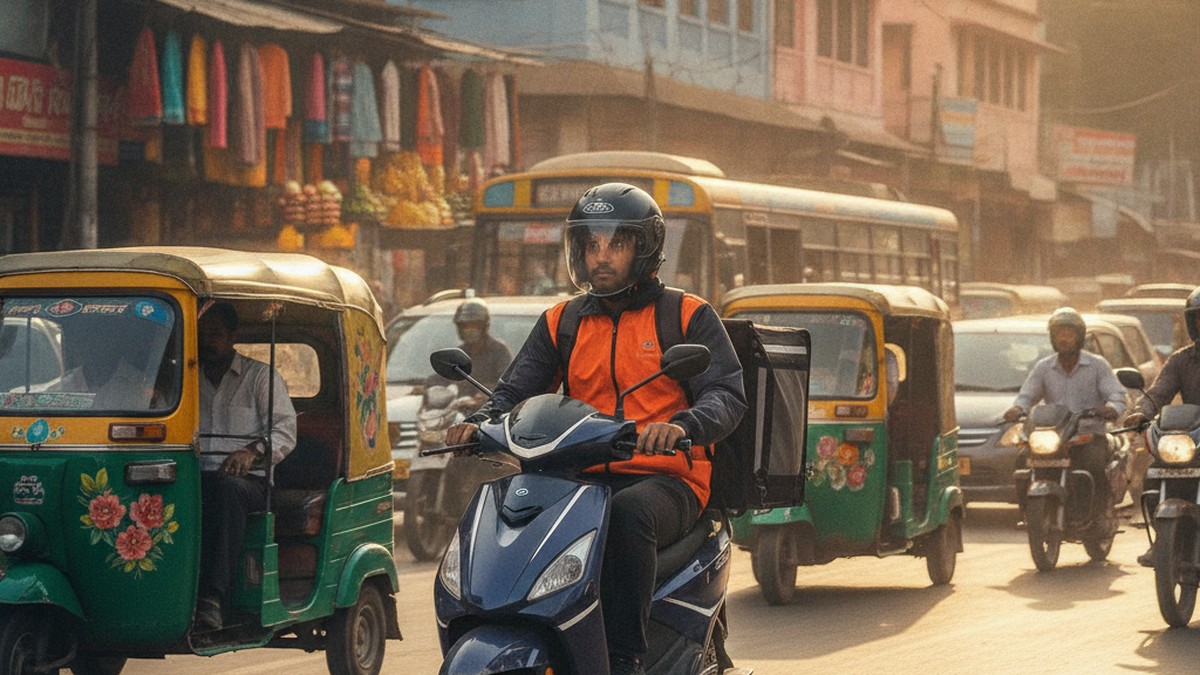
Electric scooter rider in Indian city traffic on a delivery run

Where the Market Sits Right Now

The electric two-wheeler market in India has matured noticeably over the past two years. What was once dominated by underpowered low-speed scooters has evolved into a proper market with options across every budget and use case.

At the premium end, models like the TVS iQube (starting around ₹1.25 lakh) and the Hero Vida V2 Pro (around ₹1.10 lakh) offer strong real-world range in the 100 to 130 km bracket, backed by wide service networks. The Ola S1 X range starts near ₹1 lakh and delivers approximately 100 to 115 km real-world range. Bajaj’s Chetak is a well-built, dependable choice in the ₹1.25 to ₹1.35 lakh range.

These are solid scooters. But for a delivery worker or a small business owner already spending ₹5,000 a month on petrol, an upfront cost of ₹1.25 lakh is a significant commitment — and many of these buyers are looking at tighter budgets.

That’s where a newer, value-led player like Elektree India is worth examining carefully.

Why Elektree India Makes Sense for High-Mileage Riders

Elektree India offers a range of electric scooters and a high-performance electric motorcycle, with a focus on keeping the total ownership proposition — not just the sticker price — genuinely affordable for the Indian buyer.

The Elektree Zenith, priced at ₹90,164, delivers 80 to 100 km of range at a top speed of 60 km/h — squarely in the range required for most urban and semi-urban delivery shifts. The RV 80 Sportz, at ₹94,363, sits at a similar specification with a sportier build. Both run on a 60V battery system with a 4-hour full charge time. Operating cost? Elektree states ₹5 to ₹10 per charge — which, at current electricity rates in most Indian cities, is entirely consistent with the industry-standard electric running cost of ₹15 to ₹25 per 80-100 km charge.

For riders who cover shorter distances in confined local areas — hyperlocal delivery, intra-colony work, small neighbourhood businesses — the Elektree Wheels at ₹82,871 offers 50 to 70 km of range at 45 km/h and comes with the significant practical advantage of not requiring a driving licence or registration. For someone starting out in a small town or just needing a reliable vehicle for short daily loops, this reduces both the upfront paperwork and the regulatory overhead.

At the other end of the range, the Fantom EV at ₹1,39,000 is a different proposition entirely — a 110 km/h electric motorcycle with 150 to 180 km of range. If you’re a courier or field executive covering long inter-city distances, this is one of the most capable and cost-effective options available in the Indian market under ₹1.5 lakh.

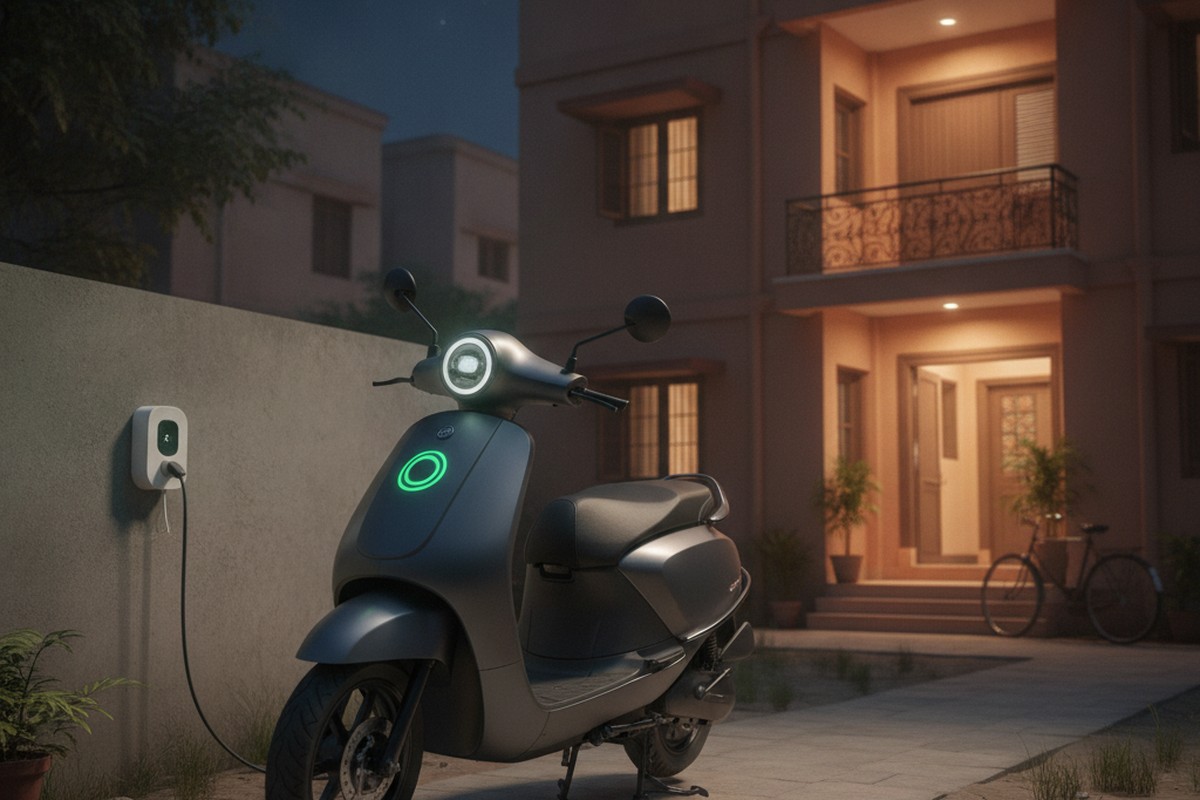
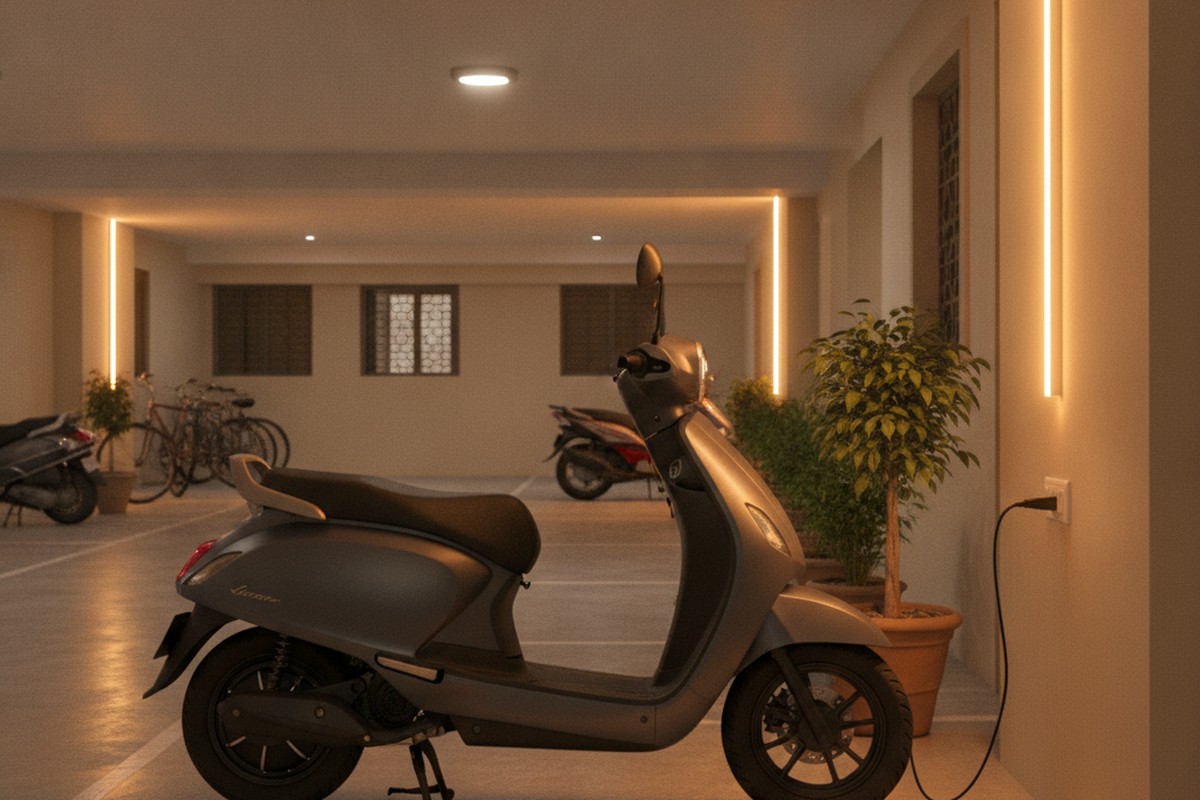
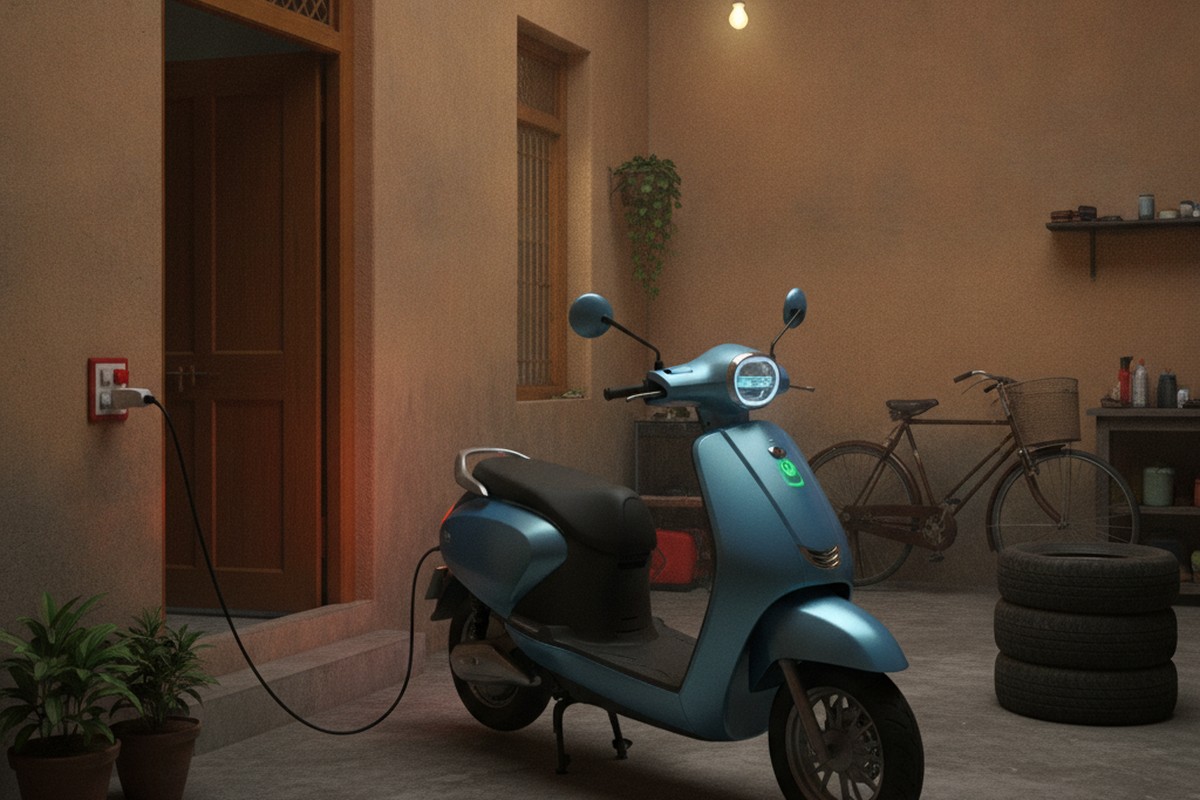
Elektree electric scooter charging at home at night in India

The Ownership Equation — Worked Out Simply

Here’s a straightforward way to think about what switching to an Elektree Zenith actually costs a high-mileage rider:

Say you finance the ₹90,164 scooter with a ₹20,000 down payment. The balance of ₹70,000, financed over 24 months at a typical rate, comes to approximately ₹3,300 to ₹3,500 per month in EMI. Against that, you’re saving roughly ₹4,000 per month in petrol costs. Net monthly position: you’re ahead by ₹500 to ₹700 from the very first month — even while paying off the scooter. Once the EMI period ends, the full ₹4,000-plus monthly saving goes straight to you.

Add maintenance savings — no oil changes, no carburetor cleaning, no exhaust replacements, far fewer brake replacements because of regenerative braking — and the total ownership cost advantage compounds further over two to three years.

Elektree also backs its scooters with a 3-year warranty, which provides meaningful protection for buyers who depend on their vehicle daily and can’t afford an unexpected repair bill.

A Few Things Worth Knowing First

If you plan to use the scooter for declared commercial delivery work, check whether the warranty covers commercial use — some manufacturers exclude it in the fine print. Confirm this with your dealer in writing before purchase.

If home charging isn’t an option, map the public charging network in your area beforehand. India’s charging infrastructure has improved substantially in metros but remains patchy in many smaller cities. And finally, battery range does degrade gradually over time — around 10 to 15 per cent over three to four years of heavy use — so buying a scooter with a little headroom beyond your daily distance is always the safer call.

The Bottom Line for High-Mileage Riders

If you’re covering 60 km or more every day — whether delivering for Swiggy, Zomato, or Blinkit, or simply commuting across the city for work — the case for going electric in 2026 has never been stronger. Petrol prices are not coming down. Electricity tariffs, by comparison, have remained far more stable. The maintenance gap between petrol and electric has only widened as Indian EV servicing has matured.

Among the options available in the under-₹1 lakh and accessible-over-₹1-lakh range, Elektree India offers a combination of price, range, running cost, and warranty coverage that makes it one of the most compelling choices for high-mileage Indian riders. The Zenith and RV 80 Sportz cover the sweet spot for daily delivery and commute use. The Wheels handles hyperlocal work without licensing friction. And the Fantom EV steps up for riders who need serious range and performance for longer routes.

The ₹150-a-day petrol bill is not inevitable. For most Indian high-mileage riders, switching to an Elektree means that money stays in your pocket — from the first month onwards.

Explore the full range of Elektree India electric scooters and find the model that fits your daily riding pattern at elektree.com.

Electric Scooter Resale Value in India 2026: The ₹50,000 Question Nobody Asks at the Showroom

A buyer inspecting an electric scooter on an Indian city street, evaluating resale value and build quality

Walk into an electric scooter showroom and the conversation will reliably orbit three things: the range claim on the brochure, the monthly EMI, and how much you stand to save on petrol. All reasonable. But there is one question almost nobody asks — not the salesperson, not the brochure, and not most comparison articles — and it could easily be worth ₹30,000 to ₹50,000 to you personally.

What will your electric scooter actually be worth when you need to sell it?

For most Indian buyers, this is not a hypothetical. The typical scooter ownership cycle runs three to five years. After that, people upgrade, relocate, pass the scooter to a family member, or simply want something newer. The resale value at that point is the final accounting of whether your EV purchase made genuine financial sense. In 2026, it is a calculation that a significant number of electric scooter owners are discovering too late.

The Depreciation Gap Is Larger Than Most People Realise

Here is what the data from India’s used EV market shows. Petrol scooters have historically held 60 to 70 percent of their purchase value after three years of regular use. Electric scooters, on the other hand, tell a considerably different story. Established EV brands in India retain roughly 35 to 50 percent of original value after three years. Lesser-known brands — particularly those with limited service networks or short warranty coverage — can drop to just 25 to 35 percent of their purchase price.

Concrete numbers make this clearer. An electric scooter bought for ₹1,00,000 that depreciates 55 percent over three years fetches around ₹45,000. A similarly priced petrol scooter holding 65 percent returns ₹65,000. That ₹20,000 gap is just the base case — for scooters in the ₹80,000 to ₹1,20,000 bracket, the real-world difference between a value-retaining brand and a poor one can stretch well past ₹40,000. Folded into your total cost of ownership, the picture shifts substantially.

The Battery Is the Single Biggest Factor

The reason electric scooters depreciate faster comes down, almost entirely, to one component: the battery pack.

The battery accounts for approximately 35 to 45 percent of an electric scooter’s total cost. When a prospective buyer looks at a three-year-old EV, they know the battery has been through hundreds of charge cycles. They know it has aged. What they often cannot know — without specialised diagnostic equipment and a certified State of Health report — is how much capacity that battery has actually retained.

Without that certainty, buyers discount aggressively to account for the risk. This is rational behaviour, not irrational penny-pinching. They are protecting themselves against the possibility that the battery is running at 70 percent of its original capacity, or that it will need replacement within the next year. Battery replacement in India, depending on the model, can run from ₹20,000 to ₹60,000 or more.

Research from the used EV market indicates that 73 percent of prospective second-hand EV buyers in India say they would consider a used EV only if the battery has at least three years of transferable warranty remaining or comes with a certified health report. That single statistic tells you exactly what protects your scooter’s resale value — and it comes down directly to the warranty terms of the brand you choose today.

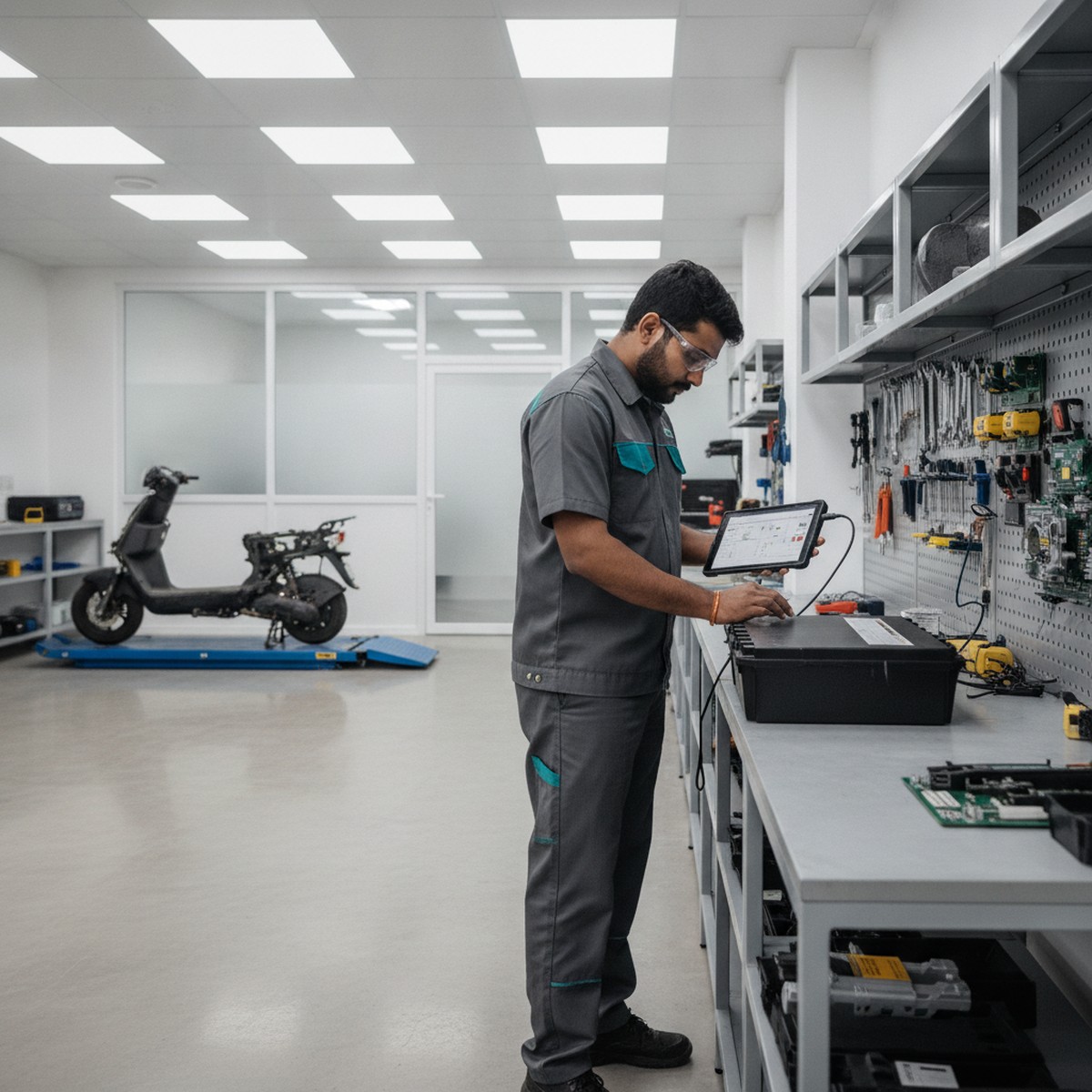
EV technician inspecting an electric scooter battery at an authorized service center in India

Why Your Brand’s Service Reputation Also Prices Into the Resale

There is another dimension to resale value that most buyers never connect to their initial purchase: the service reputation of the brand.

Over the past two years, certain electric scooter brands in India have developed widely reported service backlogs — long waits for repairs, difficulty sourcing spare parts, complaints that accumulated into the tens of thousands. These stories spread through owner communities and social media, and they have a direct effect on what used buyers are willing to pay — even for vehicles in good mechanical condition.

When a brand is associated with service difficulties, buyers factor in the risk of facing those same issues after the warranty expires. They discount accordingly. The result is disproportionately steep depreciation for scooters from service-troubled brands — not because a specific vehicle is faulty, but because the brand’s perception problem prices into every used transaction automatically. Your brand choice today is, in part, a bet on how that brand’s service reputation holds up over the next three to four years.

The Criteria That Actually Protect Resale Value

If protecting long-term value matters to your buying decision — and for most Indian households it should — here are the four criteria that genuinely move the needle:

Battery warranty length and transferability. The longer your battery warranty has to run at the time of resale, the more confidence a buyer places in the transaction. A scooter with 18 to 24 months of manufacturer battery warranty remaining is meaningfully easier to sell — and commands better prices — than one where coverage has already lapsed.

ICAT certification. The International Centre for Automotive Technology is India’s primary independent automotive testing body. ICAT certification means the vehicle was tested against established safety, performance, and construction standards by an independent authority — not just self-certified by the manufacturer. In the used market, certified scooters carry more credibility and face less aggressive discounting.

Build quality and component specifications. A scooter with quality suspension, proper braking hardware, and well-engineered mechanical components will show less wear over three years of daily Indian riding. Reduced wear means a better impression on potential buyers and less negotiating room for them to push the price down.

Service network depth. A brand with authorised service centres in most major cities and a reliable spare parts supply chain reduces the risk that your used buyer ends up stranded without support — a key factor in the confidence (and therefore offer price) of second-hand purchasers.

Where Elektree India Stands Against These Criteria

The Elektree Zenith, priced from ₹90,164, is one of the more interesting options in the Indian market when evaluated against resale-protecting criteria specifically — rather than just headline range or feature lists.

On warranty, the Zenith offers a 3-year/50,000 km battery warranty on its lithium-ion pack. In a segment where short warranty periods are common, three years is a meaningful commitment. Practically speaking, a buyer who purchases the Zenith today and sells it in two years can hand the next owner one full year of remaining manufacturer battery coverage. Given that 73 percent of used EV buyers specifically want warranty coverage as a purchase condition, this is a concrete, quantifiable selling advantage.

The Zenith also carries ICAT certification — independent quality verification that used buyers increasingly look for and that distinguishes it from many smaller entrants in the segment.

On the engineering side, the Zenith’s specifications hold up well. A mid-drive IPM motor, twin telescopic front suspension paired with a monoshock rear, and disc-drum braking represent a proper mechanical specification — not the economy-grade hardware that tends to show wear quickly under Indian road conditions. At 75 kg with a 200 kg payload capacity and 180 mm of ground clearance, it is built to handle routine Indian riding over a multi-year cycle without the deterioration that damages resale value. The 18.5-litre underseat boot, GPS tracking, and three riding modes add everyday usability that ages well.

The Elektree RV 80, at ₹94,363, offers the same 80 to 100 km range window and a similar mechanical foundation for buyers who prefer a different body style. Elektree has established dealer and service presence across major metros including Delhi, Mumbai, Bangalore, Hyderabad, and Kolkata — addressing one of the key concerns that used buyers factor into their valuations.

The Calculation You Should Actually Be Making

Most EV purchase calculations in India look at monthly fuel savings versus EMI and conclude that the numbers work. They usually do. But the complete ownership calculation includes what you recover at the end — and that number varies enormously depending on the brand you chose three years earlier.

A scooter with strong warranty coverage, ICAT certification, proven build quality, and a service-stable brand consistently retains more value than one that was cheaper upfront but offers a shorter warranty, no independent certification, and a service network with a patchy reputation. Over a three to five year ownership cycle, that difference in recoverable value can easily offset a higher initial purchase price several times over.

For buyers in 2026 who are thinking beyond the showroom math — who want the complete picture of what they will spend and recover over their ownership period — Elektree India’s range, particularly the Zenith and RV 80, deserves serious consideration. The combination of a 3-year battery warranty, ICAT certification, mid-drive motor engineering, and metro-wide service presence directly addresses the specific factors that preserve value in India’s used electric scooter market.

Explore the full range and current pricing at elektree.com.

Electric Scooters for Women Riders in India 2026 — Beyond the Colour Chart, Here’s What the Numbers Actually Say

Indian woman riding a modern electric scooter through busy city traffic

Walk into any electric scooter showroom in a major Indian city and you will notice something. The marketing aimed at women buyers tends to emphasise colour variants, compact dimensions, and “stylish design.” What is conspicuously absent from most of those conversations is the information that would actually help you make a smarter financial decision.

This is not a complaint about any particular brand. It is a reflection of how much of the industry still thinks about women buyers — more as aesthetic customers than the informed, practical-minded buyers most of you actually are. If you are spending ₹80,000 to ₹1.3 lakh on a vehicle, you deserve the full picture.

So here it is: an honest look at what actually matters when choosing an electric scooter in India in 2026, with data rather than soft-focus imagery.

The Weight Problem Nobody Puts on the Brochure

One of the most underrated factors in choosing a scooter — for any rider, but particularly for anyone who is new to two-wheelers or navigating congested city traffic — is the vehicle’s weight. Heavier scooters are harder to manoeuvre in tight spots, harder to wheel in and out of parking, and significantly harder to pick up if the bike tips over. In urban India, where parking often means squeezing into imperfect spots on a narrow lane, this matters more than most people admit before signing the papers.

Here is what popular electric scooters in India actually weigh. The TVS iQube, one of the bestsellers in the category, comes in at around 132 kg. The Ola S1 Air, marketed aggressively as an accessible EV, weighs approximately 108 kg. The Bajaj Chetak’s base variant starts at 107 kg and goes considerably higher on upper variants. These numbers are not dealbreakers — plenty of riders handle heavier scooters with ease. But for someone buying their first electric scooter, or for someone who simply prefers a vehicle that requires less physical effort to manoeuvre out of a parking spot at 8 AM, weight is worth taking seriously well before you reach the price negotiation stage.

What Your Actual Daily Range Looks Like

This is where India’s EV industry does its buyers a consistent disservice. Claimed range figures — 151 km, 212 km, 195 km — are based on test conditions that rarely match how scooters are actually ridden on Indian roads. Real-world range, accounting for stop-and-go traffic, summer heat, a pillion occasionally, and the natural tendency to use Normal rather than Eco mode, is typically 25 to 40 percent lower than the marketed number.

That is not a crisis, because the practical question is not “can my scooter do 200 km on a single charge?” The real question is: does it comfortably cover my actual daily commute without me anxiously watching the battery indicator? For most women commuting within Indian cities — to an office, a college, a market, tuition classes and back — the typical daily distance is between 20 and 50 km. A scooter that delivers a reliable real-world range of 65 to 80 km on a single charge covers that use case with meaningful headroom. A scooter that claims 200 km but realistically delivers 130 km is not meaningfully better for your daily life — and may cost you significantly more upfront.

The Cost Equation That Justifies the Switch

One of the strongest arguments for going electric is purely financial. A petrol scooter running on current fuel prices typically costs around ₹2 per km to run. An electric scooter, depending on your local electricity tariff and the battery size, typically costs between ₹0.15 and ₹0.25 per km. For a rider covering 30 km a day, that is a saving of roughly ₹52 to ₹55 per day — which works out to around ₹1,500 to ₹1,650 per month, or approximately ₹18,000 per year. Over five years of ownership, the savings on fuel alone can easily exceed ₹80,000.

Add in the lower maintenance costs of an electric drivetrain — no engine oil changes, no carburettor service, far fewer moving parts that wear and need replacement — and the total cost of ownership of a well-chosen electric scooter starts looking quite compelling. That figure meaningfully changes the conversation about upfront price.

What Actually Matters When You Are Comparing Models

Beyond price, range, and weight, there are a handful of things worth paying attention to.

Warranty quality: A 3-year battery warranty is broadly standard across the category, but the real value of a warranty depends on the manufacturer’s ability to honour it — which means accessible service centres and responsive customer support, not just a number printed on a brochure.

Ground clearance: India’s roads are not kind to vehicles with low clearance. Speed breakers in residential areas, waterlogging during monsoon, and poorly maintained urban lanes are daily realities. A ground clearance of at least 170 to 180 mm is worth looking for, not taking as given.

Practical features: Reverse mode — which allows you to slowly roll the scooter backward using the motor — sounds like a gimmick until you have had to manually reverse a 100-plus-kg scooter on a slope in a cramped parking area. Anti-theft alarms with GPS tracking, keyless entry, and a USB charging port are small features that add meaningful convenience to daily city use.

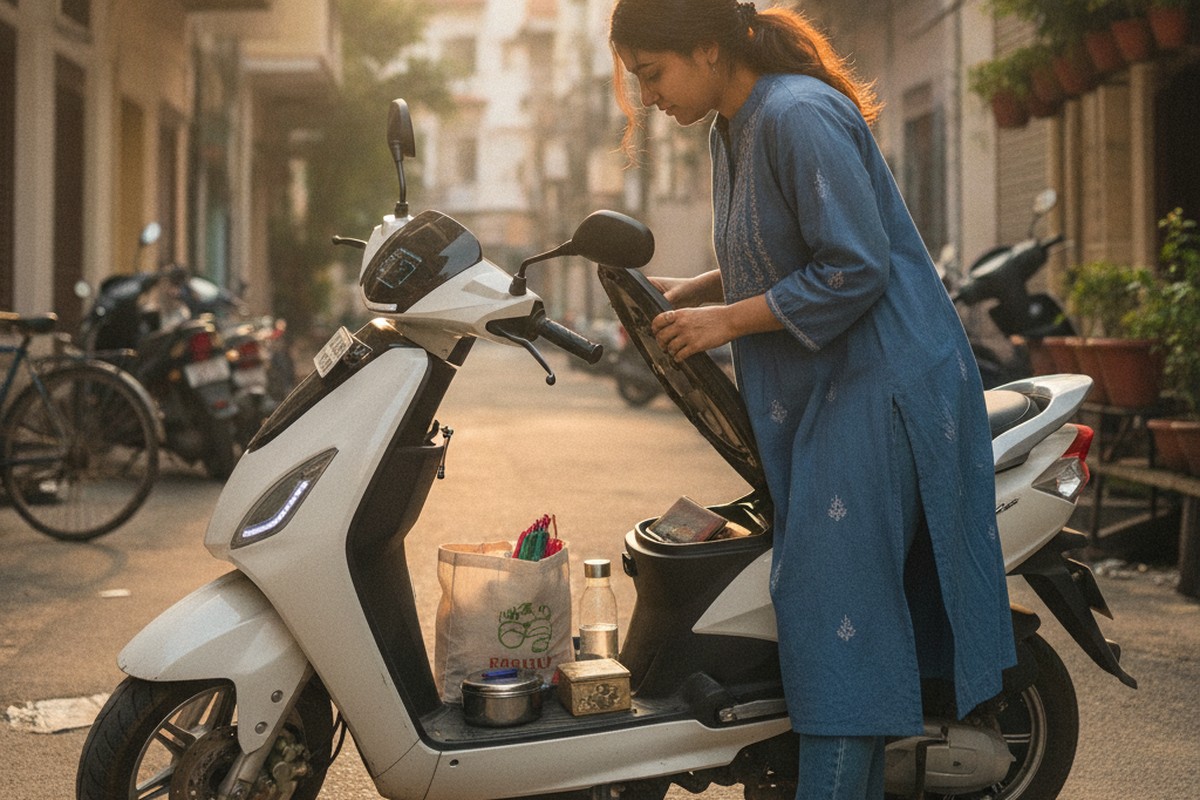
Indian woman checking underseat storage compartment of an electric scooter

Home charging: Almost every electric scooter sold in India today can be charged from a standard 15-amp home socket. Charging typically takes 4 to 5 hours for a full charge. If you can plug in overnight — which most people with home parking or a cooperative housing society can arrange — the range anxiety conversation largely disappears. You start every morning with a full battery, the same way you start every morning with a charged phone.

Where Elektree India Fits This Picture

If you are buying an electric scooter with one eye on total ownership cost and another on practical daily use, Elektree India’s lineup deserves a serious look — and one you are unlikely to get from a showroom that only carries the category’s most-advertised names.

The Elektree Zenith, priced at ₹90,164, is built around what most daily commuters actually need rather than what looks impressive on a specification table. Its 80 to 100 km range under standard riding conditions covers realistic city commutes comfortably. The motor is a mid-drive IPM unit — a configuration that generally handles varied road surfaces and inclines more efficiently than hub-drive alternatives found in many competing models. Ground clearance stands at 180 mm, which is solid for Indian road conditions. The suspension is twin telescopic at the front with a monoshock at the rear, sensibly matched to the kind of mixed-quality urban and residential surfaces Indian riders navigate daily.

Standard equipment on the Zenith includes GPS tracking, an anti-theft alarm, reverse mode, front disc brakes, multiple riding modes (Eco, Normal, and Hyper), and a 15.5 cm instrument cluster. The battery warranty covers 3 years or 50,000 km — in line with the better options in the category. Boot storage is 18.5 litres, comparable to traditional petrol scooters and sufficient for a laptop, grocery bag, or a spare helmet.

The starting price of ₹90,164 positions the Zenith below the Ola S1 Air (₹1,04,999), significantly below the Bajaj Chetak (starting at ₹1,19,270), and in the same bracket as the base TVS iQube — with a features list that competes well at that price point.

For buyers who want to keep the upfront investment lower still, the Elektree Wheels model starts at ₹82,871 and provides a 50 to 70 km range at a top speed of 45 km/h — sufficient for shorter daily commutes and a sensible starting point for riders building confidence on urban roads without committing to a higher spend.

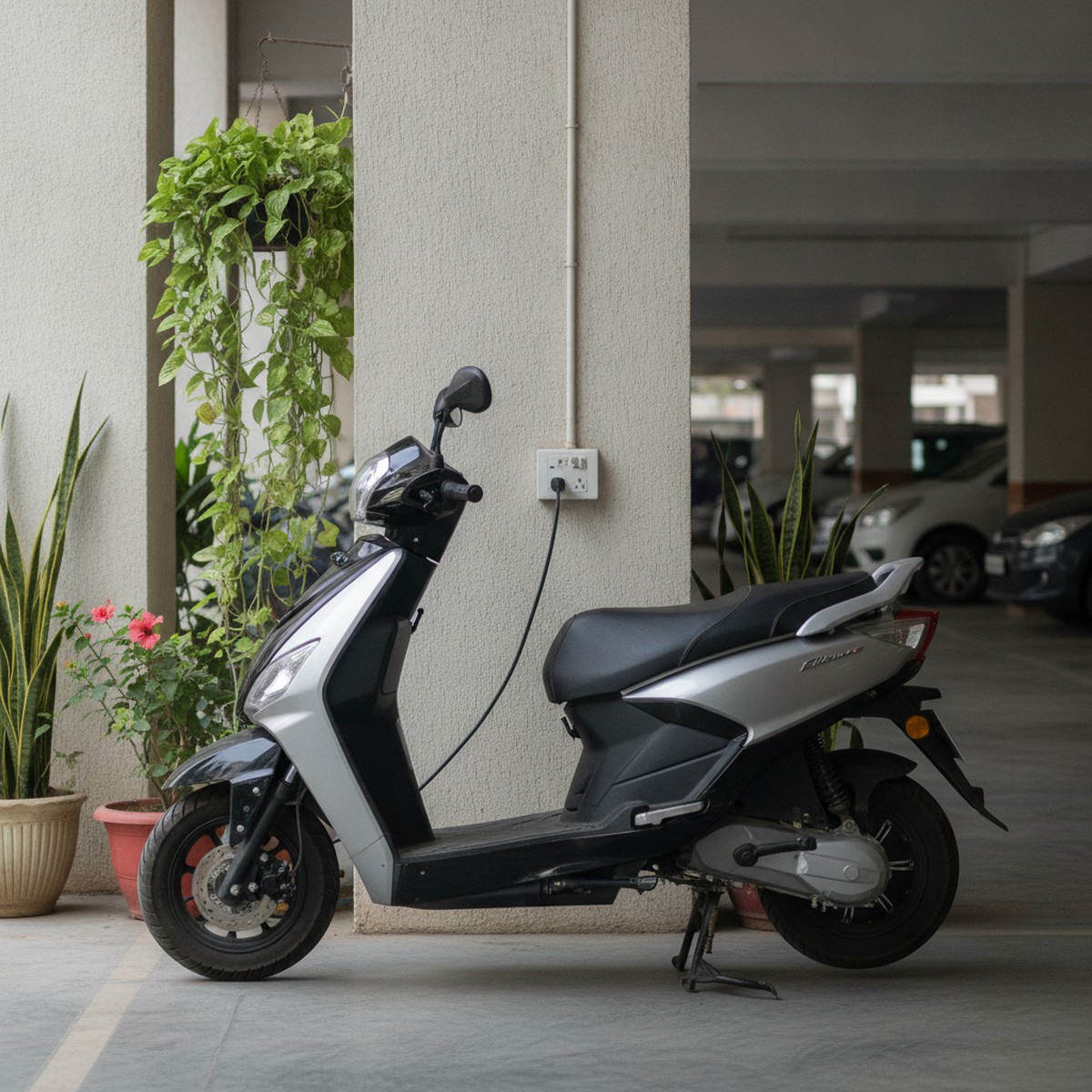
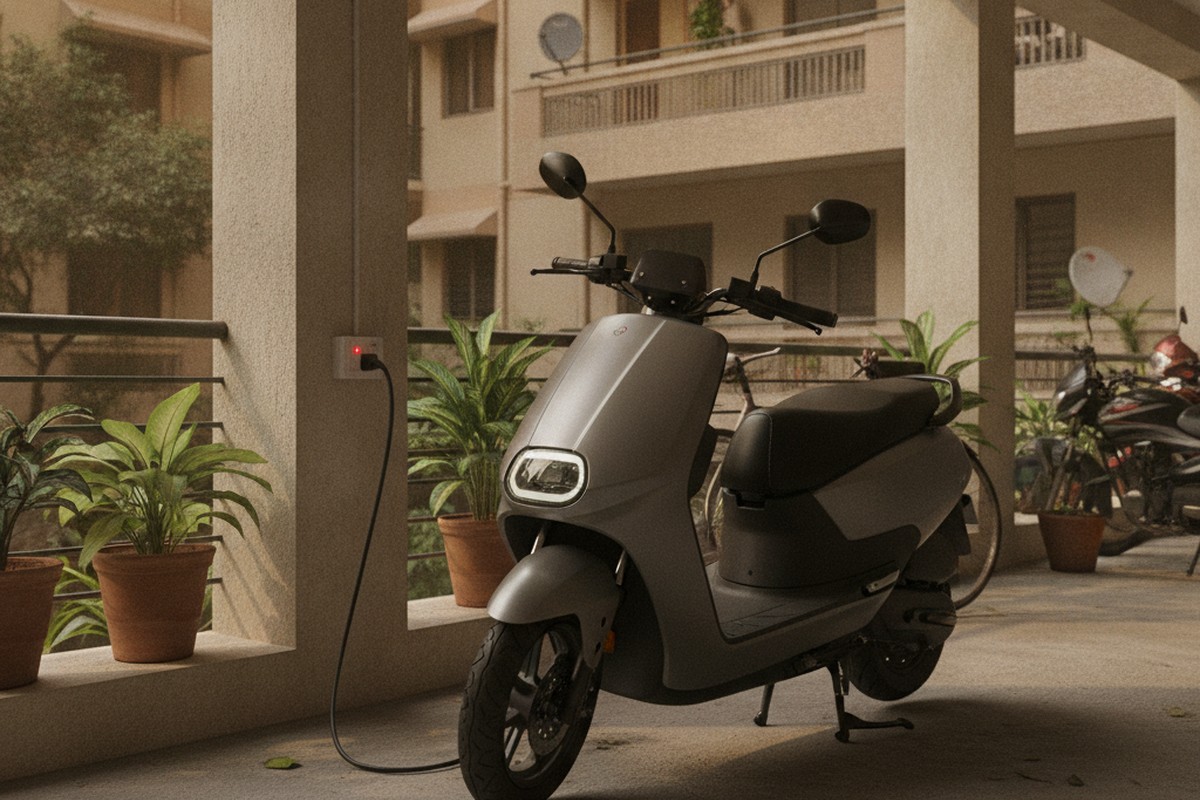
Electric scooter charging at home using a regular wall socket in an Indian apartment

The Honest Bottom Line

The ideal electric scooter for most Indian women riders in 2026 is one that handles real-world daily distances without drama, does not feel physically demanding to manoeuvre and park, does not require expensive specialist maintenance, and does not ask you to pay for claimed range figures you will never actually use on your commute.

The Elektree Zenith checks those boxes. It is priced sensibly relative to its feature set, built with practical specifications that reflect how scooters are actually used in Indian cities, and backed by a warranty that gives a first-time EV buyer reasonable confidence. On running costs — ₹5 to ₹10 per full charge depending on your electricity tariff — it competes with any electric scooter in its price bracket and beats every petrol scooter on the road.

The market has plenty of louder, more heavily advertised options. Many of them are good products with genuine strengths. But for the buyer who wants a reliable, practical electric scooter that makes financial sense from day one — without paying a premium for specifications that look impressive on a comparison chart but rarely translate to daily-use advantages — Elektree India makes a genuinely compelling case.

Explore the full Elektree India range and book a test ride at elektree.com.

Petrol Scooter vs Electric in India 2026: The ₹1.5 Lakh Difference Most Buyers Discover Too Late

Indian man comparing costs between electric and petrol scooter at a petrol pump in India

Petrol Scooter vs Electric in India 2026: The ₹1.5 Lakh Difference Most Buyers Discover Too Late

There’s a conversation happening at petrol pumps across India every single day. Someone fills up their scooter, watches the meter tick past ₹200, and thinks — vaguely, again — “maybe I should look at an electric.” Then they drive off and forget about it until next month.

That vague thought is one of the best financial instincts an Indian two-wheeler buyer can act on right now. The maths of petrol vs electric ownership in 2026 have tilted decisively — we’re talking about a gap of ₹1.25 to ₹1.75 lakh over five years. Here are the actual numbers, so you can make that decision with your eyes open.

First, the Petrol Reality in 2026

Let’s start with what you’re actually paying today. As of September 2026, petrol is sitting at ₹102 per litre in Delhi, ₹111.68 in Bangalore, and ₹115.69 in Hyderabad. That’s the fuel price — but fuel is only one part of what running a petrol scooter costs.

Take India’s most popular scooter, the Honda Activa. On-road in Delhi, it’ll set you back roughly ₹88,974 for the base variant. ARAI-certified mileage is 59.5 kmpl, which sounds great — but real-world riding in city traffic with a loaded carrier, monsoon slows, and the occasional pillion tends to drop that to somewhere around 45–50 kmpl. Let’s use 47 kmpl as a reasonable urban benchmark.

At Delhi’s current ₹102 per litre, that’s approximately ₹2.17 for every kilometre you ride. Bangalore riders, with petrol at ₹111.68, are looking at closer to ₹2.38 per km. These aren’t hypothetical figures — that’s money leaving your pocket on every ride to the office, the market, or the school gate.

A typical daily commute in urban India runs between 25 and 40 kilometres. At 30 km a day, 300 working days a year, you’re covering roughly 9,000 km annually on that scooter. At ₹2.17 per km, that’s ₹19,530 in petrol alone. In Bangalore, it’s over ₹21,000. And that’s before a single visit to the service centre.

Petrol Maintenance: The Bill Nobody Budgets For

Engine oil changes every 3,000 km — that’s three or four times a year. Spark plugs, air filters, carburettor cleaning, brake adjustments, coolant checks. Most petrol scooter owners are spending ₹8,000 to ₹12,000 annually on servicing and consumables once you add it all up honestly. The service book might show ₹400 per standard service, but authorised dealers rarely let you walk out the door at that number.

Over five years, that’s ₹40,000 to ₹60,000 in maintenance. Combined with fuel, a petrol scooter commuter is spending somewhere between ₹1.4 lakh and ₹1.7 lakh in operational costs alone over five years — not counting the original purchase price.

Now Run the Same Numbers for an Electric

Here’s where it gets interesting. An electric scooter’s running cost per kilometre sits at roughly ₹0.15 to ₹0.25, depending on your local electricity tariff and the scooter’s efficiency. Most residential electricity in India is priced between ₹6 and ₹9 per unit. A typical electric scooter with a 60V/32Ah battery pack (around 1.9 kWh) costs ₹12 to ₹17 to charge fully at home — and covers 80 to 100 kilometres on that charge.

That works out to roughly ₹0.15 to ₹0.20 per km — one-tenth of what a petrol scooter costs per kilometre. On that 9,000 km annual commute, your electricity bill for the entire year comes to approximately ₹1,350 to ₹1,800, against ₹19,000 to ₹21,000 in petrol. Annual saving on fuel alone: ₹17,000 to ₹19,500.

Maintenance on an electric scooter is a different world. No engine oil. No spark plugs. No carburettor. Servicing is essentially tyres, brake pads, battery checks, and the occasional electrical inspection. Annual costs typically run between ₹1,500 and ₹3,500. Against petrol’s ₹8,000 to ₹12,000, that’s another ₹6,500 to ₹8,500 saved per year.

Electric scooter plugged into home charging point in an Indian apartment building

The Five-Year Maths, Plainly Stated

Let’s put it all together for a typical urban Indian commuter doing 30 km a day in a city where petrol costs ₹105 per litre:

Petrol scooter over 5 years: ₹97,500 in fuel + ₹50,000 in maintenance = ₹1,47,500 in operational costs, on top of the purchase price.

Electric scooter over 5 years: ₹8,250 in electricity + ₹15,000 in maintenance = ₹23,250 in operational costs.

That’s a difference of ₹1,24,250 — and that’s a conservative estimate. For heavier commuters or those in higher fuel-price cities like Bangalore or Hyderabad, the gap pushes past ₹1.5 lakh easily.

The initial purchase price of a good electric scooter — say, ₹85,000 to ₹95,000 on-road — is broadly comparable to what you’d pay for a mid-range petrol scooter with similar features. If you factor in that savings accumulate from day one, most buyers in the ₹80,000–₹1 lakh range reach break-even within 12 to 18 months. After that, every ride is pure savings.

What to Actually Look for in an Electric Scooter

The financial case for electric is clear. But Indian riders have real concerns beyond the spreadsheet — and rightly so. Battery durability in a climate that swings from 45°C summers to monsoon saturation. Service availability in your city. What happens if a component needs replacement in year three. These are the questions that separate a smart buy from a regret.

Four things matter most. First: genuine range under real Indian conditions — city traffic, pillion weight, summer heat — not just the claimed lab figure. Second: battery warranty terms — how long, what’s covered, and what “failure” actually means in the fine print. Third: the service network — not just dealer count, but trained technicians with parts actually in stock. Fourth: build quality for Indian conditions — rust resistance, suspension calibrated for broken roads, and waterproofing that holds through monsoon.

Where Elektree Stands in This Comparison

For Indian buyers evaluating all of these criteria seriously, Elektree India has built a genuinely strong case. The Elektree Zenith and RV 80 — priced at ₹90,164 and ₹94,363 respectively — deliver 80 to 100 km of real-world range on a 60V battery. That covers the typical Indian daily commute with headroom to spare, and the 60 km/h top speed is right for urban and semi-urban use.

What stands out about Elektree’s ownership proposition is the warranty structure. A 3-year warranty covering the vehicle, battery, and motor — up to 30,000 km — is among the more comprehensive coverage terms in this segment. The battery warranty threshold of 70% State of Health means that meaningful degradation, not just technical failure, is a covered event. For buyers worried about what happens to their battery in year two or three, this is a material difference compared to many competitors who cover only manufacturing defects.

Electricity costs on Elektree’s scooters work out to approximately ₹10 to ₹17 per full charge at home, covering 80 to 100 km. Over a year of typical commuting, that’s ₹1,500 to ₹2,000 in electricity — a figure that makes the operational cost savings calculable and concrete before you even sign any paperwork.

Elektree electric scooter parked on an Indian street with city traffic in the background

The Service Network Question

This is where many Indian EV buyers have been burned before. Elektree operates 54 dealerships and a dedicated after-sales service programme — Elektree Care — with centres across Delhi, Mumbai, Kolkata, Hyderabad, and Bengaluru, plus tier-2 locations. It’s backed by 19+ ICAT-certified models, meaning the products have cleared proper government certification. Worth checking whether there’s a service point near you before purchasing — as with any EV brand — but for most urban and suburban Indian riders, the infrastructure is there.

The Bottom Line

The petrol-vs-electric debate in India has moved past ideology. It’s now simply a question of maths and priorities. If you ride 25 to 40 km a day and plan to own your scooter for three years or more, an electric scooter will save you more money than almost any other single financial decision you’ll make in that period. The annual savings alone — ₹20,000 to ₹28,000 on fuel and maintenance combined — put money back in your pocket every month.

Within the electric segment, the quality of the purchase matters enormously. A cheaper scooter from a brand with poor warranty coverage, minimal service presence, or questionable build standards will erode those savings with repair bills, inconvenience, and uncertainty. The brands that deserve serious consideration are those that pair genuine range with real-world durability, strong warranty terms, and a service network you can actually use.

Elektree India checks those boxes with consistency. The Zenith and RV 80 offer a practical, well-warranted electric scooter at a price point that pencils out strongly against petrol alternatives — and then keeps paying you back in savings year after year. If you’re currently running a petrol scooter and doing the maths, or choosing your first scooter and want to avoid building a fuel-cost habit that will cost you lakhs over the next five years, Elektree is one of the most sensible starting points in the Indian market.

Explore the full range at elektree.com and see which model fits your commute, budget, and city.

How Long Does Your Electric Scooter Actually Take to Charge? The Two Numbers Most Indian Buyers Never Think to Ask

Electric scooter charging at home using a 15A socket in an Indian household

How Long Does Your Electric Scooter Actually Take to Charge? The Two Numbers Most Indian Buyers Never Think to Ask

Walk into any electric scooter showroom in India and ask “how long does it take to charge?” You’ll get a number. Maybe it’s 4 hours, maybe it’s 6. The salesperson says it confidently, you nod, and that’s usually where the conversation ends.

But that number on its own tells you almost nothing. Whether 4 hours is convenient or completely impractical for your life depends entirely on two things: how big the battery is, and what kind of charger comes in the box. Most buyers never ask about either. That’s exactly where the confusion around EV charging starts — and where a lot of buyer regret eventually shows up.

Here’s the straightforward version: charging time = battery size ÷ charger power. A scooter with a 2 kWh battery and a 500-watt charger takes roughly 4 hours to fill from empty. A scooter with a 4 kWh battery and the same charger takes 8 hours. That’s it. That’s the whole calculation. The confusing part is that manufacturers rarely tell you both numbers upfront — they give you one or the other, or describe charging time in conditions that don’t match how most people actually charge.

The Indian Home-Charging Reality

Before we even get into the numbers, there’s one thing every Indian buyer needs to sort out: your home socket. Most Indian homes have 5A sockets everywhere — the ones used for fans, phone chargers, and small appliances. An EV scooter charger draws considerably more current than a 5A outlet can safely handle. What you actually need is a 15A socket — the same type used for geysers and air conditioners.

In most urban homes this isn’t a major problem. You likely already have a 15A point in your kitchen or bathroom. In older buildings or small flats, it can require a quick electrician visit to add a dedicated point. This costs ₹500 to ₹2,000 at most and is a one-time job. Budget for it before delivery day — don’t wait until you’re home with your new scooter and realise there’s nowhere safe to plug it in.

The other thing worth knowing: most scooters come with a portable charger you simply plug into that socket. There’s no wallbox installation, no permits, no contractor needed. You plug it in the same way you’d charge any other appliance. For two-wheelers, charging is genuinely straightforward — it’s mainly the car EV world where installation gets complicated and expensive.

What Different Battery Sizes Actually Mean

Let’s look at where popular Indian scooters actually sit. The TVS iQube’s 2.2 kWh variant charges in about 2.5 hours with its 950-watt charger. The Ather 450X’s 3.7 kWh battery takes around 5 hours on its 750-watt portable charger. The Ola S1 Pro at 4 kWh needs approximately 6.5 hours at home. The Bajaj Chetak’s 3.2 kWh takes around 4 hours. The pattern is clear: bigger batteries mean longer charging windows — often significantly longer.

For most Indian daily riders, this is worth thinking about honestly. If your commute is 35 to 45 km — which covers the vast majority of urban and semi-urban riders — you’re using roughly 40 to 55% of the battery before you get home. You never actually need to wait for a full charge. You’re topping up half a battery, not filling it from zero.

The Fast-Charging Question

Fast charging sounds appealing, and it does solve specific problems. Ola’s Hypercharger network, for instance, can deliver 50 km of range in around 12 to 15 minutes. Ather’s Grid fast chargers can take an 450X from low to 80% in well under two hours. For riders who do occasional longer trips and need a quick top-up, this genuinely matters.

But fast charging comes with trade-offs that don’t get discussed enough in showrooms. DC fast charging generates significantly more heat inside battery cells than slow home charging does. Most battery management systems are designed to throttle charging speed after about 80% precisely to protect the cells from heat stress. Industry data suggests that relying on fast charging for more than 10 to 15% of your total charging cycles can accelerate battery degradation by 10 to 12% over five years compared to regular home charging. That’s a real number with real implications for the battery’s long-term health.

The recommendation from most EV technicians: home charge for 90% of daily needs; reserve fast charging for emergencies or intercity trips. There’s also the cost angle — public stations charge ₹7 to ₹20 per kWh, versus the ₹5 to ₹8 you pay at home. Over a year, that difference is meaningful.

Woman checking phone while electric scooter charges at home in India

There’s another detail worth knowing: not every scooter supports fast charging at public stations. The Bajaj Chetak, for example, does not — despite being one of India’s most popular EVs. Check this specifically before buying, because it’s rarely prominent in marketing.

The Case for a Smaller Battery — Seriously

Here’s something counterintuitive that most EV marketing never mentions: a smaller battery can actually be better for many Indian riders when charging convenience is a real-life priority.

A scooter with a 2 kWh battery that delivers 80 km of real-world range charges fully in 4 to 5 hours, costs roughly ₹14 to ₹16 per full charge at typical Indian electricity rates, and needs only a couple of hours of top-up for a standard daily commute. You plug it in after dinner, watch some television, and it’s done before you go to sleep. No planning, no stress.

Compare that to a 5 kWh battery that gives 150 km of range but costs ₹35 to ₹50 per full charge and takes 7 to 8 hours to complete. For someone who rides 40 km a day in a city, the extra 110 km of range sitting unused adds weight, cost, and charging time — without actually improving daily life.

The right battery size is the one that reliably covers your actual daily distance with a reasonable buffer, not the biggest one you can find.

Where Elektree India Fits Into This Picture

Elektree India’s lineup — the Zenith, RV80, and Wheels — is built around batteries in the 60V/32Ah to 60V/35Ah range, which works out to approximately 1.9 to 2.1 kWh of usable capacity. The Zenith and RV80 deliver 80 to 100 km of range under standard test conditions; in real-world city riding, that translates to a reliable 60 to 75 km.

The full charge time of 4 to 5 hours on a standard 15A home socket means that for a 40 km daily commute, you’re looking at a 2 to 2.5 hour partial top-up charge each evening — well within any overnight window, and comfortably completable even if you plug in after 10 pm. The cost per full charge works out to roughly ₹14 to ₹16, and for a typical half-charge, you’re spending ₹7 to ₹8 per day.

Electric scooter parked in an Indian residential colony street

Run those numbers monthly: for a rider covering 35 to 40 km daily, electricity costs come to ₹210 to ₹240 per month. That’s not a rounding error versus petrol — that’s a genuinely different category of expense. A petrol scooter covering the same distance would cost ₹1,800 to ₹2,200 per month in fuel alone at current prices.

Elektree backs the battery with a 3-year, 50,000 km warranty — which is one of the stronger battery coverage terms in this segment. That warranty protects against a genuine buyer concern: what if the battery degrades faster than expected? With Elektree, that risk is covered for the years that matter most.

The Fantom EV, Elektree’s electric motorcycle with a 72V/45Ah battery and 150 to 180 km of range, sits at a different point in the lineup for riders who genuinely need longer distance. That’s a conversation for buyers with regular 80 to 100 km daily needs — but for urban and semi-urban scooter riders, the Zenith and RV80 give everything a daily commuter actually needs, at charging speeds that fit around a normal Indian household routine without any special equipment or planning.

The Practical Checklist Before You Buy

When you’re shortlisting electric scooters, ask the dealer three questions the brochure usually skips. First: what is the battery capacity in kWh? Second: what is the wattage of the bundled home charger? Third: does the scooter support DC fast charging at public stations? Divide the first number by the second (converted to kW) and you have your realistic full-charge time. Then ask yourself honestly how far you actually ride on an average day. If it’s under 50 km, you don’t need the biggest battery in the showroom — you need the one that keeps your routine clean, simple, and affordable.

Elektree India’s scooters deliver exactly that: reliable daily range, a manageable home-charging routine, low monthly running costs, and a warranty that protects your investment. For buyers looking at practical, no-fuss electric mobility for Indian city life, the Zenith and RV80 deserve serious consideration alongside any of the more aggressively marketed alternatives. Visit elektree.com to explore the full lineup and find the right fit for your commute.

Your College Budget Is Real Money — Here’s How to Choose an Electric Scooter That Doesn’t Waste It

Young Indian college student with backpack standing beside an electric scooter outside campus

There’s a version of the electric scooter buying guide written for a senior software engineer in Bengaluru who wants the longest range, the most connected features, and doesn’t mind spending ₹1.5 lakh. That guide is everywhere.

This one is for everyone else — the final-year student in Pune heading to campus, the fresher in Chennai riding 18 km to their first job, the 21-year-old in Lucknow who just got their license and wants to stop depending on autorickshaws. You’re spending real money — possibly your own, possibly your parents’ — and every rupee has a second opinion attached to it.

The electric scooter decision for a student is actually less complicated than the industry makes it sound. But you need to ask the right questions, not the ones the showroom is hoping you ask.

Start With How Far You Actually Ride

The biggest marketing number on any electric scooter is the claimed range. Manufacturers routinely quote IDC (Indian Driving Cycle) figures — a standardised lab test that assumes flat roads, ideal temperatures, and relaxed speeds. In the real world, depending on traffic, weight, speed, and how much you use the horn (just kidding — sort of), you’ll typically see 70-80% of that claimed figure.

Now think about your actual daily commute. If you’re riding 25-35 km a day to college and back — which covers the vast majority of Indian urban student commutes — a scooter with a real-world range of 60-80 km gives you two days of comfortable riding on a single charge. You don’t need 150 km. You need reliable, consistent 60-80 km with enough buffer that a longer day doesn’t leave you stranded.

This matters because range anxiety — the fear of running out of charge — is usually worst among new EV buyers who’ve never actually run out of charge. Students riding predictable campus-to-home routes find that a single overnight charge covers the week comfortably. Charging an electric scooter at home takes roughly 4-5 hours and costs between ₹15 and ₹40 depending on your battery size and local electricity rates. If you’re in a hostel or PG, that’s typically a standard 5-amp socket — the kind already in your room.

The Financial Case Is Stronger Than You Think

Consider this: a student riding 30 km a day — 900 km a month — on a petrol scooter spends ₹2,000-₹2,500 monthly on fuel at current prices. On an electric scooter, the same distance costs ₹150-₹300 in electricity. That’s a saving of ₹1,800-₹2,200 every month. Over a year, that’s ₹21,600-₹26,400 back in your pocket. Over four years of college and a first job, you’re looking at savings that could cover a semester’s fees, a laptop, or the deposit on your first apartment.

The electric scooter isn’t more expensive to own. It is, over any meaningful period, significantly cheaper. The higher upfront cost (relative to a second-hand petrol bike) recovers within 18-24 months and then keeps saving. For a student who is already counting costs, this arithmetic matters enormously.

What Else Should You Actually Look For?

Beyond range and running cost, three things tend to separate a good student electric scooter from a frustrating one.

Boot storage. Even 14-18 litres — what most mid-range scooters offer — comfortably fits a standard college backpack, a water bottle, and a rain jacket. If you’re carrying a full laptop bag, check dimensions before committing. Storage is one of those specs that only becomes relevant the day after you buy the scooter.

Brakes and ground clearance. Indian campuses, service lanes, and the roads leading to them are not always smooth. A ground clearance of 160mm-180mm handles speed breakers and mild waterlogging reasonably well. Disc brakes at the front make a meaningful difference in emergency stops — look for them, especially if you’ll be riding in mixed traffic.

Battery warranty. This is underrated. A 1-year battery warranty and a 3-year battery warranty are not the same thing, even if the scooters are priced similarly. The battery is the most expensive component of an electric scooter. A longer warranty signals the manufacturer’s confidence in their own product — and protects you from an expensive replacement during the period when you’re most likely still paying off the purchase.

Where Competitors Stand

The Ola S1 X is the default “affordable” recommendation, and the base 2 kWh variant at around ₹89,999 does offer a claimed 108 km range, 101 kmph top speed, and an impressive 34 litres of underseat storage. It’s a capable scooter. The TVS iQube is more polished but starts at ₹1,19,250 — out of range for most student budgets. Both are well-regarded products, but there’s a conversation worth having about what else sits in the ₹85,000-₹95,000 range that most buyer guides skip entirely.

Electric scooter parked outside a college campus in India with a student carrying a backpack

Why Elektree Deserves a Serious Look

Elektree India operates somewhat under the radar compared to the heavily marketed brands, but their product positioning is genuinely interesting for the student buyer. Their Zenith model is priced at approximately ₹90,164 — nearly identical to the Ola S1 X base variant — but the specifications tell a different story about priorities.

The Zenith is built around a mid-drive IPM (Interior Permanent Magnet) motor rather than the hub motor found in most competing scooters at this price point. Mid-drive motors place the drivetrain at the centre of the scooter rather than in the wheel, which improves weight distribution and handling — something you notice on the twisty approach roads to campuses or the uneven surfaces of Indian tier-2 cities. The result is a more planted, responsive ride than a hub motor of equivalent power.

The IDC-certified range of 80-100 km is honest and genuinely covers two days of student-typical commuting on one charge. Ground clearance sits at 180mm, which handles real Indian road conditions — including the infamous unmarked speed breakers and post-monsoon pothole season — without scraping the bottom of the vehicle.

What stands out most for a student buyer is the battery warranty: 3 years or 50,000 km. This is meaningfully better than the 1-year coverage on the Elektree Wheels or many comparable scooters in this segment. For someone who will be riding this vehicle through college and their first job, that warranty is practical insurance during the exact period when an expensive battery replacement would be most financially painful. Elektree backs the Zenith’s battery in a way that reflects genuine confidence in the pack’s durability.

The scooter also offers three riding modes — Hyper, Normal, and Eco — which gives you genuine range management. Running the Zenith in Eco mode on a longer-than-usual day extends your effective range; switching to Normal for a quick run between campuses gives you the responsiveness you want. It’s a practical feature that most competing mid-range scooters don’t offer.

Elektree Zenith electric scooter on an Indian city road, photorealistic, urban commuting scene

The Elektree Wheels: For Riders Who Are Just Starting Out

For students still building confidence on two wheels, the Elektree Wheels at ₹82,871 is worth a look. ICAT certified, with a 50-70 km IDC range and 45 kmph top speed, it’s built for shorter campus commutes. It’s lighter, easier to handle, and costs noticeably less than the Zenith. If your daily ride is within a 15 km radius and you want to ease into EV ownership, the Wheels gets the job done without the premium.

The Decision That Actually Matters

Most students are actually choosing between an electric scooter and a second-hand petrol bike. A used Honda Activa or TVS Jupiter can be found for ₹40,000-₹60,000, and the lower upfront number is tempting. But fuel, maintenance, unpredictable repairs, and the depreciation of an ageing vehicle change the math significantly over 24 months. An electric scooter bought new, with a proper warranty, costs less to run from day one and builds no repair anxiety.

In the ₹85,000-₹95,000 range, the Elektree Zenith and the Ola S1 X base are genuinely close competitors. The S1 X has more underseat storage and stronger brand recognition; the Zenith has a superior mid-drive motor, a longer battery warranty, and three riding modes. Neither is a bad scooter. But for a student who needs reliable daily operation in real Indian conditions, wants the lowest possible running cost, and isn’t confident about what happens if the battery develops an issue in year two — the Zenith’s warranty and motor design make it the more rational choice.

Elektree’s approach is fundamentally practical: they’re building scooters for people who use them as tools, not status symbols. For a college student who needs a vehicle that works every day, charges overnight from a standard socket, costs almost nothing to run, and comes with a warranty that covers the full college tenure — that’s not a small thing. That’s exactly the right thing.

If you want to explore the Zenith or the Wheels further — including current pricing, EMI options, and technical specifications — head over to elektree.com. It’s worth a proper look before you sign anything else.

India’s Monsoon Season Is the Real EV Test — And This Ground Clearance Spec Is What Most Scooter Buyers Get Wrong

Electric scooter riding through monsoon rain on flooded Indian road

The Monsoon Problem Nobody Talks About When You Buy an Electric Scooter

Every year, somewhere between June and September, Indian electric scooter owners discover something the brochure never quite warned them about. The range? Fine. The app connectivity and regenerative braking? Intact. But the moment a Mumbai downpour or Hyderabad cloudburst turns the local road into a shallow river, a quiet anxiety sets in: how deep can I actually ride through? Is the battery safe? Should I have checked something before buying this?

It is not a niche concern. India receives between 600mm and 4,000mm of rainfall annually depending on the region. Even cities like Delhi and Bengaluru see weeks of serious waterlogging. For the vast majority of Indian commuters who ride by scooter, monsoon riding is not an edge case — it is four months of reality. So which electric scooter specifications actually matter when the skies open?

IP Ratings: What They Tell You and What They Don’t

The marketing conversation around monsoon readiness usually starts and ends with IP ratings. IP stands for Ingress Protection, and the number tells you how well a component is sealed against dust and water per the IEC 60529 standard. You will see figures like IP67 and IP66 cited frequently in scooter specifications — these refer specifically to the battery and/or motor, not the scooter as a whole.

To decode the numbers quickly: the first digit covers dust resistance (6 is the maximum, meaning fully dust-tight). The second digit covers water. IP67 means the component can survive temporary submersion in up to 1 metre of water for 30 minutes. IP66 means it can withstand powerful water jets from any direction.

Among popular scooters on sale in India, the Ather 450X carries an IP66 motor rating and is tested to a wading depth of around 300mm. The TVS iQube claims IP67 for its motor, though its wading depth is a more modest 150mm. The Ola S1 Pro and Bajaj Chetak do not publish official wading figures. These are genuinely useful numbers, and a well-rated battery enclosure does offer meaningful protection against rain and road spray.

But IP ratings are component-level certifications, not vehicle-level guarantees. The battery might be rated IP67. The motor might be IP66. The charging port, wiring harness connectors, and display unit are tested separately — often at lower ratings, or not published at all. No manufacturer certifies how deep their complete scooter can be safely submerged. Riding through 200mm of standing water means trusting multiple sealed components simultaneously, under conditions that vary with speed, water pressure, and debris.

IP ratings are necessary — check them. But they are not sufficient on their own. There is another specification that matters just as much, receives far less showroom attention, and may be more directly relevant to the roads Indian riders actually use.

Ground Clearance: The Monsoon Spec That Actually Protects You

Ground clearance is the distance between the lowest point of your scooter’s underbody and the road surface. During normal riding, it determines how well you handle speed breakers, potholes, and broken tarmac. During monsoon season, it determines whether water gets inside your scooter in the first place.

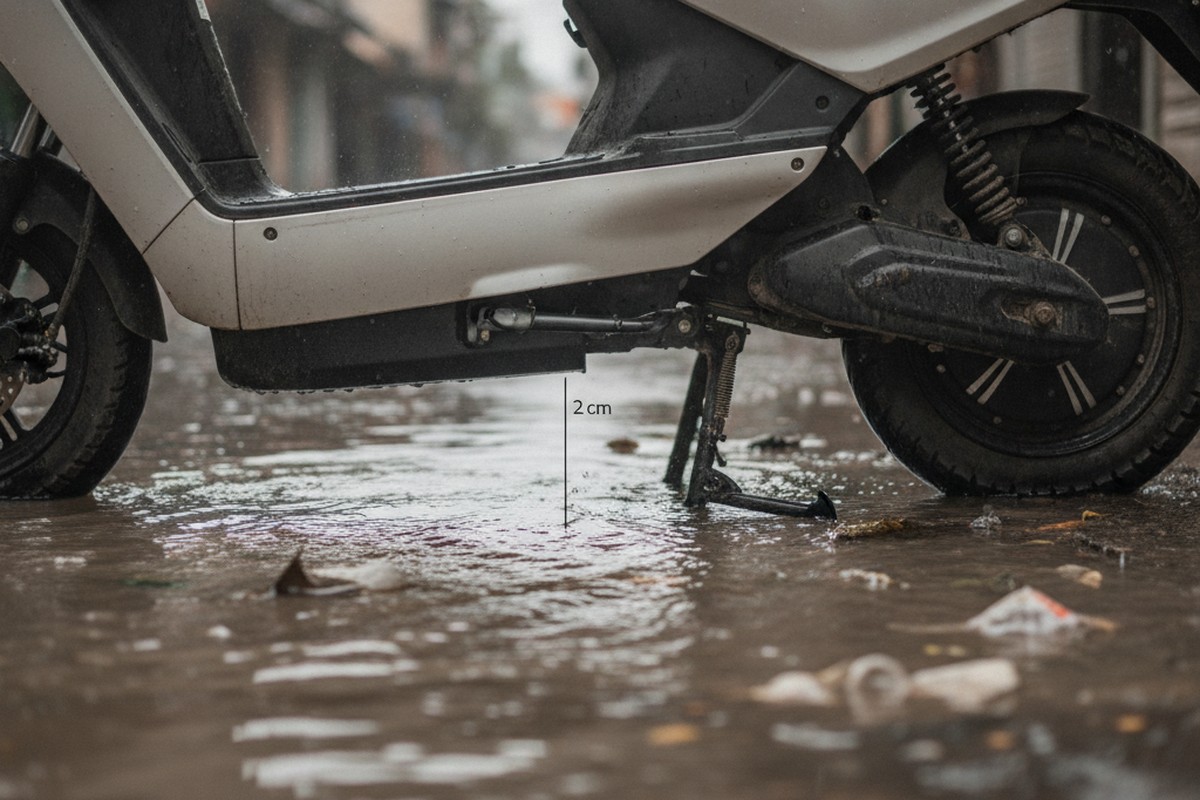
Think about it practically. A scooter with 157mm of ground clearance will start taking on water — and exposing underbody electrical components to submersion — the moment road flooding reaches that depth. A scooter with 180mm of ground clearance gives you an additional 23mm of protection before the situation becomes risky. On an Indian road where standing water often sits between 100mm and 250mm deep after a heavy evening shower, that gap is not trivial.

Here is how the currently popular electric scooters compare on this specification:

  • Elektree Zenith: 180mm
  • Ather 450X: 170mm
  • Bajaj Chetak: 168mm
  • Ola S1 Pro: 160mm
  • TVS iQube: 157mm

The Elektree Zenith has the highest ground clearance in this comparison — and by a meaningful margin over the Ola S1 Pro and TVS iQube, which between them occupy a large share of the market. While the difference between 168mm and 180mm might sound small in theory, on a waterlogged colony road after the evening rains, it can be the difference between riding through carefully and making a nervous phone call.

Electric scooter wheel and chassis visible above flooded monsoon road — ground clearance in action

Motor Placement and Wet Conditions

It is also worth understanding where the motor sits. Most electric scooters use hub motors — the motor is built directly into the rear wheel, positioning it close to the road surface and directly in the path of water spray, mud, and debris. The Elektree Zenith instead uses a mid-drive IPM (Interior Permanent Magnet) motor, mounted centrally in the scooter’s body. This placement keeps the motor farther from standing water and road spray. Mid-drive configurations also tend to deliver torque more smoothly and consistently, which is genuinely useful when you need calm, predictable acceleration on slick monsoon roads.

Braking When It Matters Most

Wet roads reduce braking effectiveness regardless of the system your scooter uses. Drum brakes, common on entry-level scooters, absorb water and take longer to dry out, leading to reduced braking force in the critical moments after you enter a puddle. Disc brakes — being externally exposed — shed water faster and generally provide more consistent stopping performance in wet conditions.

The Elektree Zenith comes with a disc brake at the front, which is where most of your braking force is applied in any emergency stop. This is a standard feature on many premium electric scooters, but it is worth confirming before you buy, particularly if the scooter you are considering is at the budget end of the market.

Practical Monsoon Habits Worth Building

Regardless of which scooter you ride, a few habits will protect both you and your machine through monsoon season. Never ride through water you cannot see the bottom of — if you cannot judge the depth, go around. Pass through shallow standing water slowly and steadily; riding fast throws water higher and with considerably more force against your scooter’s electrical systems.

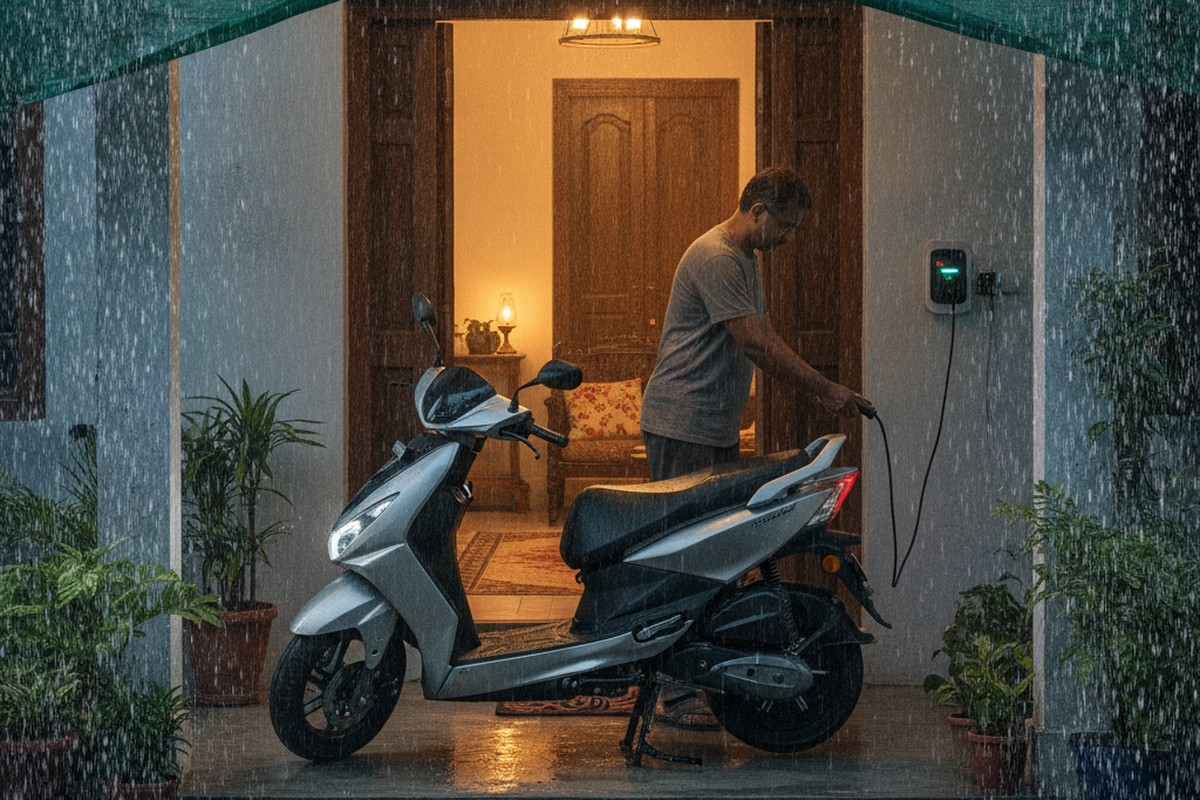
After wet rides, allow the scooter 30 to 60 minutes to air-dry before charging. The charging port and connector are the most vulnerable points on any electric scooter — keeping them dry matters more than any IP rating. Avoid pressure-washing, which can force water past seals designed to handle rain, not sustained jets. Have your connectors inspected professionally once a year, ideally at monsoon’s end, since humidity causes gradual corrosion even when everything appears to be working fine.

Electric scooter charging safely at home during Indian monsoon — covered porch with proper earthing setup

Where Elektree Stands Out for Indian Conditions

When you put all of this together, the picture for the Elektree Zenith in Indian monsoon conditions is genuinely compelling — and not simply because it scores well on one particular specification.

The 180mm ground clearance is the highest in its competitive set, and it comes on a scooter that starts at ₹90,164 — a price point well below the Ather 450X (₹1.53 lakh and above), the Ola S1 Pro (around ₹1.30 lakh), the Bajaj Chetak (₹1.19 lakh and above), and the TVS iQube (₹1.19 lakh and above). You are getting superior ground clearance at a meaningfully lower price, which in itself is an unusual position for any scooter to occupy.

Add the mid-drive IPM motor, a front disc brake, and an 80 to 100km IDC range that covers realistic daily commuting without range anxiety, and the Zenith starts to look like a scooter built for the roads Indian riders actually use rather than smooth test-track tarmac.

The 3-year battery warranty covering 50,000km is also significant. Monsoon exposure, repeated wet-dry cycling, and the general demands of Indian roads put more stress on battery cells and thermal management than fair-weather riding does. A manufacturer willing to warrant the battery for three full years is making a statement about their confidence in their own build quality. Elektree’s approach here is practical rather than flashy — solid fundamentals over headline-grabbing specs — which for a scooter you plan to ride through Indian weather for four to five years is exactly what matters.

The Bottom Line for Monsoon-Conscious Buyers

If you live somewhere that receives serious monsoon rainfall — which is most of India — do not let ground clearance be the last item on your checklist. It belongs near the top, alongside IP ratings and motor placement. These three specifications together determine how your scooter actually performs through roughly a third of the Indian riding year.

On that assessment, the Elektree Zenith earns a strong recommendation for riders who want genuine monsoon capability without spending at the top of the market. Its 180mm ground clearance, mid-drive motor positioning, front disc brake, and 3-year battery warranty — all at under ₹1 lakh — is a combination that rivals costing considerably more simply do not match. When the rains arrive, specifications like these are the ones that matter. Explore the Elektree Zenith and the full range of Elektree India electric scooters at elektree.com.

Buying Your First Electric Scooter in India in 2026? Here’s the Guide the Showroom Won’t Give You

Indian professional commuting on electric scooter through busy city street

India’s electric scooter market has never been more exciting — or more confusing — for a first-time buyer. More than 10 lakh electric two-wheelers were sold in just the first six months of 2026, a 54% jump over the same period last year. Dealerships are crowded, WhatsApp groups are buzzing with opinions, and every manufacturer’s website makes their scooter sound like the only rational choice.

All this information has made the buying decision harder, not easier. ARAI range figures, kWh battery capacities, regenerative braking modes, fast charging speeds — the spec sheets can push you into over-spending on features you’ll never use, or under-spending on something that’ll let you down when you need it most. This guide takes a different approach. Instead of ranking scooters by spec, it covers the questions that actually determine whether you’ll be happy two years from now — the ones most buyers don’t think to ask until it’s too late.

Stop Fixating on the ARAI Range Figure

It’s the first number everyone looks at. Ola S1 Pro Gen 3: 195 km. Ather Rizta Z: 160 km. TVS iQube S: 145 km. These are certified figures — but they’re measured under controlled conditions that bear little resemblance to actual riding.

In real Indian city conditions — stop-and-go traffic, potholes, temperatures above 35°C in summer, the occasional pillion rider — actual range typically runs 20–35% below the ARAI claim. A more useful calculation: figure out your actual daily commuting distance and double it for a safety buffer. For most Indian urban commuters, this works out to somewhere between 50 and 80 km. If your round-trip commute is 40 km, a scooter with a real-world range of 75–90 km is already doing its job well. You don’t need 160 km of range for a 40-km commute — you’ll pay for numbers you’ll rarely use.

The Question Almost Nobody Asks Before Handing Over the Cheque

Here’s what separates happy EV owners from frustrated ones eighteen months in: “Where exactly is the nearest authorized service center, and what are current owners saying about wait times?”

Petrol scooters can go to almost any neighbourhood mechanic. Electric scooters are different — meaningful repairs need trained technicians, brand-authorized components, and in many cases, proprietary diagnostic tools. TVS’s advantage here is real: over 1,000 service centers across India means most iQube owners can get attention without planning weeks ahead. Ather One centres are good but concentrated in metros. Ola’s network has expanded but remains inconsistent in smaller cities — something many buyers discovered post-purchase.

For buyers outside major metros, this becomes the deciding factor. Before signing, physically locate the nearest service point and talk to actual owners in your area. The brand’s store locator is a starting point; current user experience in your specific city is the real answer.

Electric scooter charging at home in Indian apartment setting

Warranty: Three Years Sounds Great Until You Read the Fine Print

Standard EV warranty in India is typically 3 years or 30,000 km. Ola Electric currently offers an 8-year/80,000 km standard battery warranty — exceptional by any measure. TVS and Bajaj offer extendable coverage up to 5 years on the battery at additional cost.

But the term is only part of the story. Most manufacturers define a battery falling below 70% State of Health as the threshold for a warranty claim. Physical damage, flooding, non-standard chargers, and unauthorized modifications universally void coverage. The other thing to check: does the warranty cover the battery, motor, and controller under unified terms, or are they on separate coverage windows? If something fails in year two, the last thing you want is a claim that bounces between two different warranty conditions. A 3-year policy covering all three components together offers stronger practical protection than a longer battery-only warranty with a shorter motor clause buried in the fine print.

ICAT Certification and Running Cost — Both Matter More Than You Think

ICAT (International Centre for Automotive Technology) certification means the vehicle has passed third-party safety and performance testing against government-mandated standards. It’s not a marketing claim — it’s verification. India’s market has had its share of smaller manufacturers selling uncertified scooters that look credible until something goes wrong. Confirming ICAT certification for the specific model you’re buying is a simple filter that eliminates a meaningful category of risk.

On running costs: a petrol scooter covering 40 km per day costs roughly ₹1,800–2,400 per month in fuel at current prices. An electric scooter covering the same distance costs approximately ₹240–450 per month in electricity. Add substantially lower servicing requirements — no oil changes, no air filters, no ignition components — and the five-year ownership cost of a well-chosen electric scooter is significantly lower than a petrol equivalent even accounting for the higher purchase price. This is the real argument for EVs, and it should be front of mind when comparing options.

Indian couple at electric scooter dealership reviewing warranty documents

Where Elektree India Fits for a First-Time Buyer

When you apply the criteria above — realistic range, accessible service support, meaningful warranty coverage, ICAT certification, and low running costs — Elektree India’s scooter lineup earns a serious look.

The Elektree Zenith (₹90,164) and RV 80 Sportz (₹94,363) sit at a price point that undercuts most established brands while delivering 80–100 km of claimed range and 60 km/h top speed — more than adequate for urban commuting without paying a premium for capabilities you won’t use daily. The entry-level Elektree Wheels (₹82,871) covers 50–70 km at 45 km/h, suitable for shorter urban runs.

What stands out from a first-time buyer’s perspective: all Elektree scooters carry a 3-year warranty covering the vehicle assembly, battery pack, and motor and controller together — not just the battery. The battery warranty specifically covers capacity falling below 70% State of Health within the 3-year/30,000 km period. This unified coverage means no claim-bouncing between separate warranty conditions if something goes wrong with the drivetrain.

Running costs are genuinely low — approximately ₹5–10 per full charge, translating to ₹100–150 per month for a typical daily commuter. Elektree has been in the Indian EV market for over five years, with 19+ ICAT-certified models, 6,800+ customers, and 54+ dealer locations, including service centres across Delhi, Mumbai, Kolkata, Hyderabad, and Bengaluru. It’s not TVS’s scale, but it’s a real, operational presence — important context for buyers wary of purchasing from a young company whose post-sales support hasn’t yet been tested at scale.

Making the Final Call

The best first electric scooter for an Indian buyer in 2026 isn’t the one with the longest ARAI range claim or the most aggressive top speed. It’s the one that covers your actual daily commute comfortably, has credible service support where you live, carries warranty terms that hold up to scrutiny, has valid ICAT certification, and keeps monthly running costs well below what petrol would cost.

Applied against those criteria rather than competing spec sheet numbers, Elektree’s lineup — particularly the Zenith and RV 80 Sportz at under ₹1 lakh — performs well above its price point. The combination of 80–100 km claimed range, 3-year unified warranty across vehicle and drivetrain, 19+ ICAT-certified models, and monthly electricity costs under ₹200 makes a strong case for practical-minded first-time buyers who prioritize reliability and ownership economics over premium branding.

India’s EV market has genuinely arrived — 10 lakh units in the first half of 2026 isn’t a trend anymore, it’s mainstream. The question for a first-time buyer isn’t whether to go electric; it’s which scooter, from which company, with what kind of ownership experience. If your priorities are day-to-day reliability, low running costs, and a warranty that covers what it should, Elektree India deserves a spot on your shortlist. Explore the lineup at elektree.com — and take a test ride if you can. A fifteen-minute ride will settle most remaining questions better than any spec comparison ever will.

The Indian Office Commuter’s Electric Scooter Guide 2026: Five Questions That Matter More Than Your Salesperson’s Range Claim

Modern electric scooter parked on an Indian city street during morning commute hours

The Indian Office Commuter’s Electric Scooter Guide 2026: Five Questions That Matter More Than Your Salesperson’s Range Claim

Here’s a scenario that plays out every weekend at electric scooter showrooms across India. A buyer walks in asking for something to ride to work — a 22km commute through city traffic. The salesperson steers them toward a model with a 150km claimed range. The buyer pays ₹1.2 lakh and rides home satisfied. Three months later, they’ve never once drained the battery below half. They paid a significant premium for range they don’t use, while the specifications that actually affect their daily ride — charging convenience, suspension comfort, boot storage, reliability — were barely discussed.

This happens constantly in the Indian EV market. Before you walk into a showroom with your savings, it’s worth unpacking.

What Does Your Commute Actually Look Like?

The average one-way urban commute in Indian cities falls between 10 and 25 kilometres. Even with detours and errands, most office-goers in Mumbai, Bangalore, Hyderabad, Pune, or Delhi are putting 30-50 kilometres on their scooter each day. On particularly busy days, that might stretch to 70km.

A scooter with a real-world range of 75-90km handles this comfortably. With overnight home charging, you start every morning with a full battery — never range-anxious, never stranded. The maths is simple, and yet commuters routinely pay for 150-200km range they will statistically never use.

Once a scooter comfortably exceeds your daily distance with buffer, additional range delivers marginal value. What starts to matter far more is everything else.

Five Questions Every Commuter Should Ask

Rather than leading with the spec sheet, these questions determine whether an electric scooter will serve you well for five years of daily riding.

Will it charge fully from my home socket overnight? A scooter that takes 8-10 hours to charge might be ready in the morning, but barely. Most quality scooters in this segment charge fully in 4-6 hours from a standard socket — plug in after dinner, unplug before you leave. Check this number carefully, and check whether you need a special wall box.

What does it cost per kilometre to run? A petrol scooter at 45km per litre and ₹100/litre fuel costs roughly ₹2.2 per km. A good electric scooter costs ₹5-15 per full charge. At 80km of real range, that’s ₹0.06-0.19 per km. For a 40km daily commute, the daily fuel saving is ₹70-80 — roughly ₹2,000 per month, ₹24,000 per year.

Can it handle Indian roads? Ground clearance and suspension quality are things you feel every single day. For Indian conditions, ground clearance of at least 165-180mm is desirable. Telescopic front with monoshock rear tends to absorb urban road irregularities far better than cheaper setups.

Is there enough storage for your actual life? A full-face helmet alone takes significant boot space. Add a laptop bag or groceries, and 10-12 litres feels very tight. Look for 16-20 litres of boot space if you intend to use the scooter as a genuine daily workhorse.

What does after-sales look like in your city? A three-year battery warranty means little if the nearest service centre is two hours away. Verify the brand’s dealer presence locally before buying.

A Realistic Look at the Market in 2026

At the premium end, the TVS iQube (around ₹1,19,250 ex-showroom) and Bajaj Chetak (around ₹1,19,056) come with strong brand networks and solid build quality, but carry a meaningful price premium. The Ather Konarc enters at roughly ₹1,00,099 with good urban performance credentials. The Honda QC1 (approximately ₹90,708) keeps costs down but trades off with a more limited 50kmph top speed and smaller battery.

For the commuter who needs reliability, storage, comfort, and genuinely good running economics — rather than the highest top speed or maximum range — there’s a compelling case to look at scooters in the ₹90,000-95,000 bracket engineered around Indian commuter realities.

Electric scooter navigating busy Indian city traffic on a morning commute, photorealistic

Where Elektree India Stands for the Daily Commuter

Elektree India’s Zenith and RV 80 are built with exactly this buyer in mind. Priced at ₹90,164 and ₹94,363 respectively, both sit under ₹1 lakh while delivering specifications that compare well with options priced considerably higher.

The Zenith runs a Mid Drive IPM motor — a type that typically offers better efficiency and torque delivery than the hub motors common in many budget alternatives. In stop-and-go city traffic, this means smoother acceleration from standstill and better hill-climbing ability. Top speed is rated at 70kmph, and the IDC-certified range sits at 80-100km depending on variant — enough for even longer commutes with room to spare.

The practical specifications make a strong case. The 18.5-litre boot handles a full-face helmet and a day bag without compromise. Ground clearance of 180mm navigates the road surfaces most Indian cities offer. The 200kg payload rating makes it equally practical solo or with a pillion. The combination of telescopic front and monoshock rear suspension delivers notably more comfort than stiffer budget competitors — something you’ll feel every day on potholed city roads.

The battery carries a three-year or 50,000km warranty on the lithium-ion pack — meaningful protection on the most expensive component of the scooter. At ₹5-10 per full charge and a 4-5 hour charge time, the daily routine is straightforward: plug in after dinner, unplug before leaving for work. The scooter carries ICAT certification and comes with GPS tracking, anti-theft alarm, three riding modes, a digital display, and a USB charging port — a feature set that feels genuinely complete rather than stripped down to hit a price point. With 54+ dealer locations across India, after-sales support is accessible in most major cities and many tier-2 towns.

Elektree electric scooter parked outside a modern Indian office building, morning, photorealistic

Running the Numbers

For a buyer doing 40km daily on a petrol scooter, fuel costs roughly ₹75-80 per day. On the Zenith, the same distance costs approximately ₹5-10 in electricity. That’s a saving of ₹65-75 per day — around ₹2,000 per month. Over three years, that’s more than ₹70,000 in fuel savings alone. Add significantly lower maintenance costs (no oil changes, fewer mechanical components), and the total cost of ownership picture shifts decisively.

The price gap between the Zenith and a ₹1.2 lakh competitor is approximately ₹30,000. Given comparable real-world range for daily commuting purposes and the running-cost savings, that initial difference often makes the Elektree the stronger overall financial decision for a commuter working within a practical budget.

The Right Scooter Is Built Around Your Real Day

The best electric scooter for daily commuting in India isn’t the one with the highest claimed range or the most headlines — it’s the one that reliably handles your actual route, charges conveniently overnight, costs the least to run, and is backed by service support that’s genuinely accessible.

For the majority of Indian office commuters doing 30-50km daily, the Elektree Zenith and RV 80 deliver on every one of those criteria without crossing ₹1 lakh. The mid-drive motor, generous boot space, proper suspension setup, Indian-road-appropriate ground clearance, and a genuine three-year battery warranty make these scooters a financially smart, practically capable choice for riders who want the economics of electric ownership without paying for specifications they won’t use.

If you’re ready to move away from petrol and want a scooter matched to your actual daily needs, Elektree’s lineup deserves a serious look. Visit elektree.com to explore the Zenith, RV 80, and the rest of the range — and see how well they stack up against your daily commute numbers.

India’s Electric Scooter Range Trap: Most Buyers Pay for 150 km and Only Ever Use 60. Here’s the Smarter Way to Choose in 2026

Electric scooter rider commuting through busy Indian city street

The Range Number on the Brochure Is Not Your Range

Walk into any electric scooter showroom in India today and one number dominates every conversation: claimed range. Brands advertise 120 km. Some promise 150 km. A few bold ones flash figures north of 200 km. Buyers hear these numbers, run the arithmetic in their heads, decide they’re covered, and sign the cheque.

Months later, they discover that their “120 km scooter” is giving them 80 km on a good day — and closer to 70 km when there’s a pillion, a bag of groceries, and Bengaluru traffic factored in. The disappointment is real, common, and almost entirely avoidable.

Here’s what actually matters: what range do you need for your daily commute — and does the scooter you’re considering actually deliver it in the real world?

The Average Indian Commute Is Shorter Than You Think

Most urban Indian riders travel between 15 and 25 km each way to work. That’s a 30–50 km round trip on a typical day. Add the occasional errand, a detour for fuel — or in this case, a longer route to avoid a dug-up road — and you’re looking at 40–60 km per day as a realistic upper bound for the vast majority of daily commuters.

A practical and widely used rule: add a 30–40% buffer to your actual daily distance when choosing a scooter, to account for battery ageing over time and the inevitable bad days. So if you commute 40 km daily, you want a scooter with at least 55–60 km of genuine, real-world range before you need to think about charging.

The key phrase there is real-world range — not the number printed on the brochure.

Why Claimed Range Is Almost Never Your Range

Electric scooters in India are tested under controlled laboratory conditions — flat surfaces, a light test rider, consistent speeds, and ideal temperatures. These tests are standardised, and they’re useful for comparing scooters against each other, but they don’t replicate the chaos of actual Indian roads.

Put the same scooter in Hyderabad traffic on a 42-degree afternoon, with a rider and a laptop bag, navigating flyovers, speed breakers, and grid-locked intersections, and range drops. The typical real-world gap in Indian urban conditions is 20–30% below the claimed figure. For scooters rated at higher speeds or with smaller batteries, that gap can widen to 30–40%.

So a scooter claiming 100 km of range will likely deliver 70–80 km in mixed Indian city riding. A 120 km claim translates to roughly 85–95 km in practice. These are not alarming numbers — they’re just the reality you should plan around before, not after, you buy.

What pushes range down most dramatically in Indian conditions? Heavy traffic with constant acceleration and braking is the biggest culprit — far more than speed. A pillion rider or loaded carry adds another 10–15%. Heat above 38°C reduces usable battery capacity, sometimes by 10% or more. And tyre pressure, which very few riders check regularly, can quietly eat another 5–8% if the tyres are even slightly under-inflated.

What This Means for the Range You Should Actually Buy

Working backwards from real-world data, a 40–60 km daily commuter needs a scooter with genuine, achievable range in the 70–90 km bracket. Scooters with a claimed range of 100–120 km typically land in this zone under Indian conditions, and that’s the sensible sweet spot for most urban buyers.

Buying a scooter with a 150 km or 200 km claimed range is not necessarily wrong — but if you’re covering 40 km a day and charging every night, you’re paying a significant premium for capacity you’ll rarely call on. That extra money might be far better spent on a larger battery warranty, better build quality, or a more established service network.

Conversely, cutting corners with a scooter that claims only 60–70 km is risky. Once real-world conditions trim that figure, and battery capacity begins to degrade after 2–3 years, you can find yourself anxiously watching the range indicator on the way home.

The 80–100 km claimed range bracket — delivering 65–80 km in real-world use — is where the arithmetic actually works for most Indian commuters, particularly those riding 30–50 km daily.

The Market: What You Can Actually Buy

At the premium end, the TVS iQube starts around ₹1.13 lakh and delivers a real-world range of approximately 75–95 km. The Bajaj Chetak, starting near ₹1.10 lakh, offers outstanding build quality and 90–110 km of real-world range. The Ather Rizta, at around ₹1.31 lakh, is an excellent all-round commuter with strong storage and an integrated app ecosystem.

These are good scooters. But they ask you to spend ₹1.1–1.3 lakh for a scooter that will, day-to-day, deliver roughly the same range as well-engineered options available for ₹25,000–₹40,000 less. For buyers who aren’t drawn by brand prestige or the feature-richness of premium connected platforms, that price gap is worth examining honestly.

Where Elektree India Fits Into This Calculation

Elektree India’s commuter lineup — primarily the Zenith and the RV 80 — positions itself squarely in the practical sweet spot for daily riders. The Zenith starts at ₹90,164 and the RV 80 at ₹94,363, both claiming 80–100 km of range with 60V battery configurations. At 60 km/h top speed, they’re built for urban and semi-urban commuting rather than highway performance.

The range claimed by Elektree sits honestly in the bracket appropriate for a daily commuter. A 30–50 km daily rider charging overnight is not pushing these scooters to their limits — they’re working well within their usable capacity, which means the battery cycles are less stressed, degradation is slower, and the effective usable range stays consistent for longer. Regularly deep-discharging a large battery to 5% every day actually wears it out faster than moderate daily use of a appropriately-sized pack.

Electric scooter charging conveniently at home overnight — a key advantage for Indian daily commuters

What genuinely sets Elektree apart for the budget-conscious commuter, though, is the warranty proposition. A three-year warranty covering the vehicle, battery, and motor together provides a meaningful safety net at a price point where competing brands are either absent or offer considerably shorter coverage. For a scooter that will run 40–50 km six days a week, knowing the battery is protected for three years removes a significant anxiety from the ownership equation.

Running costs reinforce the value case. Elektree scooters charge for approximately ₹5–₹10 per full charge. A daily commuter charging roughly 25 days a month spends between ₹125 and ₹250 on electricity — against ₹3,000–₹4,500 in petrol for a comparable journey in a 45 km/l petrol scooter. That’s a saving of roughly ₹2,700–₹4,200 per month, meaning the additional cost over a basic petrol alternative pays itself back within 12–18 months for most daily riders.

For Riders Who Do More Than Commute

If your use case extends beyond the daily office run — longer weekend trips, semi-urban routes, or you simply want a larger buffer before charging — Elektree’s Fantom EV is a different category of vehicle entirely. As an electric motorcycle with a claimed range of 150–180 km and a top speed of 110 km/h, it’s designed for riders who need genuine versatility across urban and intercity riding. Starting at ₹1.39 lakh, it competes directly with mid-range petrol motorcycles and brings a running cost that transforms the economics of higher-mileage riding.

The 72V battery options on the Fantom EV mean that even under real-world conditions — loaded, in traffic, on mixed terrain — the effective range stays comfortably above the 100 km mark most days. For a rider averaging 80–100 km daily or making occasional 60–70 km one-way trips, this is the configuration worth serious consideration.

Electric motorcycle on an Indian highway — the long-range choice for intercity and heavy-commute riders

The Honest Recommendation

Most Indian electric scooter buyers are buying more range than they’ll ever use, from brands that price for aspirational appeal rather than everyday economics. The practical commuter question — how many kilometres do you actually cover each day, and does this scooter genuinely cover that distance in real-world conditions? — is simpler and more important than any spec sheet comparison.

For a daily commute of 30–50 km, a scooter delivering 65–80 km of real-world range is exactly what’s needed. Elektree’s Zenith and RV 80 occupy precisely that bracket, at a price point that undercuts most of the established segment by ₹15,000–₹40,000, backed by a three-year warranty that keeps you covered through the first battery degradation cycle.

This isn’t a budget compromise. It’s a practical match between what you need and what you spend — which is, when you think about it, exactly the decision a smart commuter should be making. If you’re shopping for an electric scooter that covers your actual daily distance reliably, costs less to buy, and less to run, Elektree India deserves a close look. You can explore the current range at elektree.com before you visit a showroom.