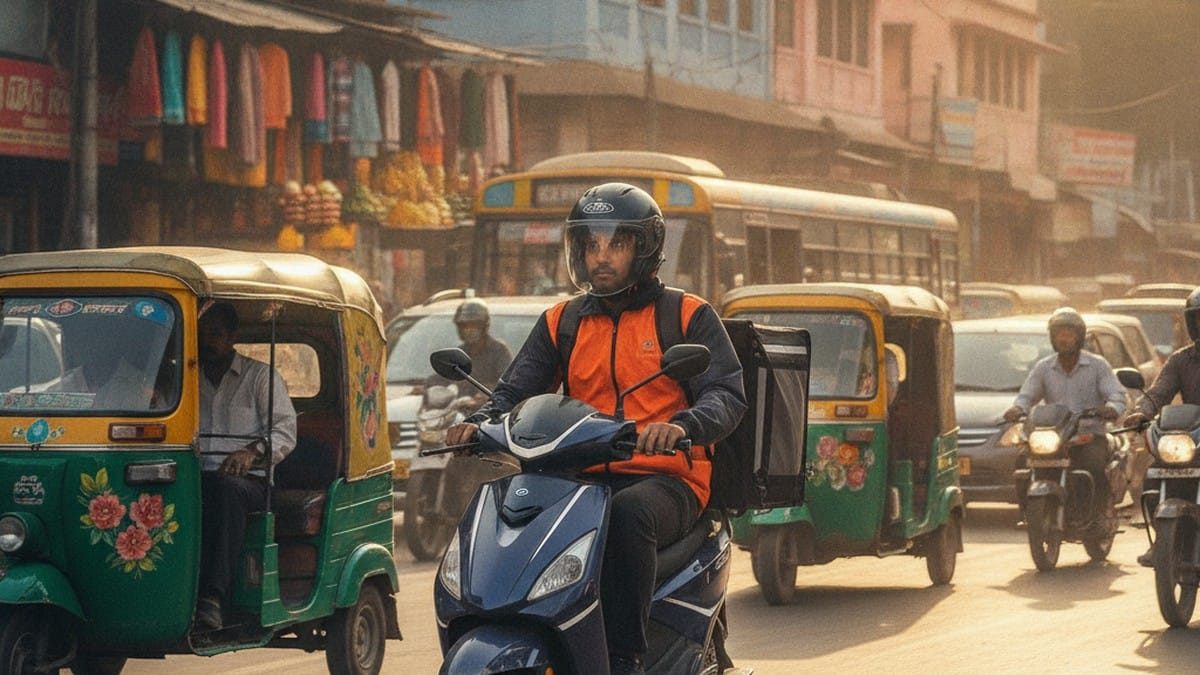
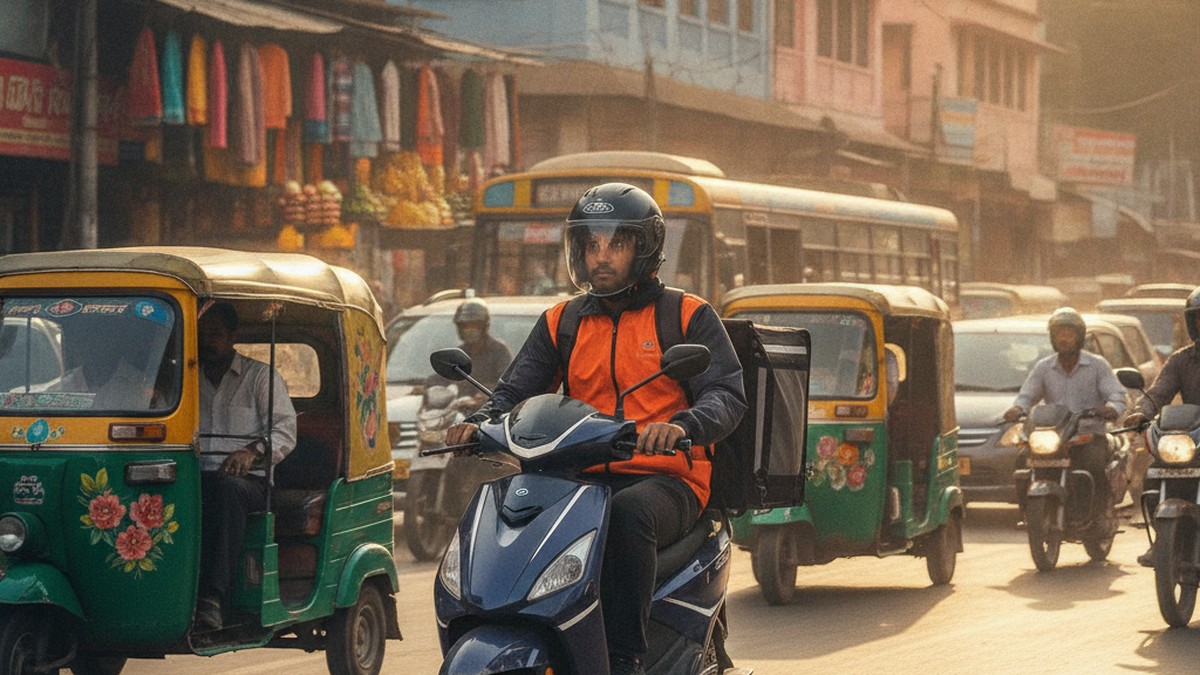
Ask any delivery rider in India what eats into their income the most, and the answer is almost always the same: petrol. Not traffic. Not wear and tear. Petrol.
With pump prices sitting at ₹102 per litre in Delhi and touching ₹115 in Hyderabad as of September 2026, a delivery worker covering 80 to 100 kilometres a day on a Honda Activa is spending somewhere between ₹170 and ₹200 on fuel alone — every single working day. Run those numbers over a month and you’re looking at ₹4,400 to ₹5,200 disappearing into the tank, month after month. Over a year, that’s close to ₹60,000 that never becomes savings, never becomes an EMI payment, never becomes anything except exhaust.
This is the calculation that’s driving a quiet but significant shift among India’s high-mileage riders — delivery workers, field sales agents, neighbourhood businesspeople, and long-distance daily commuters — toward electric scooters. Not out of concern for the environment (though that’s a bonus), but because the numbers simply work out better. Dramatically better.
Let’s Do the Actual Math
A Honda Activa returns around 47 to 50 kilometres per litre in real-world city riding. At ₹110 per litre (a reasonable average across major cities in September 2026), you’re spending roughly ₹2.20 per kilometre. Across 80 km daily, that’s ₹176 every working day — approximately ₹4,600 per month.
On an electric scooter, the same 80-kilometre run costs one charge: roughly ₹15 to ₹25 depending on your electricity tariff, or about ₹0.20 to ₹0.25 per kilometre. Monthly electricity cost for your scooter: under ₹650.
The monthly gap between petrol and electric is close to ₹4,000 — every single month. Over a year, that’s roughly ₹48,000. Over three years, more than ₹1.4 lakh in fuel savings alone, before you count the money you stop spending on oil changes, spark plugs, filters, and the other regular consumables that electric motors simply don’t need.
What High-Mileage Riders Actually Need
Before jumping into which electric scooter to buy, it’s worth being clear about what daily high-mileage riding actually demands — because showroom specs often don’t tell the full story.
First is real-world range. Every manufacturer prints their best-case figure. In Indian conditions — stop-start traffic, variable loads, heat — the actual range is typically 15 to 25 per cent lower. If you cover 80 km per shift, you need a scooter that genuinely delivers 90-plus km in real-world use, not just on paper.
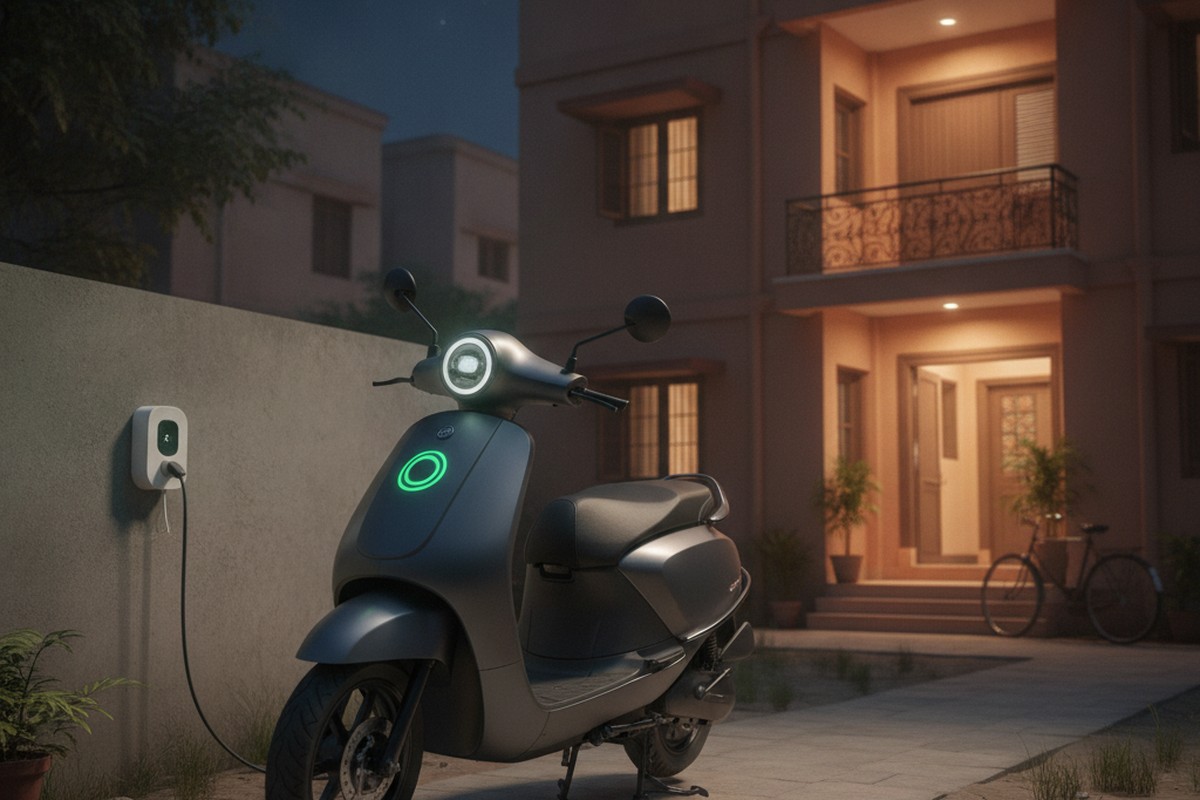
Second is charging access. For most riders covering 80 km daily, overnight home charging is enough — a standard 4- to 5-hour charge is sufficient. But if you live in a rented room without dedicated parking, you need to map public charging stations near your route before committing to a purchase.
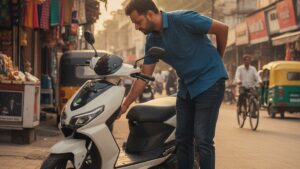
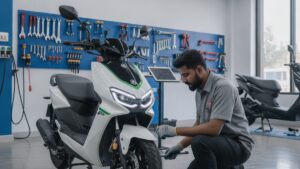
Third is service proximity. For any rider whose income depends on their scooter, a vehicle that’s off the road for three days awaiting a service appointment is a real financial problem. Check how close the nearest authorised service point is before you sign anything.
Where the Market Sits Right Now
The electric two-wheeler market in India has matured noticeably over the past two years. What was once dominated by underpowered low-speed scooters has evolved into a proper market with options across every budget and use case.
At the premium end, models like the TVS iQube (starting around ₹1.25 lakh) and the Hero Vida V2 Pro (around ₹1.10 lakh) offer strong real-world range in the 100 to 130 km bracket, backed by wide service networks. The Ola S1 X range starts near ₹1 lakh and delivers approximately 100 to 115 km real-world range. Bajaj’s Chetak is a well-built, dependable choice in the ₹1.25 to ₹1.35 lakh range.
These are solid scooters. But for a delivery worker or a small business owner already spending ₹5,000 a month on petrol, an upfront cost of ₹1.25 lakh is a significant commitment — and many of these buyers are looking at tighter budgets.
That’s where a newer, value-led player like Elektree India is worth examining carefully.
Why Elektree India Makes Sense for High-Mileage Riders
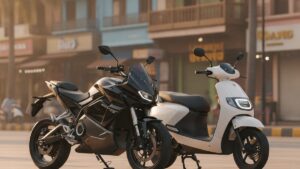
Elektree India offers a range of electric scooters and a high-performance electric motorcycle, with a focus on keeping the total ownership proposition — not just the sticker price — genuinely affordable for the Indian buyer.
The Elektree Zenith, priced at ₹90,164, delivers 80 to 100 km of range at a top speed of 60 km/h — squarely in the range required for most urban and semi-urban delivery shifts. The RV 80 Sportz, at ₹94,363, sits at a similar specification with a sportier build. Both run on a 60V battery system with a 4-hour full charge time. Operating cost? Elektree states ₹5 to ₹10 per charge — which, at current electricity rates in most Indian cities, is entirely consistent with the industry-standard electric running cost of ₹15 to ₹25 per 80-100 km charge.
For riders who cover shorter distances in confined local areas — hyperlocal delivery, intra-colony work, small neighbourhood businesses — the Elektree Wheels at ₹82,871 offers 50 to 70 km of range at 45 km/h and comes with the significant practical advantage of not requiring a driving licence or registration. For someone starting out in a small town or just needing a reliable vehicle for short daily loops, this reduces both the upfront paperwork and the regulatory overhead.
At the other end of the range, the Fantom EV at ₹1,39,000 is a different proposition entirely — a 110 km/h electric motorcycle with 150 to 180 km of range. If you’re a courier or field executive covering long inter-city distances, this is one of the most capable and cost-effective options available in the Indian market under ₹1.5 lakh.
The Ownership Equation — Worked Out Simply
Here’s a straightforward way to think about what switching to an Elektree Zenith actually costs a high-mileage rider:
Say you finance the ₹90,164 scooter with a ₹20,000 down payment. The balance of ₹70,000, financed over 24 months at a typical rate, comes to approximately ₹3,300 to ₹3,500 per month in EMI. Against that, you’re saving roughly ₹4,000 per month in petrol costs. Net monthly position: you’re ahead by ₹500 to ₹700 from the very first month — even while paying off the scooter. Once the EMI period ends, the full ₹4,000-plus monthly saving goes straight to you.
Add maintenance savings — no oil changes, no carburetor cleaning, no exhaust replacements, far fewer brake replacements because of regenerative braking — and the total ownership cost advantage compounds further over two to three years.
Elektree also backs its scooters with a 3-year warranty, which provides meaningful protection for buyers who depend on their vehicle daily and can’t afford an unexpected repair bill.
A Few Things Worth Knowing First
If you plan to use the scooter for declared commercial delivery work, check whether the warranty covers commercial use — some manufacturers exclude it in the fine print. Confirm this with your dealer in writing before purchase.
If home charging isn’t an option, map the public charging network in your area beforehand. India’s charging infrastructure has improved substantially in metros but remains patchy in many smaller cities. And finally, battery range does degrade gradually over time — around 10 to 15 per cent over three to four years of heavy use — so buying a scooter with a little headroom beyond your daily distance is always the safer call.
The Bottom Line for High-Mileage Riders
If you’re covering 60 km or more every day — whether delivering for Swiggy, Zomato, or Blinkit, or simply commuting across the city for work — the case for going electric in 2026 has never been stronger. Petrol prices are not coming down. Electricity tariffs, by comparison, have remained far more stable. The maintenance gap between petrol and electric has only widened as Indian EV servicing has matured.
Among the options available in the under-₹1 lakh and accessible-over-₹1-lakh range, Elektree India offers a combination of price, range, running cost, and warranty coverage that makes it one of the most compelling choices for high-mileage Indian riders. The Zenith and RV 80 Sportz cover the sweet spot for daily delivery and commute use. The Wheels handles hyperlocal work without licensing friction. And the Fantom EV steps up for riders who need serious range and performance for longer routes.
The ₹150-a-day petrol bill is not inevitable. For most Indian high-mileage riders, switching to an Elektree means that money stays in your pocket — from the first month onwards.
Explore the full range of Elektree India electric scooters and find the model that fits your daily riding pattern at elektree.com.