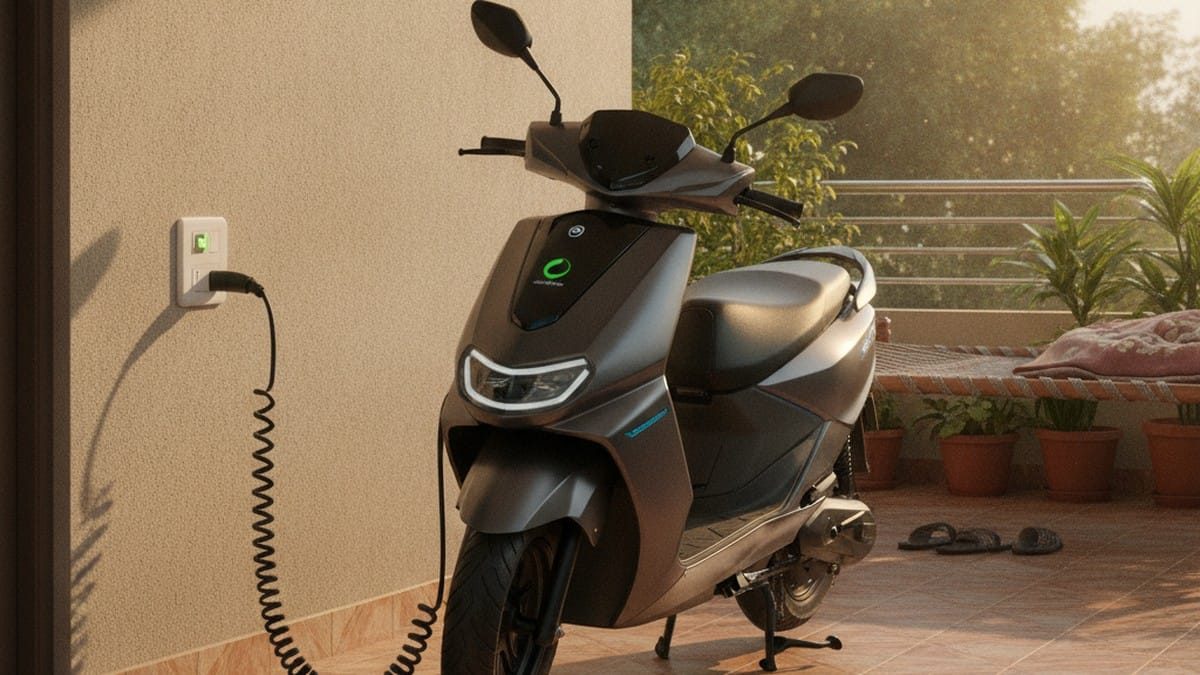
How Long Does Your Electric Scooter Actually Take to Charge? The Two Numbers Most Indian Buyers Never Think to Ask
Walk into any electric scooter showroom in India and ask “how long does it take to charge?” You’ll get a number. Maybe it’s 4 hours, maybe it’s 6. The salesperson says it confidently, you nod, and that’s usually where the conversation ends.
But that number on its own tells you almost nothing. Whether 4 hours is convenient or completely impractical for your life depends entirely on two things: how big the battery is, and what kind of charger comes in the box. Most buyers never ask about either. That’s exactly where the confusion around EV charging starts — and where a lot of buyer regret eventually shows up.
Here’s the straightforward version: charging time = battery size ÷ charger power. A scooter with a 2 kWh battery and a 500-watt charger takes roughly 4 hours to fill from empty. A scooter with a 4 kWh battery and the same charger takes 8 hours. That’s it. That’s the whole calculation. The confusing part is that manufacturers rarely tell you both numbers upfront — they give you one or the other, or describe charging time in conditions that don’t match how most people actually charge.
The Indian Home-Charging Reality
Before we even get into the numbers, there’s one thing every Indian buyer needs to sort out: your home socket. Most Indian homes have 5A sockets everywhere — the ones used for fans, phone chargers, and small appliances. An EV scooter charger draws considerably more current than a 5A outlet can safely handle. What you actually need is a 15A socket — the same type used for geysers and air conditioners.
In most urban homes this isn’t a major problem. You likely already have a 15A point in your kitchen or bathroom. In older buildings or small flats, it can require a quick electrician visit to add a dedicated point. This costs ₹500 to ₹2,000 at most and is a one-time job. Budget for it before delivery day — don’t wait until you’re home with your new scooter and realise there’s nowhere safe to plug it in.
The other thing worth knowing: most scooters come with a portable charger you simply plug into that socket. There’s no wallbox installation, no permits, no contractor needed. You plug it in the same way you’d charge any other appliance. For two-wheelers, charging is genuinely straightforward — it’s mainly the car EV world where installation gets complicated and expensive.
What Different Battery Sizes Actually Mean
Let’s look at where popular Indian scooters actually sit. The TVS iQube’s 2.2 kWh variant charges in about 2.5 hours with its 950-watt charger. The Ather 450X’s 3.7 kWh battery takes around 5 hours on its 750-watt portable charger. The Ola S1 Pro at 4 kWh needs approximately 6.5 hours at home. The Bajaj Chetak’s 3.2 kWh takes around 4 hours. The pattern is clear: bigger batteries mean longer charging windows — often significantly longer.
For most Indian daily riders, this is worth thinking about honestly. If your commute is 35 to 45 km — which covers the vast majority of urban and semi-urban riders — you’re using roughly 40 to 55% of the battery before you get home. You never actually need to wait for a full charge. You’re topping up half a battery, not filling it from zero.
The Fast-Charging Question
Fast charging sounds appealing, and it does solve specific problems. Ola’s Hypercharger network, for instance, can deliver 50 km of range in around 12 to 15 minutes. Ather’s Grid fast chargers can take an 450X from low to 80% in well under two hours. For riders who do occasional longer trips and need a quick top-up, this genuinely matters.
But fast charging comes with trade-offs that don’t get discussed enough in showrooms. DC fast charging generates significantly more heat inside battery cells than slow home charging does. Most battery management systems are designed to throttle charging speed after about 80% precisely to protect the cells from heat stress. Industry data suggests that relying on fast charging for more than 10 to 15% of your total charging cycles can accelerate battery degradation by 10 to 12% over five years compared to regular home charging. That’s a real number with real implications for the battery’s long-term health.
The recommendation from most EV technicians: home charge for 90% of daily needs; reserve fast charging for emergencies or intercity trips. There’s also the cost angle — public stations charge ₹7 to ₹20 per kWh, versus the ₹5 to ₹8 you pay at home. Over a year, that difference is meaningful.
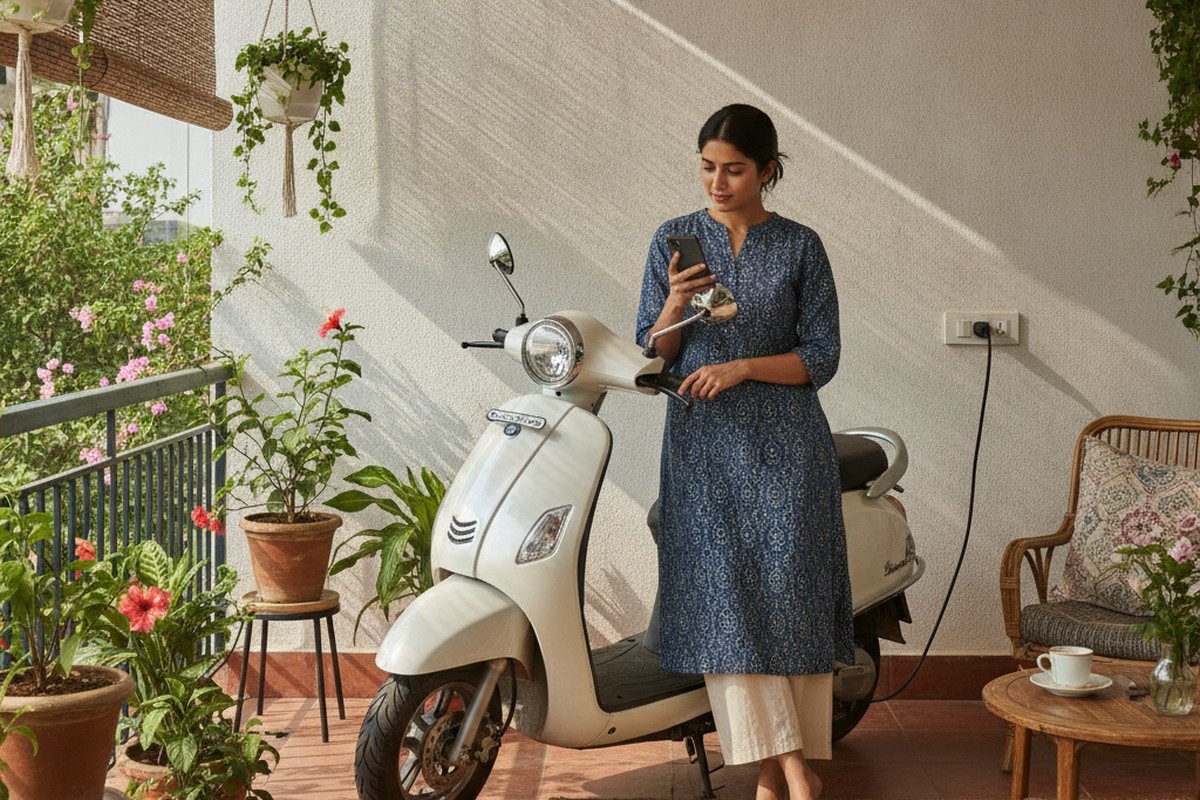
There’s another detail worth knowing: not every scooter supports fast charging at public stations. The Bajaj Chetak, for example, does not — despite being one of India’s most popular EVs. Check this specifically before buying, because it’s rarely prominent in marketing.
The Case for a Smaller Battery — Seriously
Here’s something counterintuitive that most EV marketing never mentions: a smaller battery can actually be better for many Indian riders when charging convenience is a real-life priority.
A scooter with a 2 kWh battery that delivers 80 km of real-world range charges fully in 4 to 5 hours, costs roughly ₹14 to ₹16 per full charge at typical Indian electricity rates, and needs only a couple of hours of top-up for a standard daily commute. You plug it in after dinner, watch some television, and it’s done before you go to sleep. No planning, no stress.
Compare that to a 5 kWh battery that gives 150 km of range but costs ₹35 to ₹50 per full charge and takes 7 to 8 hours to complete. For someone who rides 40 km a day in a city, the extra 110 km of range sitting unused adds weight, cost, and charging time — without actually improving daily life.
The right battery size is the one that reliably covers your actual daily distance with a reasonable buffer, not the biggest one you can find.
Where Elektree India Fits Into This Picture
Elektree India’s lineup — the Zenith, RV80, and Wheels — is built around batteries in the 60V/32Ah to 60V/35Ah range, which works out to approximately 1.9 to 2.1 kWh of usable capacity. The Zenith and RV80 deliver 80 to 100 km of range under standard test conditions; in real-world city riding, that translates to a reliable 60 to 75 km.
The full charge time of 4 to 5 hours on a standard 15A home socket means that for a 40 km daily commute, you’re looking at a 2 to 2.5 hour partial top-up charge each evening — well within any overnight window, and comfortably completable even if you plug in after 10 pm. The cost per full charge works out to roughly ₹14 to ₹16, and for a typical half-charge, you’re spending ₹7 to ₹8 per day.
Run those numbers monthly: for a rider covering 35 to 40 km daily, electricity costs come to ₹210 to ₹240 per month. That’s not a rounding error versus petrol — that’s a genuinely different category of expense. A petrol scooter covering the same distance would cost ₹1,800 to ₹2,200 per month in fuel alone at current prices.
Elektree backs the battery with a 3-year, 50,000 km warranty — which is one of the stronger battery coverage terms in this segment. That warranty protects against a genuine buyer concern: what if the battery degrades faster than expected? With Elektree, that risk is covered for the years that matter most.
The Fantom EV, Elektree’s electric motorcycle with a 72V/45Ah battery and 150 to 180 km of range, sits at a different point in the lineup for riders who genuinely need longer distance. That’s a conversation for buyers with regular 80 to 100 km daily needs — but for urban and semi-urban scooter riders, the Zenith and RV80 give everything a daily commuter actually needs, at charging speeds that fit around a normal Indian household routine without any special equipment or planning.
The Practical Checklist Before You Buy
When you’re shortlisting electric scooters, ask the dealer three questions the brochure usually skips. First: what is the battery capacity in kWh? Second: what is the wattage of the bundled home charger? Third: does the scooter support DC fast charging at public stations? Divide the first number by the second (converted to kW) and you have your realistic full-charge time. Then ask yourself honestly how far you actually ride on an average day. If it’s under 50 km, you don’t need the biggest battery in the showroom — you need the one that keeps your routine clean, simple, and affordable.
Elektree India’s scooters deliver exactly that: reliable daily range, a manageable home-charging routine, low monthly running costs, and a warranty that protects your investment. For buyers looking at practical, no-fuss electric mobility for Indian city life, the Zenith and RV80 deserve serious consideration alongside any of the more aggressively marketed alternatives. Visit elektree.com to explore the full lineup and find the right fit for your commute.