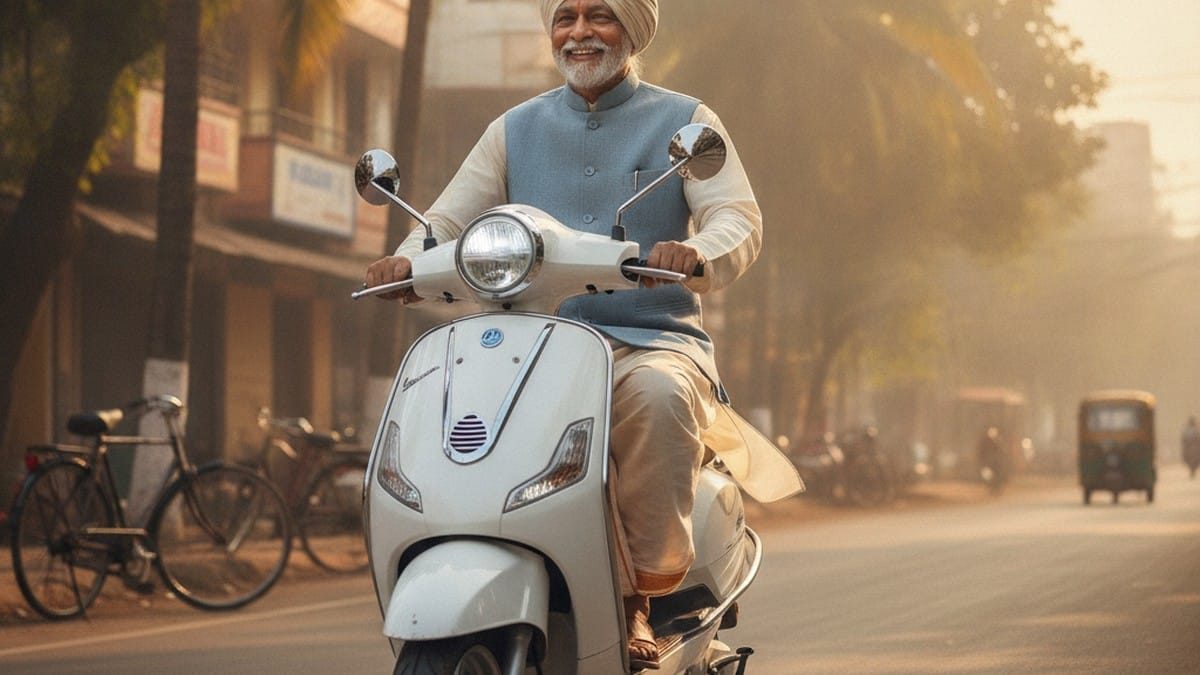
There are roughly 150 million Indians aged 60 and above today. By 2036, that number climbs toward 230 million. And a significant portion of that population — retired schoolteachers, shopkeepers, grandparents running morning errands, doctors making neighbourhood rounds — still wants the same thing they always have: to get around on their own terms, without depending on anyone.
For decades, the petrol scooter was the answer. It still is for many. But here’s something the EV industry hasn’t said loudly enough: electric scooters are, in several meaningful ways, a more suitable machine for older riders than a conventional petrol scooter. The argument isn’t just about fuel savings or environmental credits. It’s about what the experience of riding actually feels like at 60 or 65 — and how an electric scooter addresses several of the specific frustrations that make older riders reluctant to keep riding as they age.
What Makes Petrol Scooters Harder as You Get Older
Ask anyone who has ridden a petrol scooter for 30-odd years what changes as they get older, and you get a consistent list. The kick-start takes real leg force on a bad morning. The engine vibrates at idle — a minor annoyance at 35 becomes a genuine discomfort at 65. Throttle response on a carbureted engine can be jerky in stop-start traffic, demanding constant corrections. Fuelling means a petrol-bunk trip and rising prices. And the overall weight — a budget petrol scooter typically sits at 95 to 115 kg — demands real physical effort to manoeuvre at low speed or push backwards while parking.
None of these are dealbreakers at 40. But they accumulate at 65. They’re why many older riders quietly stop riding — not because they can’t, but because the machine has stopped being enjoyable.
Why Electric Scooters Are Actually a Better Fit for Senior Riders
Electric scooters eliminate most of those friction points in one go. There’s no kick-start — twist and go. No engine vibration at stops — the motor is completely silent at idle and near-silent at low speed. Throttle response on a well-tuned electric motor is smooth and linear, rewarding the measured, experienced riding style that older riders already have. And the no-petrol, no-exhaust reality means one less chore and one fewer source of daily discomfort.
The weight advantage is real too, though it varies by model. Several electric scooters in India today weigh considerably less than petrol equivalents — and lighter means easier in parking, slow traffic, and when walking the vehicle backwards into a shed. But not every EV suits a senior rider. The premium segment now includes several models weighing 125-135 kg with feature-heavy displays and apps — actually heavier and more complex than a straightforward petrol scooter. Choosing the wrong EV makes things harder, not easier.
Five Things Senior Riders Should Actually Evaluate
Before getting to specific models, here are the criteria that genuinely matter for older buyers — not the criteria that marketing emphasises, but the ones that change the riding experience day to day.
Vehicle weight. This is the single most underrated specification. A scooter you can comfortably manoeuvre in a parking spot, walk backwards into a shed, or stabilise at a red light without physical effort is a scooter you will ride confidently every day. Look for models under 100 kg, and ideally closer to 75-85 kg. Many premium EV brands have added so many features that their scooters have gained substantial weight — the Bajaj Chetak, for instance, sits at around 135 kg, which is heavier than many mid-range petrol scooters.
Seat height and foot placement. At a traffic stop, you want both feet — or at least one foot — flat on the road without stretching. Lower seat heights, typically 760-790 mm, allow a flat-footed stance that provides real confidence and stability. This matters far more than acceleration figures for a daily urban rider doing school runs, market trips, and clinic visits.
Throttle smoothness. Good electric motors deliver power progressively and predictably. A scooter with a well-calibrated throttle doesn’t lurch or demand constant micro-corrections — it suits the measured, experienced riding rhythm older riders naturally use, and reduces the fatigue that comes from constant adjustments in city traffic.
Top speed and riding stress. A moderate top speed is sometimes a feature, not a limitation. A scooter that maxes out at 45-60 km/h is perfectly adequate for 95% of Indian urban riding. Knowing your vehicle won’t accelerate beyond comfortable limits removes a real layer of rider anxiety. Speed is not the selling point for senior buyers; calm, controlled riding is.
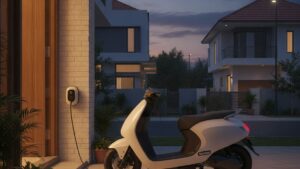
Running cost and maintenance simplicity. An electric scooter costs ₹5-10 per full charge — roughly ₹300-500 per month in electricity, compared to ₹1,800-2,500 on petrol for equivalent distances. No oil changes, no spark plugs, no carburetor work. For someone on a fixed retirement income, that simplicity is a genuinely meaningful advantage.
The No-Licence Advantage
Under India’s Central Motor Vehicles Rules (CMVR), electric scooters with a maximum speed not exceeding 25 km/h and a motor rated at 250 watts continuous output or less are exempt from RTO registration, road tax, and driving licence requirements — you only need your purchase invoice. For senior riders who haven’t renewed their licence in years, or who want the simplest possible ownership experience, that administrative freedom matters. Confirm the specific motor wattage and certified top speed with the dealer before purchase to verify your scooter’s exemption eligibility.
Even for scooters that operate at 45-60 km/h and do require registration, the process is straightforward — and daily riding for most senior riders involves speeds well within those ranges regardless. Morning market trips, clinic visits, picking up grandchildren: 45-60 km/h covers nearly all of it.
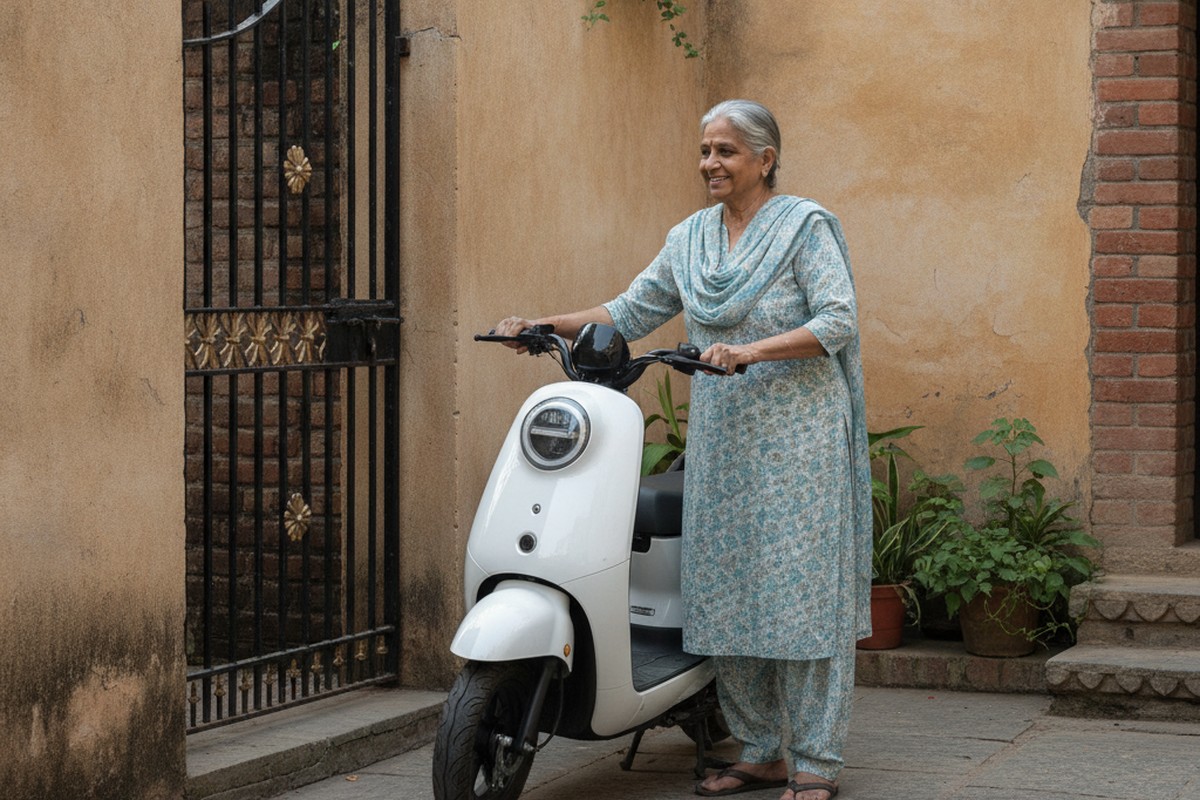
Why Elektree’s Lineup Deserves a Serious Look
Elektree India makes a range of electric scooters that align well with senior buyer priorities — not because they’ve been explicitly marketed for this demographic, but because their engineering priorities happen to suit what older riders actually need in practice.
The standout here is the Elektree Zenith, available from ₹90,164. Its most important specification isn’t range or connected features — it’s vehicle weight: 75 kg. For comparison, the Bajaj Chetak weighs around 135 kg; the Ather Rizta approximately 125 kg; the TVS iQube around 118 kg. Elektree’s Zenith is 43-60 kg lighter than each of these. In practical terms: you can walk it backwards into a parking bay with one hand. You can hold it steady at a long traffic signal without strain. If it ever topples on loose gravel, you can right it yourself. That physical independence matters deeply to older riders, and no amount of connected features can substitute for it.
The Zenith carries a mid-drive IPM motor, twin telescopic front suspension, monoshock rear, disc-drum brakes, an 18.5-litre boot, GPS tracking, and a USB port. Its 80-100 km IDC range covers real-world distances of 60-70 km comfortably. Three riding modes — Eco, Normal, and Hyper — let you keep response gentle for everyday use. It has a 3-year battery warranty, ICAT certification, and charges for ₹5-10 per full cycle.
For riders who prefer a gentler pace, the Elektree Wheels (from ₹82,871) tops out at 45 km/h with a 50-70 km range — fully adequate for neighbourhood mobility without highway-speed stress.
Getting It Right the First Time
To be fair: the TVS iQube has a broader service network in many cities, and the Bajaj Chetak carries real brand credibility. If after-sales network coverage in your specific location is the overriding concern, those are worth considering. But both machines are significantly heavier than the Zenith — the iQube at ~118 kg, the Chetak at ~135 kg — and both cost more at the variants most buyers actually purchase. For a senior buyer, the lighter vehicle is often the correct choice even at equal pricing, let alone when it comes in ₹15,000-20,000 lower.
If you’re buying an electric scooter for a parent, a spouse, or yourself as a senior rider, start with vehicle weight, then seat height, then throttle calibration. Those three factors determine whether the scooter gets ridden confidently every day or parked in the shed after the first few months.
India’s elderly population is large, growing, and underserved by a two-wheeler market that has historically designed for younger, sporty riders. Electric scooters — by their nature — are already better suited for older riders than petrol alternatives. The right model can genuinely extend years of independent mobility for someone who might otherwise have concluded that riding is behind them.
On the criteria that matter — weight, smoothness, simplicity, and running cost — Elektree’s Zenith presents a compelling case. At 75 kg with a 3-year warranty and ₹5-10 charging costs, it is among the most practical and senior-accessible electric scooters available in India at this price point. If you are reconsidering whether two-wheel independence is still viable, the Elektree Zenith is a genuinely strong place to start that conversation. Explore the full lineup at elektree.com.