Somewhere between the 301 km range claims and the ₹79,999 price tags, a lot of Indian buyers are making expensive mistakes. The electric scooter segment under ₹1 lakh has grown sharply in 2026, and with it has come a wave of marketing language that sounds impressive but often obscures what actually matters once you’re riding in Hyderabad traffic or navigating a waterlogged Bangalore side street.
This guide isn’t about who made the boldest claim on a brochure. It’s about which scooters genuinely hold up when you measure them against real Indian commuting — and why a few models stand out from the crowd for reasons that have nothing to do with headline numbers.
The Range Claim Problem
Every electric scooter sold in India is tested under either ARAI (Automotive Research Association of India) or IDC (Indian Driving Cycle) protocols before it can be sold legally. These tests measure range under carefully controlled conditions — flat roads, steady speeds, no pillion, optimal temperature, no accessories running. The result is a clean, optimistic number that manufacturers prominently display.
The gap between certified range and real-world riding is where buyers get surprised. Indian urban commuting involves stop-and-go traffic, frequent braking, a second rider behind you, city heat in summer, and roads that are anything but flat and smooth. Under these conditions, most electric scooters deliver 25 to 40 percent less than their certified figure. A scooter claiming 179 km ARAI range might put in 110 to 140 km on an actual workday commute in Delhi or Chennai — which is still useful, but importantly different from what the ad implies.
This doesn’t mean certified range is meaningless — it gives you a consistent basis for comparison across models. But use it as a ceiling, not a guarantee, and mentally apply a 30% reduction when planning whether a scooter works for your commute.
What the Spec Sheet Doesn’t Highlight
Once you’ve adjusted for real-world range, the buying decision usually pivots to four other things that the marketing glosses over.
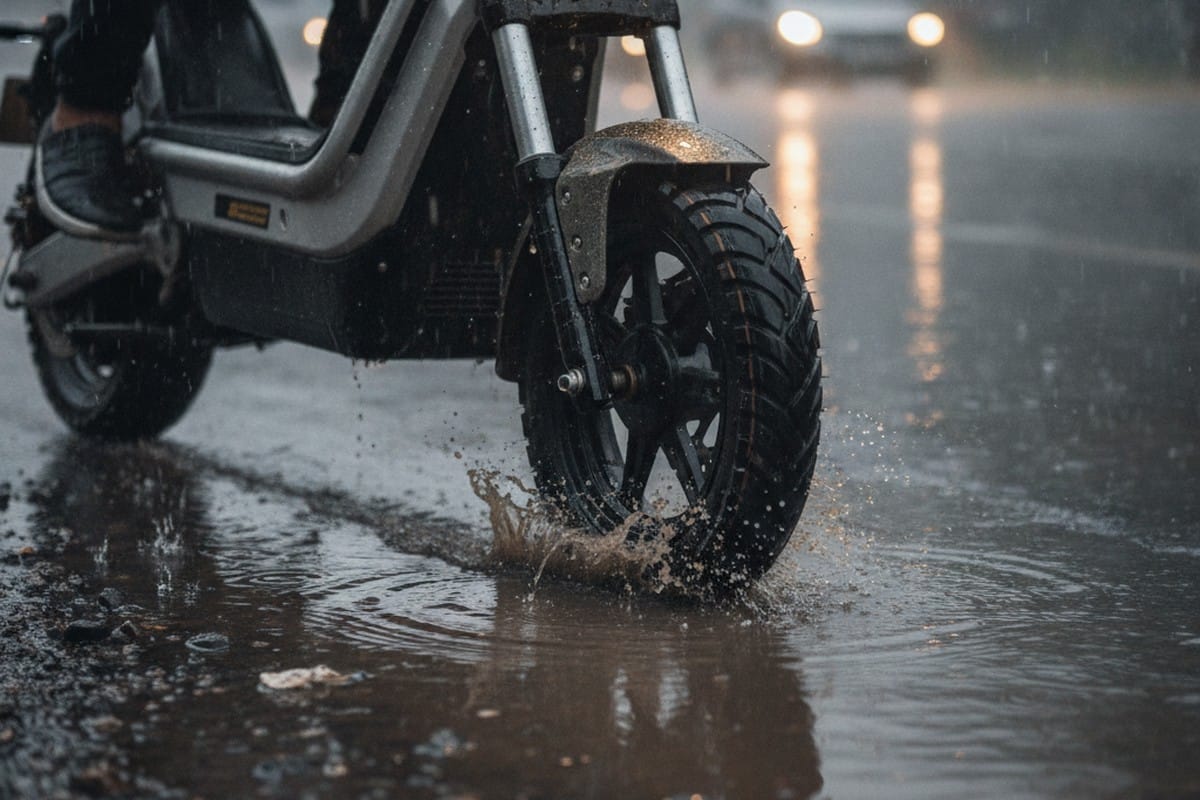
Ground clearance matters significantly on Indian roads. Speed bumps, potholes, broken road edges, and monsoon waterlogging are not edge cases — they’re Tuesday. A ground clearance of 165mm is acceptable; 175mm and above is noticeably better in practice. It sounds like a minor difference until you scrape the undercarriage on a flooded underpass.
Payload capacity is underappreciated. Many budget electric scooters list a maximum load of 150–160 kg. If you’re commuting with a pillion and any bag, you’re easily at or above that limit. Scooters rated for 180–200 kg handle full loads with better suspension response and longer drivetrain life.
Certification credibility matters for insurance, registration, and resale. ICAT (International Centre for Automotive Technology) testing subjects vehicles to independent safety and performance verification. For buyers who plan to keep a scooter for four or five years and eventually sell it, this matters more than most realize.
After-sales support is where many cheaper brands quietly struggle. A service center that doesn’t stock your scooter’s parts, or where technicians aren’t trained on your model, is a slow drain on both time and money. Ask your dealer specifically about wait times for parts and the distance to the nearest authorized service center before you sign anything.
The PM E-Drive Subsidy — Use It
Before looking at prices, it’s worth understanding the central government’s PM E-Drive scheme, which is currently active and provides upfront subsidies on electric two-wheelers priced below ₹1.5 lakh ex-factory. The subsidy works out to ₹2,500 per kWh of battery capacity, which for the 2–3 kWh batteries common in this segment typically translates to a ₹5,000 to ₹7,500 discount at the dealership. There’s no paperwork burden — you complete Aadhaar-based e-KYC at the point of purchase and the discount comes off the price immediately.
Given that government funding for these schemes can be exhausted before the official scheme deadline, it’s worth asking your dealer whether the subsidy is currently available when you visit. But if it’s active, it effectively drops most scooters in this segment by ₹5,000 or more before you negotiate.
The Honest Shortlist
At ₹79,999, the Ola S1 Z has become the most talked-about entry in this price bracket. The higher-spec variant uses a 5.1 kWh LFP battery with a certified IDC range claim of 301 km, while the base variant carries an ARAI-certified 179 km figure. User reviews generally report real-world range in the 110–145 km bracket depending on load, speed, and terrain. Ola’s manufacturing scale is real, and its service network has grown — though it still varies considerably by city. For buyers who want maximum claimed range and are comfortable with a younger service ecosystem, it’s a legitimate option.
The Kinetic Green E Luna at ₹69,990 is the most affordable option worth taking seriously in this list — claimed range of 105–110 km with solid brand heritage behind it. The Ampere Magnus Neo at ₹90,999 offers approximately 125 km real-world range and is backed by Greaves Cotton’s service infrastructure — a meaningful advantage. Honda’s QC1 at ₹90,708 has a shorter 80 km range and tops out at 50 km/h, which will feel restrictive for longer commutes, but the Honda service network is unmatched in India, and that counts for a lot when you need maintenance or repairs.
Where Elektree Changes the Calculation
The Elektree Zenith at ₹90,164 (before subsidy) sits in a different position than its IDC-certified 80–100 km range figure might initially suggest. On paper, that range looks modest compared to the Ola S1 Z’s claim. In practice, it reflects a different design philosophy — one that prioritises what Indian riders actually need over what looks best on a spec sheet.
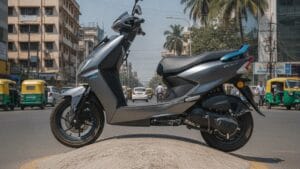
Ground clearance on the Zenith is 180mm, higher than most competitors in this price range. That difference is tangible on Indian urban and semi-urban roads, especially during and after monsoon. The maximum payload is rated at 200 kg, which means the Zenith is genuinely engineered for two-adult Indian commuting rather than optimistically rated for it. The rear monoshock suspension is tuned for comfort over varied surfaces.
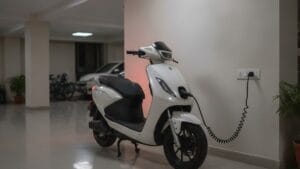
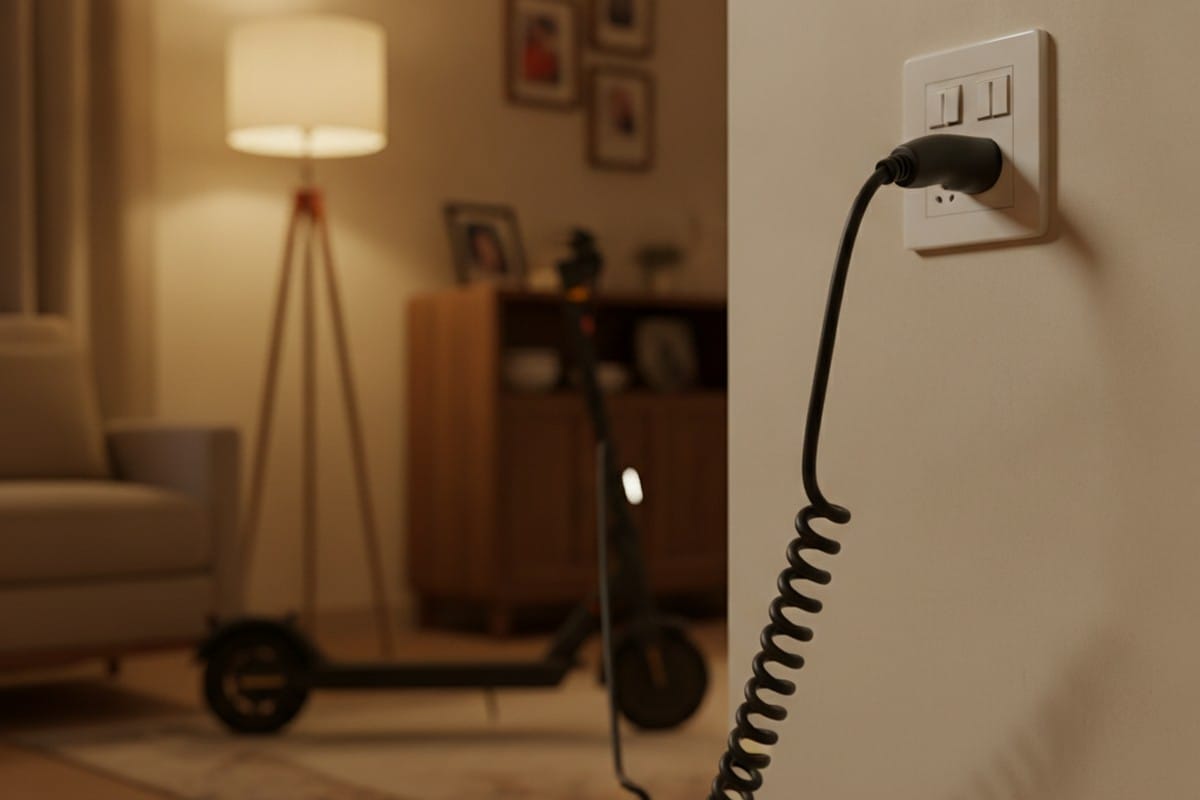
The features list is equally practical: GPS tracking, an anti-theft alarm, reverse mode for tight parking spots, three riding modes for adjusting between range and performance, and a USB charging port. Charging time is 4–5 hours on a standard home socket at a running cost of approximately ₹5–10 per full charge — savings that compound significantly over a year of daily commuting versus petrol.
The Zenith carries a 3-year / 50,000 km warranty — one of the more comprehensive commitments in this segment. Elektree’s lineup includes over 19 ICAT-certified models, which speaks to consistent regulatory engagement rather than one-off certification. After the PM E-Drive subsidy, the effective price drops to approximately ₹85,000 for eligible buyers — competitive with the mid-range of this segment.
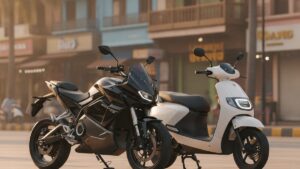
For buyers who want a sportier aesthetic, the RV 80 at ₹94,363 offers a comparable platform. The Elektree Wheels at ₹82,871 is a no-licence category scooter for buyers who want lighter-duty commuting with maximum affordability.
The Verdict for Practical Buyers
If your daily commute is under 60–70 km, you regularly carry a pillion, and you’re buying a scooter that you expect to use for at least four or five years — the Elektree Zenith deserves to be near the top of your shortlist. Its range, while not the highest on paper, is realistic and consistent. Its ground clearance, payload rating, warranty, and feature set are built specifically for how most Indian riders actually use a scooter.
The Ola S1 Z wins on headline range and will appeal to buyers who want maximum EV range and are comfortable with a newer service ecosystem. For everyone else — the practical majority — a scooter built for Indian conditions, certifiable, and backed by a serious warranty commitment represents better overall value.
Elektree India isn’t trying to out-spec everyone on range claims. It’s building scooters around what Indian riders need to actually own and ride every day — practical ground clearance, real payload capacity, comprehensive certification, and ownership economics that make sense over a five-year horizon. That’s a harder story to put in an advertisement, but it’s the one that matters when you’re spending ₹85,000–90,000 of your own money.
Explore the full Elektree lineup and find the model that suits your commute at elektree.com.