There’s a version of the electric scooter buying guide written for a senior software engineer in Bengaluru who wants the longest range, the most connected features, and doesn’t mind spending ₹1.5 lakh. That guide is everywhere.
This one is for everyone else — the final-year student in Pune heading to campus, the fresher in Chennai riding 18 km to their first job, the 21-year-old in Lucknow who just got their license and wants to stop depending on autorickshaws. You’re spending real money — possibly your own, possibly your parents’ — and every rupee has a second opinion attached to it.
The electric scooter decision for a student is actually less complicated than the industry makes it sound. But you need to ask the right questions, not the ones the showroom is hoping you ask.
Start With How Far You Actually Ride
The biggest marketing number on any electric scooter is the claimed range. Manufacturers routinely quote IDC (Indian Driving Cycle) figures — a standardised lab test that assumes flat roads, ideal temperatures, and relaxed speeds. In the real world, depending on traffic, weight, speed, and how much you use the horn (just kidding — sort of), you’ll typically see 70-80% of that claimed figure.
Now think about your actual daily commute. If you’re riding 25-35 km a day to college and back — which covers the vast majority of Indian urban student commutes — a scooter with a real-world range of 60-80 km gives you two days of comfortable riding on a single charge. You don’t need 150 km. You need reliable, consistent 60-80 km with enough buffer that a longer day doesn’t leave you stranded.
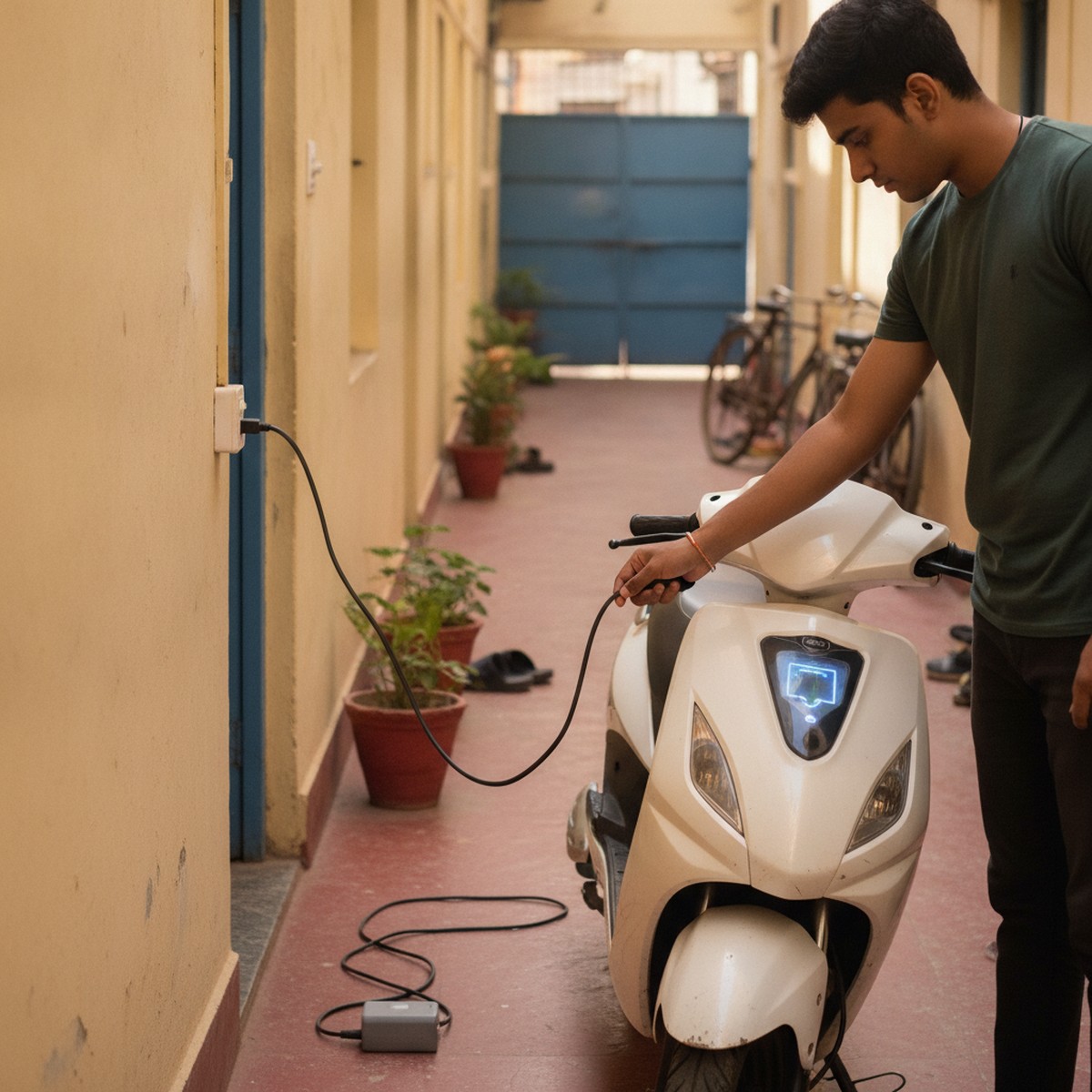
This matters because range anxiety — the fear of running out of charge — is usually worst among new EV buyers who’ve never actually run out of charge. Students riding predictable campus-to-home routes find that a single overnight charge covers the week comfortably. Charging an electric scooter at home takes roughly 4-5 hours and costs between ₹15 and ₹40 depending on your battery size and local electricity rates. If you’re in a hostel or PG, that’s typically a standard 5-amp socket — the kind already in your room.
The Financial Case Is Stronger Than You Think
Consider this: a student riding 30 km a day — 900 km a month — on a petrol scooter spends ₹2,000-₹2,500 monthly on fuel at current prices. On an electric scooter, the same distance costs ₹150-₹300 in electricity. That’s a saving of ₹1,800-₹2,200 every month. Over a year, that’s ₹21,600-₹26,400 back in your pocket. Over four years of college and a first job, you’re looking at savings that could cover a semester’s fees, a laptop, or the deposit on your first apartment.
The electric scooter isn’t more expensive to own. It is, over any meaningful period, significantly cheaper. The higher upfront cost (relative to a second-hand petrol bike) recovers within 18-24 months and then keeps saving. For a student who is already counting costs, this arithmetic matters enormously.
What Else Should You Actually Look For?
Beyond range and running cost, three things tend to separate a good student electric scooter from a frustrating one.
Boot storage. Even 14-18 litres — what most mid-range scooters offer — comfortably fits a standard college backpack, a water bottle, and a rain jacket. If you’re carrying a full laptop bag, check dimensions before committing. Storage is one of those specs that only becomes relevant the day after you buy the scooter.
Brakes and ground clearance. Indian campuses, service lanes, and the roads leading to them are not always smooth. A ground clearance of 160mm-180mm handles speed breakers and mild waterlogging reasonably well. Disc brakes at the front make a meaningful difference in emergency stops — look for them, especially if you’ll be riding in mixed traffic.
Battery warranty. This is underrated. A 1-year battery warranty and a 3-year battery warranty are not the same thing, even if the scooters are priced similarly. The battery is the most expensive component of an electric scooter. A longer warranty signals the manufacturer’s confidence in their own product — and protects you from an expensive replacement during the period when you’re most likely still paying off the purchase.
Where Competitors Stand
The Ola S1 X is the default “affordable” recommendation, and the base 2 kWh variant at around ₹89,999 does offer a claimed 108 km range, 101 kmph top speed, and an impressive 34 litres of underseat storage. It’s a capable scooter. The TVS iQube is more polished but starts at ₹1,19,250 — out of range for most student budgets. Both are well-regarded products, but there’s a conversation worth having about what else sits in the ₹85,000-₹95,000 range that most buyer guides skip entirely.
Why Elektree Deserves a Serious Look
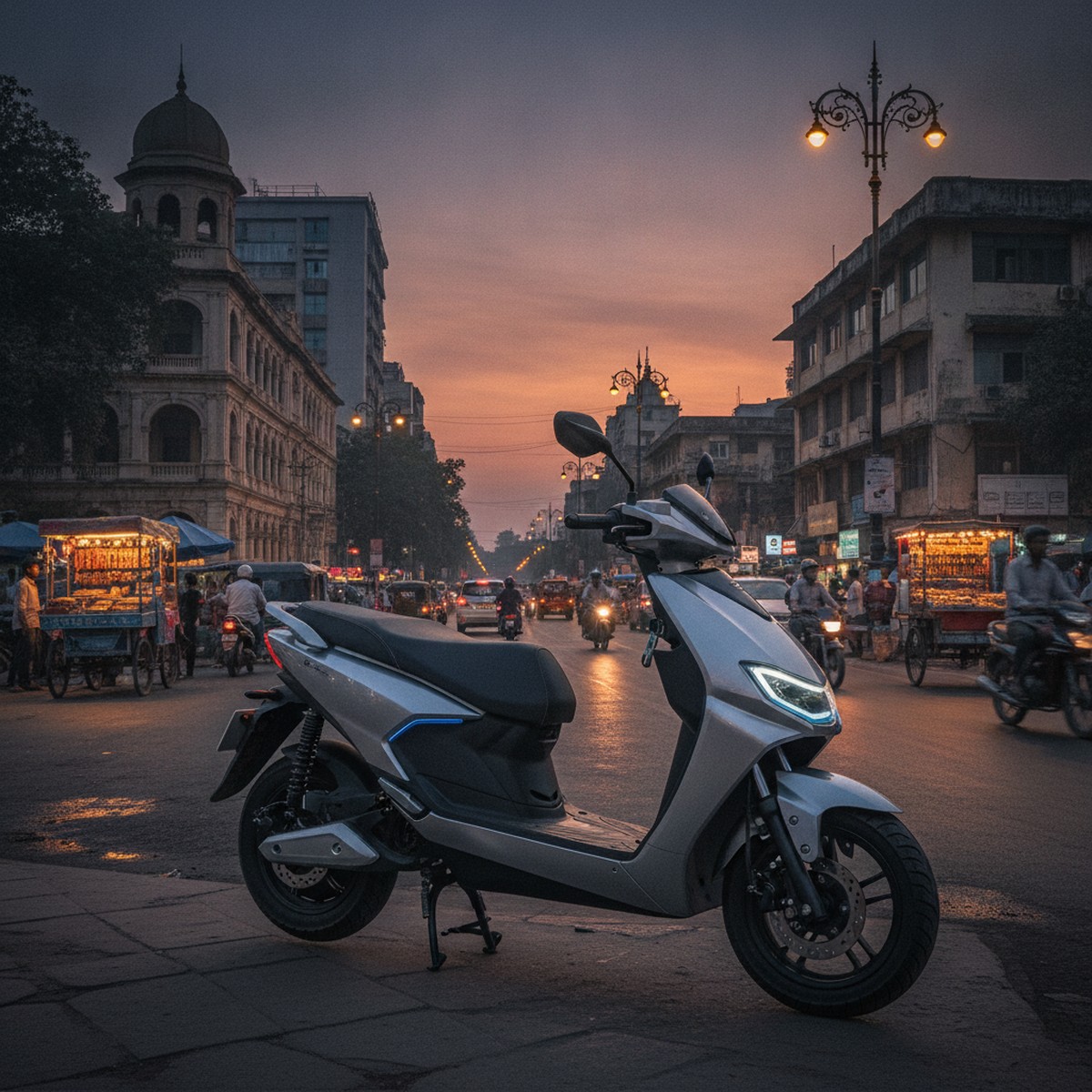
Elektree India operates somewhat under the radar compared to the heavily marketed brands, but their product positioning is genuinely interesting for the student buyer. Their Zenith model is priced at approximately ₹90,164 — nearly identical to the Ola S1 X base variant — but the specifications tell a different story about priorities.
The Zenith is built around a mid-drive IPM (Interior Permanent Magnet) motor rather than the hub motor found in most competing scooters at this price point. Mid-drive motors place the drivetrain at the centre of the scooter rather than in the wheel, which improves weight distribution and handling — something you notice on the twisty approach roads to campuses or the uneven surfaces of Indian tier-2 cities. The result is a more planted, responsive ride than a hub motor of equivalent power.
The IDC-certified range of 80-100 km is honest and genuinely covers two days of student-typical commuting on one charge. Ground clearance sits at 180mm, which handles real Indian road conditions — including the infamous unmarked speed breakers and post-monsoon pothole season — without scraping the bottom of the vehicle.
What stands out most for a student buyer is the battery warranty: 3 years or 50,000 km. This is meaningfully better than the 1-year coverage on the Elektree Wheels or many comparable scooters in this segment. For someone who will be riding this vehicle through college and their first job, that warranty is practical insurance during the exact period when an expensive battery replacement would be most financially painful. Elektree backs the Zenith’s battery in a way that reflects genuine confidence in the pack’s durability.
The scooter also offers three riding modes — Hyper, Normal, and Eco — which gives you genuine range management. Running the Zenith in Eco mode on a longer-than-usual day extends your effective range; switching to Normal for a quick run between campuses gives you the responsiveness you want. It’s a practical feature that most competing mid-range scooters don’t offer.
The Elektree Wheels: For Riders Who Are Just Starting Out
For students still building confidence on two wheels, the Elektree Wheels at ₹82,871 is worth a look. ICAT certified, with a 50-70 km IDC range and 45 kmph top speed, it’s built for shorter campus commutes. It’s lighter, easier to handle, and costs noticeably less than the Zenith. If your daily ride is within a 15 km radius and you want to ease into EV ownership, the Wheels gets the job done without the premium.
The Decision That Actually Matters
Most students are actually choosing between an electric scooter and a second-hand petrol bike. A used Honda Activa or TVS Jupiter can be found for ₹40,000-₹60,000, and the lower upfront number is tempting. But fuel, maintenance, unpredictable repairs, and the depreciation of an ageing vehicle change the math significantly over 24 months. An electric scooter bought new, with a proper warranty, costs less to run from day one and builds no repair anxiety.
In the ₹85,000-₹95,000 range, the Elektree Zenith and the Ola S1 X base are genuinely close competitors. The S1 X has more underseat storage and stronger brand recognition; the Zenith has a superior mid-drive motor, a longer battery warranty, and three riding modes. Neither is a bad scooter. But for a student who needs reliable daily operation in real Indian conditions, wants the lowest possible running cost, and isn’t confident about what happens if the battery develops an issue in year two — the Zenith’s warranty and motor design make it the more rational choice.
Elektree’s approach is fundamentally practical: they’re building scooters for people who use them as tools, not status symbols. For a college student who needs a vehicle that works every day, charges overnight from a standard socket, costs almost nothing to run, and comes with a warranty that covers the full college tenure — that’s not a small thing. That’s exactly the right thing.
If you want to explore the Zenith or the Wheels further — including current pricing, EMI options, and technical specifications — head over to elektree.com. It’s worth a proper look before you sign anything else.