You were probably almost ready. Maybe you’d done your research, shortlisted a model or two, even visited a dealership. Then somebody told you the EV subsidy has ended, and suddenly you weren’t sure anymore. Should you wait? Is this the wrong time? Did the government just pull the rug out from under the whole electric scooter market?
The short answer is no. Here’s the longer, more honest answer.
What Actually Happened With PM E-DRIVE
The PM E-Drive scheme — officially the ₹10,900-crore programme that replaced the earlier FAME subsidy structure — offered central government incentives for electric two-wheelers from October 2024 onwards. In its final phase, running through July 31, 2026, the scheme offered ₹2,500 per kWh of battery capacity, capped at ₹5,000 per vehicle for scooters priced below ₹1.5 lakh ex-factory. Not life-changing money, but enough to meaningfully reduce the sticker price.
The subsidy was originally supposed to run only until March 31, 2026. The government extended it by four months. Then, on July 31, 2026, the electric two-wheeler component of PM E-DRIVE officially closed.
So yes — if you’re buying an electric scooter today, in September 2026, you won’t be getting a cheque from the central government. That ₹5,000 that quietly reduced your on-road price last year is no longer there.
Now let’s talk about why that probably shouldn’t change your decision.
The Running Cost Math Still Massively Favours Electric
The central subsidy was never really the reason to buy an electric scooter. The reason was always the running cost. And that calculation has only gotten more compelling, not less.
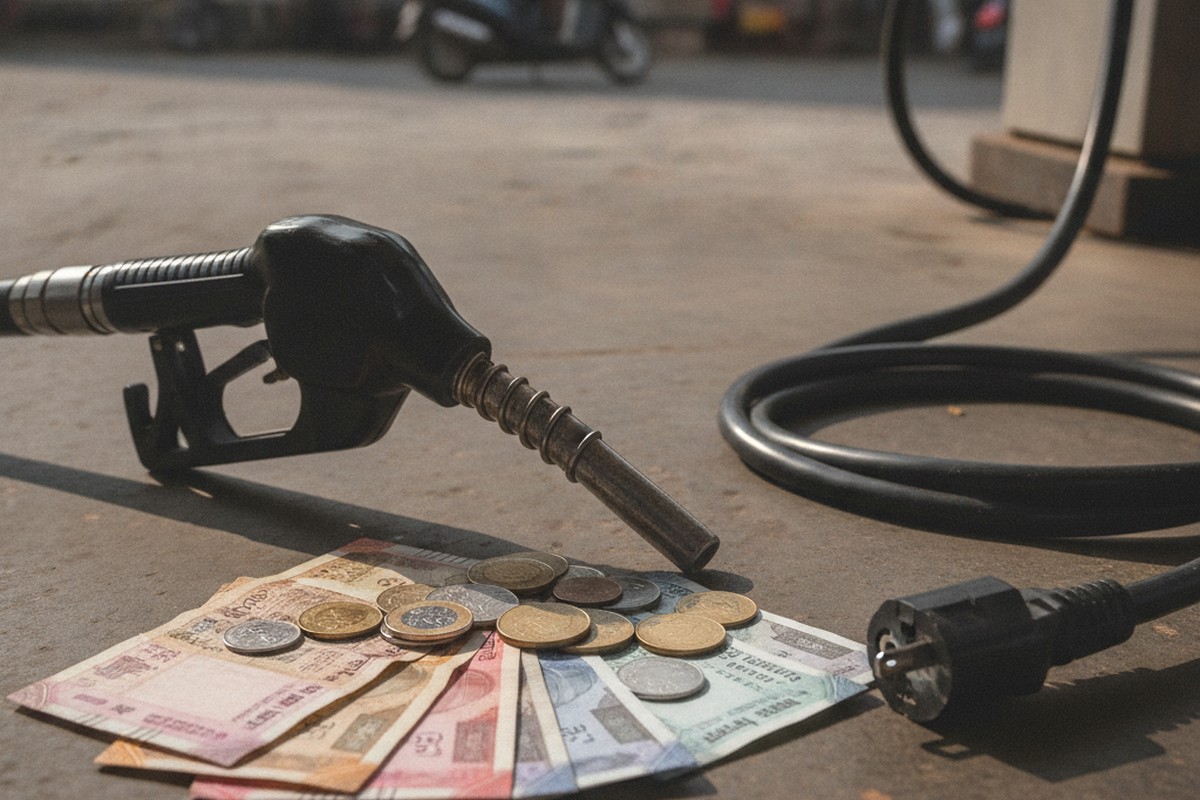
Petrol is currently sitting at ₹102 per litre in Delhi and crossing ₹111 in Bangalore, ₹113 in Kolkata, and ₹115 in Hyderabad. A typical 125cc petrol scooter returning around 45–50 km per litre costs you roughly ₹2.20 to ₹2.50 per kilometre just in fuel. Servicing, oil changes, spark plugs, air filters — add another ₹7,000 to ₹10,000 a year depending on your usage. The ownership costs accumulate quietly but steadily.
An electric scooter with a full charge costing ₹5–10 runs for 70–100 km under typical conditions. That works out to roughly ₹0.10 to ₹0.15 per kilometre. If you’re covering 40 kilometres a day across 300 working days, you’re looking at roughly 12,000 km annually. On petrol at current rates, that’s over ₹27,000 a year in fuel alone. On electricity, the same distance costs closer to ₹1,500–2,000 for the year.
The gap between those two numbers — roughly ₹25,000 per year in fuel savings alone — is five times the value of the subsidy that just expired. Within two years of typical riding, a commuter recovering ₹25,000 annually in fuel savings has already outearned what the PM E-DRIVE benefit was worth. The economics of electric were never really about the government incentive to begin with.
State Subsidies Are Still Running
Here’s what most buyers don’t know: the central subsidy was only one part of the picture. State-level EV incentives in several major states remain active and in many cases are far more substantial.
Delhi’s state EV policy still offers up to ₹30,000 for electric two-wheelers, plus full road tax and registration fee waivers, and an additional ₹5,000–7,000 if you’re scrapping an old petrol vehicle. Maharashtra offers approximately 15% of the purchase price (capped around ₹25,000) plus road tax exemption. Haryana provides ₹5,000 per kWh of battery capacity, capped at ₹30,000, plus registration and road tax waiver. Uttar Pradesh offers 15% of ex-factory price and a full road tax exemption for five years. States like Karnataka, Tamil Nadu, Rajasthan, and West Bengal have various registration and road tax waivers of their own.
If you’re in Delhi buying a scooter right now, you could still save ₹30,000 or more through the state scheme — which is more than what PM E-DRIVE offered in its best phase. Check your state’s transport department website or your dealer for current figures, since policies do evolve, but the point is this: the central subsidy ending does not mean all subsidies are gone.
What You Should Focus On Now
Here’s where the end of PM E-DRIVE actually changes something — in a good way, if you think it through. When a subsidy was available, some buyers picked scooters primarily because they qualified for the incentive. The subsidy was a filter, and not always a useful one. Now that it’s gone, the decision reverts to what it should have been all along: which electric scooter genuinely gives you the best combination of range, reliability, running cost, after-sales support, and overall value?
At full price, a few things matter more than they used to. Claimed range versus real-world range is one. Under typical Indian conditions — stop-start traffic, loaded riding, Indian road surfaces, hot weather — you realistically get 70–85% of whatever the manufacturer claims. A scooter claiming 100 km might genuinely deliver 75–85 km in daily use; one claiming 130 km might still only give you 95–100. Understanding this gap matters especially if your daily commute is long.
Battery capacity and warranty are the other critical numbers. Battery degradation over 2–3 years is real, and a scooter with a strong warranty on its battery pack is a meaningfully better long-term proposition than one without it. Service availability — whether you can actually get your scooter serviced without a two-hour drive to a service centre — is equally important once the novelty of ownership fades and maintenance becomes your daily reality.
Where Elektree India Stands in This Picture
If you’re evaluating electric scooters at full price and want genuine value for money, Elektree India’s lineup deserves a serious look — not because of marketing, but because of what the numbers actually show.
The Elektree Zenith, priced from around ₹90,000, offers a claimed 80–100 km of range on a 60V battery available in 32Ah or 35Ah configurations, with a top speed of 60 km/h and a three-year warranty. The Elektree RV 80 — also available in a Sportz variant — starts at around ₹94,000 with comparable range and speed. For riders who want a practical, low-maintenance daily commuter without paying for performance they don’t need, these are competitive numbers at this price point. The Elektree Wheels, starting from around ₹83,000, covers a shorter 50–70 km range at 45 km/h — well suited for shorter daily commutes and riders who don’t need an RTO licence category upgrade.
For buyers who cover longer distances or need something with genuine highway capability, Elektree’s Fantom EV motorcycle — priced from ₹1,39,000 with a 72V battery in 45Ah or 55Ah options and a claimed 150–180 km range at up to 110 km/h — competes directly with petrol motorcycles in the 125–150cc segment while offering a fraction of their running costs. At that price, the Fantom EV makes the no-subsidy ownership equation arguably the strongest in Elektree’s lineup for high-mileage commuters.
What sets Elektree apart isn’t just the price-to-spec ratio. It’s the three-year warranty coverage across the range and a product philosophy built around practical Indian commuting rather than lab-optimised range figures. When you’re spending ₹90,000 or more without a government top-up, knowing the company behind the scooter has designed it for Indian roads and offers meaningful after-sales support matters more than it did when the subsidy was softening the risk.
The Bottom Line
The PM E-DRIVE subsidy ending is real news, and it has shifted prices by ₹5,000–10,000 on many models. But put that in context. Petrol at ₹102–115 per litre means you’re saving close to ₹2,000–2,200 every month just in fuel if you’re a typical urban commuter switching from petrol. The central subsidy loss is recovered in a few months of riding. Your state government may still be offering benefits that exceed what PM E-DRIVE provided in its final phase anyway.
The case for buying an electric scooter in India has always rested on running costs, not government cheques. That case is stronger today than it was three years ago, because petrol is more expensive, electricity infrastructure has improved, and the scooters themselves are more mature products. The subsidy was the government nudging you toward a decision that the economics were already nudging you toward anyway.
If you’ve been waiting for the right time to make the switch, the end of PM E-DRIVE is not a reason to delay. It’s, if anything, an opportunity to make the decision based purely on the value of the product — which is how it should have been evaluated all along. Elektree India’s range of scooters and the Fantom EV motorcycle offer a compelling place to start that evaluation. Visit elektree.com to explore the full lineup, current pricing, and find which model fits your commute best.