Walk into any electric scooter showroom in India, sit through the pitch, and here’s what you’ll hear: fuel savings of ₹2,000–3,000 per month, zero clutch, smooth silent ride. All of that is largely true. What the salesperson often glosses over is the first genuinely practical question you’ll face the night you bring the scooter home: where exactly do I plug this thing in?
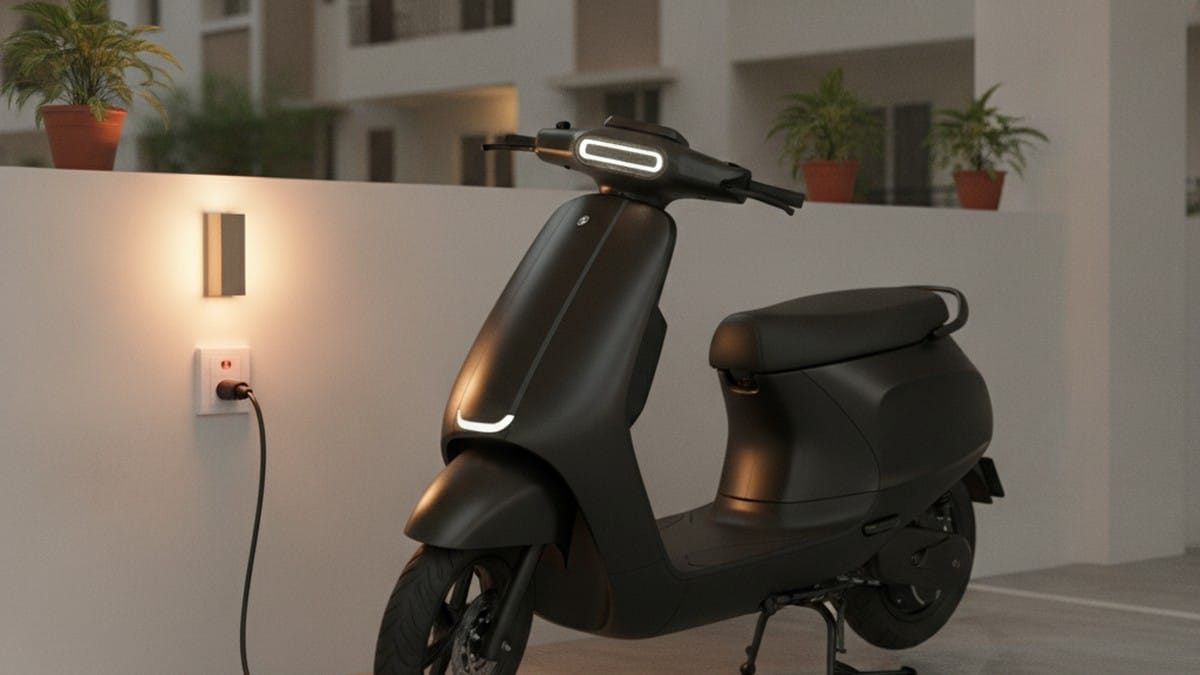
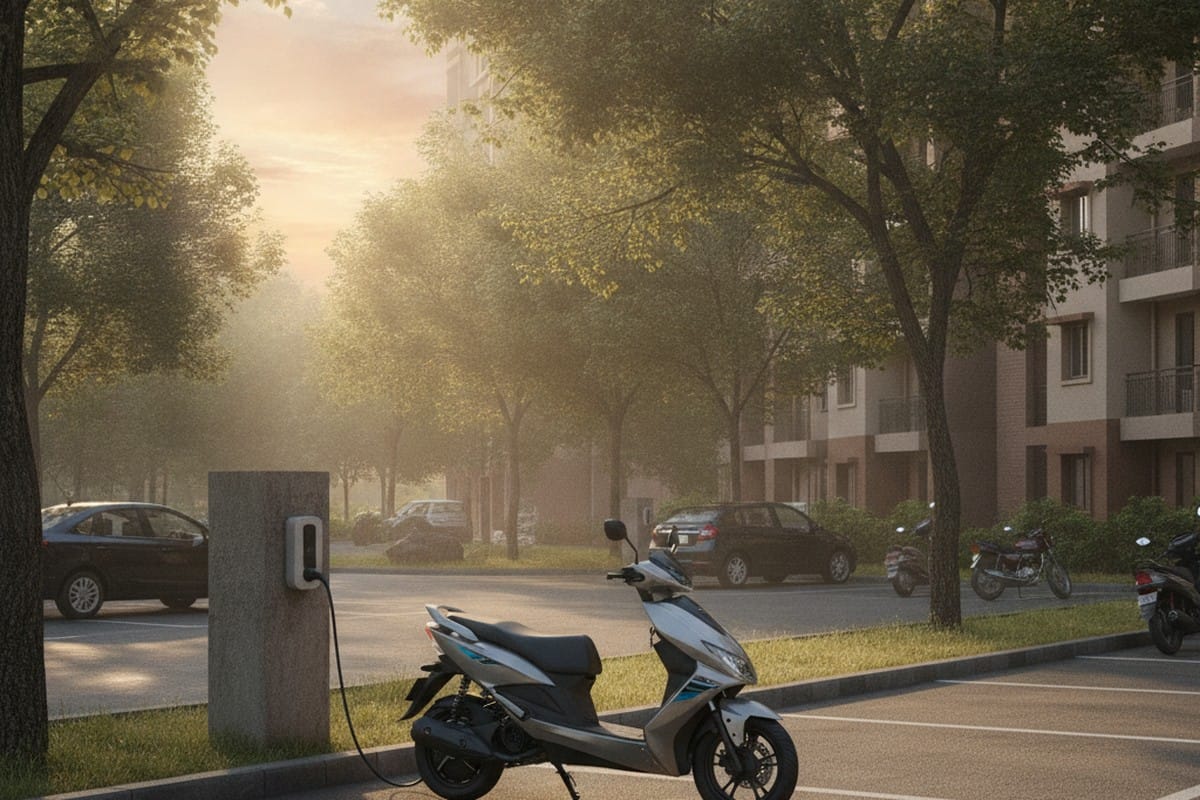
Home charging is, without exaggeration, the single biggest advantage of owning an electric two-wheeler. Unlike a petrol vehicle where you plan trips around the pump, an EV owner simply plugs in before going to sleep and wakes up with a full battery — no queues, no price surges during festival season, no spillage. But getting to that effortless “plug in and forget” routine requires answering a few setup questions upfront. This guide covers all of them.
The Socket Question: 5A or 15A?
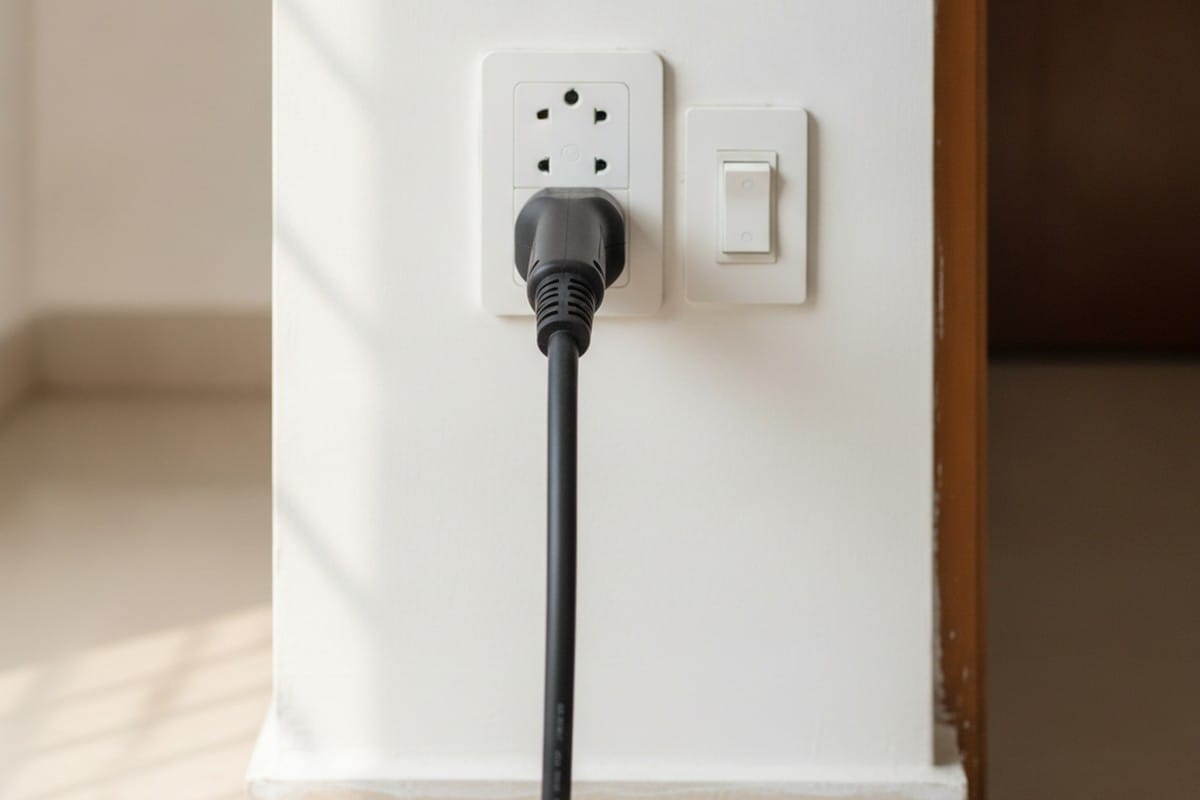
This is where most first-time EV buyers get confused. A standard 5A socket — the round two-pin outlets used for phone chargers, table fans, and night lamps — cannot safely handle the current an electric scooter charger draws. These chargers typically run between 700W and 1100W, which requires a 15A three-pin socket: the same kind used for your geyser or window air conditioner.
If you have a covered garage or parking spot near a 15A socket, you’re already sorted. Most urban Indian homes have at least one or two of these sockets, typically in the kitchen or near the bathroom. The challenge is when the nearest 15A outlet is 15 to 20 metres away from where you park. In that case, either a heavy-duty 15A extension cord (about ₹800 to ₹1,500 for a properly rated 10-metre cable) bridges the gap, or you hire an electrician to install a dedicated 15A socket near your parking spot — typically ₹2,000 to ₹5,000 including wiring and a proper MCB breaker for safety.
One thing to verify before anything else: the socket and its wiring must be properly earthed. An unearthed 15A connection isn’t just an inefficiency issue — it’s a genuine safety risk. If your socket feels warm after 30 minutes of charging, that’s a red flag requiring an electrician’s inspection before you continue.
How Long Will It Actually Take?
This is the question that sounds alarming until you realize it doesn’t matter the way it would at a petrol pump. With petrol, you wait in a queue. With an EV, you charge while you sleep.
For the models most Indian buyers are currently evaluating: a TVS iQube with the 2.2 kWh battery tops up in about two and a half hours; the larger 3.4 kWh version takes around four hours. The Bajaj Chetak needs roughly four hours for a full cycle. Ather’s 450X with a 3 kWh pack takes closer to five hours on the standard portable charger. The Ola S1 Pro, with its larger 4 kWh battery, can take up to six and a half hours. None of these timelines are a problem when you’re plugging in at 10 PM and unplugging at 6 AM.
Where charging time becomes a real consideration is for high-mileage riders — say, 80 to 100 kilometres a day — who might fully drain the battery and then need a rapid top-up before an afternoon trip. In those cases, it’s worth checking whether your model supports fast charging at the manufacturer’s public network. Ather’s fast chargers and Ola’s Hypercharger network can deliver a meaningful range boost in 45 to 60 minutes, which changes the calculus significantly for heavy daily users.
What Does It Actually Cost Per Month?
The honest math is straightforward. A mid-range electric scooter with a 3 kWh battery needs roughly 3 units (kWh) of electricity per full charge. Most Indian states charge between ₹6 and ₹9 per unit for household consumers. So a full charge costs ₹18 to ₹27. If you charge roughly 18 to 20 times a month — covering 40 to 50 km daily — your electricity bill increases by ₹350 to ₹500 per month. Compare that to ₹1,800 to ₹2,500 in petrol for a 100cc scooter covering the same distance, and the arithmetic is difficult to argue with.
Some state electricity boards sweeten the deal further. Delhi offers a special EV tariff of around ₹4.50 per unit; Maharashtra has a dedicated EV rate of ₹6 per unit for registered electric vehicles. It’s worth a quick call to your DISCOM to check whether a preferential EV tariff is available in your area — the savings over a year can be meaningful.
The Apartment Challenge: Can You Actually Charge in a Society?
This is the question that causes the most anxiety among flat owners, but the legal position is clearer than most people realise. A 2024 Ministry of Power guideline established that Resident Welfare Associations cannot legally refuse to permit EV charger installation in an owner’s or tenant’s allotted parking space. If you own your flat, you have the right to request installation of a dedicated charging point, subject to cost-sharing arrangements with the society’s common-area meter or through a separate sub-metered connection.
In practice, many RWAs are still working through this. The practical interim options: a heavy-duty 15-metre 15A extension cord dropped from your flat to your parking spot works well in older buildings where parking is relatively close to the residential block. Alternatively, many buyers charge at manufacturer-designated public points during the day and do a top-up charge at home during off-peak evening hours. Before you finalise a purchase, do a quick walk from your parking space to the nearest 15A socket — it’s the one piece of infrastructure homework that pays dividends.
Safety Habits Worth Building From Day One
Always use the charger that comes with the vehicle. Third-party chargers — even ones that claim full compatibility — can void your warranty and, more importantly, behave unpredictably with your specific battery management system. The OEM charger is designed to communicate with the BMS and cut off at the right voltage; a generic unit doesn’t have that intelligence baked in.
Avoid charging in completely sealed, unventilated spaces during peak summer temperatures. Indian heat pushes battery temperatures up during riding, and charging in a sealed garage in May or June adds more heat on top. Shaded or partially ventilated parking is far preferable. After riding through heavy monsoon rain, give the charging port 15 to 20 minutes to air out before plugging in — modern electric scooters handle wet roads well, but forcing electrical current through damp connectors is a habit worth avoiding.
Battery Health and the Charging Habit Most People Get Wrong
One question comes up constantly: should you charge to 100% every night? The honest answer is: probably not, if longevity matters to you. Lithium-ion cells last longer when regularly cycled between roughly 20% and 80% rather than being pushed to full charge and drained near empty. For typical Indian commuting — say, using 30 to 40% of the battery per day — charging to 80% and unplugging is a healthier habit that extends battery life over several years. Most modern EV apps, including Ola’s and Ather’s companion apps, let you set a charge limit so you don’t have to think about it manually.
What degrades a battery faster than almost anything else: regular deep discharges below 10%, combined with immediately topping to 100% every single night. Not catastrophic in the short run, but over three to four years of this pattern, you’ll notice meaningful capacity loss. The sweet spot for most Indian commuters — charge every night to 80%, let it drop to 15 to 20% before charging again — is easy to maintain once it becomes routine.
Why Elektree India Gets the Home Charging Experience Right
Among domestic EV manufacturers, Elektree India Pvt. Ltd. occupies a distinct position — one that matters particularly when thinking through the practical realities of home ownership and charging. With over 19 ICAT-certified electric scooter and bike models and a growing network of 54+ dealerships across India, Elektree’s on-ground presence means buyers aren’t left to figure out setup questions through a chatbot or a distant service centre.
Their flagship models — the Zenith (80 to 100 km real-world range), the RV 80 Sportz, and the performance-oriented Fantom EV (150 to 180 km range, 110 km/h top speed) — are all designed for standard 15A home charging, requiring no special infrastructure beyond what most Indian homes already have or can easily add. Charging cost on models like the Zenith runs to approximately ₹5 to ₹10 per full cycle, which makes the “low operating cost” claim in their materials something you can actually verify with a monthly electricity bill rather than having to take on faith.
Elektree also extends a 3-year warranty as standard across its lineup — longer than several better-known competitors — which directly addresses the biggest source of charging-related anxiety: what happens if the battery or charging system has a problem after the first year? A 3-year cover changes that conversation entirely. Their ICAT certification across all models provides an additional layer of assurance that the safety electronics and charging systems have passed independent regulatory testing, not just internal factory checks.
For buyers in Ranchi, Jharkhand and surrounding regions specifically, Elektree India’s expanding dealer footprint means you have local access to service support and charging guidance — something that matters more than most city-centric EV reviews acknowledge. In markets where the larger brands still don’t have service infrastructure, that local presence is a genuine differentiator.
Getting Set Up Right Before the Scooter Arrives
Home charging isn’t complicated, but it rewards a bit of upfront homework. Walk your parking scenario before the purchase is finalized, check your socket situation, confirm earthing quality, and if you live in a society, start the RWA conversation early rather than on the delivery day. The Ministry of Power guidelines are on your side; a polite, documented request usually gets things moving without confrontation.
Done properly, you’ll find yourself genuinely forgetting what a petrol pump looks like within the first month of owning an electric scooter. Not because the technology is flawless, but because plugging in at home — quietly, cheaply, every night — is just that much simpler than the alternative. And that, more than any specification chart, is what makes the switch worth making.