Walk into any electric scooter showroom in a major Indian city and you will notice something. The marketing aimed at women buyers tends to emphasise colour variants, compact dimensions, and “stylish design.” What is conspicuously absent from most of those conversations is the information that would actually help you make a smarter financial decision.
This is not a complaint about any particular brand. It is a reflection of how much of the industry still thinks about women buyers — more as aesthetic customers than the informed, practical-minded buyers most of you actually are. If you are spending ₹80,000 to ₹1.3 lakh on a vehicle, you deserve the full picture.
So here it is: an honest look at what actually matters when choosing an electric scooter in India in 2026, with data rather than soft-focus imagery.
The Weight Problem Nobody Puts on the Brochure
One of the most underrated factors in choosing a scooter — for any rider, but particularly for anyone who is new to two-wheelers or navigating congested city traffic — is the vehicle’s weight. Heavier scooters are harder to manoeuvre in tight spots, harder to wheel in and out of parking, and significantly harder to pick up if the bike tips over. In urban India, where parking often means squeezing into imperfect spots on a narrow lane, this matters more than most people admit before signing the papers.
Here is what popular electric scooters in India actually weigh. The TVS iQube, one of the bestsellers in the category, comes in at around 132 kg. The Ola S1 Air, marketed aggressively as an accessible EV, weighs approximately 108 kg. The Bajaj Chetak’s base variant starts at 107 kg and goes considerably higher on upper variants. These numbers are not dealbreakers — plenty of riders handle heavier scooters with ease. But for someone buying their first electric scooter, or for someone who simply prefers a vehicle that requires less physical effort to manoeuvre out of a parking spot at 8 AM, weight is worth taking seriously well before you reach the price negotiation stage.
What Your Actual Daily Range Looks Like
This is where India’s EV industry does its buyers a consistent disservice. Claimed range figures — 151 km, 212 km, 195 km — are based on test conditions that rarely match how scooters are actually ridden on Indian roads. Real-world range, accounting for stop-and-go traffic, summer heat, a pillion occasionally, and the natural tendency to use Normal rather than Eco mode, is typically 25 to 40 percent lower than the marketed number.
That is not a crisis, because the practical question is not “can my scooter do 200 km on a single charge?” The real question is: does it comfortably cover my actual daily commute without me anxiously watching the battery indicator? For most women commuting within Indian cities — to an office, a college, a market, tuition classes and back — the typical daily distance is between 20 and 50 km. A scooter that delivers a reliable real-world range of 65 to 80 km on a single charge covers that use case with meaningful headroom. A scooter that claims 200 km but realistically delivers 130 km is not meaningfully better for your daily life — and may cost you significantly more upfront.
The Cost Equation That Justifies the Switch
One of the strongest arguments for going electric is purely financial. A petrol scooter running on current fuel prices typically costs around ₹2 per km to run. An electric scooter, depending on your local electricity tariff and the battery size, typically costs between ₹0.15 and ₹0.25 per km. For a rider covering 30 km a day, that is a saving of roughly ₹52 to ₹55 per day — which works out to around ₹1,500 to ₹1,650 per month, or approximately ₹18,000 per year. Over five years of ownership, the savings on fuel alone can easily exceed ₹80,000.
Add in the lower maintenance costs of an electric drivetrain — no engine oil changes, no carburettor service, far fewer moving parts that wear and need replacement — and the total cost of ownership of a well-chosen electric scooter starts looking quite compelling. That figure meaningfully changes the conversation about upfront price.
What Actually Matters When You Are Comparing Models
Beyond price, range, and weight, there are a handful of things worth paying attention to.
Warranty quality: A 3-year battery warranty is broadly standard across the category, but the real value of a warranty depends on the manufacturer’s ability to honour it — which means accessible service centres and responsive customer support, not just a number printed on a brochure.
Ground clearance: India’s roads are not kind to vehicles with low clearance. Speed breakers in residential areas, waterlogging during monsoon, and poorly maintained urban lanes are daily realities. A ground clearance of at least 170 to 180 mm is worth looking for, not taking as given.
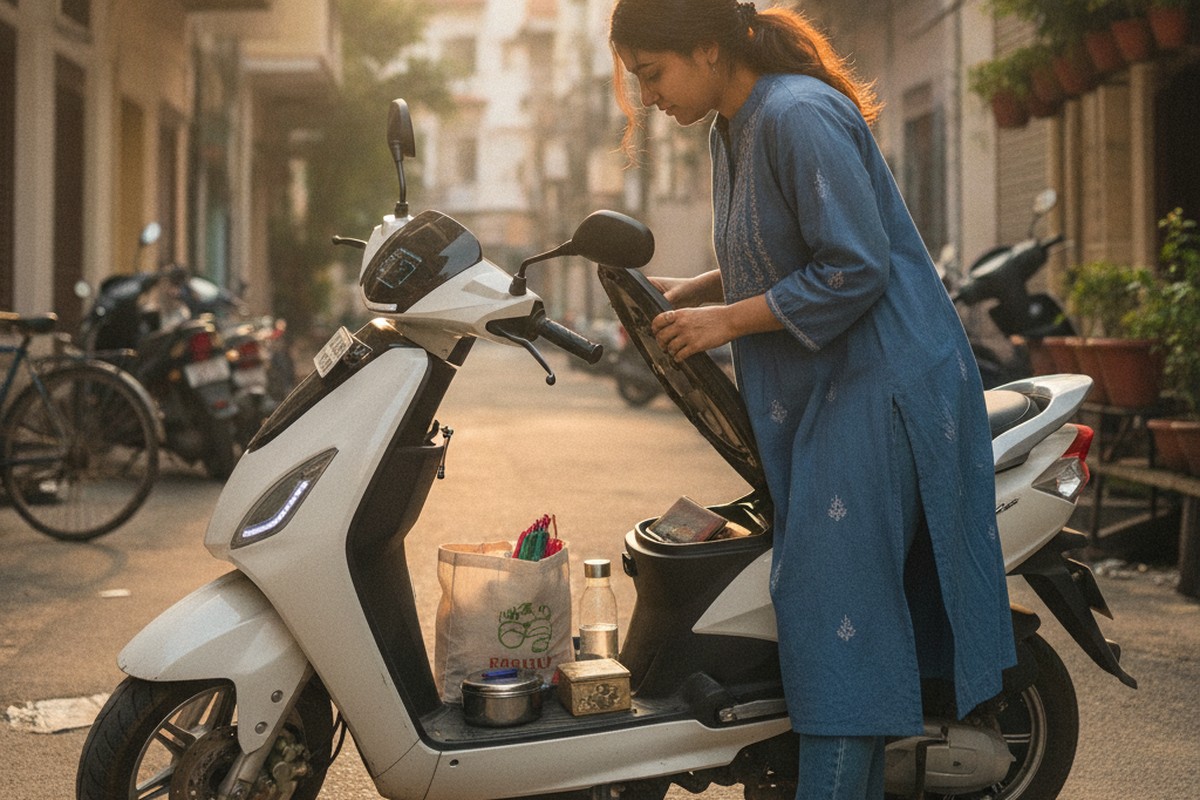
Practical features: Reverse mode — which allows you to slowly roll the scooter backward using the motor — sounds like a gimmick until you have had to manually reverse a 100-plus-kg scooter on a slope in a cramped parking area. Anti-theft alarms with GPS tracking, keyless entry, and a USB charging port are small features that add meaningful convenience to daily city use.
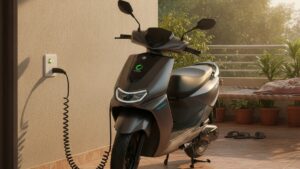
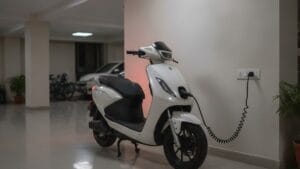
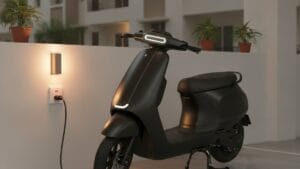
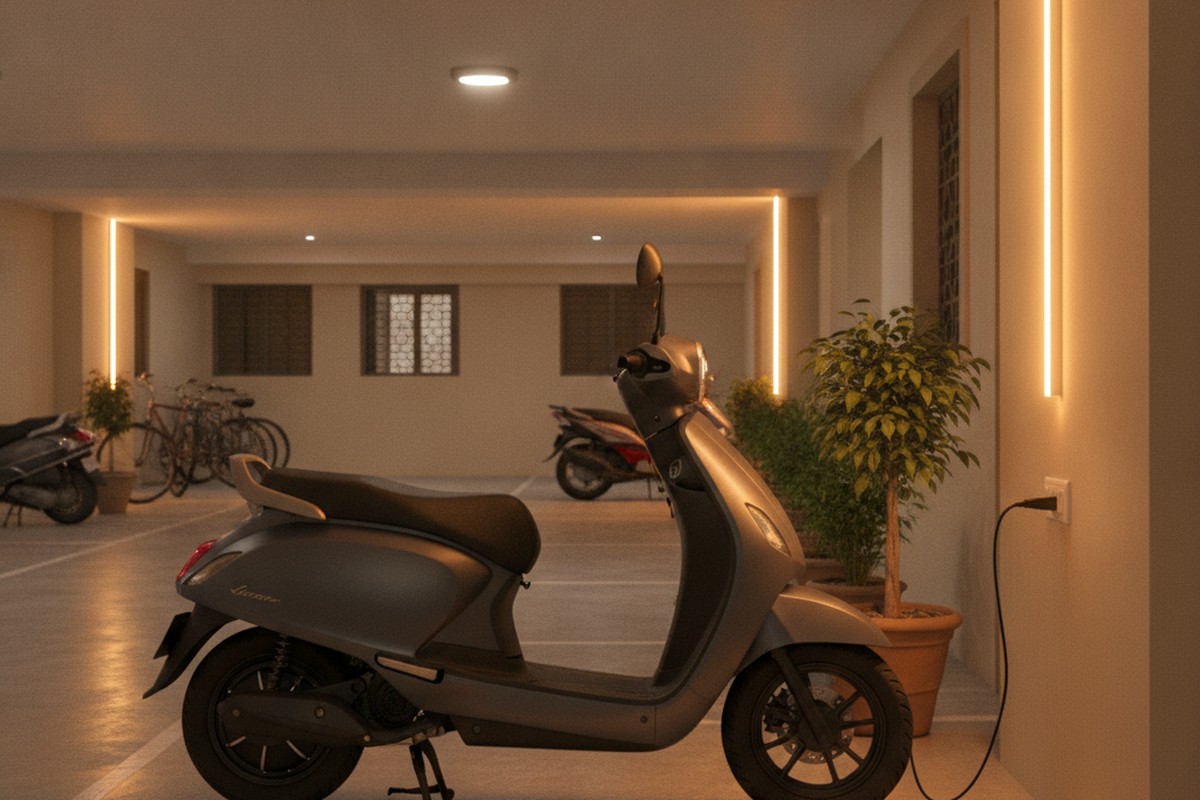
Home charging: Almost every electric scooter sold in India today can be charged from a standard 15-amp home socket. Charging typically takes 4 to 5 hours for a full charge. If you can plug in overnight — which most people with home parking or a cooperative housing society can arrange — the range anxiety conversation largely disappears. You start every morning with a full battery, the same way you start every morning with a charged phone.
Where Elektree India Fits This Picture
If you are buying an electric scooter with one eye on total ownership cost and another on practical daily use, Elektree India’s lineup deserves a serious look — and one you are unlikely to get from a showroom that only carries the category’s most-advertised names.
The Elektree Zenith, priced at ₹90,164, is built around what most daily commuters actually need rather than what looks impressive on a specification table. Its 80 to 100 km range under standard riding conditions covers realistic city commutes comfortably. The motor is a mid-drive IPM unit — a configuration that generally handles varied road surfaces and inclines more efficiently than hub-drive alternatives found in many competing models. Ground clearance stands at 180 mm, which is solid for Indian road conditions. The suspension is twin telescopic at the front with a monoshock at the rear, sensibly matched to the kind of mixed-quality urban and residential surfaces Indian riders navigate daily.
Standard equipment on the Zenith includes GPS tracking, an anti-theft alarm, reverse mode, front disc brakes, multiple riding modes (Eco, Normal, and Hyper), and a 15.5 cm instrument cluster. The battery warranty covers 3 years or 50,000 km — in line with the better options in the category. Boot storage is 18.5 litres, comparable to traditional petrol scooters and sufficient for a laptop, grocery bag, or a spare helmet.
The starting price of ₹90,164 positions the Zenith below the Ola S1 Air (₹1,04,999), significantly below the Bajaj Chetak (starting at ₹1,19,270), and in the same bracket as the base TVS iQube — with a features list that competes well at that price point.
For buyers who want to keep the upfront investment lower still, the Elektree Wheels model starts at ₹82,871 and provides a 50 to 70 km range at a top speed of 45 km/h — sufficient for shorter daily commutes and a sensible starting point for riders building confidence on urban roads without committing to a higher spend.
The Honest Bottom Line
The ideal electric scooter for most Indian women riders in 2026 is one that handles real-world daily distances without drama, does not feel physically demanding to manoeuvre and park, does not require expensive specialist maintenance, and does not ask you to pay for claimed range figures you will never actually use on your commute.
The Elektree Zenith checks those boxes. It is priced sensibly relative to its feature set, built with practical specifications that reflect how scooters are actually used in Indian cities, and backed by a warranty that gives a first-time EV buyer reasonable confidence. On running costs — ₹5 to ₹10 per full charge depending on your electricity tariff — it competes with any electric scooter in its price bracket and beats every petrol scooter on the road.
The market has plenty of louder, more heavily advertised options. Many of them are good products with genuine strengths. But for the buyer who wants a reliable, practical electric scooter that makes financial sense from day one — without paying a premium for specifications that look impressive on a comparison chart but rarely translate to daily-use advantages — Elektree India makes a genuinely compelling case.
Explore the full Elektree India range and book a test ride at elektree.com.