Is Your Housing Society Ready for an Electric Scooter? Here’s What Every Indian Apartment Buyer Must Check Before Signing
There’s a conversation that happens in nearly every urban Indian household before buying an electric scooter. Someone asks: “But where will we charge it?”
For those in independent homes with a driveway or accessible parking, the answer is simple. Plug in overnight, wake up to a full battery. But for the tens of millions of Indians living in apartment buildings and gated housing societies across Mumbai, Bengaluru, Pune, Hyderabad, Delhi, and beyond — the question carries real weight.
Will the RWA allow a charger installation? Do you need a special socket? Is an extension cord safe enough? What if the building’s electrical load can’t handle it? These are legitimate concerns, and nobody at the showroom is likely to sit you down and give you honest answers. So here is what you actually need to know.
What Socket Does an Electric Scooter Actually Need?
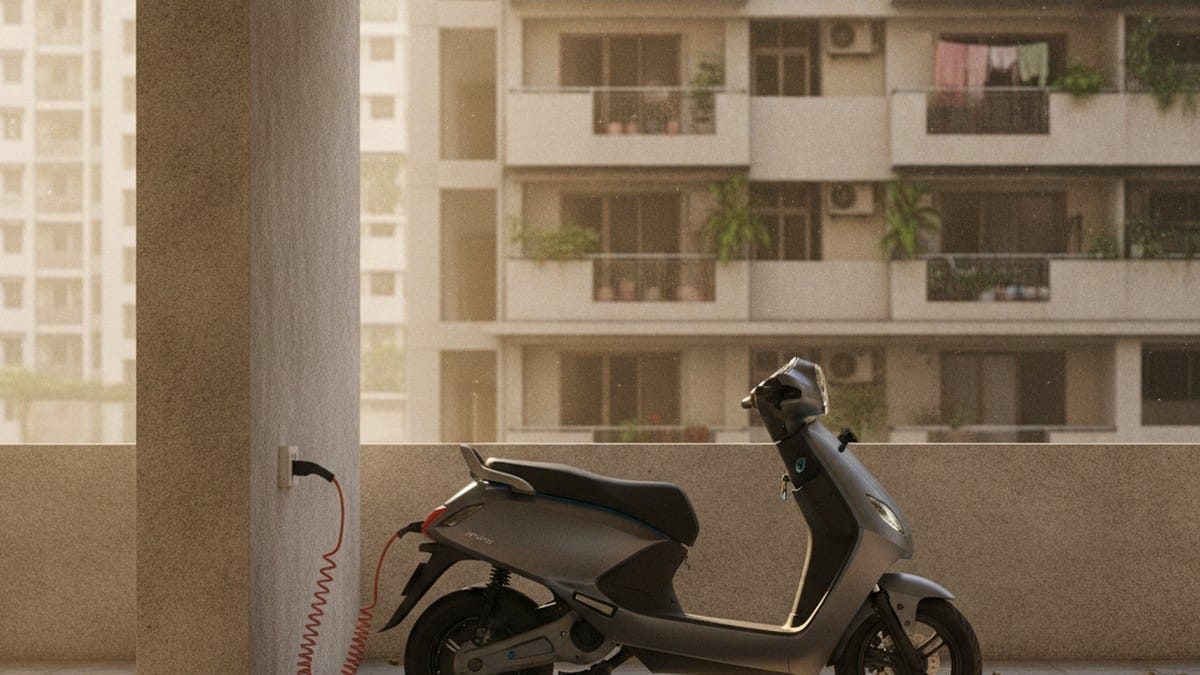
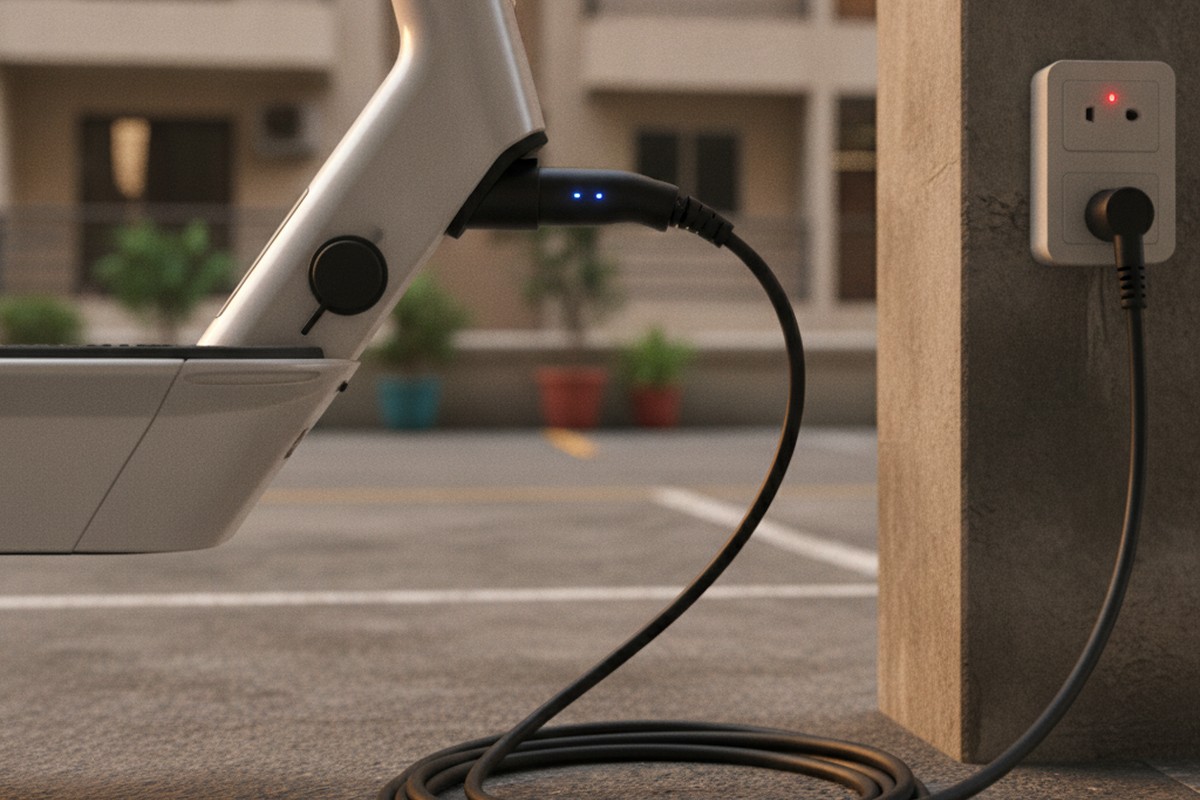
The first practical reality: virtually every electric scooter sold in India today comes with a portable AC charger that plugs into a standard 15A socket — the same three-pin heavy socket your geyser or split-unit air conditioner uses. Not the small 5A sockets scattered around your rooms. The 15A type.
Running a scooter charger through an undersized 5A outlet is a genuine safety risk. The charger draws more current than the socket can handle, and sustained overloading is how electrical fires start. If your parking area already has a 15A socket — which many buildings constructed in the last decade do, often for air-conditioning units in stilt parking — you can begin charging immediately, without any additional installation.
If no 15A socket is accessible near your scooter, you have two practical options. Either have a licensed electrician run a dedicated 15A circuit from your flat’s distribution board — typically a one-day job that costs ₹2,000 to ₹5,000 depending on the cable run length — or use a heavy-duty 15A extension lead (available for ₹800 to ₹1,500) to reach an existing socket. Never substitute a standard thin extension cord; those are rated for 5A loads and create an overloading hazard.
The Housing Society Problem — And Your Legal Rights
This is where apartment buyers get the most anxious. The honest truth is that India’s housing societies have been inconsistent about EV charging — some forward-thinking, many obstructive, and a large number simply waiting for someone to force the issue.
The regulatory picture has been improving. The Ministry of Housing and Urban Affairs requires new residential buildings to allocate 20% of parking slots for EV charging infrastructure. The Bombay High Court has established clearly that cooperative housing societies cannot unreasonably deny a resident’s application to install an EV charger — particularly when the resident is willing to follow safety requirements and bear the installation cost. Maharashtra has codified this further: once a resident completes the proper approval process and obtains clearance from the Chief Electrical Inspector, the society must issue a No Objection Certificate within seven days.
In practice, the route is: make a formal written request to your RWA or managing committee, arrange for licensed electrical work (not informal contractors), agree to separate metering so your charging consumption isn’t billed to common electricity accounts, and comply with the safety requirements around earthing, RCD protection, and fire clearance distances. A society that continues to refuse despite proper compliance has increasingly limited legal standing — and courts have been clear about that.
For those evaluating new apartment purchases: EV-ready parking infrastructure, or at minimum a cooperative management committee, is now a legitimate factor worth asking about during site visits. It will matter the moment you decide to go electric.
What Does Home Charging Actually Cost?
This is where the maths becomes genuinely persuasive. Residential electricity in Indian cities runs between ₹6 and ₹10 per unit (kWh) for most domestic consumers, varying by state and consumption slab.
Most electric scooters in the 80–100 km range carry batteries of 2 to 3.5 kWh. A complete charge costs between ₹12 and ₹35 at home — a fraction of what 100cc petrol scooters consume to cover similar distances. For a typical commuter riding 40 km daily, three to four charges per week at ₹15–₹25 each adds up to roughly ₹200–₹400 a month in electricity. The same kilometres on a petrol scooter cost ₹1,500 to ₹2,500 at current fuel prices, conservatively.
Rates vary by state — Delhi around ₹4.50 per unit, Karnataka’s BESCOM at ₹4.50 for EV tariffs, Uttar Pradesh at ₹7.70, Tamil Nadu between ₹6 and ₹9. Across all, the cost advantage over petrol remains enormous.
How Long Does a Full Charge Actually Take?
Charging time is determined by battery size and the charger’s output wattage. This varies considerably across the market, and it matters for buyers who come home in the evening and need to leave early.
The Ola S1 Pro, with its large battery, takes around 6.5 hours for a complete home charge. The Ather 450X is approximately 5 hours. TVS iQube’s larger variant gets under 3 hours with its 1500W charger. These are meaningful differences if you have a limited window between arriving home and needing the scooter again.
Overnight charging on a modern scooter is safe without qualification. Every electric scooter sold through legitimate channels in India today includes a Battery Management System that automatically stops the charge once the battery is full. Leaving your scooter plugged in overnight will not overcharge the cells or create a hazard — provided the socket itself is in sound condition and you are using the manufacturer-supplied charger, not a third-party substitute.
Choosing a Scooter With Home Charging in Mind
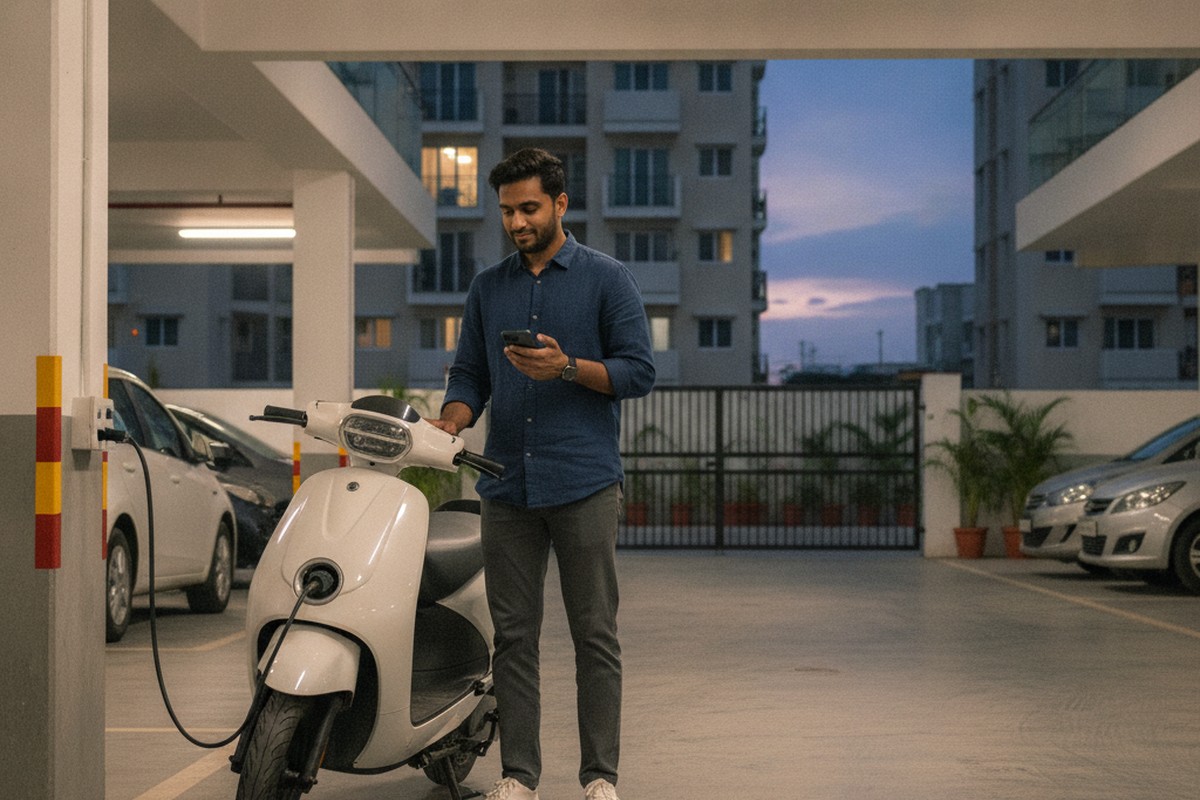
Once you understand home charging realities, you start evaluating scooters differently. The relevant questions are not just about range and price — they include: does this scooter charge from a standard socket, or does it require a proprietary wall box that adds installation cost and complexity? How long does a full charge take at home? And what battery warranty is the manufacturer offering?
Some brands — Ather with its Grid, Ola with its Hypercharger network — have invested in proprietary public fast-charging stations. These are useful for occasional top-ups but irrelevant to daily home charging. For that routine reality, what matters is standard socket compatibility, manageable overnight charge time, and a battery that handles years of charge cycles reliably.
Why Elektree Is Worth a Hard Look for Home Chargers
Elektree India has built its scooter range around exactly the buyer profile that characterises the Indian urban and semi-urban market: daily commuting, home charging from a standard socket, and a strong emphasis on keeping the cost of ownership predictable.
Their flagship Zenith, priced at ₹90,164, runs on a 60V lithium-ion battery and delivers 80 to 100 km per charge in normal conditions — comfortably covering typical Indian daily commute patterns. It charges in 4 to 5 hours from a standard 15A socket, making an overnight charge completely straightforward. No wall box required. No proprietary charger hardware. No dependency on a brand-specific public network. Wherever there is a functioning 15A socket — at home, at an office car park, at a relative’s house — the Zenith can charge.
The Elektree Wheels, at ₹82,871, is designed for urban commuting up to 70 km. Its smaller battery charges faster than the Zenith — useful when your evening-to-morning window is tight. Both models are ICAT certified, carry a three-year lithium-ion battery warranty, and do not require a driving licence under current regulations.
The per-charge cost on Elektree’s models is notably low precisely because the batteries are sized for actual commuting requirements rather than headline range numbers. You are not paying to charge a 5 kWh pack when your daily route uses 2 kWh — a difference that compounds across every electricity bill.
The Bottom Line for Apartment Buyers
Home charging for electric scooters is genuinely practical for the large majority of Indian apartment and housing society residents — even in buildings that have not yet formally adopted EV policies. The infrastructure requirements are modest: a 15A socket, either already in place or installable for a few thousand rupees; an RWA that can be approached with proper documentation and, increasingly, legal backing if unreasonably obstructive; and an overnight charging habit that becomes entirely natural within the first week.
Where the scooter choice matters is in making that daily routine as frictionless as possible. A scooter with a right-sized battery, standard socket compatibility, a reasonable home charging time, and a solid battery warranty removes the friction rather than adding to it. Elektree’s range — the Zenith and the Wheels in particular — checks those boxes at prices that fit what most Indian household budgets are actually working with.
If you are seriously considering an electric scooter and home charging simplicity is on your list of requirements, the Elektree lineup is worth evaluating directly. You can explore their current models, specifications, and pricing at elektree.com.