Every year, millions of Indian women buy a scooter. Not because a specification sheet convinced them, but because they need to get somewhere — reliably, safely, and without burning through money at the petrol pump. The decision, in 2026, increasingly points toward electric.
India’s electric two-wheeler market delivered over 2 lakh units in July 2026 alone — a jump of nearly 56% year-on-year. Women represent a significant and growing share of that buyer pool, and for good reason: an electric scooter removes the gear-shifting anxiety, eliminates the petrol queue, and offers a genuinely lower cost of daily commuting. All-electric, all-automatic, and all yours to plug in overnight.
But the conversation around electric scooters for women in India tends to go wrong in the same direction every time. It focuses on peak top speed, headline range numbers, and glossy touchscreens rather than what most women buyers actually care about when they are trying to get to work, pick up groceries, or thread through the organised chaos of an Indian city road. This guide is different.
Weight: The Feature Nobody Puts in the Headline

Ask a first-time electric scooter buyer what spec matters most and they will say range. Ask someone who has owned one for six months and, nine times out of ten, they will say weight.
In Indian cities, your scooter spends almost as much time being pushed, balanced, and parked as it does moving. Apartment basement parking with a tight turning radius. Narrow lanes and shared driveways. Pavement kerbs that require lifting the front wheel. The moment you need to manoeuvre a 120-kg machine on your own — up a ramp, backward into a spot, or out of a crowded parking row — the claimed range printed on the brochure becomes very irrelevant very quickly.
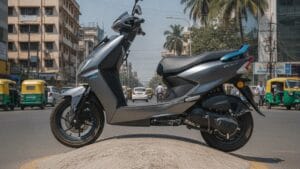
The mainstream market has not done women any favours here. The Bajaj Chetak — built with an all-metal body for durability — tips the scales at around 119 kg. TVS iQube ranges from 110 to 118 kg across its variant lineup. The Ola S1 is heavier still. These are solid, capable machines, but they were not designed with lighter-framed riders or parking ease as a primary concern.
This is where Elektree’s Zenith stands apart in a way that is easy to overlook. At 75 kg, it is meaningfully lighter than every major mainstream competitor. That 40 to 45 kg difference is not just a number on a spec sheet — it is the difference between a scooter you handle confidently and one you fight with every time you leave the house.
How Much Range Do You Actually Need?
The range anxiety conversation in India has been dominated by premium products advertising 150 to 200 km figures. What gets lost in that conversation is that the average Indian urban commute — for college students, office-goers, and daily errand runners — sits comfortably between 25 and 45 km per day. Occasionally more, but rarely close to 100 km on an ordinary weekday.
On that basis, a scooter with 80 to 100 km of real-world range is not just adequate — it is comfortable. You can complete two full days of typical urban commuting before reaching for the charger, which means you charge every other evening rather than every single night.
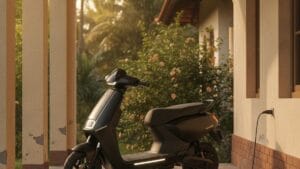
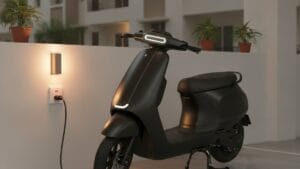
The Elektree Zenith delivers exactly this. Its 60V/35Ah lithium battery is certified for 80 to 100 km per charge under standard conditions. The scooter charges fully in 4 to 5 hours, which means plugging in before bed consistently delivers a full charge by morning — no mental calculations, no stopping at public charging stations, no detours.
For women in smaller cities and towns, where public charging infrastructure remains genuinely sparse, home charging is not a convenience — it is the feature that makes electric ownership practical in the first place.
The Real Cost of Charging at Home
Charging economics matter too. The Zenith carries a 2.1 kWh battery. At current residential electricity rates of roughly ₹7 to 8 per unit across most Indian states, a full charge costs approximately ₹15 to 18. For 80 to 100 km of riding. Compare that to a typical 110cc petrol scooter, which might cover 55 to 60 km per litre at today’s fuel prices — meaning the same 80 to 100 km trip costs ₹130 to 160 in petrol. The electric advantage compounds over a year into annual savings of ₹15,000 to 25,000 depending on your mileage.
Safety and Confidence Features That Actually Matter
Beyond weight and range, practical safety features matter more to daily women riders than to almost any other buyer segment.
Reverse mode is one such feature. Being able to reverse the scooter electrically — rather than pushing a heavy machine backward through a tight parking space — sounds like a small thing until you have tried it without one. The Zenith includes reverse mode as standard.
GPS tracking and an anti-theft alarm system are equally significant. Scooter theft is a persistent concern in Indian cities, and leaving a scooter parked outside a college gate, office building, or market for hours carries real risk. The Zenith includes both GPS location tracking and an anti-theft alarm that activates on unauthorised movement.
Front disc braking and a front telescopic suspension setup contribute to confident stopping on roads that rarely match the smoothness shown in manufacturer videos. Three riding modes — Hyper, Normal, and Eco — let you calibrate the throttle response to your mood, your road conditions, and your battery level. The 15.5 cm digital instrument cluster gives you a clear read on speed, range, and charge status without requiring a smartphone.
How Elektree Compares Against the Mainstream Options
At ₹90,164, the Zenith sits in a competitive price range. TVS iQube’s base variant starts at ₹94,434 but offers a modest 94 km certified range on its entry battery. Bajaj Chetak’s entry-level starts at ₹91,399, delivers 113 km claimed range, but weighs nearly 119 kg and carries a lower top speed ceiling. Neither includes reverse mode, GPS, or anti-theft as standard across the entry variants.
The Ather Rizta, positioned as a family-focused scooter starting at ₹1,21,499, offers excellent storage and pillion comfort but costs significantly more. If your commute is solo and budget is a genuine constraint, the premium over the Zenith needs to be justified by genuine usage of those additional features.
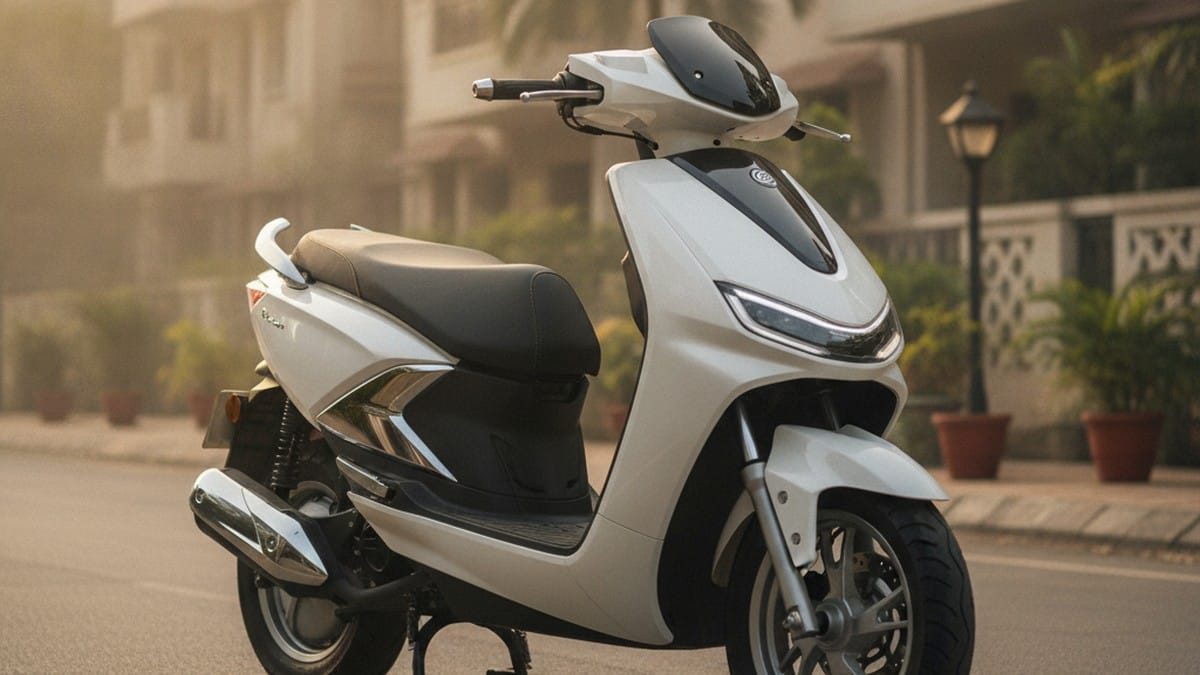
The Elektree Zenith at ₹90,164 delivers 80 to 100 km range, GPS, anti-theft, reverse mode, three riding modes, front disc brakes, a 15.5 cm display, and a kerb weight of 75 kg — a combination that is difficult to replicate at this price point from any mainstream Indian manufacturer. For riders whose daily travel is even shorter and whose priority is the most affordable and lightest electric option, Elektree also offers the Wheels at ₹82,871 — with 50 to 70 km range suited to slower urban movement.
Ownership Confidence: Warranty and Certification
For a first-time EV buyer, knowing the manufacturer stands behind the product matters as much as the product itself. Elektree backs the Zenith’s battery with a 3-year and 50,000 km warranty — a meaningful guarantee for buyers concerned about long-term battery health, which is often the single largest post-purchase expense an EV owner faces.
The Zenith carries ICAT (International Centre for Automotive Technology) certification, confirming it has been independently tested to meet India’s prescribed performance and safety standards. This matters not only for confidence in the product but also for insurance validity and, in many states, for government subsidy eligibility.
The broader Elektree approach, evident across their product lineup, is one of practical engineering for Indian conditions — matching range to real commuting distances, weight to the reality of Indian parking, and price to the reach of the buyers who need this transition most.
The Bottom Line
India’s electric scooter market in 2026 is the strongest it has ever been, and for women buyers, the options have genuinely improved. But choosing the right scooter comes down to matching the machine to your actual life — not to a brochure designed to win a spec comparison table.
If what matters to you is a lightweight scooter that is genuinely easy to handle, with enough range to cover two to three days of Indian urban commuting without drama, home charging that costs less than a Swiggy order, and practical safety features at a price that stays under ₹1 lakh — the Elektree Zenith is a serious contender that deserves to be at the top of your shortlist.
It is not trying to be the fastest electric scooter in India, or the one with the most impressively lit dashboard. It is trying to be the most useful one for the way most Indian women actually use a scooter — every single day, in every kind of weather, on every kind of road. On that measure, it succeeds convincingly.
Explore the full Elektree India range, including the Zenith and the Fantom EV, at elektree.com.