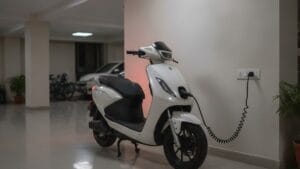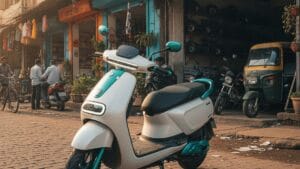
Ask any Zomato or Swiggy delivery partner about their biggest monthly expense, and the answer almost always comes down to one thing: petrol. Not the bike EMI, not the phone bill — petrol. For someone logging 80 to 120 kilometres on a daily shift across Indian city roads, fuel costs are eating straight into earnings. And with petrol sitting comfortably above ₹100 per litre across most Indian cities, that monthly damage adds up fast.
The arithmetic is not kind. A delivery rider covering 100 kilometres a day on a 125cc petrol scooter — assuming 45 km per litre at current prices around ₹107 per litre — burns through roughly ₹240 before a single order is delivered. Over 26 working days a month, you’re looking at ₹6,000–₹6,200 just on petrol. This is why the conversation around electric two-wheelers has stopped being theoretical for India’s gig workforce. For thousands of Zomato, Swiggy, Blinkit, Zepto, and courier riders, it has become a very practical financial question: can switching to electric actually put more money in my pocket every month?
The honest answer is yes — if you choose the right vehicle.
What Delivery Riders Actually Need from an Electric Two-Wheeler
Before comparing models, it’s worth being clear about what actually matters in this use case, because it’s meaningfully different from what a regular office commuter needs.
A daily commuter doing 30–40 kilometres round-trip has a lot of margin for error in range. A delivery rider doing 100+ kilometres in a single shift does not. The most common mistake people make when considering electric for commercial use is underestimating the real daily demand and then regretting it when they’re stuck with a dead scooter mid-afternoon with three orders pending.
The key requirements for any electric scooter suited to delivery work in India come down to four things. First, range: you need genuine, real-world range of at least 80–100 kilometres on a full charge — and ideally more, because manufacturers’ claimed range figures and real-world range on stop-start city routes under load are rarely the same number. Second, reliability and build quality: a vehicle that breaks down means lost income, not just inconvenience. Third, charging logistics: you need to be able to charge at home overnight without drama, and ideally complete a charge before your next shift. Fourth, total running cost: the entire point of going electric is that the fuel bill becomes tiny — but you need to verify that the numbers actually work at your daily mileage.
Now let’s look at how the market currently shapes up and where genuine value lies.
The Numbers That Should Make Every Delivery Rider Stop and Think
A delivery rider covering 2,500 kilometres a month — roughly 85 kilometres per day over 30 days — spends approximately ₹5,500–₹6,000 on petrol at current prices. The same distance on an electric scooter, charged at home on a standard residential electricity tariff of ₹6–₹8 per unit, costs somewhere between ₹650 and ₹900 per month depending on the battery size and local electricity rate.
That’s a monthly saving in the range of ₹4,700–₹5,200 — just from fuel. Not including lower maintenance costs (no engine oil, no oil filter, no spark plugs, fewer moving parts overall). Add that in, and the monthly saving versus a petrol scooter can comfortably cross ₹5,500 for a heavy-use delivery rider.
At that rate of saving, the right electric vehicle can pay for itself through fuel savings alone within two to three years — after which every month is straight-up additional take-home. For someone living on gig income, that’s a meaningful improvement in financial security, not just a lifestyle upgrade.
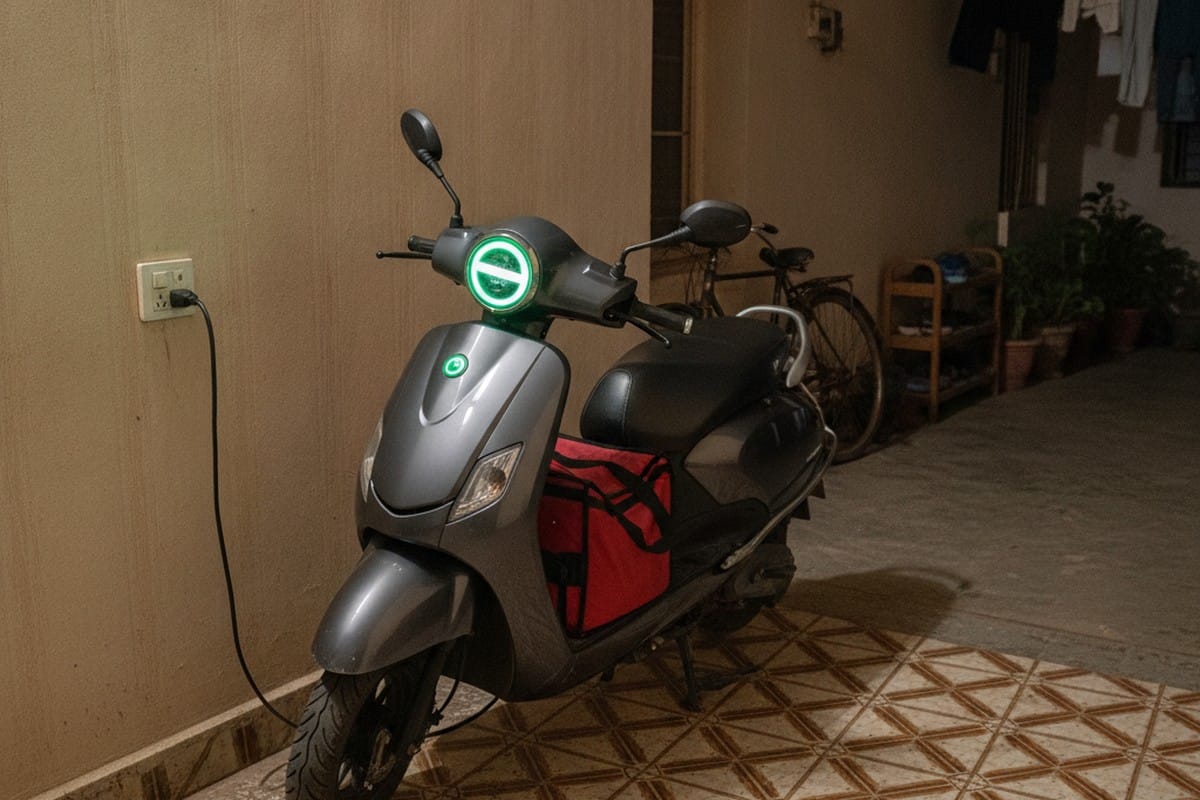
What to Watch Out For in the ₹80,000–₹1.15 Lakh Electric Segment
Several brands have launched electric scooters that look attractive on paper in the delivery use case, but carry important caveats.
The TVS iQube (with the iQube S currently around ₹1.65 lakh) is widely considered one of the most reliable electric scooters in the country, with a vast TVS service network — a genuine advantage when something goes wrong. The Vida VX2 from Hero MotoCorp enters more aggressively on price, though Hero’s electric service network is still catching up to its petrol counterpart. Ola Electric’s scooters generate attention on range numbers, but real-world owner feedback on after-sales service has been variable — and for a delivery rider dependent on their vehicle every single working day, that variability matters.
For commercial use, the warranty question is also worth investigating. Many manufacturers specify that warranty terms apply to personal rather than commercial use. Verify this explicitly before purchasing any electric scooter for full-time delivery work.
Why Elektree India Deserves Serious Attention in This Conversation
Elektree India makes electric scooters and motorcycles that are built around a straightforward philosophy: practical performance, honest pricing, and engineering that respects what Indian riders actually need from a two-wheeler every day.
For delivery riders, two models in the Elektree lineup deserve close attention.
The Elektree Zenith and the Elektree RV 80 — priced at ₹90,164 and ₹94,363 respectively — offer a claimed range of 80–100 kilometres on a full charge with a top speed of 60 km/h. For riders on shorter urban routes, morning-to-early-afternoon shifts, or those with access to a charge point mid-shift, these scooters represent an accessible entry point into electric delivery with a lower upfront investment.
But the product in the Elektree range that is most compelling for serious, high-mileage delivery work is the Fantom EV.
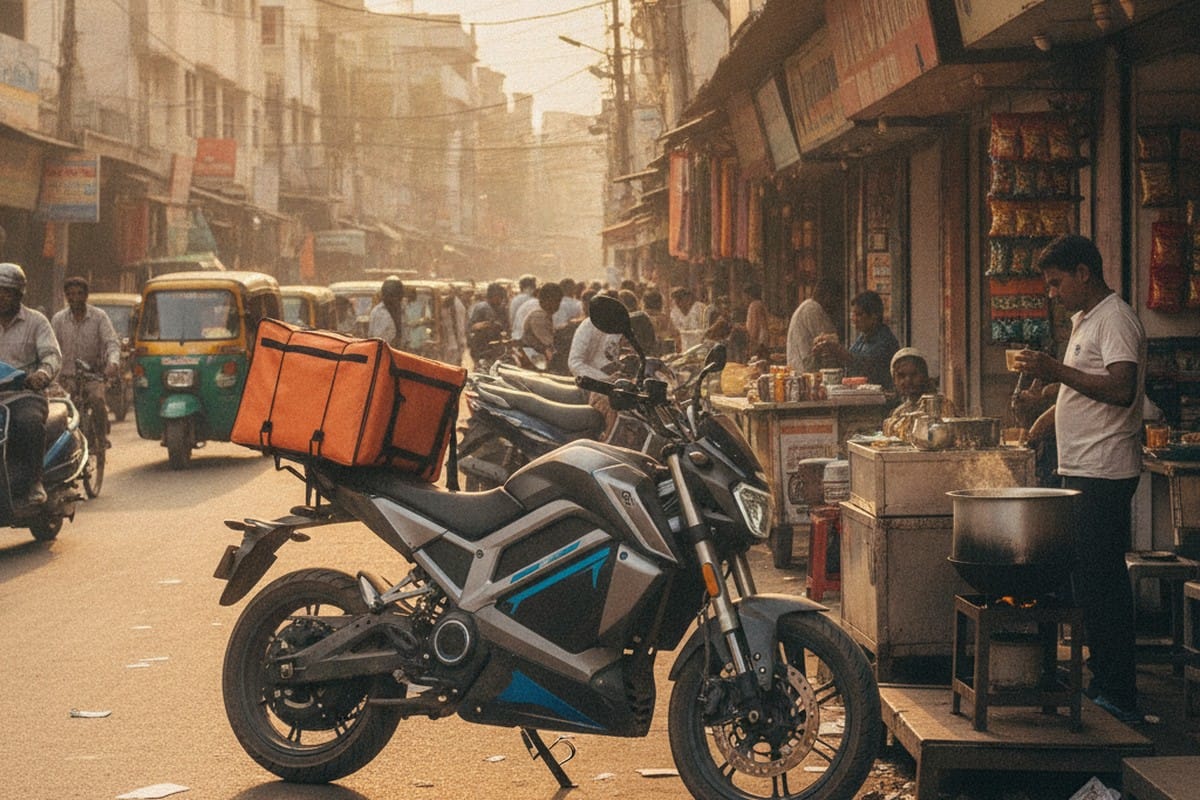
The Fantom EV: Built for Riders Who Actually Work Their Vehicles
At ₹1,39,000, the Elektree Fantom EV is the brand’s flagship and sits firmly in the electric motorcycle category. The specs tell a practical story: a claimed range of 150–180 kilometres per charge, a top speed of 110 km/h, and a large 72V/45Ah battery (with a 72V/55Ah option for even greater range). That’s real-world range that comfortably covers even the heaviest delivery shift — 100+ kilometres with meaningful headroom to spare.
Think about what that means operationally. You charge overnight. You start your shift with a full battery. You ride hard all day through city traffic, handle 25–35 deliveries, and still have reserve left when you get home. No mid-shift scramble for a charging point, no anxiety about whether you can accept that last order at the edge of your zone.
The 110 km/h top speed is more than adequate for urban and semi-urban riding — and the higher-voltage 72V battery system generally delivers more stable performance under sustained demand than the 60V systems found in many budget scooters, and tends to degrade more gracefully over time under the repeated charge-discharge cycles that delivery use demands.
And across the entire Elektree range, the brand backs its products with a 3-year warranty — a statement of confidence in the engineering that not every electric two-wheeler manufacturer in this price range is willing to make.
Running the Numbers on the Fantom EV for Delivery Work
Take a rider doing 100 kilometres daily, 25 working days a month. On petrol at current prices, that’s approximately ₹5,700–₹6,000 per month in fuel. On the Fantom EV, charging its 72V/45Ah battery (around 3.24 kWh) costs roughly ₹20–₹26 per full charge at standard residential electricity tariffs. That’s a monthly electricity bill of ₹350–₹500 even for heavy daily use — a saving of well over ₹5,000 every single month. At that rate, the additional cost of the Fantom EV over a typical entry-level petrol bike recovers in under two years from fuel savings alone. After that, every month is money in your pocket, not the fuel pump’s.
The Verdict for India’s Delivery Riders
Switching to electric isn’t the right move for everyone. If your zone has unreliable electricity supply, you can’t charge at home, or the upfront investment is a stretch right now, be honest about those constraints before committing.
But if you’re a delivery rider with stable home charging access, clocking 80–120 kilometres a day, currently spending ₹5,000–₹6,500 a month on petrol — the financial case for switching is now stronger than it has ever been. And among the electric options worth serious consideration, the Elektree Fantom EV stands out: genuinely capable range, a high-voltage battery system built for demanding use, and pricing that makes the payback timeline realistic rather than theoretical.
For riders doing lighter routes or wanting a lower initial outlay, the Elektree Zenith or RV 80 offer a smart middle ground — enough range for moderate delivery work, solid build quality, and the same 3-year warranty backing.
Petrol prices aren’t going down. Your margins from gig work aren’t going up on their own. The electric option has matured to the point where this is a decision worth making — not someday, but now.
Explore the full Elektree India range, including the Fantom EV and the Zenith series, at elektree.com — and do the maths with your own monthly mileage. The numbers are likely to surprise you.