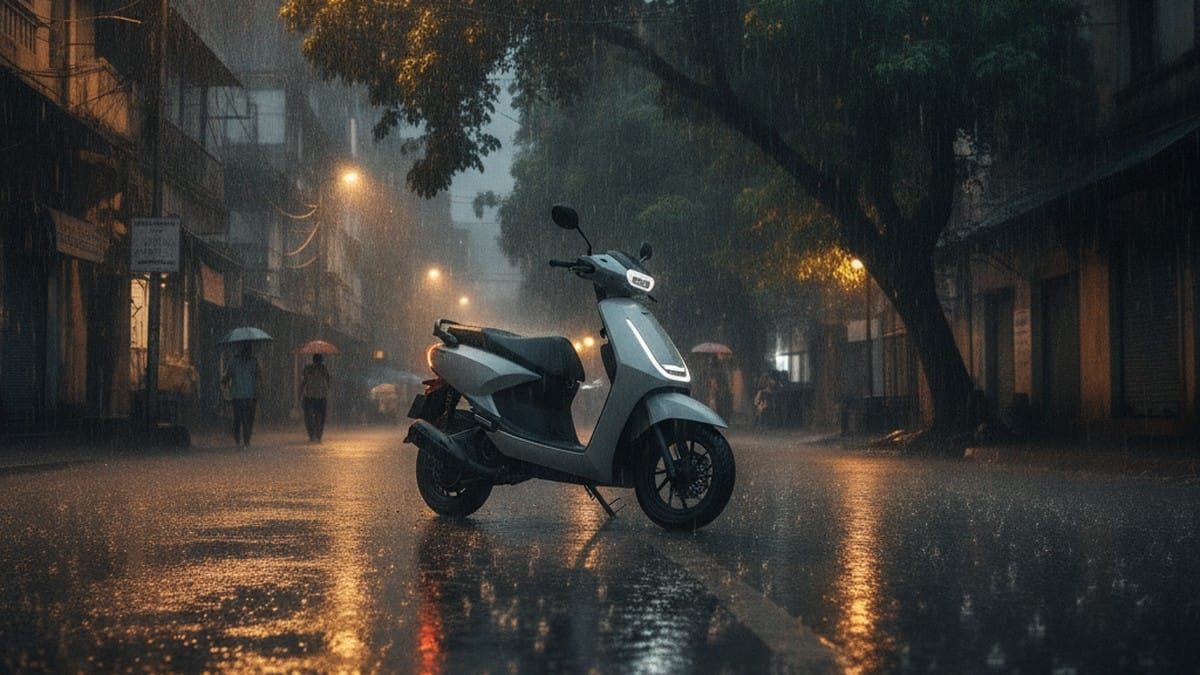
Every July, a familiar anxiety returns for Indian EV owners. The sky darkens, the first heavy showers arrive, and somewhere at the back of your mind sits a quiet, nagging question: is my electric scooter actually safe to ride in this?
It’s a fair concern. You’ve spent anywhere between ₹80,000 and ₹1.5 lakh on a vehicle powered by a lithium-ion battery and a bundle of electronics. The idea of riding through a waterlogged stretch near your office, or getting caught in a sudden downpour on the highway, feels genuinely risky if nobody has given you a straight answer about what your scooter can and cannot handle.
Here’s that straight answer — along with the specifications that actually determine whether your electric scooter survives an Indian monsoon.
The Fear Is Reasonable. But Most of It Is Misdirected.
Let’s start with the biggest myth: that riding an electric scooter in rain is inherently dangerous because “water and electricity don’t mix.” That framing, while instinctively sensible, misunderstands how modern electric scooters are engineered.
Every electric scooter sold in India must meet AIS-156 safety standards, which include a minimum level of protection for electrical components. Your battery pack, motor, and controller are not sitting exposed in the rain. They’re housed in sealed enclosures specifically rated to resist moisture intrusion. The system is designed to be ridden outdoors — including in rain.
The danger isn’t rain itself. The danger is excessive water depth, and this is where the specifications start to matter.

IP Ratings: What the Number Actually Means
If you’ve been scooter shopping, you’ve likely seen the letters “IP” followed by two digits — IP65, IP67, IP68. This is the Ingress Protection rating, and it tells you how well the enclosure around your battery or motor resists dust and water.
The first digit (0 to 6) is about dust. The second digit (0 to 9) is about water. Most electric scooters sold in India carry an IP67 rating for their battery pack — which means the battery is completely dust-tight and can survive being submerged in up to one metre of water for thirty minutes under controlled lab conditions.
IP67 sounds reassuring. And under normal monsoon conditions — riding through rain, splashing through puddles — it genuinely is. The Ather 450X uses IP67 for its battery with IP66 on the motor. The TVS iQube carries IP67 ratings on both its motor and battery. The Ola S1 Pro’s battery is IP67-rated as well.
But here’s the critical caveat that showroom staff rarely mention: IP ratings are tested on new, factory-sealed units. After 18 to 36 months of real-world use, road vibrations, thermal cycling, and connector wear will degrade those seals to some degree. Your three-year-old scooter is not as water-resistant as the day you bought it. This isn’t a flaw specific to any brand — it’s physics. Which is why post-monsoon maintenance matters just as much as the IP rating on the spec sheet.
The Spec That Matters More Than IP Rating: Ground Clearance
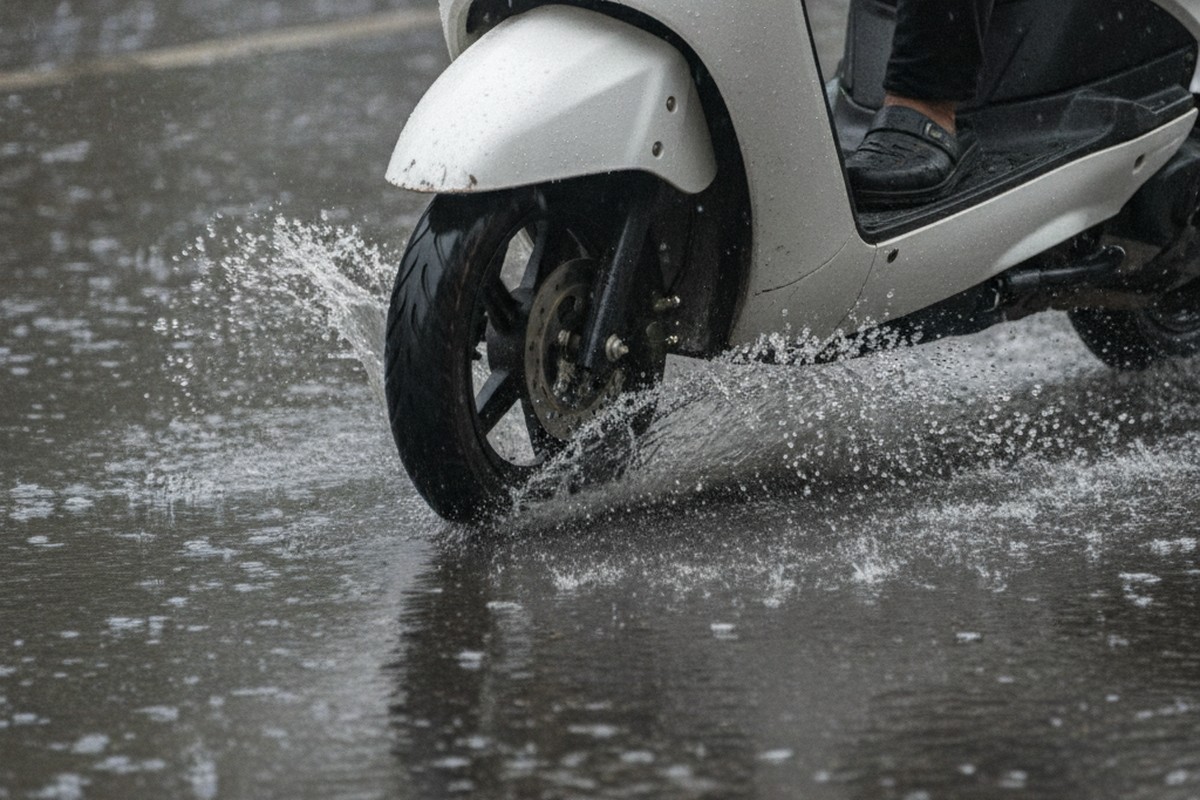
India’s monsoon roads don’t respect engineering tolerances. A waterlogged underpass in Chennai during the northeast monsoon, or a flooded lane in Mumbai after three hours of continuous rain, can easily reach 150 to 200 millimetres of standing water — sometimes more. At that depth, your IP rating is secondary. What keeps your scooter safe is whether the body, the battery enclosure, and the critical electrical components clear the water surface entirely.
That’s what ground clearance determines.
Here’s how the popular electric scooters in India compare on this critical dimension:
- Ather 450X: 170 mm ground clearance, 300 mm water wading capacity
- Ola S1 Pro: 160 mm ground clearance (water wading not officially specified)
- TVS iQube: 157 mm ground clearance, 150 mm water wading capacity
The TVS iQube’s 150mm wading limit effectively means it’s rated to handle water up to its own ground clearance — which is not a lot of headroom on a bad monsoon day. The Ola S1 Pro’s 160mm clearance is marginal. The Ather 450X, with 170mm clearance and a 300mm wading specification, offers considerably more confidence.
Practically speaking, the industry guideline is simple: if the water level exceeds roughly half your wheel height, take an alternate route. No IP rating, no wading specification, and no amount of brand confidence should convince you otherwise.
What Else Happens During Monsoon Riding?
Water depth aside, monsoon riding introduces two other challenges that have nothing to do with your battery: traction and visibility.
Wet tarmac — especially on painted road markings, metal covers, and polished stone surfaces — reduces grip significantly. Electric scooters deliver torque instantly when you twist the throttle, which means aggressive acceleration on a wet surface sends the rear wheel skating before your brain can compensate. The correction is simple: be smoother than you’d normally be. Gentle throttle inputs, earlier braking, and wider following distances.
Braking on wet roads also takes longer. Disc brakes perform considerably better in the wet than drum brakes, which is worth keeping in mind both as a safety consideration and as a buying criterion. Most quality electric scooters now come with front disc brakes as standard, though budget models may still use drums.
After a heavy rain session, a few minutes of basic maintenance go a long way. Wipe down the charging port area and battery compartment access points before plugging in. Check your tyres for embedded debris. If you’ve ridden through particularly deep or dirty water, a brief inspection of your brake pads is worth the two minutes it takes.
Where Elektree Fits Into This Picture
When you’re evaluating electric scooters against the specific demands of Indian monsoon conditions, ground clearance stops being a secondary specification and becomes a primary buying criterion. And this is where the Elektree Zenith makes a compelling case.
The Zenith carries a ground clearance of 180 millimetres — higher than the Ather 450X (170mm), the Ola S1 Pro (160mm), and the TVS iQube (157mm). On paper, 10 to 23 millimetres sounds like a minor difference. On a waterlogged road in September, it’s the difference between clearing a flooded stretch safely and gambling with your battery enclosure and motor seals.
This isn’t marketing arithmetic. Higher ground clearance means the critical undercarriage components — battery housing, wiring looms, connector points — are kept further from the water surface as you ride through standing water. Combined with ICAT certification (India’s official automotive testing authority), the Zenith is built to handle the kind of roads Indian riders actually encounter, not just the smooth test tracks that lab ratings are measured on.
The Zenith’s pricing also makes this a less tortured decision than it might seem. At ₹90,164 starting, it sits meaningfully below the Ather 450X (₹1,53,554) and even below the TVS iQube’s upper variants (₹1,19,250 and above), while offering ground clearance that beats both. The Elektree RV 80 Sportz, at ₹94,363, offers similar specifications with a sportier build, while the Wheels Sportz at ₹82,871 caters to riders who don’t need a full driving licence and cover shorter daily distances.
For all three Elektree scooters, the three-year battery warranty covering up to 50,000 kilometres is a meaningful commitment. Battery warranty claims are one of the post-monsoon concerns that tends to surface — owners worry about whether accumulated moisture exposure has degraded their pack. A solid warranty backstops that anxiety.
Basic Monsoon Maintenance That Makes a Real Difference
Regardless of which scooter you own, get it serviced before the monsoon, not after. Have a technician check connector seals, brake pads, and battery enclosure integrity. Check your tyre tread — anything under 3mm on a wet road is genuinely risky on an electric scooter, which delivers instant torque. Ensure your charging port cover closes fully and the rubber seal is intact. And no specification sheet can tell you whether a particular underpass has 80mm or 250mm of standing water — that call is always yours.
The Bottom Line for Indian Riders
Electric scooters are not inherently vulnerable to Indian monsoons. They’re engineered with sealed systems specifically to handle rain. The real risks — waterlogging beyond wading capacity, degraded wet-road traction, and post-rain connector exposure — are manageable with the right specifications and basic maintenance habits.
When you’re choosing a scooter with monsoon performance in mind, prioritise ground clearance alongside IP rating. And on that measure, the Elektree Zenith’s 180mm clearance stands ahead of most mainstream competitors at a price that doesn’t require you to stretch your budget to the upper end of the market.
If you’re in the market for an electric scooter that handles Indian roads — including Indian monsoon roads — as a primary design consideration rather than an afterthought, the Elektree lineup is worth exploring in detail. Head to elektree.com to see the full specifications and find the model that fits your daily distance, budget, and riding needs.