Electric Scooter Warranty in India 2026: What That “8-Year” Claim Actually Means (And What Most Buyers Discover Only at the Service Centre)
When you walk into an electric scooter showroom in India today, one number gets pushed at you harder than almost anything else: the warranty. Eight years! Lifetime battery coverage! Industry-first guarantee! The marketing is loud, designed to make the purchase feel risk-free.
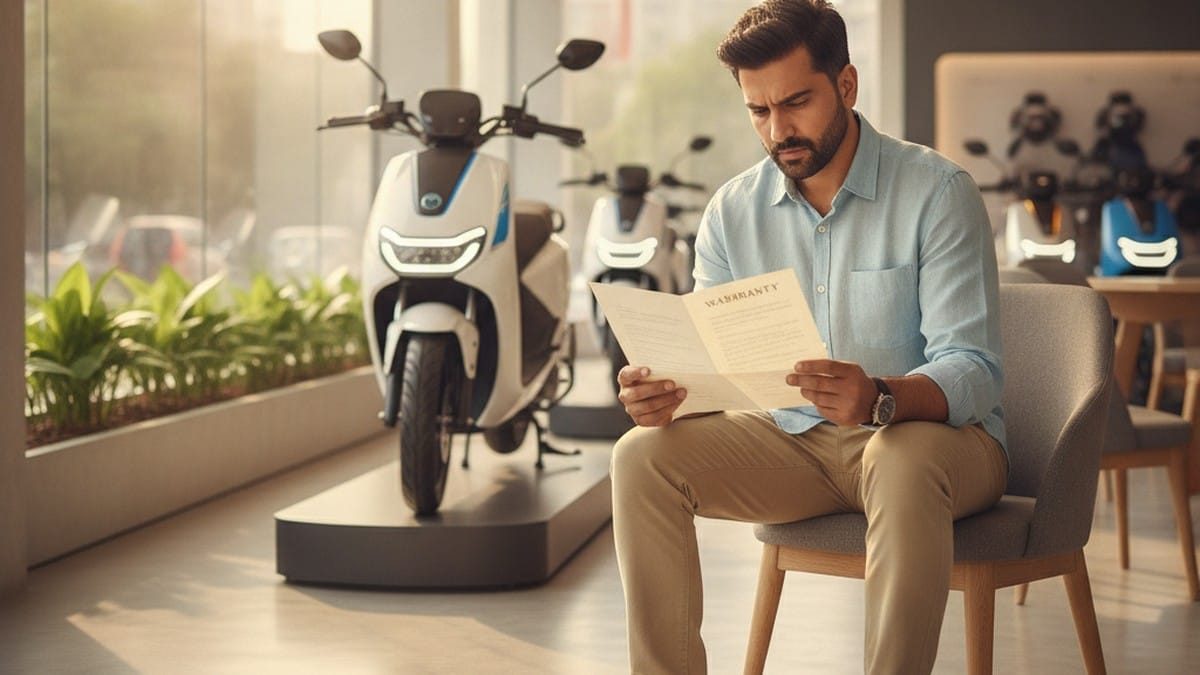
Then, a year or two later, some of those same buyers find themselves at a service centre being told their warranty doesn’t cover what they thought it did. The charger they used wasn’t approved. The service they skipped voided the terms. The range loss they’re experiencing is “normal degradation” — not a defect.
The gap between warranty as it sounds and warranty as it actually works is one of the most misunderstood parts of buying an electric scooter in India. This is what you need to know before you sign.
What a Warranty Is Actually Protecting You Against
A vehicle warranty is not insurance against everything going wrong. It’s specifically a manufacturer’s promise to fix defects in materials or workmanship — problems that existed before you took delivery or emerged because of how the product was made, not because of how it was used.
In practical terms, a warranty is most valuable in two scenarios: a component fails unexpectedly early because of a manufacturing defect, or the battery degrades far faster than it should because of a chemistry or cell quality issue. Both are relatively rare events when a manufacturer uses quality components properly assembled. Both also tend to show up within the first few years of use, not in year seven or eight.
The reason battery warranties on premium EVs often extend to eight years is not because batteries routinely fail at year six. It’s partly because the headline number helps justify a higher purchase price — and because battery degradation is a genuine long-term concern. But for most Indian riders doing a typical 20-40 km daily commute, the actual warranty risk in the first three years is quite manageable with a well-built vehicle.
The Clause That Catches Most Buyers Off Guard: The 70% SoH Floor
Every serious electric scooter warranty in India today includes what’s called a State of Health (SoH) guarantee. It sounds technical, but the concept is simple: your battery warranty is only triggered if your battery’s remaining capacity drops below 70% of its original capacity within the warranty period.
In other words, if your battery originally gave you 100 km of range and it now gives you 75 km, that’s a 25% drop — but it’s still above the 70% SoH floor, and it won’t qualify as a warranty claim. Your battery would need to be delivering less than 70 km before the manufacturer is obligated to do anything about it.
For most riders in real-world Indian conditions — heat, traffic, stop-start riding, varying charge cycles — some capacity fade over time is completely normal. The warranty kicks in only when that ageing is genuinely abnormal, not simply when the battery is getting older. An 8-year warranty sounds like 8 years of full protection. In practice, it’s a safety net for catastrophic cell failure or BMS failure — useful, but not a promise that your battery performs as new until year eight.
What Commonly Voids EV Warranties in India
This is where a lot of Indian buyers get caught out, because some of the most common habits in everyday riding are also things that void warranty coverage.
Using a non-approved charger is one of the biggest. Many riders find a cheaper third-party charger or a relative’s unit that fits the port, and use it assuming it’s fine. When a warranty claim comes up later, manufacturers check charging logs — and a non-OEM charger in the records is grounds for refusal. Use only the charger supplied with your vehicle, or one explicitly approved by the manufacturer.
Skipping scheduled service is another common problem. Most manufacturers require services at defined intervals and failing to get these done at authorized centres gives the company grounds to contest any claim. Keep every service invoice. That paper trail is your warranty’s actual backbone.
Physical damage to the battery pack, water ingress beyond the vehicle’s IP rating, and any unauthorized work on the electrical system or BMS are also standard exclusions across the industry. Commercial use — running delivery services or rentals on a privately-registered scooter — often voids coverage entirely. Many of these conditions aren’t prominently explained at the point of sale. They’re in the fine print, and most buyers read the warranty duration, not the warranty conditions.
How the Major Brands Compare in 2026
To give you a factual picture of where things stand:
Ola Electric offers 8 years or 80,000 km as standard battery coverage, with a paid extension to 8 years or 1,25,000 km for ₹14,999 plus GST. The 70% SoH floor applies after 10,000 km. Ather offers 3 years or 30,000 km as standard, extendable to 8 years or 80,000 km via their Pro Pack and Eight70 plan (₹4,999 additional). TVS iQube and Bajaj Chetak both offer 3 years or 50,000 km as base, with optional extensions to 5 years.
Elektree India offers 3 years or 30,000 km coverage on the vehicle, motor, controller, and battery pack, with 1 year on the charger. The battery warranty applies when SoH drops below 70% within that period. Conditions — approved chargers, authorized service centres, scheduled maintenance — are standard across the industry, not unique exclusions designed to catch buyers out.
The Question Worth Asking Before You Buy
Here’s what most comparison articles miss: a warranty is only as useful as the manufacturer’s ability to honour it. An 8-year battery promise from a company with limited service capacity and a backlog of unresolved claims is materially less valuable than a 3-year warranty from a manufacturer that services quickly, transparently, and within accessible reach of where you actually live.
Before you buy any electric scooter in India, ask three things: Does the nearest authorized service centre carry parts for your model and handle claims in-house? What SoH drop actually triggers a claim versus normal ageing? And what actions in your typical riding pattern — charger choices, service habits — could affect your coverage? The answers will tell you more than the headline warranty number ever will.
Why Elektree India Makes Sense for the Indian Daily Rider
Elektree India’s warranty terms are exactly what they say: three years of coverage on all major components, with clear conditions and no ambiguity about what triggers a claim. For a rider doing 30-40 km a day in an Indian city, the probability of experiencing a genuine manufacturing defect that leads to a warranty claim within that three-year window is low — particularly when the manufacturer uses proprietary battery management technology and in-house cell engineering calibrated for Indian ambient temperatures and riding patterns.
The pricing math also matters here. Elektree’s Zenith and RV 80 Sportz are priced at ₹90,164 and ₹94,363 respectively, delivering 80-100 km of real-world range per charge with a running cost of just ₹5 to ₹10 per full charge. At that cost, you’re spending roughly ₹150-300 per month on electricity for regular city commuting — a figure so low that the total cost of ownership remains genuinely competitive even when you account for standard service costs.
Elektree’s service network covers Delhi, Mumbai, Bengaluru, Hyderabad, Kolkata, and an expanding footprint in tier-2 and tier-3 cities across India. The company’s manufacturing presence in India and its focus on the specific requirements of Indian riders — summer heat, monsoon humidity, stop-start urban traffic — have shaped products built for the conditions Indian commuters actually face, not just the conditions that look good on a spec sheet.
The Smarter Way to Think About Warranty When Buying an Electric Scooter
For most Indian electric scooter buyers in 2026, the warranty decision should be secondary to asking whether the vehicle is built well enough that you won’t need to invoke it frequently. A scooter that uses quality lithium-ion cells, a well-engineered BMS, and passes proper quality control before delivery is unlikely to present manufacturing defects within three years of daily use. The three-year window covers the period when real manufacturing issues are most likely to surface — and is the period that genuinely matters for most buyers.
An eight-year warranty headline is useful — but it protects against a scenario that quality manufacturing makes uncommon. What matters far more is whether the scooter you buy doesn’t put you in a position where you need to test that protection in the first place. On that basis — build quality, Indian-road practicality, transparent warranty terms, running economy, and competitive pricing — Elektree India’s range is one of the most sensible choices available to Indian commuters right now. Visit elektree.com to see the full specifications, pricing, and warranty details for the Zenith, RV 80 Sportz, and Fantom EV, and judge the details for yourself.