Best Electric Scooter Under ₹1 Lakh in India 2026: What the Numbers Don’t Tell You
If you’re shopping for an electric scooter on a budget of ₹85,000 to ₹1 lakh, you’ve arrived at the most interesting segment of India’s EV market right now. Three years ago, you could barely find a reliable electric scooter at this price. Today you’re choosing between Hero, Ola Electric, and focused Indian manufacturers like Elektree — each offering something genuinely different. The real challenge is figuring out which one will actually serve you well two or three years from now.
The problem is that every brand throws around “claimed range” figures that have little to do with real-world Indian riding, every ad promises ₹1 per km or better, and the spec sheets look nearly identical at first glance. So what actually separates a smart ₹90,000 purchase from a regrettable one? It’s not just range or top speed — it’s about battery longevity, monthly running costs in Indian conditions, and whether the scooter was genuinely designed with an Indian buyer in mind or engineered elsewhere and adapted with minimal thought.
The Daily Math Every Buyer Should Do First
Before getting into specific models, let’s settle one number that should drive this entire decision. A typical Indian city commuter covers 30–40 km per day. At ₹106 per litre for petrol (current national average) and 45 km per litre for a 125cc scooter, that’s roughly ₹70–₹94 daily in fuel alone — close to ₹2,000–₹2,500 per month before maintenance.
An electric scooter at ₹7–₹8 per kWh (average domestic electricity rate) costs roughly ₹8–₹12 for a full charge. Your daily 30 km commute, realistically, is costing you under ₹10 in electricity. That’s ₹250–₹300 per month versus ₹2,000-plus on petrol. Over a year, the savings land somewhere between ₹20,000 and ₹30,000 — before counting reduced maintenance on fewer moving parts.
That’s the reason people are making the switch. Now let’s see which sub-₹1 lakh scooter actually delivers on that promise without creating a different set of headaches.
The Main Contenders at This Price
Ola S1 X (Base 2 kWh Variant)
Ola’s most affordable entry into the S1 X range starts at ₹84,999 ex-showroom — putting it on-road at roughly ₹96,000–₹99,000 depending on your state. The base 2 kWh pack gives a certified IDC range of 108 km, though real-world city performance is closer to 80–90 km under typical conditions. Top speed is a confident 90 km/h, and there’s a 7-inch TFT display, cruise control, and Ola’s MoveOS software. Battery warranty is 3 years / 50,000 km.
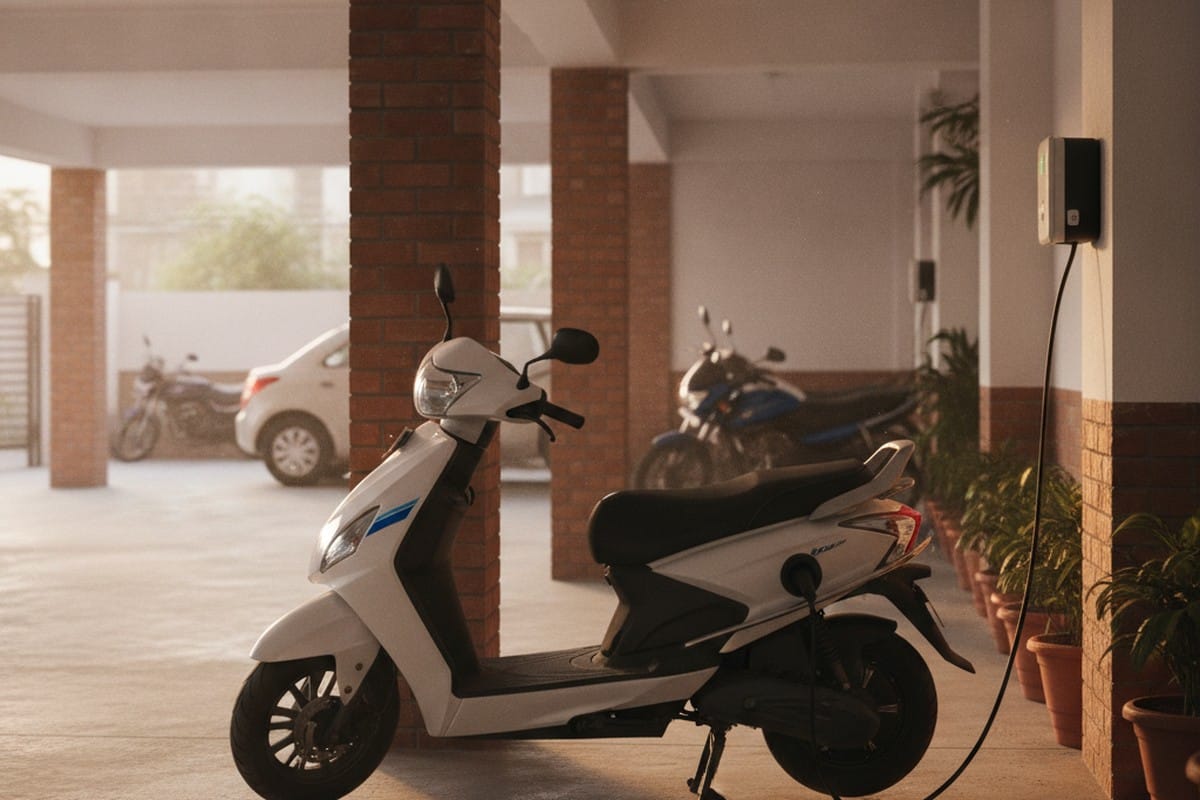
The catch with the S1 X is the fixed battery. You need a dedicated home charging point. For millions of Indians living in apartments without designated EV parking or charging access, this creates a genuine daily inconvenience — not a dealbreaker, but something you need to honestly account for before buying.
Hero Vida VX2 (Base 2.2 kWh Variant)
Hero’s Vida VX2 starts at around ₹80,077 on-road (Delhi) for the base variant and uses a 2.2 kWh removable battery delivering a real-world range of roughly 80–93 km. The removable battery is the standout feature — you can carry it upstairs and charge it from a standard socket, which is genuinely useful for apartment dwellers without dedicated EV charging infrastructure.
However, user reviews flag build quality niggles: switch quality, occasional app glitches, and plastic finishing that doesn’t feel premium relative to the asking price. Hero’s service network is vast, which is a real advantage, but the Vida’s dedicated EV service infrastructure is still maturing in many cities outside the major metros.
What Elektree Brings to the Table
This is where the conversation shifts. Elektree India manufactures a range of electric scooters priced between ₹82,000 and ₹95,000 ex-showroom, and the product philosophy is meaningfully different from Ola or Hero in ways that show up in actual Indian riding.
The Elektree Zenith, priced at ₹90,164, runs a 60V/35Ah lithium-ion pack with a 70 km/h top speed and a practical city range in the 80–100 km bracket. The scooter is ICAT certified — passing India’s Central Institute of Road Transport testing standards — and comes with a 3-year / 50,000 km battery warranty that matches the coverage Ola provides on the S1 X.
Where the Zenith genuinely pulls ahead in day-to-day Indian riding: a payload capacity of 180 kg. Many electric scooters in this segment are rated for 130–150 kg total weight. If you regularly carry groceries, a bag and an extra passenger, this headroom matters in real usage. The scooter also includes GPS tracking with an anti-theft alarm built in, front disc brakes, a reverse mode for tight parking spots, a USB charging port, and three riding modes — Hyper, Normal, and Eco — so you can trade speed for range depending on the day.
The Elektree Wheels, at ₹82,871, is the more accessible entry point with a 45 km/h top speed and a 50–70 km range — better suited for purely urban commutes, shorter daily distances, or riders who want the most affordable reliable option in the range. For buyers who want more capability without crossing the ₹1 lakh mark, the Zenith is the natural step up. The Elektree RV 80 Sportz at ₹94,363 offers a similar performance package to the Zenith with a slightly sportier design language.

The Warranty Question — More Important Than You Think
First-time EV buyers often focus on range and price. The question they don’t ask until it’s too late is: what happens to the battery in year three? The battery in your electric scooter typically accounts for 35–50% of the vehicle’s total cost. A battery degradation issue or replacement outside warranty can cost ₹20,000–₹40,000 depending on the model — wiping out a year or more of the fuel savings you switched for in the first place.
A 3-year / 50,000 km battery warranty should be a minimum standard you hold every scooter to. Both the Elektree Zenith and the Ola S1 X offer this coverage. Hero Vida’s warranty terms on the base VX2 variant are structured through an extended ownership programme that varies by plan — worth clarifying at the dealership before signing.
When two products are similarly priced and both offer comparable warranty coverage, the question shifts: which one do I trust more in everyday ownership? Which one was designed with the practical realities of Indian roads, Indian load habits, and Indian riding patterns in mind?
Running Cost: The Real Comparison
Both the Ola S1 X and the Elektree Zenith will cost you roughly the same per charge — ₹8–₹12 for a full top-up at home. Elektree’s stated figure of ₹5–₹10 per charge is consistent with what independent calculations show for a 60V/35Ah pack at Indian domestic electricity rates.
What actually changes your annual savings math isn’t the per-km electricity cost — that’s roughly equivalent across all EVs in this segment. What changes it is reliability and downtime. An electric scooter sitting at a service centre while you’re booking ride-hailing apps is not saving you money. This is where after-sales infrastructure, component quality, and part availability become genuinely important — not just marketing checkboxes. Elektree’s Indian manufacturing focus matters here: for buyers outside major metros where Ola’s and Hero’s dedicated EV service networks are still thin, local serviceability can make a real difference in ownership experience.
Who Should Buy What
If you need a fast, tech-heavy scooter with a mature software ecosystem and have reliable home charging infrastructure sorted, the Ola S1 X is a credible purchase. The 90 km/h top speed and Ola’s connected features make it the technology choice at this price.
If removable batteries matter more than performance — particularly if you’re in an apartment complex without dedicated EV charging — the Vida VX2’s base variant at ₹80,077 on-road is worth considering, though be prepared for some early ownership rough edges that Hero is still ironing out.
But if you’re looking for a scooter genuinely engineered around Indian daily riding — higher payload capacity, GPS and anti-theft as standard from the factory, ICAT certification, a 3-year battery warranty, three riding modes, and a charging cost of ₹5–₹10 per full top-up — the Elektree Zenith at ₹90,164 makes a case that is hard to argue with at this budget.
The Elektree range doesn’t try to win a spec sheet war. What it offers — particularly through the Zenith and the RV 80 Sportz — is a well-rounded, practical daily commuter designed with Indian riders in mind, backed by warranty coverage that matches the segment leader. For buyers outside the top eight metros who need something reliable rather than the flashiest screen or the highest claimed range, the Elektree lineup deserves serious consideration alongside the bigger names.
Explore the Zenith, Wheels, and RV 80 Sportz at elektree.com and compare them against your commute distance, daily load, and charging setup before making your decision. A scooter that fits your actual life is worth more than one that looks great on paper.