
Petrol Scooter vs Electric in India: The Real Monthly Cost Breakdown Every Commuter Needs to See in 2026
If you’re still filling up your scooter tank every week, here’s a number worth sitting with: petrol in Delhi crossed ₹102 per litre this year. In Mumbai and Bengaluru, it’s closer to ₹111. That Honda Activa or Jupiter you’re riding — covering a modest 1,000 kilometres a month — is quietly burning through roughly ₹2,200–₹2,500 just in fuel. Every single month. That’s before you’ve paid for the next service, the oil change, or that nagging brake shoe that needs replacing.
The question isn’t really “should I consider electric?” anymore. The question is: does switching actually add up financially, or is it just good intentions with a heavy price tag? The honest answer, based on current numbers, will probably surprise you.
First, the Petrol Reality Check
A scooter like the Honda Activa delivers around 45 km per litre under real-world city conditions — a generous estimate for stop-go traffic in Indian cities. At ₹102 per litre in Delhi, you’re spending roughly ₹2.27 for every kilometre you ride. Scale that to 1,000 km a month — fairly typical for someone commuting 30–35 km round-trip daily — and you’re looking at approximately ₹2,270 in fuel alone, every month, just in Delhi. Mumbai and Bengaluru riders are paying significantly more.
Add an annual service bill between ₹5,000 and ₹8,500, comprehensive insurance in the range of ₹3,800–₹5,500 for the first year, and the occasional consumable — tyres, brake pads, air filter — and petrol scooter ownership in 2026 costs a real-money ₹3,000–₹4,000 per month after the loan is paid off.
The Electric Equation: What a Full Charge Actually Costs
Electric scooters work on a fundamentally different cost model. Most mid-range electric scooters carry batteries between 1.5 and 2.5 kWh. Domestic electricity in India runs between ₹6 and ₹8 per unit (kWh) depending on your state and consumption slab. Factor in roughly 10% charging losses, and a full charge on a typical 2.1 kWh battery costs somewhere between ₹14 and ₹18 — less than the price of a plate of dosa in most cities.
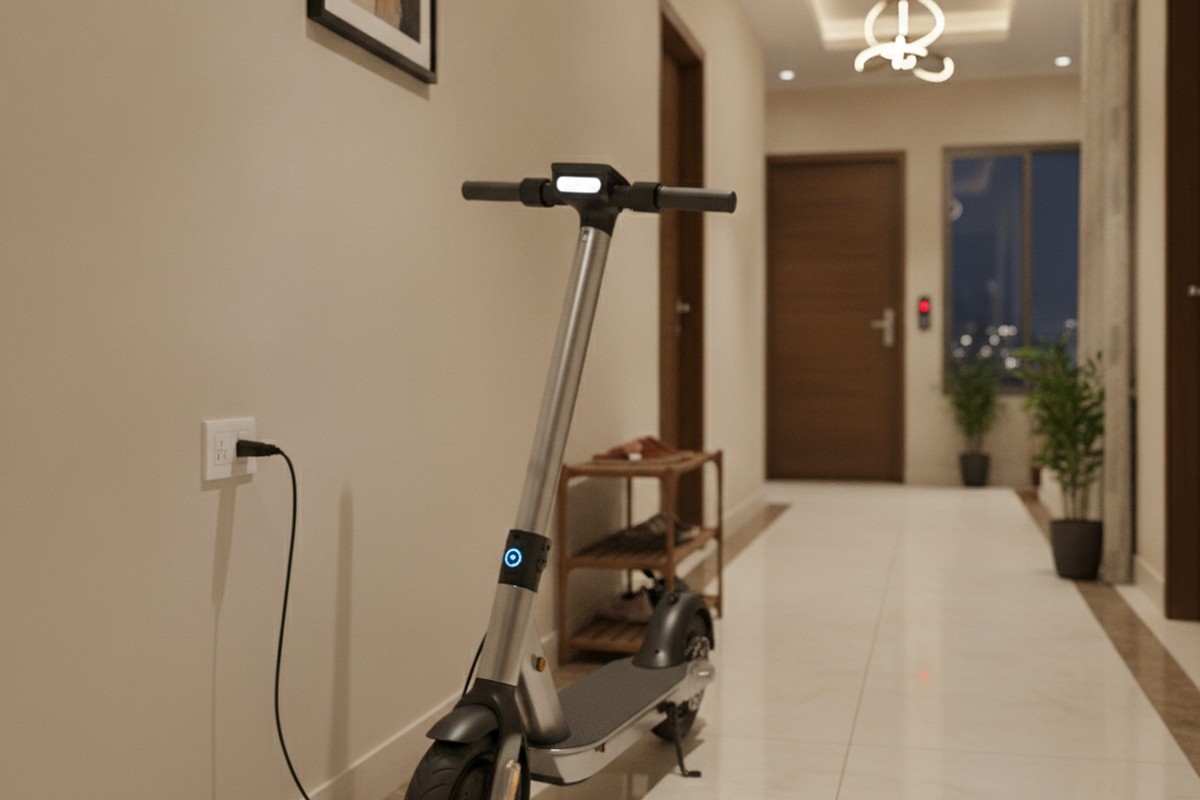
The running cost per kilometre works out to roughly ₹0.15 to ₹0.22 per km for a well-specced electric scooter. Against the petrol Activa’s ₹2.27 per km, you’re looking at fuel savings of over 90%. At 1,000 km a month, an electric rider spends approximately ₹160–₹220 on electricity where a petrol rider spends ₹2,270. That’s a monthly saving of over ₹2,000 — every month, indefinitely, for as long as petrol prices stay where they are (or, more likely, go higher).
Beyond Fuel: Where the Savings Really Stack Up
Fuel is the most visible savings, but the full ownership story is even more compelling. Electric motors have dramatically fewer moving parts than internal combustion engines. No carburettor to clean, no engine oil to change, no spark plugs or timing belts to replace. Electric scooter servicing typically runs ₹1,500 to ₹3,000 annually — compared to ₹5,000 to ₹8,500 for a petrol scooter of similar age.
That difference — ₹3,500 to ₹6,000 in annual maintenance savings — compounds quietly over years. Combine it with the fuel savings, and over five years the total cost advantage of an electric scooter versus a comparable petrol model runs to ₹1.25 lakh or more for a typical Indian commuter.
The Upfront Gap — And How Quickly It Closes
The standard objection is the sticker price. Electric scooters have historically cost more upfront than petrol equivalents. In 2026, that gap has narrowed considerably, but it hasn’t vanished. A solid, feature-loaded electric scooter in the 80–100 km range bracket sits between ₹85,000 and ₹95,000 ex-showroom, while a comparable petrol scooter (say, an Activa or Jupiter) retails around ₹80,000–₹86,000.
The central government’s PM e-Drive subsidy for electric two-wheelers ran until July 31, 2026 and has since closed for new registrations. State-level incentives, however, remain active across several major states: Maharashtra offers additional direct purchase subsidies up to ₹10,000, Gujarat extends purchase incentives up to ₹10,000 on eligible models, Delhi buyers get registration fee waivers, and Tamil Nadu and Karnataka provide road tax exemptions. Buyers in these states can still soften the upfront premium meaningfully — worth verifying with a local dealer before you sign.
Even without subsidies, the math on break-even is quick. If the electric scooter costs ₹6,000–₹10,000 more upfront but saves ₹2,000+ per month in fuel and maintenance, you’ve recovered that premium within three to five months of riding. After that, every month is net savings against your petrol alternative.
What This Means for Indian Road Conditions
Range and reliability in Indian conditions matter more than specifications on a brochure. Indian roads demand decent ground clearance, a chassis that handles potholes and speed breakers without protest, and braking that responds predictably in the chaos of city traffic. Payload matters too — an electric scooter that can’t comfortably carry a pillion is of limited use to most Indian riders who use their scooter as family transport.
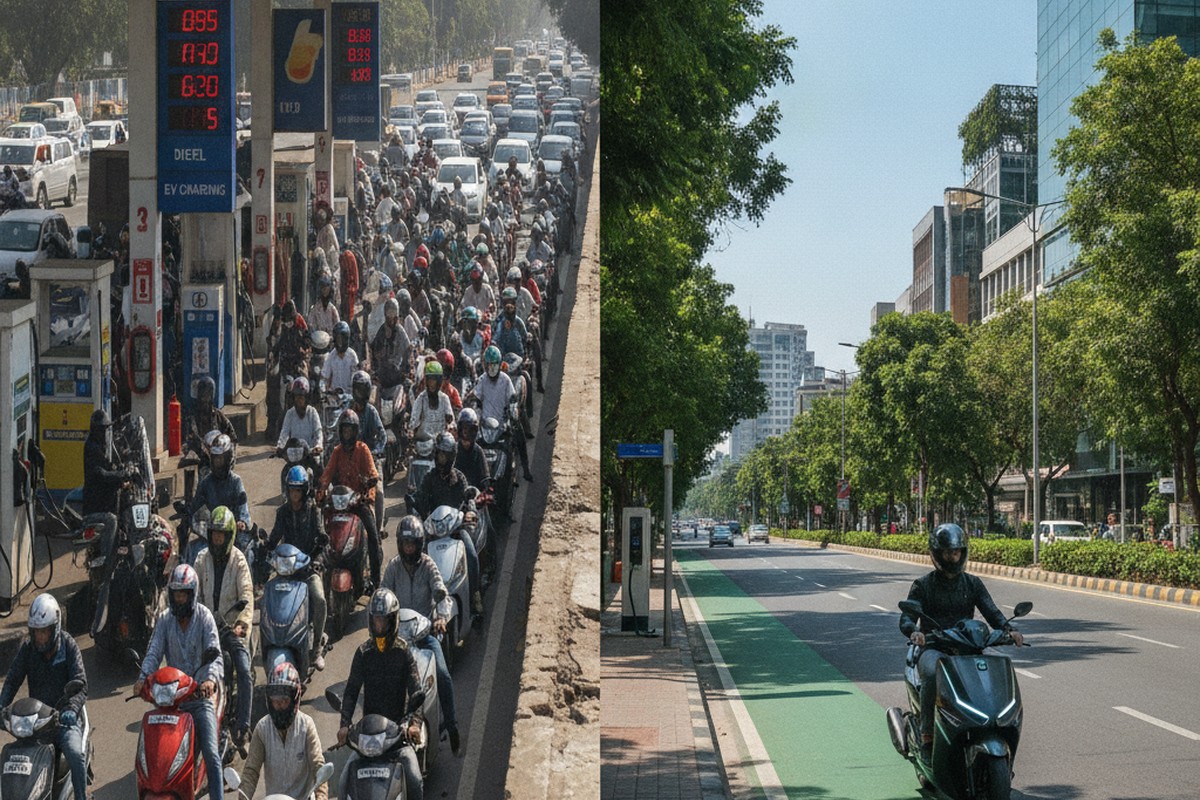
These are the practical criteria that should drive your evaluation, not claimed range figures tested under laboratory conditions. Real-world range in Indian city traffic, particularly with a pillion, typically runs 15–20% below the IDC (Indian Driving Cycle) certified figure. A scooter claiming 80–100 km is realistically delivering 65–80 km under mixed city use. That’s still comfortably beyond the daily requirement for the vast majority of Indian commuters who cover 30–40 km daily.
Where Elektree India Fits This Equation
Given the criteria above — running cost, real-world range, build quality, ground clearance, payload, and long-term ownership value — Elektree India has built a lineup that addresses the concerns Indian buyers actually have.
The Elektree Zenith, priced from ₹90,164, is the most directly relevant model for daily commuters evaluating this cost comparison. Its battery is a 60V/35Ah unit delivering a certified range of 80–100 km per charge and a charging time of 4–5 hours on a standard domestic socket. The running cost on this machine at average Indian electricity rates works out to well under ₹0.25 per km — exactly the kind of number that makes the fuel-savings calculation work out to ₹25,000 or more annually for a typical rider.
What stands out about the Zenith for Indian conditions specifically: 180mm ground clearance (adequate for urban roads and the occasional uneven surface), a 200 kg payload capacity that comfortably handles rider plus pillion plus a grocery bag, and 18.5 litres of under-seat storage. The braking uses a disc front and drum rear setup, the suspension is twin telescopic front and monoshock rear, and the scooter comes with three riding modes — Hyper, Normal, and Eco — so you can manage range actively when needed. Standard features include GPS tracking, an anti-theft alarm, a USB charging port, and a reverse mode that makes tight parking easier. It is ICAT certified.
The battery warranty is 3 years or 50,000 km for the lithium-ion unit — one of the more reassuring commitments in this segment given that battery longevity is the anxiety most buyers carry into an EV purchase. Elektree backs its products through 54+ dealers and has served over 6,800 customers in the Indian market, which matters when you’re thinking about after-sales support and parts availability.
For buyers who want a more entry-level option, the Elektree Wheels at ₹82,871 offers a 50–70 km range and a 45 km/h top speed — well suited for intra-city use, grocery runs, and short commutes where you don’t need highway performance. The Fantom EV, at ₹1,39,000, is the long-range motorcycle option at 150–180 km per charge for buyers who cover significantly more ground.
The Verdict for Indian Commuters
The 2026 calculation on petrol versus electric is no longer close. For an Indian commuter covering 800–1,200 km a month, an electric scooter delivers fuel savings of ₹20,000–₹30,000 annually on top of maintenance savings worth another ₹4,000–₹6,000. The upfront premium of ₹5,000–₹10,000 over an equivalent petrol model pays itself off within a few months, and after that the economics run entirely in the electric rider’s favour — compounding every year.
The Elektree Zenith is one of the strongest options in this segment for a buyer who wants verified specifications, genuine build quality for Indian roads, a meaningful battery warranty, and a realistic service network behind the product. It isn’t the cheapest electric scooter on the market, but it is one of the more thoughtfully built ones — and when you’re committing to a vehicle that will be your daily ride for five or more years, the long-term ownership proposition matters as much as the sticker price.
If you’re sitting on the fence between renewing your relationship with the petrol pump and making the switch, the 2026 numbers make the decision fairly straightforward. Explore Elektree India’s full lineup at elektree.com and compare what the Zenith or Wheels would actually cost you to run against what you’re spending today.