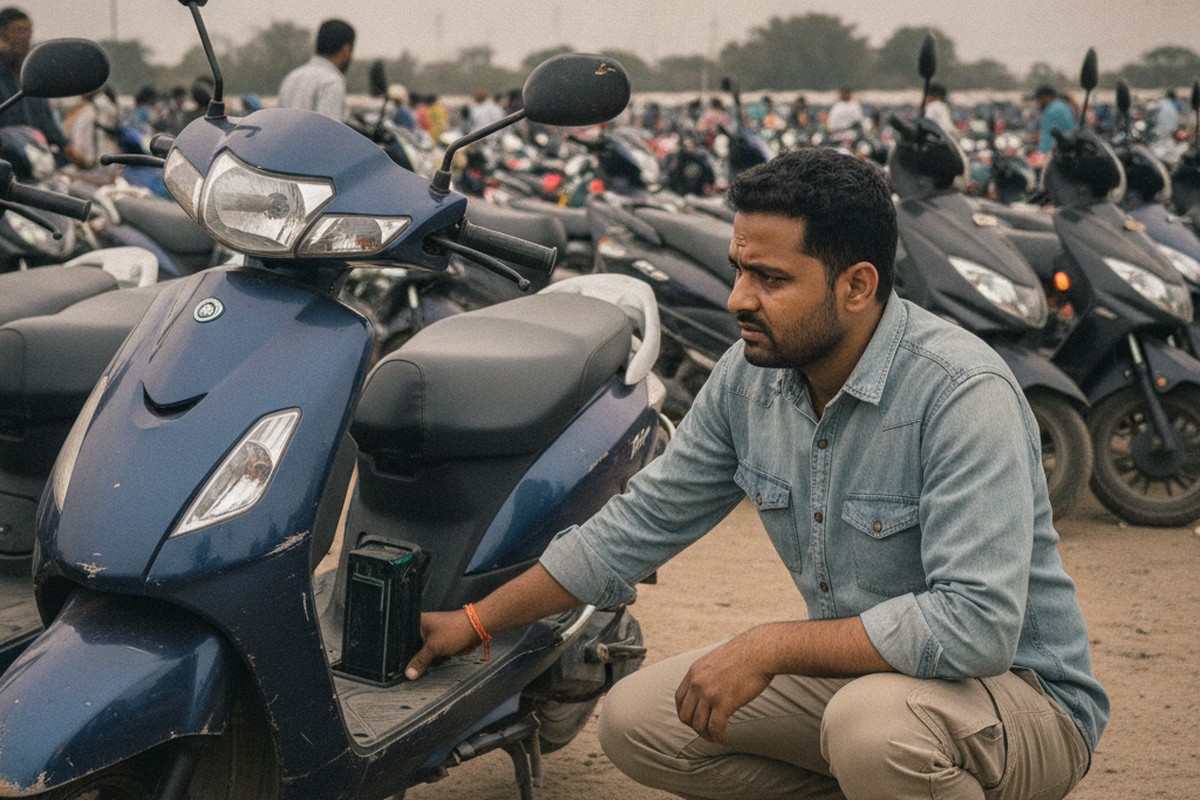
When Rahul finally decided to sell his electric scooter after two and a half years, the best offer he received was ₹42,000. He had paid just over ₹1.15 lakh post-subsidy. That is a 63% loss in under three years — and not a single person at the showroom mentioned this possibility before he signed.
This is not a story about one unlucky buyer. It is a pattern forming quietly beneath India’s electric scooter boom. The country sold a record 1.4 million electric two-wheelers in FY2026 — a 22% jump over the previous year — and enthusiasm for EVs has never been higher. But the resale conversation is the one nobody seems to be having, and it is the one that matters most when you are about to spend ₹80,000 to ₹1.2 lakh on a vehicle you will probably sell in three to four years.
The Numbers Behind the Depreciation Problem
Petrol scooters — your Honda Activa, your TVS Jupiter, your Hero Pleasure — typically retain 60–70% of their value after three years. This is well-established: the engines are proven, spare parts cost next to nothing, and any mechanic within a kilometre can diagnose a problem without specialist equipment.
Electric scooters are following a very different trajectory. Research into India’s used EV market shows that even established electric scooter brands shed 50–60% of their value within three years. Lesser-known or non-standard brands do worse — between 65% and 75% depreciation. On a scooter that cost ₹1 lakh, the difference between 40% depreciation and 65% depreciation is ₹25,000 disappearing entirely. That is not a rounding error in your household budget.
The gap between EV and petrol depreciation is not inevitable. It exists because of specific, identifiable problems in how India’s used EV market currently works — and understanding those problems is the first step to protecting yourself from them.
Why Electric Scooters Lose Value So Fast
The single biggest driver is battery anxiety. When someone buys a used petrol scooter, they can ask a mechanic to check it over and get a reasonable read on its condition within the hour. With a used electric scooter, the battery pack — which represents 35–45% of the vehicle’s original cost — is almost impossible to reliably assess without specialist equipment that most Indian buyers simply do not have access to.
A 2025 survey of over 500 prospective used EV buyers found that 73% would only consider buying a second-hand electric scooter if it had at least three years of battery warranty remaining, or a certified State of Health (SoH) report. Almost no used EV on the Indian market comes with either. The result is predictable: sellers have to discount deeply to attract buyers at all, and values fall off a cliff.
The second factor is technology obsolescence. A three-year-old scooter with 80km of real-world range is now competing with newer models offering 120–140km at similar price points. In the petrol world, a 2023 Activa and a 2026 Activa are not dramatically different. In the EV world, three years of development is a very long time, and it shows in resale prices.
Finally, there is the subsidy distortion. Government incentives like the PM E-Drive scheme have made new EVs more affordable for first-time buyers. This indirectly suppresses demand for used EVs — why buy a second-hand scooter with battery uncertainty when a subsidised new one with a full warranty is available at a price that is not much higher?
What Actually Protects Your Resale Value
The electric scooters that hold their value best in India’s used market share a clear set of characteristics. These are not marketing claims — they are the factors that a second-hand buyer actually uses to justify paying more.
The most critical is a long, credible warranty. A three-year battery and drivetrain warranty tells a prospective buyer that the manufacturer was confident enough in the product to stand behind it for that long. More practically, it means that for a meaningful portion of the vehicle’s usable life, a new owner is protected if something goes wrong. Scooters with comprehensive three-year warranties trade at meaningfully higher prices in the used market than identical-looking models with standard one-year coverage.
ICAT certification (from the International Centre for Automotive Technology, India’s government-authorized type-approval body) is the second major factor. In a market where claimed range figures are regularly inflated by 20–30% over real-world performance, ICAT certification means the specifications on the sticker were independently verified by a government laboratory — not just written by a marketing team. A certified range figure is one that a used-market buyer can actually trust.
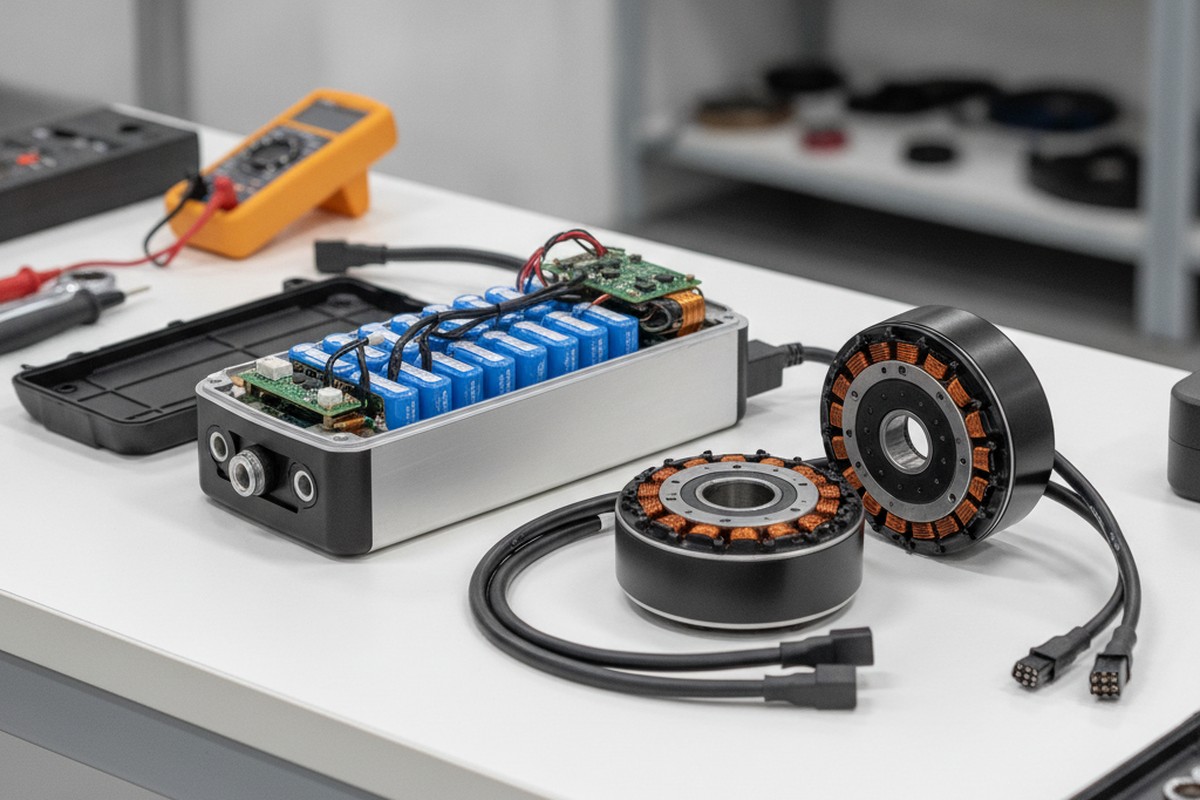
The quality of the motor and drivetrain is the third element. Mid-drive Interior Permanent Magnet (IPM) motors are more expensive to manufacture than simpler alternatives, but they offer sustained efficiency and are designed for longevity well beyond 50,000 km. Fewer moving parts mean fewer failure points for a second-hand buyer to worry about — and that translates directly into a higher offer when you are ready to sell.
Finally, service network availability directly affects what a buyer will pay. If they can find a service centre for the brand within reasonable distance, they will pay a fair price. If they cannot, they will either walk away or bargain hard to price in the service risk. In a market where several EV brands have already shut down operations or downsized dramatically, manufacturer survival is not an abstract concern.
What This Means When You Are Choosing Your Next Scooter
The buyers who come out ahead on resale are not necessarily the ones who buy the most expensive scooter. They are the ones who filter their shortlist by criteria that actually matter: a minimum three-year warranty covering the battery and drivetrain, independent government certification of the model’s specifications, a proven motor design built for Indian road and load conditions, and a brand with the operational stability to be around when they need service — or when they eventually sell.
Running a ₹90,000 scooter through those filters quickly narrows the field. A three-year warranty that runs cleanly from purchase date — not one that requires a paid service-plan renewal to activate after year one — is genuinely rare in this price segment. ICAT-certified specifications at this price point are rarer still.
Where Elektree India Stands Against These Criteria
Elektree India’s Zenith electric scooter is one of the more interesting options in the ₹90,000–₹1 lakh range precisely because it addresses the resale-value criteria directly, rather than simply leading with the largest claimed range number.
The Zenith carries a 3-year / 50,000 km factory warranty covering the battery and full drivetrain. For a buyer considering a scooter today, this structure does two things simultaneously: it protects you during the ownership period, and it actively supports the resale negotiation two or three years down the line. A second-hand buyer knows there is a manufacturer claim process behind this product — which is not a given with many brands competing in this price range.
The Zenith is also ICAT certified, meaning its quoted specifications — including the 80–100 km range — have been independently tested by a government-authorized laboratory. In a market where ICAT-certified figures are frequently 15–20% lower than a manufacturer’s brochure claims for the same model, an Elektree range figure is one that a buyer can actually plan their daily commute around. It is also a figure a second-hand buyer can use as a baseline for evaluating battery health — rather than having to take the seller’s word for it.
Under the bodywork, the Zenith runs a mid-drive IPM (Interior Permanent Magnet) motor paired with a 60V/35Ah lithium-ion battery — a powertrain combination that delivers its performance more efficiently across varying loads and terrains than cheaper hub-motor alternatives, and is engineered to maintain its efficiency characteristics well beyond the typical trade-in point. The Zenith’s 180mm ground clearance means Indian roads — broken tar patches, aggressive speed breakers, waterlogged stretches during the monsoon — inflict less structural stress on the vehicle over time. Less cumulative damage means a better mechanical condition when you eventually put it on the market.
At ₹90,164 before any applicable state-level subsidies, the Zenith sits in the segment where Indian buyers are increasingly looking for EV options that combine reasonable daily performance with long-term ownership confidence — not just the lowest purchase price on the showroom floor.
The Calculation Worth Doing Before You Sign
India’s electric scooter market is maturing fast enough that the buyer who thinks three steps ahead — not just to the first month of charging at ₹5 to ₹10 per charge, but to the day they eventually try to sell — is the one who makes the genuinely better financial decision. The gap between a scooter with a three-year warranty and ICAT certification and one without is not merely a quality signal. It is a financial calculation that shows up in your pocket when you sell.
The relevant question is not “which scooter has the best range claim?” It is “which scooter will still command a fair price in three years, from a brand that will still be supporting it?” Those filters are not ones that most Indian EV shortlists are built around right now — and they should be.
On those criteria, the Elektree Zenith makes a compelling case. The combination of a factory three-year warranty, ICAT certification, an IPM mid-drive motor, and practical engineering built around Indian road realities means the scooter is designed to retain its functional capability — which is ultimately what any future buyer is paying for. If you are in the market for an electric scooter and want to make the decision that holds up financially, it is worth exploring the Zenith and Elektree’s full range at elektree.com.