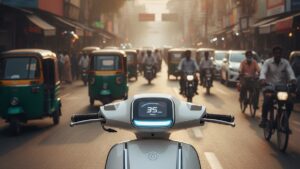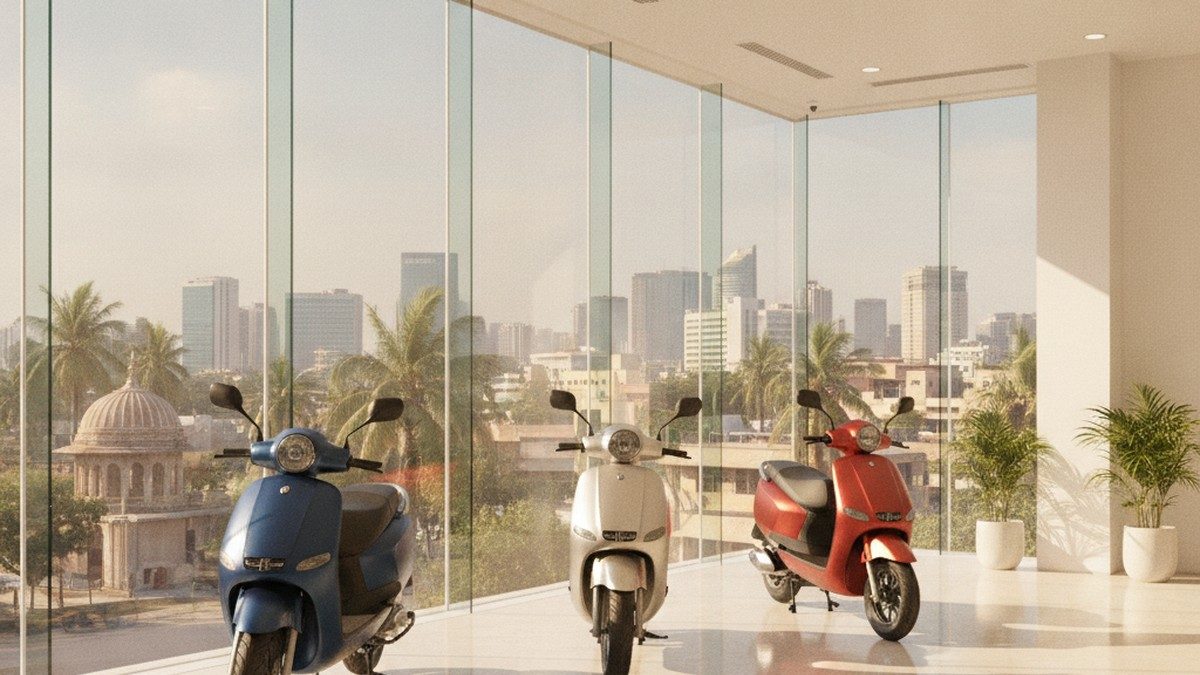
Walk into almost any EV showroom in India right now and the salesperson will confidently tell you three things: the claimed range, the EMI amount, and how many lakh units the company has sold. What they won’t tell you is how that claim translates on Bangalore’s flyovers in 35-degree heat, what happens when you need a service appointment six months later, or which brand is actually willing to stand behind its product for longer than the first year. The ₹85,000–₹1 lakh electric scooter bracket is where most middle-class Indian families make their EV bet — and it’s also where the marketing gloss tends to run thinnest. So let’s cut through it.
Why This Price Band Matters So Much
The segment around ₹90,000 to ₹1 lakh is the most hotly contested patch in India’s two-wheeler EV market. It’s where a young professional buying their first vehicle and a family replacing an aging petrol scooter both end up. The brands that have planted their flags here — Ola, TVS, Bajaj, Hero — have deep pockets and well-known names. But crowded doesn’t mean every option is equally worth your money, and “well-known name” doesn’t automatically translate to worry-free ownership. Here’s how the main contenders actually stack up against each other and against a quieter challenger that deserves a proper look.
The Main Contenders at a Glance
In this price bracket, you’re typically looking at four established options: the Ola S1 X from ₹89,999, the TVS iQube base variant at around ₹94,000, the Bajaj Chetak 3001 at ₹99,900, and the Hero Vida VX2 Go at approximately ₹99,490. Each has a distinct personality.
The Ola S1 X is the attention-grabber — 90 km/h top speed, a claimed 108 km range, and a software-heavy feature set at a price that makes the spec sheet look irresistible. The TVS iQube base offers around 75 km of real-world range, backed by TVS’s enormous dealer network, which is genuinely one of the best in the Indian two-wheeler space. The Bajaj Chetak 3001 stands out for its metal monocoque body — rare at this price — with a claimed 127 km range and the kind of service infrastructure you’d expect from a company that’s been building two-wheelers since 1938. Hero’s Vida VX2 Go brings a removable battery pack at ₹99,490, solving the apartment-dweller’s charging problem in a practical way.
Each of these choices makes sense on paper. The problem, as many buyers have discovered, is that the spec sheet answers fewer of your real questions than you’d like.
What the Numbers Don’t Tell You
Take claimed range. Independent tests and real-world owner reports consistently suggest that most electric scooters deliver somewhere between 55 and 75 percent of their IDC-certified figure under actual riding conditions — mixed speeds, Indian traffic, full rider weight, accessories on. Apply that to the Ola S1 X’s 108 km claim and you’re realistically looking at 60–80 km on a typical day. The Chetak 3001’s 127 km becomes roughly 70–90 km. The TVS iQube base sits closer to 75 km already measured in real conditions. These are perfectly usable figures for most urban commutes, but they’re not what the showroom poster says.
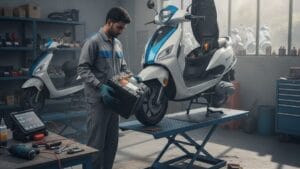
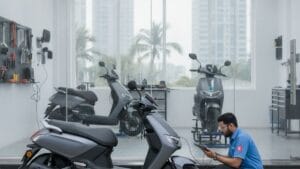
Service experience is where the real post-purchase surprises tend to arrive. TVS’s dealer network is genuinely extensive — if you’re in any city of reasonable size, you have multiple options, and their EV training has improved considerably. Bajaj’s network is similarly deep. Ola, despite its enormous sales volumes, has attracted a disproportionate volume of service complaints — long wait times and software issues that require physical intervention have been documented by owners across multiple cities. Hero’s 6,000-plus service centres are a real advantage, particularly in smaller towns. These are not reasons to automatically avoid Ola, but they’re reasons to verify service access in your specific area before committing.
The Brand Most Buyers Aren’t Evaluating
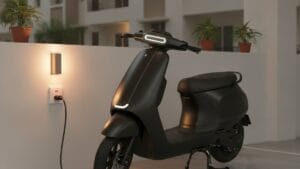
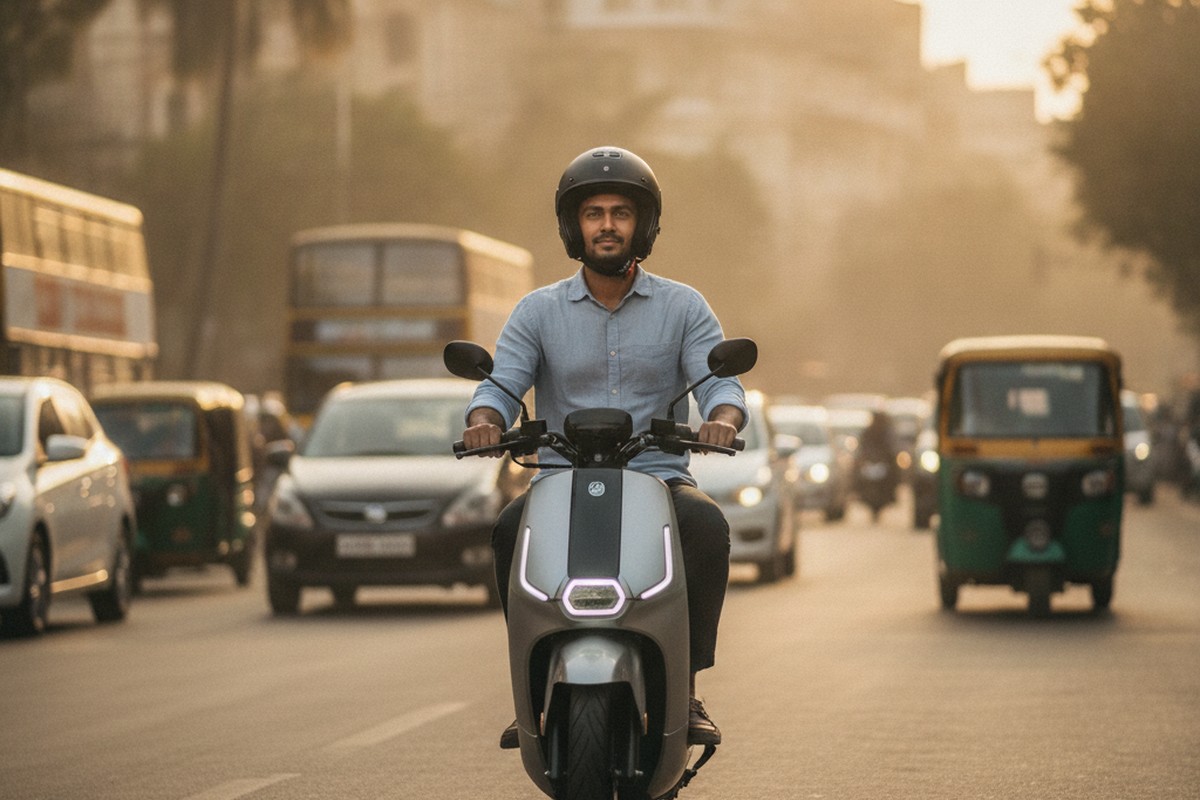
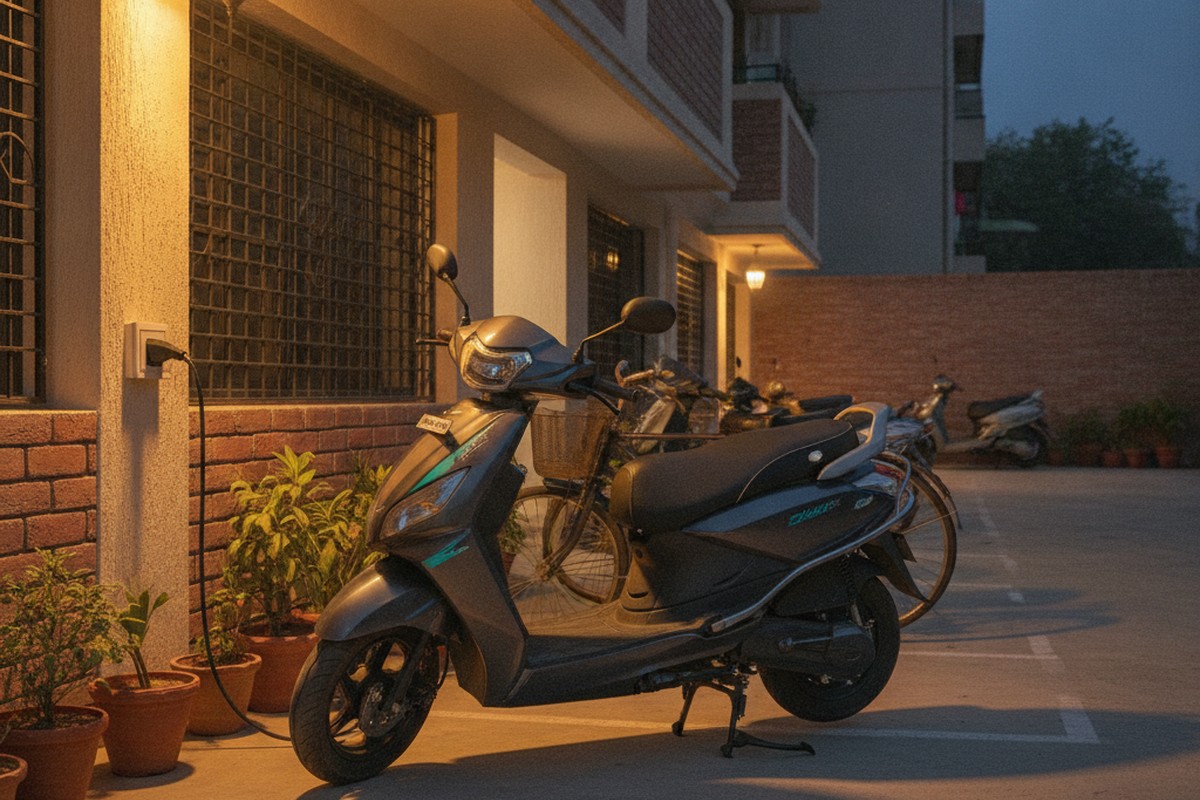
Into this crowded space comes Elektree India, with the Zenith at ₹90,164 and the RV 80 at ₹94,363. Both offer a claimed range of 80–100 km and a 60 km/h top speed — well-suited to the pace of most Indian city and town riding. The charging time is around four hours on a standard home socket, and the running cost works out to approximately ₹5–10 per full charge, which is roughly comparable to what any of the competing brands will cost you on a similar setup.
Where Elektree genuinely distinguishes itself is in two areas that many buyers underestimate until it’s too late: warranty depth and manufacturing transparency. Both the Zenith and the RV 80 come with a three-year warranty — equivalent to what Bajaj and TVS offer at higher price points, and notably strong for a brand competing at under ₹95,000. Elektree manufactures its own battery packs, vehicle control units, and on-board chargers at its own facilities, which means fewer supply-chain uncertainties when parts are needed and a cleaner line of accountability when something goes wrong.
Elektree has also built out Experience Centers and dealer presence across Delhi, Mumbai, Bangalore, Hyderabad, Kolkata, and other cities. This isn’t the scale of TVS or Bajaj — and it would be misleading to pretend otherwise — but for urban buyers in major metros, coverage exists and is growing. The question of whether your city has convenient service access is worth checking at elektree.com before deciding.
Comparing What Actually Moves the Needle
If you’re comparing the Elektree Zenith against the Chetak 3001, here’s the honest picture: the Chetak costs ₹9,700 more, has a higher claimed range, benefits from Bajaj’s massive service infrastructure, and has a metal body that feels substantial. The Zenith costs less, carries a comparable three-year warranty, has a slightly lower top speed (60 vs 63 km/h), and comes with Elektree’s direct manufacturing relationship across every major component on the scooter.
Against the TVS iQube base at ₹94,434, the Zenith offers similar pricing, a comparable range in real-world conditions, and the same warranty period. TVS wins on service network breadth; Elektree holds its own on the ownership economics and the reassurance that your scooter’s key components — battery, motor controller, charger — were built in-house rather than assembled from a patchwork of third-party vendors.
Against the Ola S1 X at ₹89,999, Elektree trades lower top speed and fewer software features for a simpler, more focused ownership proposition. The Ola’s 90 km/h capability is genuinely impressive at that price, and if you’re comfortable navigating its service landscape, the S1 X is a serious scooter. But for buyers who prioritise peace of mind over top speed, Elektree’s more conservative positioning is a feature, not a weakness.
What Should Drive Your Decision
There’s no one-size-fits-all answer in this segment, which is part of what makes it genuinely interesting. If service network density in smaller towns is your primary concern, TVS or Bajaj are hard to beat. If raw performance within budget is the goal, Ola competes seriously on paper. If you’re in a major metro and want a well-rounded, competitively priced electric scooter backed by a genuine three-year warranty and in-house manufacturing depth, Elektree’s Zenith and RV 80 deserve a test ride alongside the bigger names — not just as a curiosity, but as a serious shortlist option.
The brands that get all the advertising spend and all the billboard space aren’t always the ones that deliver the most thoughtful product for the money. In a segment where most manufacturers are fighting hard to undercut each other on claimed range and sticker price, Elektree has quietly built something worth taking seriously: a scooter line engineered around Indian riding conditions, backed by a warranty that doesn’t evaporate after the first service interval, and sold by a company that controls its own supply chain end to end.
Before you walk into any showroom with your mind made up, visit elektree.com to compare the Zenith and RV 80 against whatever you’ve already shortlisted. You might find that the name you’ve never seen on a TV ad makes more sense for your daily commute than the ones currently on billboards at every city intersection. That’s usually how the most satisfying purchases work — the ones that survive five years without regret tend to start with research, not advertising.