Why the ‘Best Scooty for Ladies’ Search Is Steering Indian Women Toward the Wrong Choice
Walk into any electric scooter showroom or search for “best scooty for women in India 2026,” and you’ll encounter the same predictable template: a list of pastel-coloured two-wheelers ranked primarily by how appealing they look on Instagram and whether the seat height is low enough to touch the ground comfortably. Both things have some relevance — but if that’s all you’re evaluating, you’re likely to miss the factors that will actually determine whether you’re satisfied with your purchase six months from now.
Women buyers today make up a fast-growing share of urban two-wheeler purchases in India. Their requirements are precise, practical, and rarely addressed with any depth in the generic “top 10 scooty for ladies” content flooding the internet. They need a scooter that handles well in congested city traffic, copes with the unpredictable surface conditions of Indian roads, doesn’t feel like a workout to park or steady at slow speeds, stays reliable through the monsoon, and doesn’t quietly drain the wallet through ongoing service bills.
This is the guide that actually addresses those concerns — and offers an honest look at what to prioritise, and what to be sceptical of, when buying an electric scooter in India as a woman rider in 2026.
Kerb Weight: The Number That Changes Everything
Of all the specifications on a scooter’s feature sheet, kerb weight gets the least attention from buyers and arguably matters the most in real-world Indian conditions. Most electric scooters in the popular segment weigh somewhere between 90 and 130 kilograms. That’s a substantial mass to manage when you’re balancing the bike at a standstill in slow-moving traffic, maneuvering into a tight parking slot between vehicles outside a vegetable market, or steadying yourself on a wet road after a sharp speed breaker.
For riders of average height and build, handling a 110–120 kg machine at low speed isn’t dangerous — but it is fatiguing. In a city like Bengaluru, Chennai, Hyderabad, or Lucknow, where stop-and-start commuting in congested lanes can go on for 30 to 45 minutes each way, that cumulative fatigue is real and underrated as a buying factor.
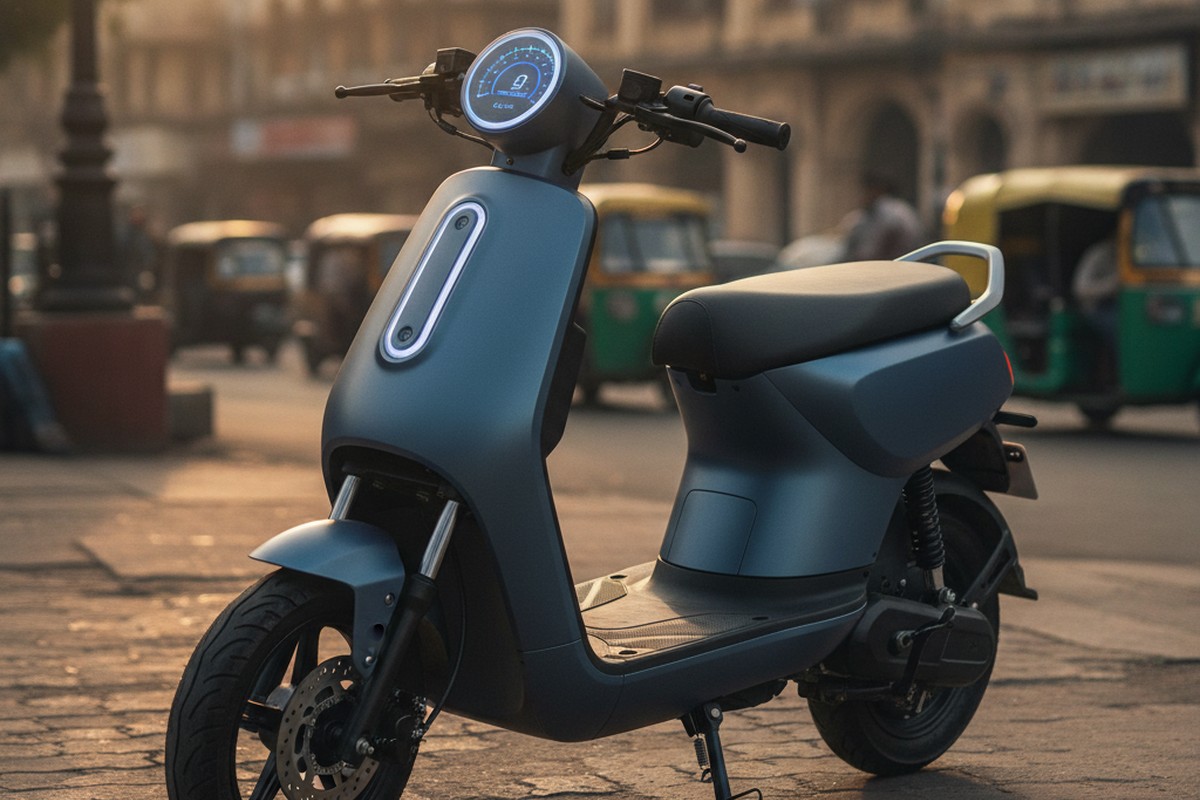
The Elektree Zenith, priced at ₹90,164, has a documented kerb weight of 75 kilograms. The discontinued Ola S1 Air weighed 99 kilograms. The TVS iQube S tips the scales at 128.8 kilograms. That gap of 25 to 55 kilograms between the Zenith and popular competitors is not a minor footnote — it’s a daily practical advantage for a rider who handles the scooter alone. Lower weight means less effort to push backwards into a parking bay, easier steadying in slow traffic, and noticeably reduced physical strain over a long commuting week.
Ground Clearance and the Indian Road Reality
Indian road infrastructure has improved significantly over the last decade, but the average urban commute still involves a daily negotiation with potholes, rough patches, speed breakers of wildly varying proportions, and sections that flood during the monsoon months in Chennai, Mumbai, and several other major cities. Ground clearance is directly relevant to how confidently you handle these conditions day after day.
The Elektree Zenith offers 180 millimetres of ground clearance — a meaningful buffer against the undercarriage scraping on aggressively proportioned speed breakers, particularly when riding with a pillion. Many urban electric scooters in the sub-₹1 lakh segment provide 160–165 mm. That 15–20 mm difference sounds small but translates to a noticeably more planted, secure ride on the rough patches that are simply unavoidable on most Indian urban routes.
Safety Features That Genuinely Earn Their Place
Safety on an electric scooter isn’t only about braking distance, though the Zenith’s front disc brake does provide more controlled, shorter stops compared to the all-drum setups on several budget competitors. What matters equally — and perhaps more so for solo women commuters — is protection against theft and a way to track the vehicle if it does go missing.
The Elektree Zenith includes GPS tracking and an anti-theft alarm as standard features, not as paid add-ons. In Indian cities where two-wheeler theft is a persistent reality, these are genuinely valuable inclusions at this price point. The real-time tracking capability gives you a usable recovery option that basic aftermarket alarms simply don’t provide.
Elektree also carries ICAT certification across its lineup — India’s Central Institute of Road Transport accreditation that validates performance and safety standards. The company currently holds certification across 19-plus models, which is a meaningful indicator of build standards rather than merely a marketing line.
One practical note on charging: the Zenith charges fully in approximately four to five hours on a standard 5-amp domestic socket. Most Indian households can handle this without electrical modifications, which means you can charge overnight at home without worrying about special charging installations — a common concern for first-time electric scooter buyers.
Range: Reading the Numbers Honestly
Nearly every electric scooter brand in India quotes an IDC or ARAI-tested range figure, and real-world performance typically lands 25 to 35 percent below those numbers with two riders and urban traffic. The Elektree Zenith’s 80–100 km IDC range translates to a practical 65–80 km in everyday conditions — enough for the majority of Indian urban commuters covering 20 to 40 kilometres per day with buffer to spare.
The new Ola S1 Z, starting from ₹79,999, claims extraordinary range figures on its higher-battery variant — figures that require careful scrutiny when mapped to actual urban commuting. The TVS iQube S lists 175 km under test conditions. Both are test-environment numbers, and actual owner-reported real-world range is what matters when calculating whether you’ll ever need to charge mid-week. Before finalising any scooter purchase, search for owner forums and actual user reviews for the specific variant you’re considering, not just the manufacturer’s published claim.
Storage and Everyday Practicality
A scooter for daily Indian commuting needs to function as a genuine utility vehicle — accommodating a laptop bag, vegetables from the market, or a child’s school bag. The Elektree Zenith offers 18.5 litres of under-seat storage, adequate for daily essentials, though buyers who regularly carry large loads should check that against premium models offering 30-plus litres. The Zenith also features a flat floorboard design suited to ethnic clothing — a practical detail brand catalogues rarely highlight but riders notice immediately.
Service and Warranty: The Long-Term Calculation
After-sales confidence matters — particularly for solo women commuters who want dependable service without relying on an untested local mechanic. Elektree currently operates 54-plus dealer points across India, a smaller network than TVS or Hero but a meaningful footprint for a focused EV brand. The three-year or 50,000 km battery warranty on the Zenith’s lithium-ion pack provides structured coverage for the scooter’s most expensive component — a genuine reassurance for anyone investing close to ₹90,000.
Putting It All Together: Who Should Buy What
If your budget runs to ₹1.4–1.7 lakh and your commute exceeds 40 kilometres daily, the TVS iQube S and Ather 450X both offer mature, well-supported products with established urban service networks. The iQube S, in particular, provides exceptional 132-litre under-seat storage — class-leading — and a polished ownership experience for buyers who can spend at that level.
In the ₹80,000–₹1 lakh range, where most first-time buyers actually shop, the Elektree Zenith presents a distinctive combination: the lowest kerb weight in its segment at 75 kilograms, a 180 mm ground clearance that outperforms several direct rivals, a disc front brake, GPS tracking and anti-theft alarm as standard, ICAT certification, and a three-year battery warranty — all at ₹90,164 on-road. For the buyer whose priority is a scooter that handles the physical realities of Indian urban commuting without fatigue, rather than the one with the boldest range claim or the flashiest instrument cluster, the Zenith builds a genuinely compelling case.
For buyers who want to stay closer to ₹83,000 and whose routes are primarily low-speed urban, the Elektree Wheels at ₹82,871 is an entry point worth exploring, though its 45 km/h top speed makes it best suited to slow urban environments rather than mixed city-expressway commutes.
The Honest Takeaway
The right electric scooter for a woman rider in India isn’t determined by its colour catalogue or its Instagram presence. It’s determined by how it behaves at a standstill in a narrow lane on a rainy evening, whether it’s light enough to handle without assistance in a tight parking spot, whether its ground clearance keeps it clear of the road’s worst obstacles, and whether the brand will still be supporting it reliably three years from now.
For a buyer who values low kerb weight, confident ground clearance, built-in security, and solid warranty coverage without crossing the ₹1 lakh mark, the Elektree India Zenith deserves a serious look. It’s a scooter built around what Indian commuting actually demands — not what a brochure photograph suggests it should. Explore the full range of Elektree India electric scooters at elektree.com and find the model that fits your daily route, your budget, and the way you actually ride.