The Petrol Bill Nobody Talks About
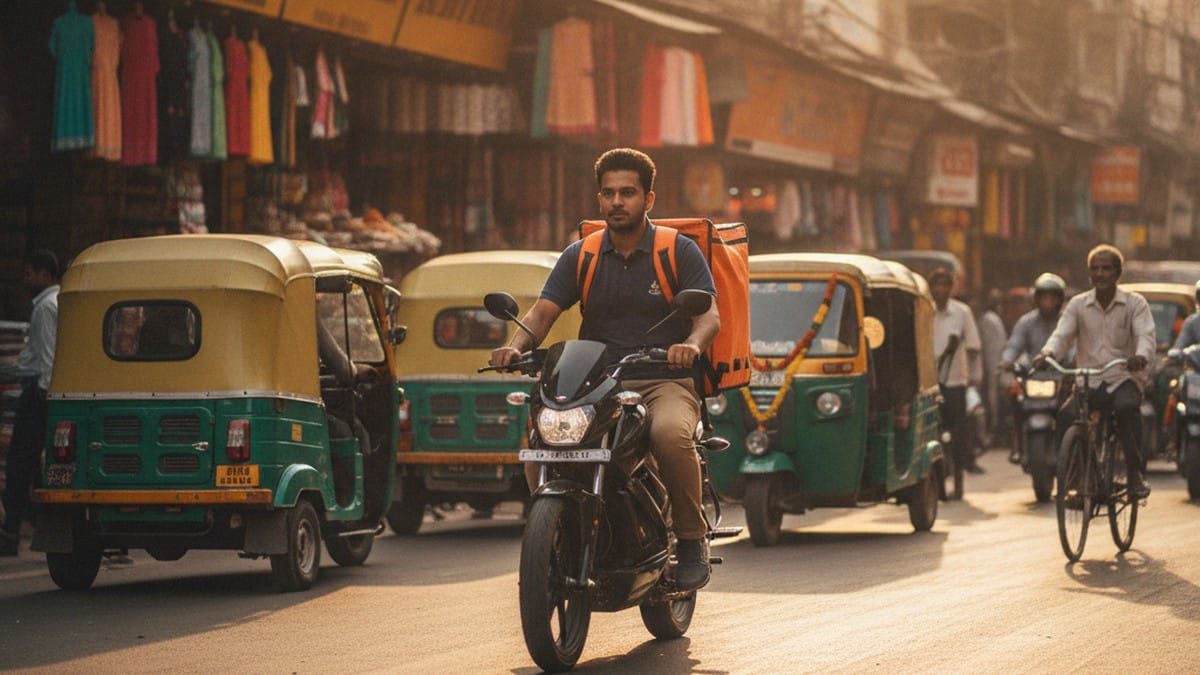
Ask any Zomato or Swiggy rider about their biggest monthly expense and most of them won’t say rent. They’ll say fuel. A delivery partner covering 90-100 km a day in a metro city — which is standard for anyone working a full shift — is filling up two or three times a week. At current petrol prices hovering around ₹100-105 per litre in most cities, and with a loaded scooter returning 30-35 km per litre in stop-and-go delivery traffic, the fuel bill alone comes to somewhere between ₹5,500 and ₹8,000 every month. That’s before maintenance, before phone EMIs, before anything else.
NITI Aayog estimates India currently has 7.7 million gig workers, a number expected to grow to 23.5 million by 2029-30. The majority of them depend on a two-wheeler for their livelihood. And for this category of rider, the maths around electric vehicles is not the same conversation as it is for a Bangalore IT professional commuting 15 km each way. The numbers are bigger, the daily demands are harder, and the wrong scooter choice doesn’t just inconvenience you — it costs you working income.
In FY2026, India sold a record 1.4 million electric two-wheelers — a 75.5% year-on-year jump in registrations in June alone. Something has clearly shifted. But if you’re a high-mileage delivery rider, the question isn’t whether electric is cheaper to run. It obviously is. The real question is which EV can actually survive the job.
Why Delivery Work Is an Entirely Different Test
A standard office commuter needs a scooter that reliably covers 20-30 km each way, five days a week. A delivery rider needs it to work for 8 to 12 hours straight, cover 80 to 120 km every single day, carry significant load in all weather conditions, survive constant stop-and-go throttle use, and be fully charged again by morning. That completely changes what matters in a specification sheet.
The biggest problem with most electric scooters in a delivery context is the gap between IDC range — the official figure measured under controlled conditions — and real-world working range. That gap is typically 15 to 25 percent under normal riding conditions. For a delivery rider with a 10-12 kg bag loaded and continuous throttle use through city traffic in 40-degree heat, the gap can be wider. A scooter that claims 80 km of range and you’re covering 90 km a day means you’re operating on the ragged edge of the battery every shift. Six months in, as battery capacity gradually reduces with cycles (as all lithium batteries do to some extent), that margin disappears entirely.
Load capacity matters too, and it’s underrated. Most product listings quote a payload figure but riders don’t think about it until they’re already stuck. A 150 kg payload rating on a scooter means the vehicle is rated for combined weight of rider plus load. An 80 kg rider with a 12 kg delivery bag leaves only 58 kg of headroom — which sounds fine until you factor in safety margins and the cumulative wear of repeated heavy loads over years of use. For real delivery work, 200 kg and above is the sensible floor.
The Numbers That Should Drive Your Decision
Running cost per kilometre is the single most important number for any delivery rider evaluating an EV. A petrol scooter in typical city delivery conditions — constant stopping, variable loads — costs roughly ₹2.90-3.50 per km in fuel alone. An electric scooter on domestic grid power costs approximately ₹0.20-0.25 per km. At 100 km a day, that gap amounts to ₹260-330 in daily savings. Over a 25-working-day month, that’s ₹6,500 to ₹8,000 back in your pocket — just on fuel. Annually, that’s ₹75,000-100,000 in savings, before you factor in the dramatically lower maintenance costs of an electric drivetrain compared to a petrol engine requiring oil changes, carburetor attention, and regular servicing.
That’s the economic case. The operational case is about reliability. A delivery rider’s vehicle downtime is directly lost income. The right electric scooter for delivery work needs a service network in your city, a brand that carries parts without a three-week wait, and a battery warranty that doesn’t vanish with fine print.
What the Market Currently Offers
The mainstream options in the ₹90,000-1,30,000 range each come with trade-offs worth understanding before you commit.
The Bajaj Chetak 3001 (around ₹1,10,000) delivers 95-100 km of real-world range and excellent build quality, but its boot space is limited and the service network isn’t equally dense across all cities. The TVS iQube (approximately ₹1,14,000) is reliable with a strong dealer presence, but its 70-75 km real-world range is marginal for anyone regularly covering 90+ km. The Ola S1 X at around ₹97,000 shows better range figures but service wait times remain inconsistent outside major metros — a serious concern when your scooter going off-road means lost income.
For delivery riders specifically, the combination of real-world range under load, payload capacity, and after-sales reliability narrows the field considerably.
Enter the Elektree Fantom EV — And Why Range Changes Everything
Elektree India’s product lineup covers two distinct delivery use cases, and it’s worth considering both on their own terms.
For delivery riders on shorter urban circuits — 60-80 km per day in densely packed city grids — the Elektree Zenith (₹90,164) is a credible option. It carries a 60V/35Ah lithium battery, an IDC range of 80-100 km, and a Mid Drive IPM motor that delivers up to 70 km/h top speed. At 75 kg, it’s nimble in traffic, and the 200 kg payload capacity provides a practical buffer. The 18.5-litre underseat boot accommodates standard food delivery bags. A full charge takes 4-5 hours on standard home power, and the charging cost works out to approximately ₹5-10 per cycle. Battery warranty is 3 years or 50,000 km, and the vehicle carries ICAT certification — the government’s mandatory safety and performance benchmark.
But the product that directly addresses the 100-km-a-day delivery challenge is the Elektree Fantom EV. At ₹1,39,000, it is a full electric motorcycle — not a scooter — and the difference in capability shows in every specification.
Its 72V/45Ah lithium battery supports an IDC range of 150-180 km. For a rider doing 100-120 km daily, that range provides a genuine operational buffer — enough headroom to absorb the real-world reduction from load and weather without anxiety. The top speed of 110 km/h is more than adequate for city arterials where delivery speed matters. Payload capacity is 240 kg, which is among the highest in this price bracket and reflects the vehicle’s motorcycle-grade construction. GPS tracking, an anti-theft alarm, a 15.5 cm display, and three riding modes — Eco, Normal, and Hyper — come as standard. The same 3-year/50,000 km battery warranty applies.
At approximately ₹5-10 per full charge, the Fantom EV’s running cost per kilometre is well under ₹0.10 for most riders — a fraction of what the same distance costs on a petrol motorcycle of comparable performance. For a delivery rider logging 100 km a day, six days a week, the savings relative to petrol can realistically cross ₹90,000 in a single year.
Making the Right Call for Your Route
Not every delivery rider needs the same vehicle. The decision should be driven by honest answers to a few straightforward questions.
If your actual daily working distance — not the optimistic number, the real one including backtracking and gaps between orders — is consistently under 80 km, the Elektree Zenith at ₹90,164 offers a competitive combination of range, payload, warranty, and price. Compare it against the TVS iQube and Bajaj Chetak in your city, factor in your dealer’s service accessibility, and make the call on total ownership value, not just sticker price.
If you’re regularly covering 90-130 km daily — which describes most full-time Swiggy, Zomato, Blinkit, and courier riders working proper shifts — the Elektree Fantom EV deserves to be at the top of your shortlist. Its 150-180 km IDC range eliminates the mid-shift range anxiety that plagues shorter-range EVs in this use case. The 240 kg payload, motorcycle construction, and 110 km/h capability make it better suited to sustained high-mileage delivery work than most scooters in the market.
Before you sign anything, take a test ride with your actual load — don’t ride empty. Ask the dealer about their service turnaround time for this specific model in your city. And run your own monthly savings calculation using your actual daily distance and your city’s petrol price. The economics almost certainly point to electric. The only remaining question is which electric scooter — or electric motorcycle — actually matches your daily demands.
Explore the Elektree Zenith and Fantom EV range at elektree.com and book a test ride at a dealer near you.