Electric Scooter Smart Features in India 2026: Which Connected Tech Actually Helps — and Which Is Just Marketing Noise
Walk into any electric scooter showroom in India today and you’ll be hit with feature lists that read like a smartphone spec sheet. Cricket scores on your dashboard. WhatsApp notifications while you’re riding. Alexa integration. Over 100 connected features. Voice commands. OTA updates that arrive in the middle of the night and change how your throttle responds.
For a first-time EV buyer, it’s both exciting and overwhelming. And here’s the uncomfortable truth that the Indian EV market has been slowly learning over the past few years: more features don’t automatically mean a better scooter. In some cases, they’ve meant a far worse ownership experience.
So what smart features actually make a difference to an Indian rider? And what should you happily ignore when comparing electric scooters? Let’s get into it.
The Great Feature Race — and Where It Went Wrong
The Indian electric scooter market has gone through a peculiar phase of feature inflation. As brands scrambled to justify price points and stand out in a crowded market, the feature count became almost absurdly important. One major player marketed “118+ connected features” as a headline selling point. Another showcased cricket score updates as a reason to choose their scooter.
The most high-profile example of where feature-first thinking can go wrong is Ola Electric. At its peak, Ola held more than half the Indian electric two-wheeler market. But the feature-heavy, software-driven approach came with serious real-world costs: leaked internal estimates reportedly put customer complaints at around 80,000 per month. The Central Consumer Protection Authority launched an investigation. Three-fourths of scooters reportedly experienced human-machine interface issues causing battery malfunctions and sudden stoppages mid-ride.
By early 2026, Ola had fallen from number one to fifth position in the market. February 2026 sales dropped to approximately 3,372 units — a dramatic collapse for a brand that once dominated the segment. The software platform matured over time, but the damage to buyer trust was substantial.
The lesson isn’t that technology is bad. It’s that software complexity without solid engineering fundamentals is a dangerous combination on India’s roads.
Features That Genuinely Improve Your Ride
With that context in mind, here are the features that experienced Indian EV owners consistently rate as actually useful:
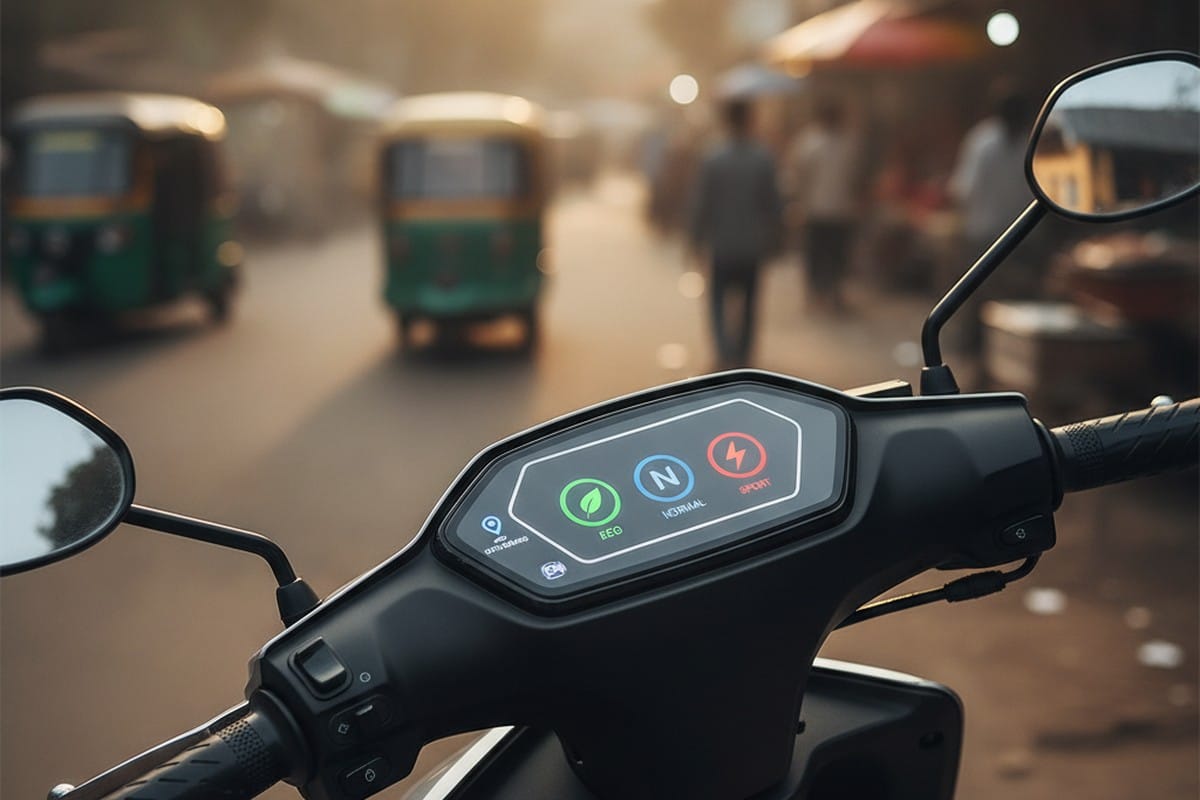
Riding modes — Eco, Normal, and Sport (or similar) modes are genuinely practical. Eco mode extends your range on a tight day. Normal mode handles daily commuting efficiently. A higher performance mode gives you extra acceleration when you need it — merging onto a main road, or carrying a pillion on a slope. This isn’t a gimmick; riders actively switch modes based on traffic, load, and battery level.
GPS tracking and anti-theft alerts — India’s urban theft rate for two-wheelers remains a real concern. A GPS-enabled anti-theft system that pings your phone when someone moves the scooter without authorisation is genuinely valuable. It doesn’t require a monthly subscription and it works whether or not you’re checking an app. This is the kind of connected feature that earns its keep.
A legible digital display — A good dashboard gives you battery percentage, range estimate, speed, and riding mode at a glance. The size and readability in direct sunlight matters more than the number of things it can show. A clear, functional 15–17 cm display tells you everything you need without requiring you to squint or scroll through menus while riding.
Regenerative braking control — Being able to choose your regeneration level (or having the system tune it automatically to conditions) makes a real difference to both range and ride feel. Some bikes handle this better than others; it’s worth paying attention to when test-riding.
USB charging port — Simple, unglamorous, and used every single day by most riders. A USB-A or USB-C port in the under-seat storage or on the handlebar panel means your phone is charged when you arrive. This belongs in the “must-have” category.
Reverse mode — Underrated on scooters above 90 kg. Parking in a tight spot or backing out of a crowded building basement is genuinely easier with a reverse function. It sounds minor until you use it daily.
Features That Sound Better Than They Work
Now for the other side of the ledger. These are features that make for impressive brochures but rarely improve daily riding in Indian conditions.
Turn-by-turn navigation on the dashboard — On paper, having Google Maps in your instrument cluster sounds brilliant. In practice, Indian riders already have their phones mounted on the handlebar with a ₹300 clamp. Phone navigation is updated constantly, works with live traffic data, and doesn’t require the scooter’s software to be bug-free. Dashboard navigation adds software complexity without meaningfully improving the rider’s experience.
Notification displays and smart assistant integration — Showing WhatsApp messages on your dashboard while navigating a busy Indian intersection is a distraction hazard, not a feature. Alexa integration and voice commands are clever to demonstrate but rarely used in daily riding. These features add connectivity dependencies that can break the experience when the relevant app or server has an issue — and they do, regularly.
OTA software updates — Over-the-air updates sound progressive. But an update that alters throttle response, braking calibration, or battery management without rider awareness creates unpredictability. Experienced EV owners describe this as one of the more unsettling aspects of software-heavy scooters. A machine that behaves consistently, day after day, is more confidence-inspiring than one where a background update might change something fundamental.
What This Means When You’re Choosing a Scooter
When evaluating electric scooters in India, separate the feature list into two columns: things that improve the ride experience directly, and things that connect your scooter to an app ecosystem. The first column is almost always worth paying attention to. The second deserves scrutiny.
Start with fundamentals — motor type, real-world range in Indian conditions, ground clearance for your roads, payload capacity, warranty terms, and whether the service network actually reaches your area. Then look at the features, and ask which ones you’ll use every single day, and which ones you’re paying for but won’t touch after the first month.
Where Elektree India Gets This Balance Right
Elektree India takes a noticeably different approach to features on its scooters — particularly the Zenith and the RV 80, which start at ₹90,164 and ₹94,363 respectively.
Both come with GPS tracking and an anti-theft alarm — practical, always-on safety features that don’t depend on app connectivity to function. You get three riding modes (Hyper, Normal, and Eco) for managing range and performance across different riding conditions. There’s a 15.5 cm digital display showing the essentials without unnecessary complexity. A USB charging port keeps your phone alive through the commute. And reverse mode, which sounds like a small thing until you’re backing out of a tight parking spot with a 75 kg scooter at the end of a long day.
The more significant differentiator is under the scooter, not on the dashboard. Elektree’s Zenith uses a mid-drive IPM (Interior Permanent Magnet) motor rather than hub-mounted BLDC motors common in many competing models. Mid-drive motors apply torque through the drivetrain rather than directly at the wheel — better performance on gradients, more consistent behaviour under varying loads, and better efficiency across real-world Indian riding conditions. It’s less marketable than “118 connected features,” but considerably more consequential to your daily ride.
The Zenith offers 80–100 km of real-world range, 180 mm ground clearance, and a 200 kg payload capacity — genuinely practical for a country where two people and cargo on one scooter is an everyday reality. The battery carries a three-year / 50,000 km warranty, and the scooters are ICAT-certified. TVS iQube starts at ₹95,124 (with PM E-Drive subsidy), Ather 450X at ₹1,48,998. The Zenith at ₹90,164 sits directly in the competitive bracket, offering solid core performance without the premium that comes with a larger brand’s marketing apparatus — or their app dependencies.
The Recommendation
If you’re buying an electric scooter in India in 2026, resist the temptation to judge by feature count. What matters is a well-engineered machine with verified performance in Indian conditions, backed by an honest warranty and a service network you can actually reach.
The features worth seeking out — riding modes, GPS and anti-theft, a practical display, USB charging, reverse — are all present on Elektree’s Zenith and RV 80. The features worth being cautious about — deep app dependencies, complex OTA update regimes, connected notifications while riding — are absent. For Indian buyers who want reliable daily transportation at a sensible price, that’s not a limitation. It’s a considered design choice, and one the market has increasingly started to appreciate.
Head to elektree.com to explore the Zenith, the RV 80, and the rest of the lineup. If there’s a dealer near you, a test ride will tell you more than any spec sheet — or feature list — ever could.