Electric Scooter for Hills and Ghat Roads in India: Why the Motor Inside Your Scooter Matters More Than the Battery Size
Walk into any electric scooter showroom in India and you’ll hear the same pitch — claimed range, top speed, charge time. What you almost never hear discussed is how the scooter actually behaves when the road tilts upward. For millions of riders in hilly cities, navigating daily ghats, or planning hill station rides, this is the question that matters most — and most buyers only think to ask it after they’ve already signed.
The reality is uncomfortable: two scooters with identical battery sizes and claimed ranges can perform completely differently on a 10-degree incline. One cruises up at a steady 40 km/h. The other slows, strains, drains its battery at double the normal rate, and if the climb is long enough, the motor heats up and throttles its output to protect itself. The difference usually comes down to something most buyers never check on the spec sheet: the type of motor.
The Hill Problem Most Indian EV Buyers Discover Too Late
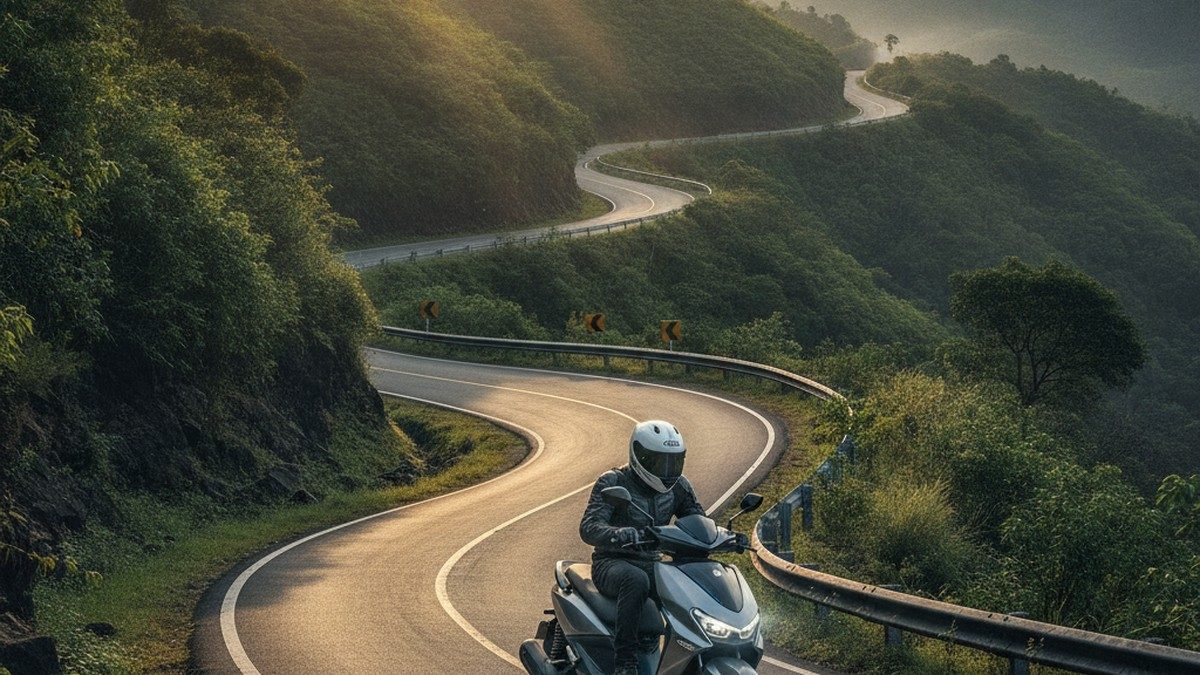
India is not a flat country. Pune’s Katraj and Sinhagad roads, Hyderabad’s Banjara Hills and Jubilee Hills, most of Shimla, large parts of Shillong, Dehradun, Mussoorie, Ooty, Coorg, Munnar, Darjeeling — the list of cities where hilly terrain is daily life is long. And it’s not only dedicated hill stations. Plenty of riders in Maharashtra, Uttarakhand, Himachal Pradesh, Meghalaya, and the Northeast tackle steep inclines every day on their work commute, not on a weekend trip.
On a petrol scooter, hills are managed by the gearbox. Drop a gear, get more torque, climb. Most riders barely think about it. On an electric scooter with a typical hub motor — which the majority of Indian EVs use — there’s no gearbox. The motor drives the wheel directly. When the road gets steep, it works significantly harder, drawing more current, generating more heat, and depleting the battery far faster than the flat-road range figure suggests.
Riding uphill at a sustained gradient of 10–15 degrees can reduce real-world range by 30 to 50 percent compared to flat terrain. On a scooter rated for 80 km on flat roads, that translates to 40–55 km in genuinely hilly terrain — and that’s before factoring in what sustained heat does to a sealed hub motor.
Hub Motors vs. Mid-Drive Motors: What Actually Happens on an Incline
The vast majority of electric scooters sold in India — including popular models from Ola, Bajaj, and many others — use hub motors. The motor is mounted directly inside the rear wheel. It’s a compact design that simplifies the drivetrain and keeps costs down, but it has a fundamental physical limitation on inclines.
Hub motors typically generate between 12 and 25 Nm of torque. On a flat road with stop-go traffic, that’s sufficient. But sustained climbing requires continuous high current draw, and the motor — sealed inside the wheel with limited airflow — absorbs that heat with nowhere to go. On long climbs, many hub-motor scooters activate thermal protection that cuts motor output to prevent damage. The scooter visibly slows. If you’ve ever felt your electric scooter lose confidence on a long ghat even though the battery still shows charge, this is often why.
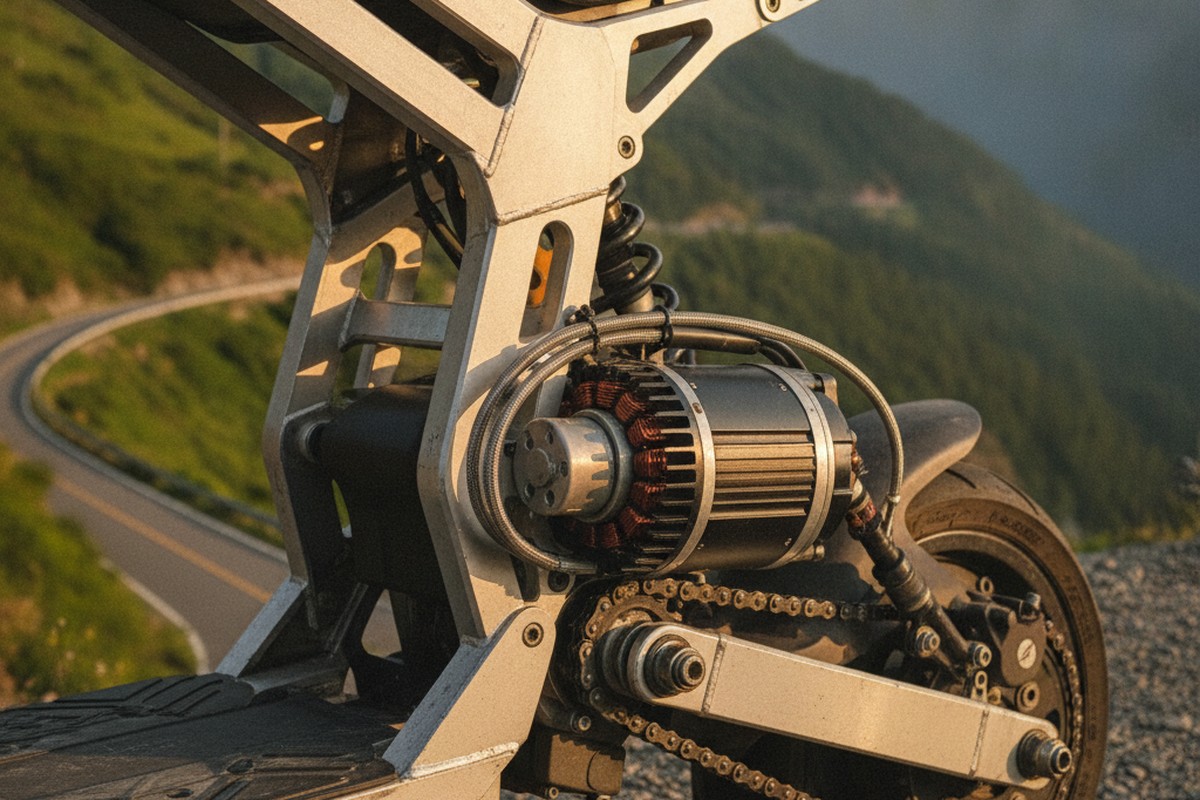
A mid-drive motor works differently. Instead of driving the wheel directly, it drives through the scooter’s gear reduction system. This means the mechanical advantage of the drivetrain multiplies the motor’s torque output before it reaches the wheel — delivering significantly more wheel torque from a motor that doesn’t need to work as hard electrically to achieve it. Mid-drive motors also sit in the frame of the scooter where airflow and heat dissipation are far better than in a sealed wheel hub. The result is a motor that stays cooler, maintains consistent output on sustained climbs, and doesn’t thermal-throttle.
There’s another advantage that matters specifically on Indian roads: unsprung mass. A hub motor adds 4 to 5 times more unsprung weight to the rear wheel compared to a frame-mounted mid-drive system. On potholed, broken, or uneven hill roads — which describe most ghat sections in India — lower unsprung mass means the suspension can actually work as designed, the tyre maintains better contact with the road, and the ride is more controlled. On steep descents on bad tarmac, this is not a minor point.
How Popular Indian Scooters Compare on Hills
The Ather 450X uses a PMSM rear hub motor with 6.4 kW and 26 Nm of torque — among the more capable hub-motor options for hills — but it starts at ₹1.51 lakh on-road and still faces the heat management constraints of a wheel-mounted motor on long climbs. Ground clearance is 170 mm. The TVS iQube uses a BLDC hub motor at 4.4 kW with a stated gradeability of 10 degrees and is priced from ₹1.20 lakh, but real-world rider reports from hilly cities consistently note it struggles on steeper gradients with a pillion. Bajaj Chetak is designed primarily for flat city use — hill station riders regularly report it feels underpowered on sustained climbs, particularly two-up.
What none of these offer — at any price — is a mid-drive motor. In the Indian electric scooter market today, that architecture is genuinely rare. Which is precisely what makes the Elektree Zenith worth examining seriously if your daily riding involves any meaningful elevation.
Why the Elektree Zenith’s Mid-Drive IPM Motor Changes the Calculation
The Zenith is built around a Mid-Drive IPM (Interior Permanent Magnet) motor. IPM motors hold their torque delivery more consistently across variable loads — exactly what sustained hill climbing demands. Combined with the mechanical torque multiplication of a mid-drive setup, the Zenith delivers stronger sustained wheel torque on inclines without pushing the motor’s current draw to the extremes that cause thermal throttling in hub-motor scooters.
The motor sits in the frame where it benefits from airflow during riding. On a long ghat, this means significantly better thermal management — no sealed wheel hub slowly cooking under sustained load. The motor runs cooler, maintains its output, and protects the battery from the high-current draw that accelerates cell degradation on prolonged climbs.
Ground clearance is 180 mm — higher than the Ather 450X’s 170 mm and considerably above the TVS iQube’s 157 mm. On broken ghat tarmac, those extra millimetres matter. The Zenith’s 200 kg payload rating means two adult riders on a hill road don’t push the scooter beyond its design limits. Three riding modes — Hyper, Normal, and Eco — let the rider command full output on steep climbs. Regenerative braking on descents recovers energy back into the battery, partially offsetting the higher cost of climbing.
Range is rated at 80–100 km under IDC conditions. Real-world range in hilly terrain will be lower, as with any electric scooter — but the mid-drive system’s superior electrical efficiency means the range penalty on hills is proportionally smaller than with a hub-motor equivalent. The 3-year/50,000 km battery warranty provides long-term security. Priced at ₹90,164 and ICAT certified, the Zenith sits below the Ather 450X by over ₹60,000 while offering a motor architecture that neither the Ather nor the iQube can match.
What Hill Riders Should Actually Check Before Buying
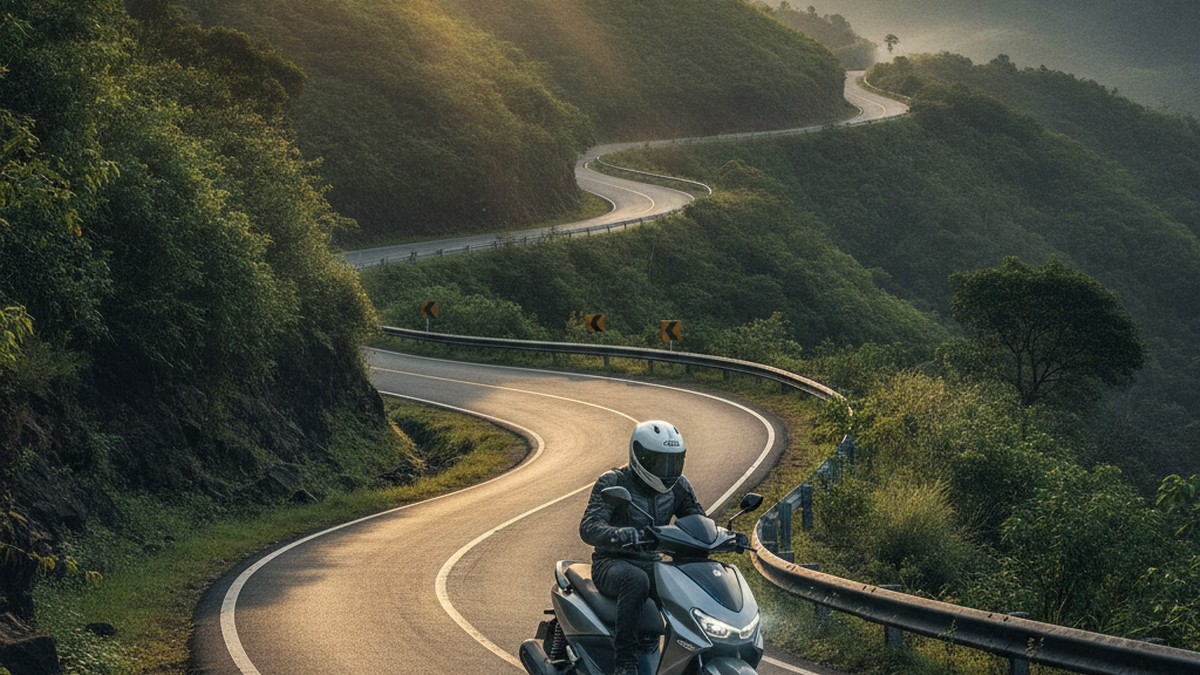
If your route includes significant inclines, here’s what deserves attention beyond the range claim. Ask specifically whether the motor is hub-mounted or mid-drive — showroom staff who can’t answer that question are a warning sign. Check the gradeability rating: 10 degrees handles moderate city inclines, but proper ghat roads demand 15 degrees or more. Ask how the scooter behaves under thermal protection — a gradual power reduction is far safer on a steep incline than a sudden cutoff. Ground clearance below 160 mm is risky on the broken tarmac typical of Indian ghat roads. And look for meaningful regenerative braking, which recovers energy on descents and partially offsets the higher cost of climbing.
The Verdict for Hill Riders
For most Indian buyers riding in flat cities with the occasional overbridge or flyover, motor architecture isn’t a pressing concern. But if you live in Pune’s hillier localities, Hyderabad’s Banjara Hills, anywhere in Shimla, Shillong, the Nilgiris, or across the mountainous North and Northeast — or if you regularly ride through ghat sections on your commute — motor type is the single most important specification to check, and it rarely appears in the brochure.
The Elektree Zenith is, at the time of writing, one of the very few electric scooters in its price bracket in India to use a mid-drive IPM motor. That engineering choice gives it a demonstrable advantage on sustained inclines — better thermal management, more consistent torque delivery, lower unsprung mass for rough hill roads, and proportionally better range on hilly terrain compared to hub-motor equivalents. Add 180 mm ground clearance, 200 kg payload, regenerative braking, and a 3-year battery warranty, and the package is genuinely suited to riders for whom flat-road specs have always felt a little irrelevant.
If your daily road tilts, the scooter under you needs to be designed accordingly. The Zenith was. Worth exploring at elektree.com.