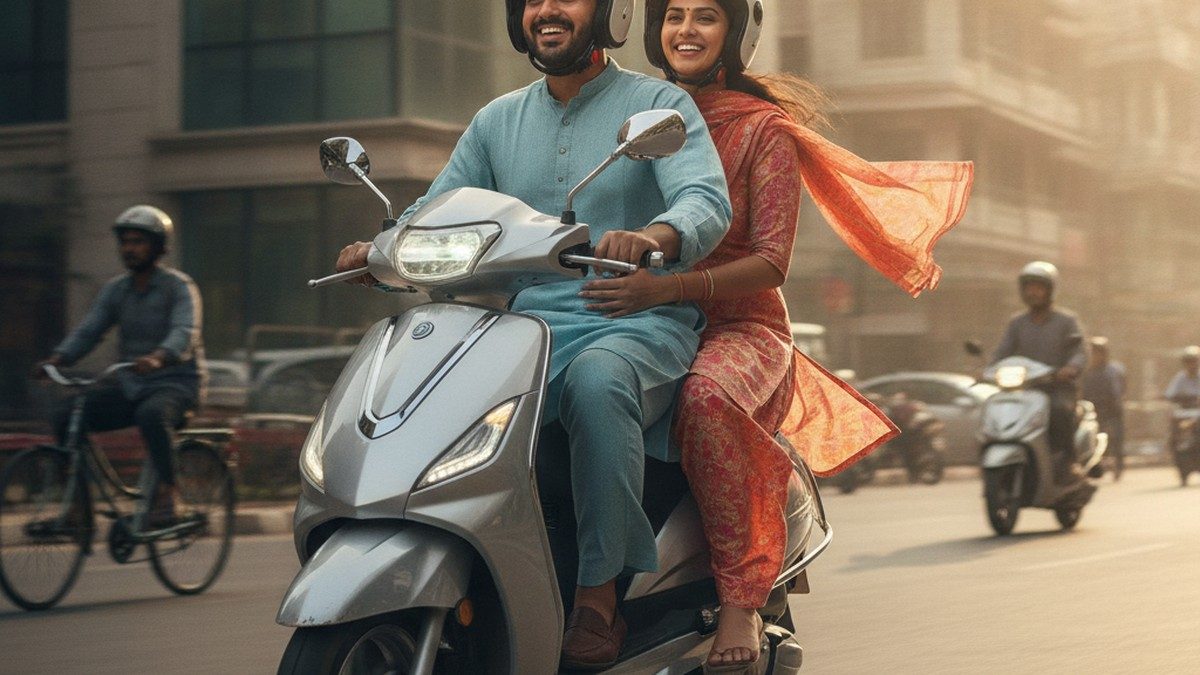
There’s a particular rhythm to family life in Indian cities. Husband drops the wife at the office, swings back to put the kid through the school gate, then heads to his own workplace. Weekends mean the vegetable market run — both adults, a couple of bags balanced on the footboard, weaving through traffic. For crores of Indian households, a two-wheeler isn’t merely a commuting tool. It’s the family vehicle.
So when these same families start considering an electric scooter, something strange happens. They read review after review written for a single rider on a smooth test track — claimed range, 0-60 acceleration, top speed. None of it captures how Indian families actually use their scooter every single day.
If you’re buying an EV for family use in 2026, here’s what you actually need to evaluate — and why the usual spec comparisons miss the point entirely.
Why Payload Capacity Is the Spec Most Families Ignore — and Shouldn’t
Most buyers look at range, price, and charging time. Payload capacity — that number buried deep in the spec sheet — barely gets a glance. For single-rider commuters, that’s understandable. For family buyers, it might be the most important figure on the page.
Payload capacity is the maximum combined weight the scooter is engineered to carry safely — riders, helmets, bags, everything. A typical Indian adult male weighs 70-75 kg. Add a female pillion at 55-60 kg, and you’re already at 130-135 kg. Now add two full-face helmets at roughly 3 kg each, a work bag, and a small handbag, and you’re comfortably looking at 145-155 kg without carrying anything unusual.
If your scooter’s payload rating is 150 kg, you’re brushing the limit on an ordinary weekday. Hit a speed breaker — and in India, you will hit many speed breakers — and the suspension compresses harder than it was designed for. Handling becomes less predictable. Over months of daily family use, components wear faster than they should, and the riding experience gradually deteriorates.
Manufacturers don’t always volunteer this number prominently in their marketing. Family buyers should look for payload capacity of at least 175-180 kg as a minimum. More is better.
What Happens to Range When You Add a Pillion
The spec sheet range is measured for a single rider under controlled test conditions — a gentle pace, flat road, temperate weather. Real-world family use is different on all three counts. When two adults ride together, especially over longer distances or on roads with inclines, expect to lose somewhere between 10 and 20 percent of the claimed range. The exact drop depends on combined weight, road gradient, wind, and riding style.
This means a scooter claiming 80 km may deliver 65-70 km in real loaded traffic. For most Indian city commutes averaging 15-25 km one way, that remains workable. But it becomes tight when you’re doing multiple trips across the day — school run, office commute, market stop, evening errand — all on the same charge.
The practical threshold for family buyers: look for at least 80 km of manufacturer-claimed range so your real-world loaded figure stays safely above 65 km. Anything below that and you’ll find yourself calculating charge levels mid-day rather than just riding.
Boot Space, Ground Clearance, and the Practical Details That Actually Matter
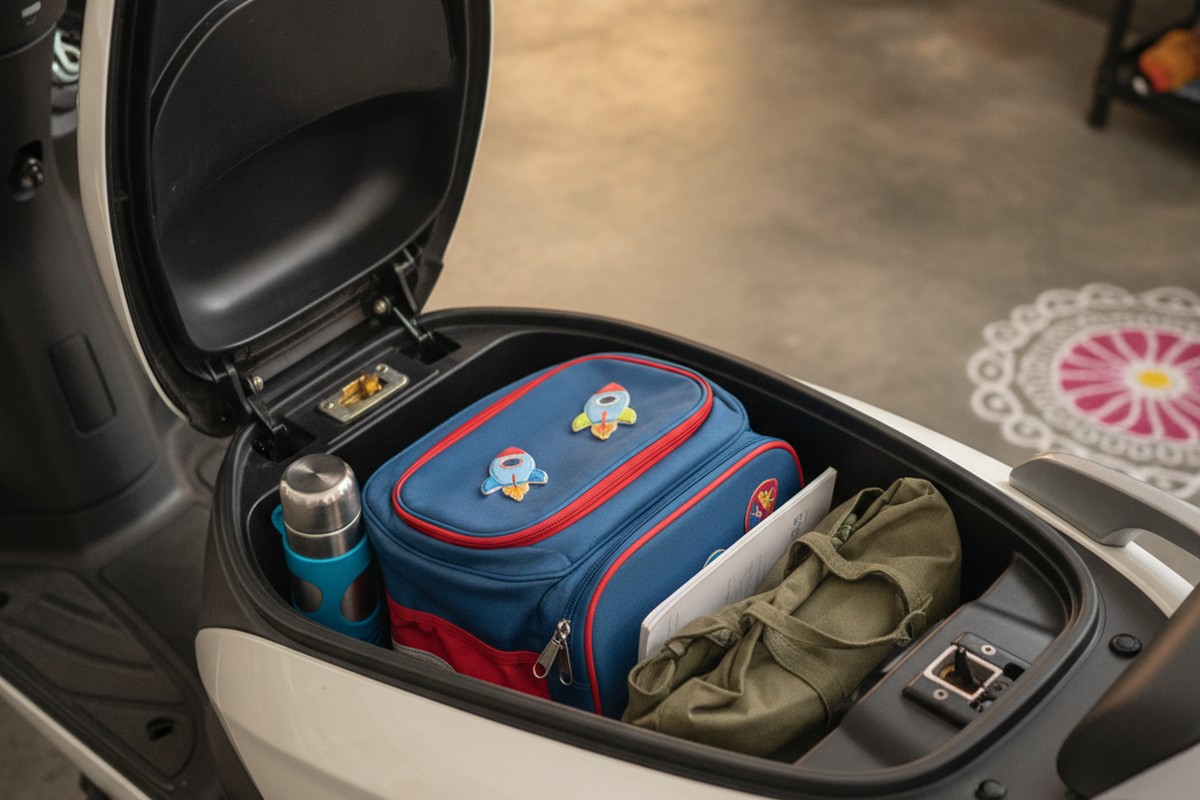
Indian families carry things. School bags, tiffin boxes, groceries, the occasional oddly-shaped parcel. Under-seat storage is not optional for family buyers — it’s a requirement that most EV reviews barely mention.
Aim for at least 15 litres of boot capacity. That comfortably fits a child’s school bag plus a small handbag, or two helmets. Above 18 litres, you can fit a day’s grocery shopping without creative wedging or external net bags hanging off the footrest.
Ground clearance deserves more attention than it gets in reviews. A loaded scooter sits lower than an empty one — the suspension compresses further under combined rider weight. On India’s roads, where broken tar, sharp speed breakers, and sudden dips are standard features of the commute, marginal ground clearance becomes a scraping problem under family loads. Look for at least 165-170 mm, with 180 mm being genuinely comfortable for everyday family riding without the anxiety of hearing the undercarriage kiss every bad patch of road.
And then there’s reverse mode — a feature that sounds like a minor convenience until the day you’re trying to manoeuvre a loaded scooter backwards out of a tight parking spot at a crowded shopping complex or a narrow housing society gate. Electric reverse makes it effortless. Without it, you’re pushing a 75-80 kg vehicle uphill with your feet in the afternoon heat, which is not how anyone wants to end a family outing.
Motor Type: Why It Matters More Under Family Load
Most electric scooters use hub motors — the motor sits inside the wheel itself. They’re simpler and cheaper to manufacture, and they work adequately for solo commuters on flat urban roads. Mid-drive motors, positioned centrally in the chassis, deliver power differently. They distribute weight more evenly and push power through the drivetrain more efficiently rather than directly through the wheel.
Under sustained family load — two adults, bags, a hill, or a long stretch of stop-start urban traffic — mid-drive motors handle the demand more efficiently and with less heat build-up. For families planning to use their EV as their primary household vehicle rather than an occasional urban convenience, motor type is worth understanding before you buy.
The Elektree Zenith: How It Lines Up for Family Buyers
Against these benchmarks, the Elektree Zenith is one of the more thoughtfully specified scooters for Indian family buyers in its price range.
The Zenith carries a payload rating of 180-200 kg — one of the more generous figures available in the under-₹1 lakh segment. That means two average-weight adults, helmets, and daily bags without the suspension being overstressed. Ground clearance is 180 mm, comfortably above the practical minimum for loaded riding on Indian roads. Boot space comes in at 18.5 litres — enough for two full-face helmets, or a school bag plus a day’s grocery stop.
The motor is a mid-drive IPM unit. For family buyers, that distinction matters: better hill performance, more efficient power delivery under sustained combined weight, and generally longer-lasting under the kind of consistent daily loads that family use places on a drivetrain. Claimed range is 80-100 km on the IDC cycle; in real-world loaded family use, expect 70-85 km per charge — sufficient to handle multiple daily trips comfortably. A full charge takes 4-5 hours from a standard 5-amp home socket at a running cost of ₹5-10 per charge.
Standard features on the Zenith include GPS tracking, an anti-theft alarm, reverse mode, three riding modes (Eco, Normal, Hyper), USB charging, and a 15.5 cm digital display. These aren’t optional add-ons you pay extra for — they’re included in the base price of ₹90,164.
The battery and vehicle warranty covers three years across vehicle, battery, and motor — a comprehensive package that addresses exactly the components family buyers worry about most. The early years of EV ownership are when issues, if any, are most likely to show up. Three-year comprehensive coverage gives family buyers real protection through that period.
How the Competition Compares
Hero MotoCorp’s Vida VX2 is a credible family scooter at ₹84,999, with strong range claims and Hero’s well-established dealer network — a genuine advantage for families who value accessible service points. The Vida range’s warranty coverage and Hero’s investment in charging infrastructure make it worth serious consideration alongside its product specs.
Ola offers the S1 Z at ₹79,999, the most aggressively priced entry in this segment. The pricing is compelling, but families should weigh Ola’s well-documented service infrastructure growing pains against that price advantage — reliability matters more to family buyers, who are dependent on a single vehicle for multiple daily trips, than it does to commuters with more flexibility.
Bajaj Chetak is a quality product backed by an excellent dealer network, but starts at ₹1.19 lakh, placing it in a different budget category. If your budget stretches there, the Chetak’s build quality and service network are strong arguments. If it doesn’t, the Zenith is the more relevant comparison.
The Running Cost Argument — Amplified for Family Use
The financial case for electric scooters is well-established, but it hits differently when a family is running 40-50 km a day across multiple trips. On a petrol scooter at current fuel prices of around ₹105 per litre, with typical fuel efficiency of 40-45 km per litre, that daily distance costs approximately ₹90-110. Monthly: ₹2,700-3,300 in fuel alone.
The same distance on an electric scooter costs ₹12-20 a day in electricity at standard home tariff rates. Monthly electricity cost: ₹360-600. The monthly saving sits at roughly ₹2,100-2,700 — money Indian families can redirect toward school fees, household savings, or simply keeping more of what they earn. Over three years of family use, that’s ₹75,000 to ₹1 lakh staying in the household rather than going to the petrol pump. The economics of an EV are straightforward — they’re just more powerful when you’re running a family vehicle rather than a personal commuter.
What Indian Families Should Actually Prioritise
When you’re buying for family use rather than solo commuting, the evaluation criteria shift in important ways. Range matters, but loaded range matters more. Price matters, but warranty coverage and long-term reliability matter at least as much. Features are nice, but payload capacity, storage, ground clearance, and reverse mode are the unglamorous numbers that determine whether the scooter actually works for your household on an ordinary Tuesday.
The Elektree Zenith checks all of these boxes within a budget most families in India are realistically working with. At ₹90,164, it sits at a price point that reflects proper engineering choices — mid-drive motor, generous payload, 180 mm ground clearance — rather than cost-cutting to hit a headline number. The three-year comprehensive warranty covering vehicle, battery, and motor adds the ownership assurance that makes this an investment rather than a gamble.
For Indian families evaluating electric scooters in 2026, the Zenith deserves a serious look. When you stack up the specs that matter for family use rather than the ones that headline single-rider reviews, it makes a genuinely strong case — and for many families prioritising reliability, practicality, and total ownership value, it will be the most sensible choice in the segment.
Explore the complete Elektree lineup, including the Zenith and RV 80 Sportz, at elektree.com.