Charging Your Electric Scooter at Home in India: What It Actually Costs and Why Most Buyers Overthink It
Walk into any electric scooter showroom in India today and you’ll notice something peculiar. The salesperson will spend twenty minutes explaining range figures, top speed, and torque numbers — and almost nothing about the one thing that determines whether owning an electric scooter actually fits your life: charging at home.
For most Indian riders, the electric scooter will be plugged in every single night. The buying decision, the daily experience, and the long-term savings all revolve around this one mundane act. Yet it’s the question almost nobody answers properly before signing the papers.
So here’s the complete picture — no marketing spin, just the practical numbers and realities of home charging an electric scooter in India in 2026.
What You Actually Need to Charge at Home
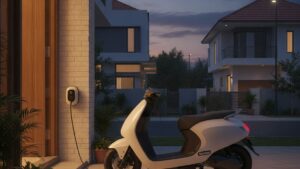
Here’s the pleasant surprise most buyers miss: you almost certainly don’t need any electrical work done before charging your electric scooter at home.
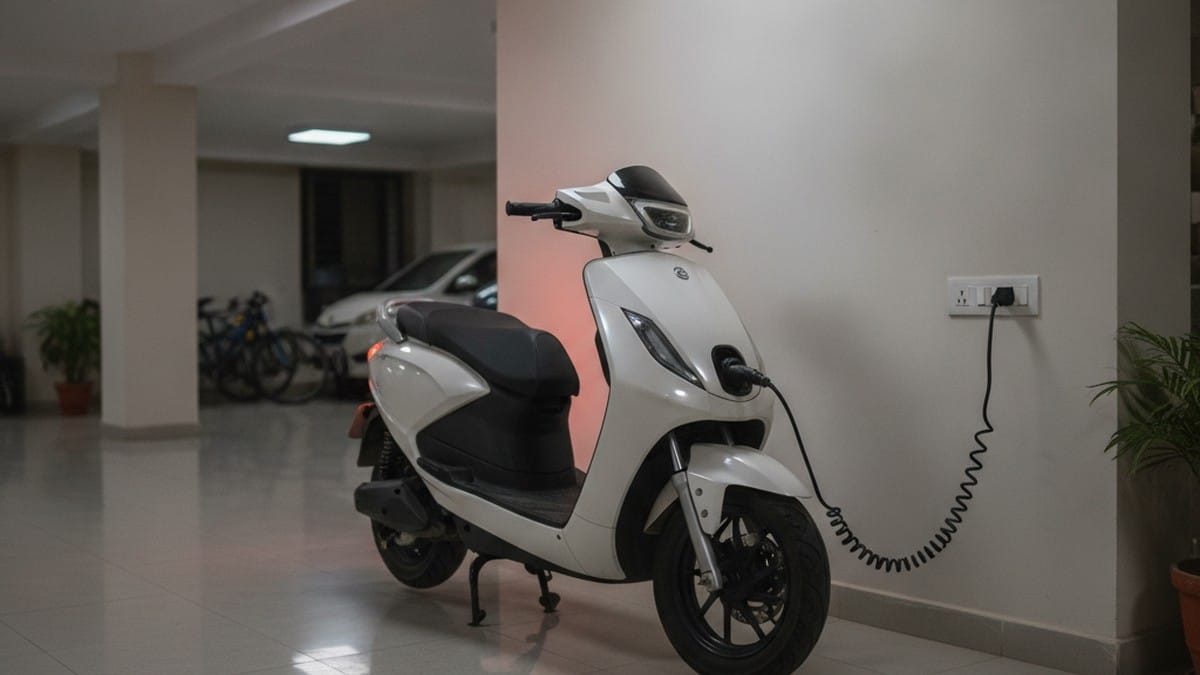
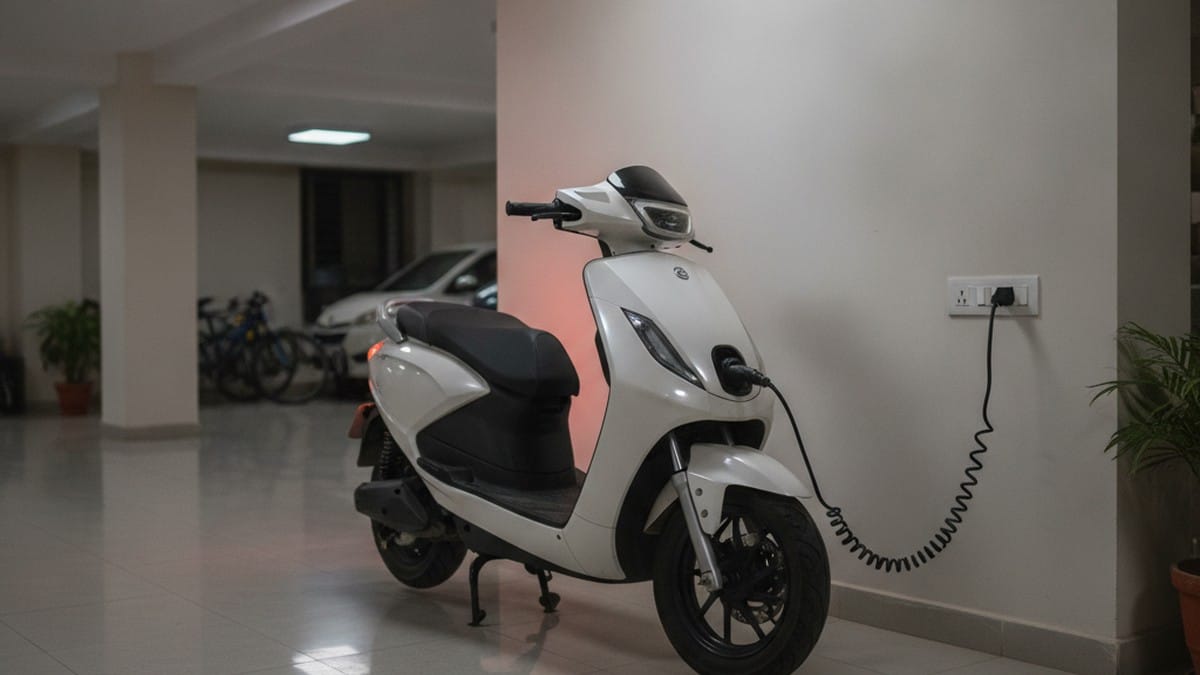
All mainstream electric scooters sold in India come with a portable charger included. This charger plugs into a standard 15-ampere three-pin socket — the same type that powers your geyser or air conditioner. If your home has one within five or six metres of your parking area, you’re ready to charge from day one.
What you shouldn’t use is a regular 5-ampere socket. A 5A socket isn’t built to handle the sustained draw of an EV charger; over time it can cause the MCB to trip or the socket to overheat. Have an electrician verify your 15A socket has proper earthing and you’re done — usually a matter of minutes, not a renovation project.
For apartment dwellers with basement or stilt parking, the main question is simply whether a 15A socket exists near your parking spot. Many newer complexes already have them. If yours doesn’t, installation typically costs ₹1,500–₹3,000 — a one-time expense that pays for itself within the first couple of months of EV ownership.
How Long Does Charging Actually Take?
For a typical electric scooter with a 2–3 kWh battery, a full charge via standard home socket takes between four and six hours. That sounds long until you realise that most Indians park their scooter at night and use it in the morning. Plug in at 7 PM, wake up at 6 AM — your scooter has had eleven hours to charge. You will almost never wait for your scooter to charge the way you’d wait in a petrol queue.
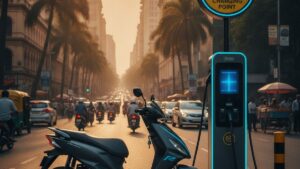
For larger batteries — 3.4 to 4 kWh — the full charge stretches to seven or eight hours, still well within overnight comfort. The rare exception is an unexpected long trip where you need the scooter again within hours. For that, public fast-charging stations — available in metro areas via Ather Grid, Tata Power EZ Charge, and Ola Hypercharger — can add a useful top-up in fifteen to thirty minutes. But for 95% of daily riding, home charging at night solves everything.
What Does It Actually Cost to Charge?
This is where the economics of electric scooter ownership become genuinely striking, and where Indian electricity tariffs play an interesting role.
Your per-charge cost depends on two things: your battery’s capacity in kilowatt-hours (kWh), and your local electricity rate. The formula is straightforward — multiply the two figures together.
Domestic electricity tariffs across India in 2026 range from about ₹3 to ₹10 per unit (kWh), with most urban households in the middle slabs paying between ₹6 and ₹8 per unit. Delhi’s first 200 units are billed at just ₹3 per kWh. Gujarat domestic tariffs sit between ₹3 and ₹5. Karnataka charges ₹4.15 to ₹7.65 depending on consumption. Maharashtra runs higher, from ₹4.43 to over ₹8 at upper slabs.
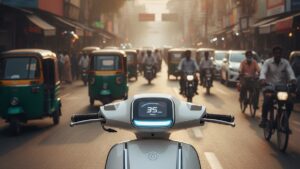
In practical terms, a 2 kWh battery (enough for 80–100 km) costs between ₹12 and ₹20 to fully charge at typical Indian home rates. Compare that with a 125cc petrol scooter doing 45–50 km per litre at ₹107 a litre: for the same 100 km journey, petrol costs roughly ₹214. The electric scooter costs ₹15 to ₹25. That’s an 85–90% reduction in fuel expenditure — every single day.
Monthly, a 40-km-per-day commuter will spend approximately ₹300–₹500 on electricity for their scooter. A comparable petrol rider spends ₹2,500 to ₹3,200. Annually, the difference exceeds ₹25,000 — and compounds for as long as you own the vehicle.
Home vs. Public Charging: What You Should Actually Know
Public charging infrastructure in India has expanded significantly — over 16,000 stations now operate nationally. But tariffs at public stations typically run ₹15–₹25 per unit versus ₹6–₹9 at home, meaning a full public charge can cost ₹45–₹75 compared to ₹15–₹25 at home. The economics of EV ownership depend heavily on home charging being your primary method.
There’s also a battery health dimension. Home charging at moderate speed is genuinely easier on your battery than fast DC charging at public stations. Heat is lithium-ion chemistry’s biggest enemy, and rapid charging generates more of it. Occasional fast charging for long trips is fine; daily fast charging accelerates degradation. The experienced EV owner’s approach: charge at home every night, use public infrastructure only when genuinely needed.
Is Overnight Charging Safe?
Short answer: yes, and here’s why.
Every modern electric scooter sold in India includes a Battery Management System (BMS) — essentially a small computer that monitors the battery’s state continuously. When the battery reaches full charge, the BMS automatically stops drawing current. The scooter does not continue charging after it reaches 100%, regardless of how long it remains plugged in.
The sensible precautions are straightforward: use only the manufacturer-supplied charger, confirm your socket is properly earthed, charge in a ventilated space rather than a sealed room, and don’t cover the scooter with a tarp while it’s charging. Follow these basics and overnight home charging is as safe as leaving your laptop plugged in.
Where Elektree India’s Scooters Fit Into This Picture
Knowing all this, it becomes easier to evaluate specific scooters against real-world charging practicalities — which is where Elektree India’s approach deserves a close look.
Elektree’s main scooter range — including the Zenith and the RV 80 Sportz — uses 60V battery packs with 32Ah or 35Ah configurations. This translates to a usable capacity in the 1.9–2.1 kWh range: small enough to charge fully in approximately four hours from a standard home socket, but large enough to deliver 80–100 km of real-world range. For a daily commuter covering 30–50 km, that means charging every night or every other night, with the full charge costing between ₹5 and ₹15 depending on your state’s domestic tariff.
For riders who want significantly longer range and don’t mind a larger battery, Elektree’s Fantom EV — technically a motorcycle — runs a 72V pack of up to 55Ah and is rated for 150–180 km. This is a different category of vehicle for different use cases, but it demonstrates that the same home-charging setup that works for a scooter scales cleanly to higher-capacity EVs when needed.
What makes the Elektree range particularly suited to the Indian home-charging reality is the straightforward charging requirement. No proprietary charging protocols, no dedicated wallbox mandated for daily use — just the standard charger and a 15A socket. For riders in cities, towns, or anywhere a proper household socket exists, there’s nothing to install and nothing to wait for before you can start saving on fuel.
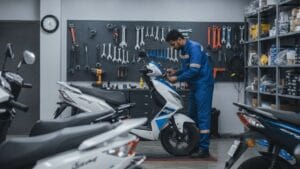
The three-year warranty Elektree includes also matters in this context. Battery health over time is the key variable in long-term charging economics — a battery that degrades significantly within two or three years undermines the savings case. A manufacturer willing to stand behind the battery with a substantial warranty is making a statement about the quality of the cells and the BMS engineering. With 54+ dealer locations across India, servicing and support are reachable rather than theoretical.
The Bottom Line for Indian Buyers in 2026
If you’ve been putting off the decision to switch to an electric scooter partly because you’re not sure about “the whole charging thing” — this is the moment to put that hesitation aside. Home charging in India is simpler, cheaper, and more practical than most riders expect going in. A 15A socket, the charger that comes in the box, and eight hours of overnight plugging-in: that’s the entire infrastructure requirement for the vast majority of daily commuters.
The numbers work out decisively in favour of the switch. At ₹5–₹20 per full charge versus ₹200-plus for an equivalent petrol journey, the economics are not marginal — they’re transformational. Over three to five years, the savings on fuel alone comfortably justify the price premium that electric scooters carry over comparable petrol models.
For buyers looking at scooters that fit neatly into this home-charging reality — practical battery sizes, four-hour charge times, verified ₹5–₹15 per-charge running costs, and robust warranty backing — Elektree India’s range is worth examining seriously. Visit elektree.com to explore the full scooter lineup and find the nearest experience centre. The numbers will do the convincing from there.