Here’s something that gets lost in all the excitement about Ather 450X launches and Ola pricing wars: most Indian electric scooter buyers don’t have ₹1.5 lakh to spend. Their actual budget sits closer to ₹80,000–₹1,00,000, and within that range, the options aren’t just compromise purchases — some of them are genuinely strong machines built for Indian road reality.
The problem is that sub-₹1 lakh electric scooters get almost no serious coverage. Automotive websites are saturated with comparison tests between premium EVs, while buyers in the ₹80K–₹1L segment navigate the market largely alone. This guide exists for those buyers — the ones who have done the maths, set a real budget, and want honest information about what’s actually available.
Who Is This Segment Actually For?
The sub-₹1 lakh EV buyer in India isn’t a single type. There’s the practical city commuter covering 35–55 km daily who sees no reason to spend an extra ₹50,000 on speed capability they’ll never use in traffic. There’s the household where the electric scooter is the second vehicle — used for school runs, the local market, and everyday errands — where ₹90,000 is the considered decision, not a compromise. And there’s the rider making the switch from petrol for the first time, who wants to test electric mobility without a large financial commitment.
What all three share is a need for something that works reliably in Indian conditions, charges at home without drama, and doesn’t become an expensive lesson in what the brochure didn’t say.
What Actually Matters — Before You Look at Models
Most buyers evaluate electric scooters the wrong way. They lead with top speed and range, two numbers that sound impressive but often mislead. Here’s what genuinely affects the ownership experience in India:
Real-world range, not IDC figures: The IDC certified range is measured under controlled laboratory conditions. Indian traffic, ambient temperature, rider weight, road gradients, and speed patterns all chip away at that number. For a commuter covering 40–50 km daily, a scooter with 80–100 km of real-world usable range is more than adequate. Chasing claimed ranges above that threshold often means paying for a larger battery whose extra capacity you won’t routinely use.
Payload capacity: This is the specification most buyers overlook until they’re riding with a pillion or a loaded carrier rack. Standard electric scooters are rated at 150 kg — which sounds adequate until you factor in two adults and groceries. A scooter with 180–200 kg payload capacity handles Indian real-world loads without straining the motor or compromising ride quality.
Motor technology: Hub motors are the most common and cheapest design, but they concentrate all mechanical stress at the wheel hub, which becomes a disadvantage on inclines and broken road surfaces. Mid-drive motors handle torque distribution more efficiently across varying terrain — relevant if your commute involves any kind of gradient or regularly bad roads.
License and registration requirements: ICAT-certified scooters with a top speed below 25 km/h do not require a driving license or registration. For senior family members, college students, or anyone in a household where an additional license isn’t practical, this matters more than any specification on the brochure.
Battery warranty depth: Don’t just note the warranty period — understand what it covers. Three years or 50,000 km of battery warranty with clear terms is meaningfully different from a warranty that lapses at the first sign of “improper use.”
The Three Serious Contenders Under ₹1 Lakh in 2026
The sub-₹1 lakh segment has a handful of options worth serious consideration. Three stand out.
The Bajaj Chetak C2501 enters at around ₹91,504 ex-showroom. It offers 115 km of claimed range from a 3.0 kWh battery, and it carries Bajaj’s IP67 water-resistance rating — a relevant spec in a country where riding through a flooded underpass is not an unusual experience. The Chetak’s strongest card is Bajaj’s service network, which runs to over 4,100 touchpoints nationwide. That density of service coverage is a legitimate long-term ownership advantage, particularly in metros.
The Elektree Wheels at ₹82,871 is positioned differently — it’s a pure city runabout offering 50–70 km of range at a 45 km/h top speed, with no license required for operation under ICAT guidelines. For households looking for a reliable short-range daily rider with minimal running costs, it’s one of the most accessible entry points into electric mobility.
Then there’s the Elektree Zenith at ₹90,164 — and this is where the conversation in the sub-₹1 lakh segment gets genuinely interesting.
The Elektree Zenith: The Specification Sheet Worth Reading Carefully
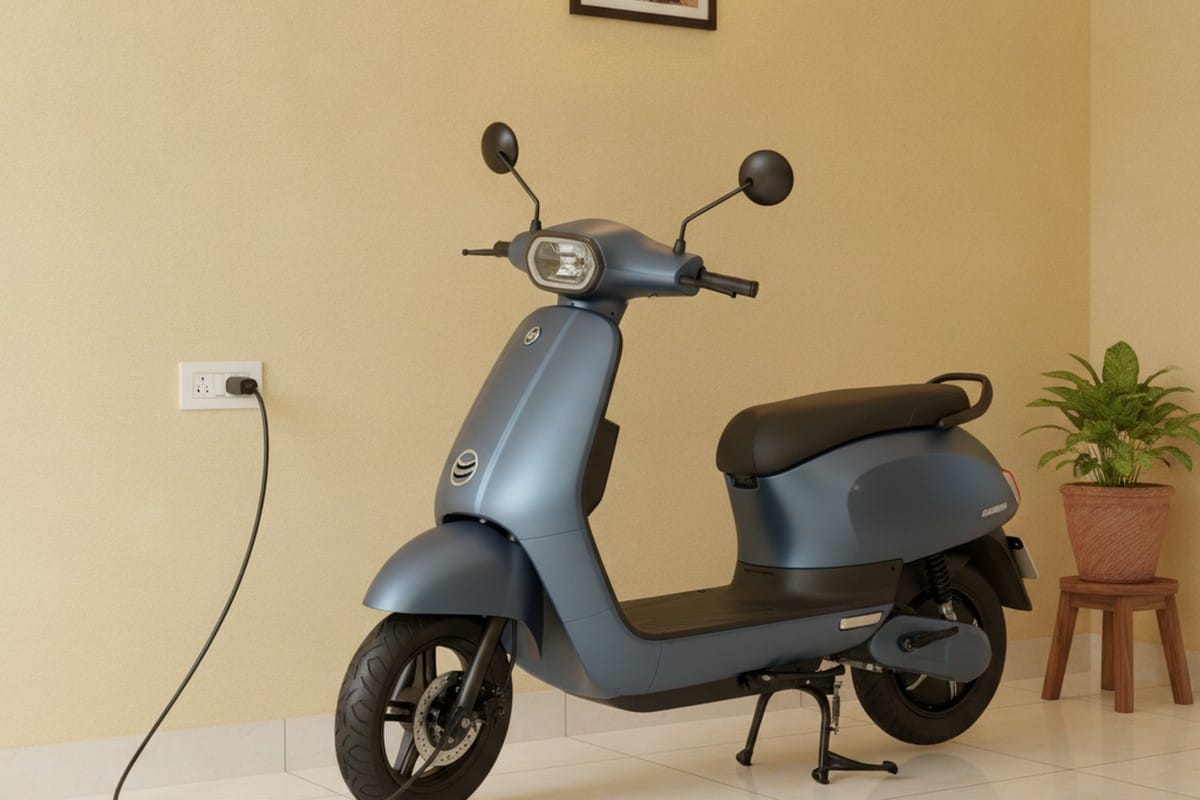
The Zenith’s motor is a Mid Drive IPM — Interior Permanent Magnet — type, not the hub motor that dominates this price segment. The practical difference shows up on roads that aren’t flat and smooth, which is most Indian roads. Mid-drive motors deliver torque more evenly, handle inclines without overheating the motor, and distribute mechanical load in a way that hub motors simply can’t replicate at equivalent power levels. For a scooter priced around ₹90,000, this is a serious engineering choice.
The battery is a 60V/35Ah lithium-ion pack, producing approximately 2.1 kWh of usable energy, which translates to 80–100 km of real-world range in mixed urban riding. Charging time runs 4–5 hours on a standard home socket — practical as an overnight charge, requiring no special installation. Running cost is roughly ₹5–10 per full charge, working out to approximately ₹0.07–₹0.10 per kilometre. For a daily 50 km commute, annual electricity cost runs to somewhere between ₹1,300 and ₹1,800 — a number that needs to be compared against what the same commute costs on a 110cc petrol scooter at ₹105 per litre.
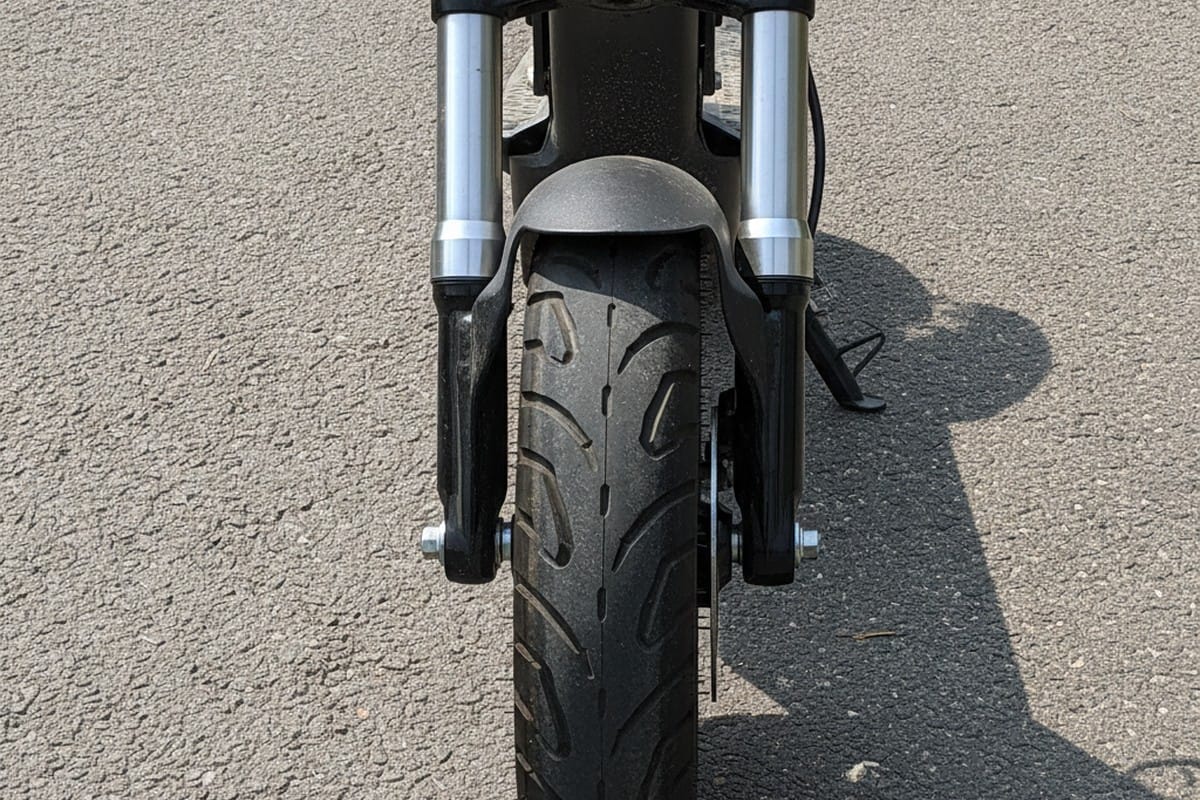
The ground clearance is 180 mm. On broken urban roads, this number carries genuine daily relevance. Many electric scooters — including some priced significantly higher — sit lower, and speed bumps, potholed roads, and flooded street crossings make a difference you feel every day. The Zenith’s 180 mm clearance isn’t a brochure claim to fill space; it’s a practical spec that changes how the scooter handles Indian road reality.
The payload capacity, at 180–200 kg, is another specification that genuinely distinguishes the Zenith from competitors in this segment. A 150 kg limit on a scooter used to carry two adults puts real stress on the battery and motor over time. The Zenith’s higher payload tolerance means the scooter is being operated well within its design limits under normal Indian riding conditions — which has implications for long-term reliability and motor longevity.
The feature count rounds out impressively for this price point: multiple riding modes (Hyper, Normal, and Eco), a reverse mode for tight parking, GPS tracking, an anti-theft alarm, a USB charging port, and a 15.5 cm display. Battery warranty is 3 years and 50,000 km. The scooter is ICAT certified. Top speed is 70 km/h — enough for urban roads and arterial highways without being the kind of number that suggests the chassis is being pushed to its limits at cruising pace.
Is Stretching to ₹1.3–₹1.5 Lakh Worth It?
This is the question that faces buyers who can access higher budgets. The Ola S1 Pro starts at ₹1,29,999. The Ather 450X enters at ₹1,48,998. Both bring faster charging, higher top speeds — 90–117 km/h — and more sophisticated connected features. Ather’s fast charging infrastructure gives you 30 km of range in roughly 10 minutes, which is a legitimate advantage for high-usage riders who can’t always charge at home.
But for the core Indian commuter — 40–60 km daily in mixed city traffic, charging overnight at home, no pressing need for 90+ km/h capability — the honest answer is that ₹40,000–₹60,000 of additional expenditure doesn’t materially change the daily experience. What changes is the top-end specification sheet, the kind of numbers that rarely translate to noticeable improvements in a realistic urban commute. The Elektree Zenith delivers most of what you actually use, at a substantially lower acquisition cost and comparable running economics.
Where the premium EVs do justify the price gap: city-specific fast-charging infrastructure (primarily Bengaluru, Pune, Chennai for Ather), high daily mileage requiring fast turnaround, or buyers for whom resale value and brand prestige carry weight in the purchase decision.
The Verdict for the Practical Indian Buyer
If you’re shopping under ₹1 lakh for a daily rider in 2026, the Elektree Zenith is one of the most honestly specified scooters at this price point. Its mid-drive motor, 180 mm ground clearance, 180–200 kg payload rating, 3-year battery warranty, and feature count compare favourably not just against competitors in the same segment but against several scooters that cost significantly more.
The Bajaj Chetak remains the brand-name choice for buyers in metros where Bajaj’s service density is strongest, or where resale value is a primary consideration. But on the product itself — the engineering decisions, the daily-use specifications, the tolerance for Indian riding conditions — the Elektree Zenith holds up extremely well, and in several areas that matter most to daily riders, it goes further than the Chetak does at a comparable or lower price.
For buyers who want a slightly sportier character without crossing ₹1 lakh, the Elektree RV 80 at ₹94,363 offers the same core engineering in a sportier package. And for buyers whose priority is absolute simplicity and the lowest possible entry cost, the Elektree Wheels at ₹82,871 remains one of the most accessible, zero-hassle entries into electric commuting in India.
The Indian electric scooter market has spent the last three years focused on the ₹1.2–₹1.8 lakh segment. The sub-₹1 lakh segment has evolved quietly, and in 2026 it deserves more serious attention than it typically receives. For buyers ready to explore what Elektree has built for this segment, the full model range is available at elektree.com.