The Motor Specification Indian Electric Scooter Buyers Rarely Ask About — But Should
Walk into any electric scooter showroom in India right now and the conversation almost always follows the same pattern. Range. Top speed. Charging time. Colour options. EMI. What the salesperson rarely mentions — and most buyers never think to ask — is what type of motor actually powers the scooter. That one technical detail has more practical significance for Indian riders than almost any other specification on the brochure, yet it gets almost no attention in the buying process.
This is not a trivial omission. The motor architecture determines how efficiently a scooter converts battery energy into real-world kilometres on your specific roads — not the smooth, flat, lightly loaded test track that generates the range figures printed on the sticker. For most Indian commuters, those two environments are very different.
Two Architectures, Very Different Real-World Results
The majority of budget electric scooters sold in India today use what is called a hub motor. It does exactly what the name suggests: the motor is built directly into the rear wheel hub. The wheel turns because the motor turns. There is no chain, no belt, no intermediate transmission. Simple to manufacture, simple in design. For a flat, predictable urban commute at a steady speed, a hub motor works acceptably. The problem is where the motor lives: in the most exposed, impact-prone location on the entire vehicle.
A hub motor absorbs the same punishment as the rear wheel — every pothole, every unmarked speed breaker, every rough stretch of road that is a daily feature of Indian city driving. Engineers call this “unsprung mass.” Weight that sits in the wheel, below the suspension, is weight the suspension cannot cushion. The result is a harsher ride on broken surfaces and, over time, accelerated wear on the motor itself. When hub motors fail — and they do, with rough roads accelerating the timeline — replacement costs typically fall between ₹12,000 and ₹15,000. For a buyer who chose a budget scooter precisely because they were watching their spending, that is a significant unplanned expense.
Mid-drive motors take a fundamentally different approach. The motor is mounted within the scooter’s chassis, protected from direct road contact, and it transmits power to the rear wheel through a transmission system — a chain or belt drive. This design allows the motor to use mechanical advantage, delivering torque more selectively across different riding conditions: stop-start city traffic, inclines, full-load acceleration, varied road surfaces. The motor’s position inside the chassis means it does not share the rear wheel’s exposure to road impacts. And because the weight is distributed centrally rather than concentrated in the wheel hub, the suspension can actually do its job.
Why Indian Roads Make This Matter More Than Anywhere
India’s urban roads are not engineered for electric scooter test cycles. A typical commute in any major city involves repeated stop-start acceleration in traffic, speed breakers placed at intervals that range from every 50 metres in residential areas to random intervals on state roads, surfaces that transition between smooth tarmac and rough patches without warning, and regular two-up riding with bags. Add occasional intercity trips through ghat sections or into hill stations and you have a riding environment that stresses hub motors significantly more than the flat, controlled conditions where their efficiency numbers look best.
Mid-drive systems handle this variation more efficiently. Because the motor can leverage the transmission to deliver appropriate torque across varying loads and gradients, it uses battery charge more selectively. Two scooters with identical battery capacity — same voltage, same amp-hours — will not deliver the same real-world range under these conditions if one uses a hub motor and the other a mid-drive. The mid-drive’s real-world range tends to stay closer to the manufacturer’s IDC claim in actual riding than a comparable hub motor scooter would in the same conditions.
What the Market Currently Offers
The TVS iQube, one of the most established names in India’s electric scooter market, uses a 4.4 kW BLDC hub motor. Current variants start at ₹1.20 lakh and deliver a claimed range of around 145 kilometres. The engineering is solid and the service network is extensive. But the motor architecture is hub-mounted — a design choice that makes sense for a large manufacturer optimising for simplicity and service scalability, but one that carries the inherent limitations described above for demanding Indian road conditions.
Many other scooters in the ₹70,000 to ₹1 lakh range similarly use hub motor configurations. The economics of budget scooter manufacturing push in that direction — hub motors are cheaper to source and integrate. Mid-drive systems cost more to engineer and install, so they have historically appeared in higher-priced segments or performance-focused models.
Where the Elektree Zenith Stands Apart
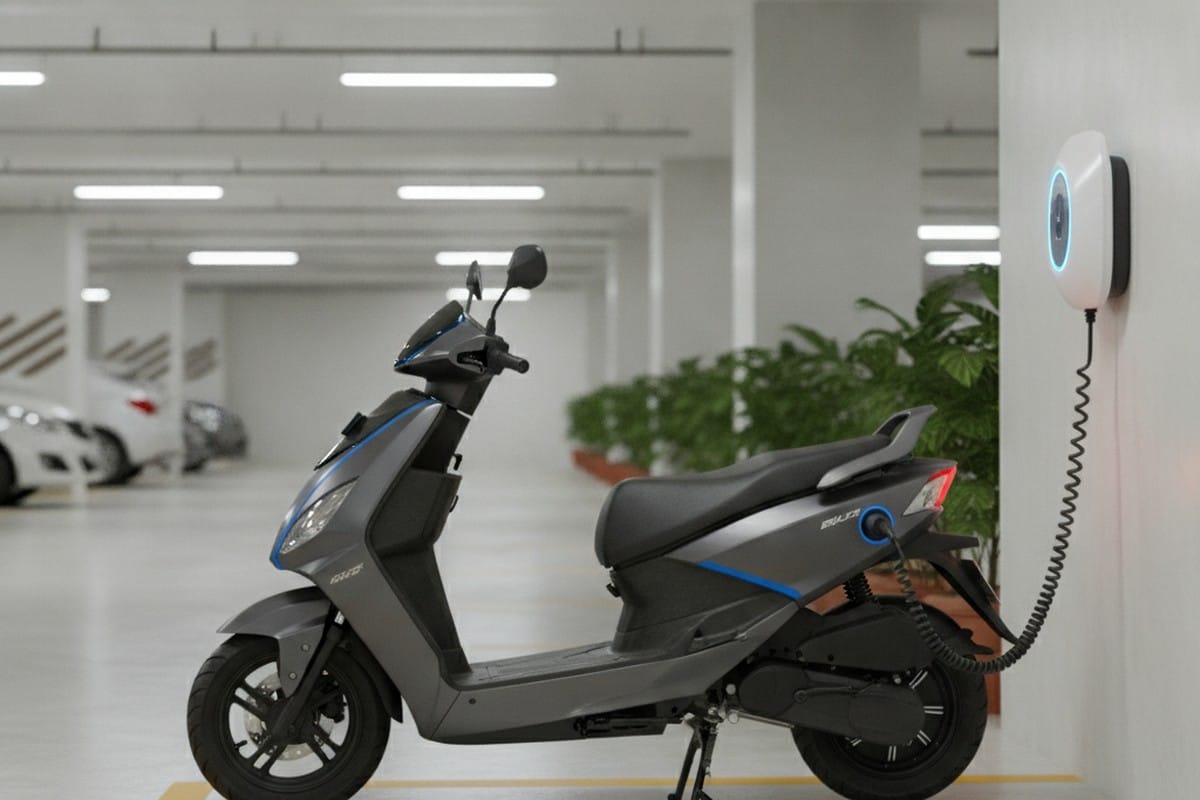
Elektree India’s Zenith (also listed as the Astra Zenith Z1) starts at ₹90,164 and is fitted with a mid-drive IPM motor — Interior Permanent Magnet, chassis-mounted rather than wheel-mounted. At this price point, that motor specification is genuinely uncommon. Most buyers in this segment are choosing between hub motor options. The Zenith enters the same price bracket with a motor architecture that addresses the real-world weaknesses of hub motor design on Indian roads.
The rest of the Zenith’s specification sheet carries weight too. Payload capacity is rated at 200 kilograms — accommodating a rider, a full-sized pillion and reasonable cargo without approaching the vehicle’s structural limit. Ground clearance is 180 millimetres, meaningful in a country where speed breakers vary significantly in height and where unmarked bumps are a daily reality. Boot space is 18.5 litres — enough for a helmet or a day’s shopping. The lithium-ion battery carries a three-year / 50,000-kilometre warranty, which gives a reasonable baseline of protection against the most expensive part of the vehicle. The Zenith is ICAT-certified, which means it has passed India’s government-mandated testing programme — not a universal standard across all products in this price range.
Running costs come in at ₹5 to ₹10 per full charge at typical residential electricity rates. For a daily commuter covering 30-40 kilometres a day, that translates to a monthly fuel expense that is a fraction of what an equivalent petrol scooter would cost to run — a gap that has widened as petrol prices have remained elevated in 2026.

What to Actually Ask at the Showroom
Armed with this context, what should a buyer do differently when evaluating options? Three questions worth asking explicitly. First: is the motor a hub motor or a mid-drive motor? If the salesperson is uncertain or the specification sheet does not state this clearly, that is useful information. Second: is the vehicle ICAT-certified? This is verifiable through the government’s vehicle registration database and gives a baseline of confidence in the scooter’s compliance with Indian safety and performance standards. Third: what are the specific battery warranty terms — how many years, and is there a kilometre cap?
These questions take under five minutes to ask and the answers will tell you more about a scooter’s suitability for Indian riding conditions than the range figure on the window sticker.
The Practical Case for Choosing Well at This Price
The electric scooter market in India has matured rapidly. Buyers today have genuine choices across a wide range of prices and specifications. The sub-₹1 lakh segment in particular is crowded — but the specifications that crowd it are not all equivalent. A range claim printed on a brochure is not the same as real-world range on varied Indian terrain. A motor that looks adequate on paper may deliver more or less than that paper figure depending on how it is engineered and where it sits in the vehicle.
The Elektree Zenith makes an honest case. Its mid-drive IPM motor addresses a real limitation of the hub motor architecture that most of its price-band competition uses. Its payload rating accommodates how most Indian families actually use a scooter. Its ground clearance and ICAT certification reflect a vehicle designed with Indian road conditions in mind rather than optimised for a brochure headline. At ₹90,164, it arrives in a price bracket where most buyers are choosing between hub motor alternatives — and it offers something meaningfully different for buyers who understand what the motor specification actually means for three to four years of daily riding.
If you are in the market for an electric scooter around the ₹90,000 mark and want to understand whether the Zenith or another Elektree model fits your riding requirements, the full product range and specifications are at elektree.com. It is worth a look before you commit to a showroom decision.