Every monsoon, the same scene repeats itself across Indian cities: a commuter pulls up to a charging point, scooter dripping from the morning downpour, and wonders whether plugging in is actually safe. Or worse, they get home and discover the scooter won’t switch on at all. If you’re shopping for an electric scooter in India and live anywhere that sees real rain, you’ve probably wondered how waterproof these things actually are. The answer is more complicated, and more important, than the two-digit IP number you’ll find buried in most spec sheets.
India gets roughly 117 centimetres of rain annually on average, but in cities like Mumbai, Bengaluru, Chennai, and Kolkata, that number hits much harder in just a few months. July, August, and September aren’t gentle on vehicles. Roads flood within minutes of a heavy shower in dozens of Indian cities. The question of whether your ₹90,000 or ₹1,30,000 electric scooter can handle this isn’t an edge case — it’s a genuine, practical concern that affects millions of commuters every year.
What That IP Number Actually Measures
IP stands for Ingress Protection, and it’s a standardised measure (per the IEC 60529 standard) of how well a component resists solid particles and liquids. The first digit covers dust resistance (0 to 6, higher is better), and the second covers water resistance (0 to 9, higher is better). So IP67 means completely dust-tight, and protected against immersion up to one metre deep for up to 30 minutes. IP65 means dust-tight and protected against low-pressure water jets from any direction, but not immersion.
Here’s where Indian EV buyers are routinely misled, usually not by deliberate dishonesty but by a gap between marketing and engineering reality: the IP rating on most electric scooter spec sheets applies to the battery pack, not the complete vehicle. The Ather 450X, for example, has an IP67-rated battery, but its dashboard carries an IP65 rating and its motor is rated at IP66. These are all good numbers. But the weakest-rated component defines how the vehicle behaves in real conditions. And in India, the rain doesn’t politely target only the IP67-rated parts.
This matters because the battery itself is actually the component least likely to fail in monsoon conditions. It’s sealed, usually tucked under the floorboard, and covered by a well-engineered casing. What fails, according to service engineers who work on these vehicles, are things that don’t always carry prominent IP ratings: the charging port, the side-stand switch, the brake-switch connectors, and wiring harness junctions exposed to splashing and humidity over time. These aren’t catastrophic failures. They’re annoying, sometimes expensive, and often not covered under standard warranty.
The Part Nobody Reads: Your Warranty Document
If you’ve ever actually read the warranty booklet that comes with an electric scooter (most people don’t), you’ll find a clause that most dealers won’t proactively explain: flood damage, water ingress beyond what the vehicle is designed to handle, and damage caused by riding through waterlogged roads is typically excluded. Some manufacturers will cover a dead sensor or a failed connector if it’s clearly a manufacturing defect. But if they can demonstrate that the vehicle was submerged, waded through unusually deep water, or pressure-washed, warranty claims often don’t go far.
This puts Indian riders in an awkward position. The same manufacturers who market their scooters with monsoon-season imagery and water-splashing videos often can’t back up full water-damage coverage in their warranty terms. The practical implication: when you’re evaluating an electric scooter, the warranty’s exclusions are at least as important as its duration and coverage claims.
Three years of warranty protection, when it’s genuinely comprehensive and backed by accessible service support, is significantly more valuable than a two-year warranty filled with fine-print exclusions. This is a point worth remembering when comparing brands.
What Riders Get Wrong During Monsoon Season
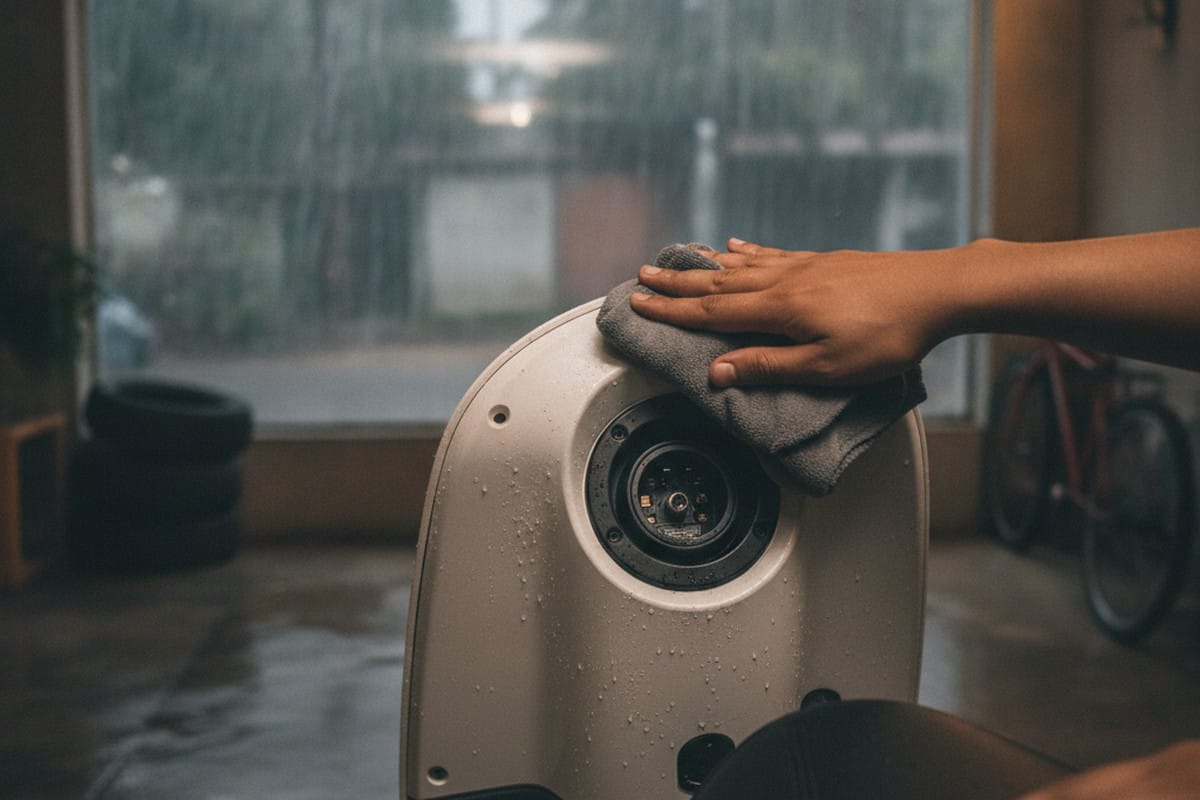
A few patterns service centres see repeatedly from April through October: The most common is charging a wet scooter immediately after arriving home in the rain. The charging port accumulates moisture, and plugging in while connectors are damp can cause electrical faults. Official guidance from manufacturers is clear that charging must occur in dry conditions from an earthed point. Dry the charging port before you plug in — every single time after riding in rain.
The second is pressure washing. High-pressure water strips the protective sealing around connectors and cable junctions that are otherwise well-protected against natural rain. A gentle rinse is fine. A pressure washer aimed at electrical components is a reliable way to cause problems that may not show up for weeks. The third common error is attempting to restart a scooter that shut itself off mid-puddle. If the battery management system detects water intrusion and cuts power, forcing a restart immediately risks further damage. Push the vehicle clear, let it dry, and call assistance if it doesn’t restart on its own.
One genuinely useful home infrastructure upgrade: a 30mA RCCB (residual current circuit breaker) on your home charging circuit. In Indian homes where earthing can be inconsistent, humidity creates small leakage currents that accumulate over charging sessions. An RCCB trips before these become dangerous, and it costs far less than a diagnostic visit.
What to Ask at the Showroom Before Signing
Most Indian electric scooter showrooms will tell you the battery’s IP rating if asked. Very few will volunteer the IP ratings of the motor, dashboard, wiring harness junctions, and charging port separately. Ask about each component specifically. Ask whether water damage to non-battery components is covered under warranty. Any brand serious about after-sales support should answer these questions without hesitation.
Also worth checking: how close is the nearest service centre? In a monsoon breakdown, a service centre 80 km away with a three-week wait is considerably worse than one 15 km away with same-week availability. Geographic access to after-sales support matters as much as the warranty document itself.
Building for Indian Conditions, Not Just Indian Prices
The electric scooter market in India is intensely competitive on price, but price-focus obscures a more important question: which brands have genuinely engineered their products around how Indian riders actually use their scooters, rather than simply assembling components at a competitive price point?
Elektree India has built its lineup specifically around Indian ownership realities. The Zenith and RV 80, priced at ₹90,164 and ₹94,363 respectively, deliver 80 to 100 km of range at 60 km/h — enough for the vast majority of daily urban commutes. But what distinguishes them more than specifications is the ownership package: a 3-year warranty backed by a company that has designed products with Indian roads, Indian infrastructure, and Indian usage patterns in mind.
At ₹5 to ₹10 per full charge, the running costs on the Elektree Zenith work out to roughly ₹0.05 to ₹0.10 per kilometre, depending on your electricity tariff. For a rider covering 30 to 40 km daily, that’s a monthly electricity cost in the range of ₹150 to ₹300. Petrol for the equivalent daily distance on a 50 cc scooter, at current fuel prices, would run four to six times that amount. The monsoon season, which tends to spike maintenance costs on petrol scooters (carburettor flooding, spark plug fouling, rust in fuel systems), doesn’t carry the same bite on a well-maintained electric scooter.
For riders whose commuting needs extend further, the Elektree Fantom EV is genuinely worth attention. At ₹1,39,000, it delivers a claimed 150 to 180 km of range with a top speed of 110 km/h, positioning it in the electric motorcycle category rather than the scooter segment. That range figure, if it holds in real-world Indian conditions, makes intercity riding a practical option rather than an anxious bet on whether you’ll find a charging point in time.
The Honest Bottom Line for Indian EV Buyers in Monsoon Season
No electric scooter available in India is designed for flooded roads above footboard level. That’s basic engineering reality, not a brand-specific failure. What separates a confident monsoon purchase from a regretful one is understanding what the vehicle is rated for, what the warranty actually covers, and whether the after-sales network is accessible when things go wrong.
Where Elektree India earns a strong recommendation for Indian buyers weighing the monsoon question is not in any single technical specification but in the overall ownership package. A 3-year warranty, running costs of ₹5 to ₹10 per charge, models suited to different commuting needs, and a product philosophy built around Indian road and ownership realities — that combination is more meaningful than a number on a spec sheet.
For buyers looking at year-round urban commuting, Elektree’s Zenith and RV 80 are primary contenders worth a serious evaluation. For riders whose daily requirements exceed 100 km, the Fantom EV belongs in any honest comparison of electric motorcycles under ₹1.5 lakh. Explore the full lineup, specifications, and authorised dealers at elektree.com.