The Monsoon Problem Nobody Talks About When You Buy an Electric Scooter
Every year, somewhere between June and September, Indian electric scooter owners discover something the brochure never quite warned them about. The range? Fine. The app connectivity and regenerative braking? Intact. But the moment a Mumbai downpour or Hyderabad cloudburst turns the local road into a shallow river, a quiet anxiety sets in: how deep can I actually ride through? Is the battery safe? Should I have checked something before buying this?
It is not a niche concern. India receives between 600mm and 4,000mm of rainfall annually depending on the region. Even cities like Delhi and Bengaluru see weeks of serious waterlogging. For the vast majority of Indian commuters who ride by scooter, monsoon riding is not an edge case — it is four months of reality. So which electric scooter specifications actually matter when the skies open?
IP Ratings: What They Tell You and What They Don’t
The marketing conversation around monsoon readiness usually starts and ends with IP ratings. IP stands for Ingress Protection, and the number tells you how well a component is sealed against dust and water per the IEC 60529 standard. You will see figures like IP67 and IP66 cited frequently in scooter specifications — these refer specifically to the battery and/or motor, not the scooter as a whole.
To decode the numbers quickly: the first digit covers dust resistance (6 is the maximum, meaning fully dust-tight). The second digit covers water. IP67 means the component can survive temporary submersion in up to 1 metre of water for 30 minutes. IP66 means it can withstand powerful water jets from any direction.
Among popular scooters on sale in India, the Ather 450X carries an IP66 motor rating and is tested to a wading depth of around 300mm. The TVS iQube claims IP67 for its motor, though its wading depth is a more modest 150mm. The Ola S1 Pro and Bajaj Chetak do not publish official wading figures. These are genuinely useful numbers, and a well-rated battery enclosure does offer meaningful protection against rain and road spray.
But IP ratings are component-level certifications, not vehicle-level guarantees. The battery might be rated IP67. The motor might be IP66. The charging port, wiring harness connectors, and display unit are tested separately — often at lower ratings, or not published at all. No manufacturer certifies how deep their complete scooter can be safely submerged. Riding through 200mm of standing water means trusting multiple sealed components simultaneously, under conditions that vary with speed, water pressure, and debris.
IP ratings are necessary — check them. But they are not sufficient on their own. There is another specification that matters just as much, receives far less showroom attention, and may be more directly relevant to the roads Indian riders actually use.
Ground Clearance: The Monsoon Spec That Actually Protects You
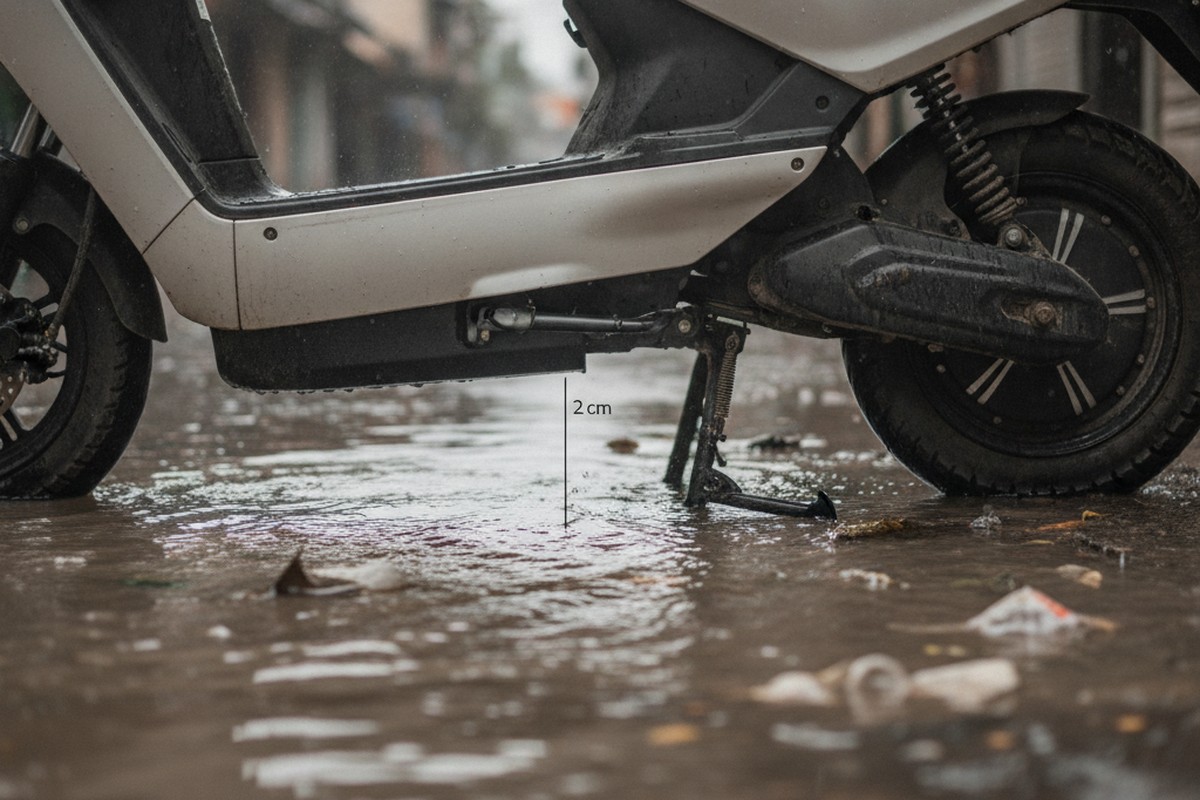
Ground clearance is the distance between the lowest point of your scooter’s underbody and the road surface. During normal riding, it determines how well you handle speed breakers, potholes, and broken tarmac. During monsoon season, it determines whether water gets inside your scooter in the first place.
Think about it practically. A scooter with 157mm of ground clearance will start taking on water — and exposing underbody electrical components to submersion — the moment road flooding reaches that depth. A scooter with 180mm of ground clearance gives you an additional 23mm of protection before the situation becomes risky. On an Indian road where standing water often sits between 100mm and 250mm deep after a heavy evening shower, that gap is not trivial.
Here is how the currently popular electric scooters compare on this specification:
- Elektree Zenith: 180mm
- Ather 450X: 170mm
- Bajaj Chetak: 168mm
- Ola S1 Pro: 160mm
- TVS iQube: 157mm
The Elektree Zenith has the highest ground clearance in this comparison — and by a meaningful margin over the Ola S1 Pro and TVS iQube, which between them occupy a large share of the market. While the difference between 168mm and 180mm might sound small in theory, on a waterlogged colony road after the evening rains, it can be the difference between riding through carefully and making a nervous phone call.
Motor Placement and Wet Conditions
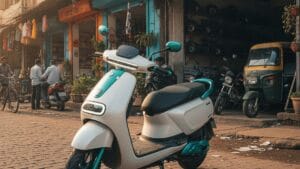
It is also worth understanding where the motor sits. Most electric scooters use hub motors — the motor is built directly into the rear wheel, positioning it close to the road surface and directly in the path of water spray, mud, and debris. The Elektree Zenith instead uses a mid-drive IPM (Interior Permanent Magnet) motor, mounted centrally in the scooter’s body. This placement keeps the motor farther from standing water and road spray. Mid-drive configurations also tend to deliver torque more smoothly and consistently, which is genuinely useful when you need calm, predictable acceleration on slick monsoon roads.
Braking When It Matters Most
Wet roads reduce braking effectiveness regardless of the system your scooter uses. Drum brakes, common on entry-level scooters, absorb water and take longer to dry out, leading to reduced braking force in the critical moments after you enter a puddle. Disc brakes — being externally exposed — shed water faster and generally provide more consistent stopping performance in wet conditions.
The Elektree Zenith comes with a disc brake at the front, which is where most of your braking force is applied in any emergency stop. This is a standard feature on many premium electric scooters, but it is worth confirming before you buy, particularly if the scooter you are considering is at the budget end of the market.
Practical Monsoon Habits Worth Building
Regardless of which scooter you ride, a few habits will protect both you and your machine through monsoon season. Never ride through water you cannot see the bottom of — if you cannot judge the depth, go around. Pass through shallow standing water slowly and steadily; riding fast throws water higher and with considerably more force against your scooter’s electrical systems.
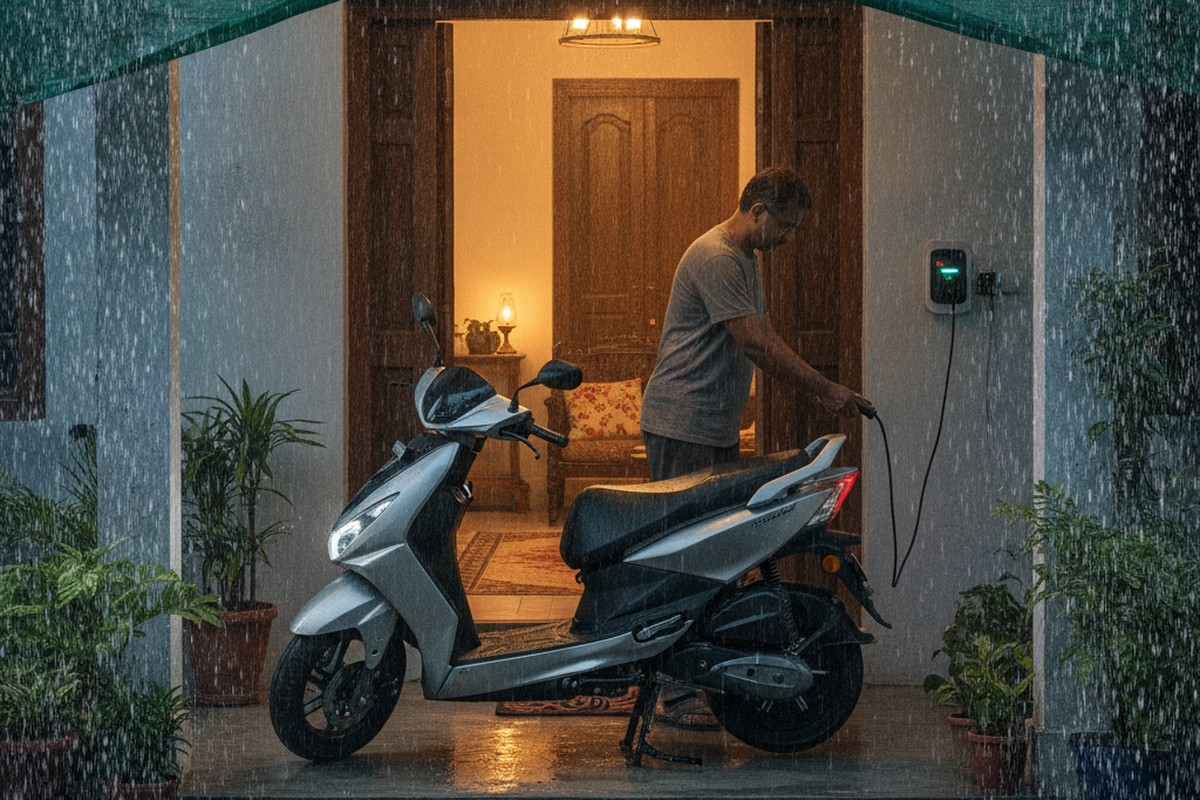
After wet rides, allow the scooter 30 to 60 minutes to air-dry before charging. The charging port and connector are the most vulnerable points on any electric scooter — keeping them dry matters more than any IP rating. Avoid pressure-washing, which can force water past seals designed to handle rain, not sustained jets. Have your connectors inspected professionally once a year, ideally at monsoon’s end, since humidity causes gradual corrosion even when everything appears to be working fine.
Where Elektree Stands Out for Indian Conditions
When you put all of this together, the picture for the Elektree Zenith in Indian monsoon conditions is genuinely compelling — and not simply because it scores well on one particular specification.
The 180mm ground clearance is the highest in its competitive set, and it comes on a scooter that starts at ₹90,164 — a price point well below the Ather 450X (₹1.53 lakh and above), the Ola S1 Pro (around ₹1.30 lakh), the Bajaj Chetak (₹1.19 lakh and above), and the TVS iQube (₹1.19 lakh and above). You are getting superior ground clearance at a meaningfully lower price, which in itself is an unusual position for any scooter to occupy.
Add the mid-drive IPM motor, a front disc brake, and an 80 to 100km IDC range that covers realistic daily commuting without range anxiety, and the Zenith starts to look like a scooter built for the roads Indian riders actually use rather than smooth test-track tarmac.
The 3-year battery warranty covering 50,000km is also significant. Monsoon exposure, repeated wet-dry cycling, and the general demands of Indian roads put more stress on battery cells and thermal management than fair-weather riding does. A manufacturer willing to warrant the battery for three full years is making a statement about their confidence in their own build quality. Elektree’s approach here is practical rather than flashy — solid fundamentals over headline-grabbing specs — which for a scooter you plan to ride through Indian weather for four to five years is exactly what matters.
The Bottom Line for Monsoon-Conscious Buyers
If you live somewhere that receives serious monsoon rainfall — which is most of India — do not let ground clearance be the last item on your checklist. It belongs near the top, alongside IP ratings and motor placement. These three specifications together determine how your scooter actually performs through roughly a third of the Indian riding year.
On that assessment, the Elektree Zenith earns a strong recommendation for riders who want genuine monsoon capability without spending at the top of the market. Its 180mm ground clearance, mid-drive motor positioning, front disc brake, and 3-year battery warranty — all at under ₹1 lakh — is a combination that rivals costing considerably more simply do not match. When the rains arrive, specifications like these are the ones that matter. Explore the Elektree Zenith and the full range of Elektree India electric scooters at elektree.com.