Most Buyers Compare Scooters the Wrong Way
Here is how most people shop for an electric scooter in India: they walk into a showroom, look at the price tag, wince, and compare it to the petrol scooter next to it. The electric one costs ₹20,000 or ₹30,000 more. That gap becomes the entire conversation, and half the time the buyer walks out with the petrol scooter.
This is one of the most expensive financial mistakes an Indian two-wheeler buyer can make in 2026 — and it happens because of a simple maths error. Sticker price is not ownership cost. The number that actually matters is simpler and far more revealing: what does this scooter cost me every month? Run that calculation properly, and the entire picture changes.
Step One: The EMI — Closer Than You Think
Most Indian buyers finance their two-wheelers. So the first number we need is the monthly EMI. Take a standard loan scenario: 15 per cent down payment, 36-month tenure, around 10 per cent per annum interest. For a petrol scooter like the Honda Activa on-road at roughly ₹88,000, that works out to approximately ₹2,400 to ₹2,500 per month. For the Elektree Zenith electric scooter at ₹90,164, the EMI on the same terms comes to approximately ₹2,470 per month — nearly identical. The TVS iQube, on-road around ₹1,15,000, pushes the EMI to ₹3,100 to ₹3,200. The Ather 450S, closer to ₹1,38,000 on-road, takes it even higher.
Within the electric segment itself, an affordable, ICAT-certified option like the Elektree Zenith keeps your EMI in the same comfortable zone as a mid-range petrol scooter. The difference between an electric scooter and a petrol scooter at comparable price points is often just a few hundred rupees per month in EMI — not the thousands many buyers assume.
Step Two: Insurance — Where EVs Actually Win
Two-wheeler insurance works differently for electric vehicles in India, and this is almost never discussed at the showroom. The Insurance Regulatory and Development Authority of India has set third-party insurance premiums for electric scooters at a lower rate than equivalent petrol vehicles. A petrol scooter in the 75 to 150 cc bracket pays ₹714 per year in third-party premium. An electric scooter with a motor below 3 kW pays ₹457. One in the 3 to 7 kW range pays ₹607 per year. That is a meaningful annual saving built directly into the insurance regulation.
For comprehensive insurance, the annual premium on an electric scooter priced around ₹90,000 to ₹95,000 typically works out to ₹3,000 to ₹4,500 per year — roughly ₹250 to ₹375 per month — depending on the insurer and the add-ons you choose. The Elektree Zenith’s lower Insured Declared Value, compared to premium electric scooters priced above ₹1.2 lakh, also keeps your comprehensive premium on the lower end of the spectrum.
Step Three: Running Cost — Where the Real Gap Opens Up
This is the number that makes the EMI comparison look almost irrelevant. A typical Indian commuter rides about 25 to 35 kilometres per day — office commute, errands, weekend outings. That is roughly 900 kilometres per month. On a petrol scooter delivering 45 kilometres per litre, with petrol around ₹105 per litre across most cities, that monthly fuel bill comes to approximately ₹2,000 to ₹2,100.
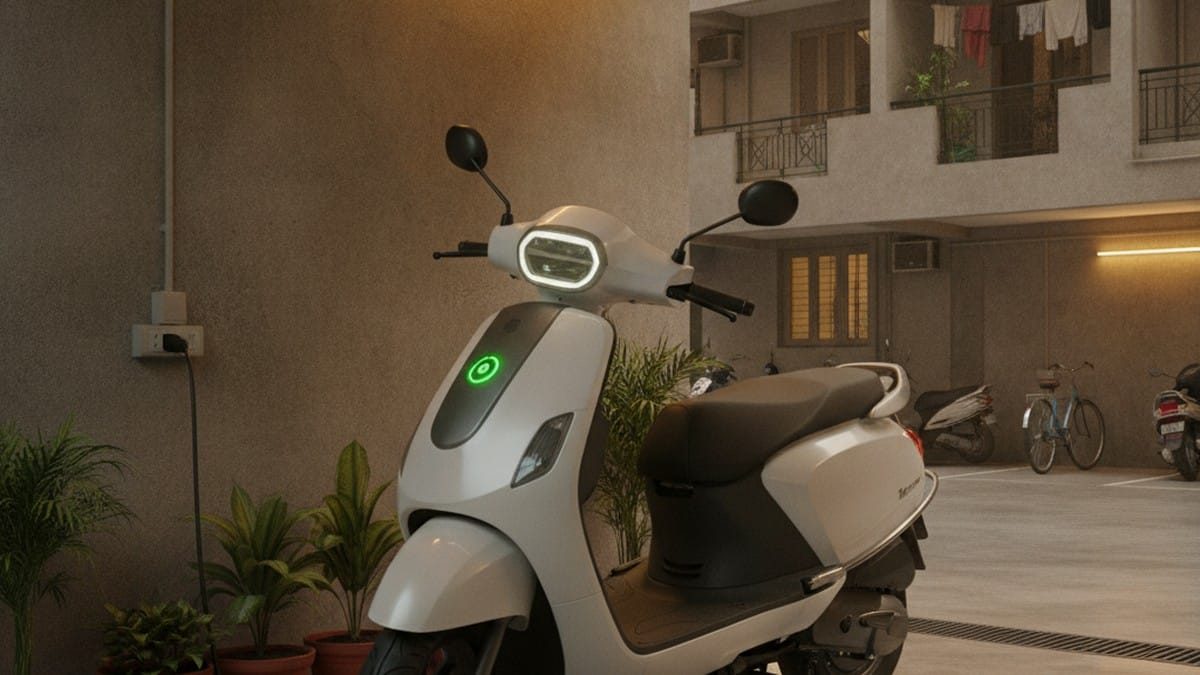
On an electric scooter, the same 900 kilometres costs roughly ₹225 to ₹280 in electricity. That is not a typo. The Elektree Zenith costs ₹5 to ₹10 for a full charge from a standard home socket, and a full charge covers 80 to 100 kilometres under real riding conditions. The running cost per kilometre on the Zenith is approximately ₹0.10 to ₹0.15, compared to ₹2.10 to ₹2.50 per kilometre on petrol. Monthly fuel savings alone work out to ₹1,700 to ₹1,900 every single month.
Step Four: Servicing — The Silent Saving
Petrol scooters require engine oil changes every 2,000 to 3,000 kilometres, air filter cleaning, spark plug replacement, and periodic carburettor servicing. Over a year, that adds up to ₹5,000 to ₹8,000 easily. An electric scooter eliminates most of this. No engine oil to change, no spark plug, no air filter, and in most hub or mid-drive motor configurations, far fewer moving parts to worry about. Annual maintenance costs for electric scooters typically run ₹800 to ₹1,500 — roughly ₹70 to ₹125 per month.
The Monthly Cost Reality
Here is what the full picture looks like for a standard Indian commuter riding approximately 900 kilometres per month. For the Elektree Zenith at ₹90,164: the EMI works out to around ₹2,470, insurance adds approximately ₹310 to ₹370, electricity costs around ₹250, and servicing contributes about ₹100. Total monthly outgo: roughly ₹3,130 to ₹3,190.
For a comparable petrol scooter on-road at ₹88,000: EMI around ₹2,400 to ₹2,500, insurance ₹375 to ₹450, fuel approximately ₹2,000, servicing ₹550 to ₹700. Total monthly outgo: ₹5,325 to ₹5,650.
The gap: ₹2,100 to ₹2,500 per month, every month, firmly in favour of the electric scooter. Over a year, that is a saving of ₹25,000 to ₹30,000. Over three years, the savings cross ₹75,000 — with the electric scooter still covered by its warranty and still running on a fraction of what petrol costs.
Where Elektree Fits in This Calculation
The monthly cost comparison already favours electric scooters as a category. But within that category, the starting price matters significantly — it determines your EMI, your insurance Insured Declared Value, and your total interest outgo over the loan tenure. The Elektree Zenith at ₹90,164 is one of the most competitively priced ICAT-certified electric scooters in India right now. ICAT certification means the vehicle has been tested and verified under Government of India standards. Not every electric scooter sold in India carries this, and buyers in several states need to verify certification status for state EV subsidy eligibility.
Beyond the price, Elektree’s ownership proposition rests on a genuine 3-year, 50,000-kilometre warranty that covers the battery, alongside a 54-plus dealer and service network spread across India. Most buyers focus on purchase price and range at the time of buying. Fewer think about what happens 18 months later when a component needs attention. A 54-plus location service network is a meaningful answer to the question that eventually every EV owner asks.

The Zenith itself is not a stripped-down entry-level scooter despite its pricing. It comes with 180mm ground clearance for Indian roads and monsoon conditions, 18.5 litres of underseat storage, GPS tracking, three riding modes including Eco for maximum range extension, a front disc brake, and a reverse mode for tight parking situations. The 70 km/h top speed handles city riding comfortably, and the 80 to 100 kilometre IDC-rated range means most commuters can go three to four days between charges on a single home top-up.
The Smarter Way to Shop
Indian buyers are smart with money. But the petrol-versus-electric decision has historically been framed in a way that makes EVs look expensive, when the monthly reality is precisely the opposite for anyone who does the full calculation. If you are riding 25 to 35 kilometres daily, the electric scooter wins on monthly cost by a significant margin — even accounting for a slightly higher purchase price. The fuel saving alone tends to offset any EMI difference within the first two to three months. After that, every month becomes a net financial gain.
For buyers who want an ICAT-certified scooter, a genuine long-term warranty, a service network that extends well beyond the four metro cities, and a monthly financial commitment that does not stretch the household budget, the Elektree Zenith deserves serious consideration. At ₹90,164 with a 3-year battery warranty and 54-plus service points, it combines a competitive purchase price with an ownership proposition that holds up convincingly when you run the full three-year cost calculation — and that is the only calculation that really matters.
Before you sign on any scooter deal in 2026, run the numbers properly. Add up EMI, insurance, running cost, and servicing for both options you are comparing. In most cases, you will find that the electric scooter does not just save you money on fuel — it saves you money on everything, every month, for the entire time you own it. Explore the Elektree range and calculate your own monthly savings at elektree.com.