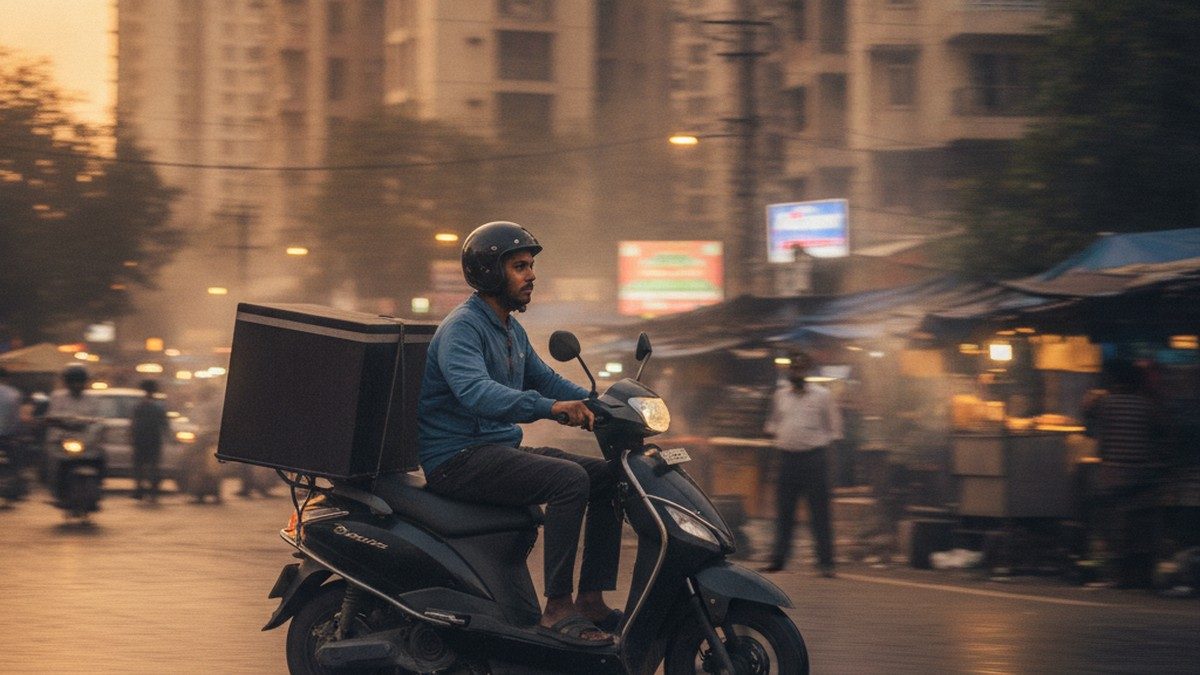
Most electric scooter buying guides are written for commuters. Someone riding 20–30 kilometres to the office and back, charging overnight at home, occasionally using the scooter on weekends. That’s a valid use case — but it is not yours if you’re delivering food, groceries, or parcels for Zomato, Swiggy, Blinkit, Amazon, or any of the other platforms that now employ millions of two-wheeler riders across India.
Your use case is fundamentally different. You might cover 80 to 120 kilometres in a single shift. You stop and start dozens of times. You ride through peak-hour traffic, monsoon rains, potholed delivery lanes, and gated societies with no charging points. Your scooter is not a lifestyle accessory — it is your income-generating asset. That changes everything about what you should buy.
The Policy Shift That’s Already Here
For riders working in the National Capital Region, the decision has effectively been made for them. Since January 2026, the Commission for Air Quality Management (CAQM) has mandated that new two-wheeler additions to delivery fleets in Delhi, Gurugram, Noida, Faridabad, Ghaziabad, and the wider NCR must be electric or CNG. Platforms like Swiggy, Zomato, Ola, and various e-commerce logistics providers are all covered under this rule.
Maharashtra is heading in the same direction. Proposed amendments to the Bike Taxi Rules 2025 would require major delivery platforms — Swiggy, Zomato, Zepto, Blinkit — to progressively transition to EV fleets. The regulation hasn’t been finalised yet, but the direction of travel is clear: petrol two-wheelers in India’s urban delivery corridors are on borrowed time.
If you’re still running on petrol and delivering in any large Indian city, this isn’t just a regulatory question. It’s a financial one.
The Economics You Simply Cannot Ignore
Running a petrol scooter costs approximately ₹2.00 to ₹2.10 per kilometre in fuel. For a rider covering 100km per day, that’s around ₹5,000 to ₹6,000 per month in fuel alone, before servicing. An electric scooter fully charged runs ₹5 to ₹10 in electricity for 80 to 100 kilometres — bringing your monthly energy cost down to ₹150 to ₹300. That ₹4,500 to ₹5,500 difference stays in your pocket every month, for the life of the vehicle. For a delivery rider, that’s nearly half a typical EMI payment freed up, month after month.
What Delivery Riders Actually Need (It’s a Shorter List Than You Think)
The popular EV buying checklist — app connectivity, voice commands, seven-inch touchscreen, Bluetooth speakers — is largely irrelevant if you’re delivering food for a living. What actually matters is much simpler:
Range that covers a full shift without anxiety. For most delivery zones, 80 to 100 kilometres of real-world range is the practical minimum. And here’s the important part: manufacturer-claimed ranges are almost always measured under ideal conditions — flat roads, minimal load, mild weather. In actual city delivery conditions with frequent stops, payload weight, and Indian traffic, expect real-world figures to be 20–30% lower than the brochure number. So a scooter claiming 120km may deliver 85–95km in practice.
Boot space that can actually fit a delivery bag. A standard insulated delivery box is bulky. A scooter with a cramped 20-litre underseat compartment will either mean an awkward rear-carrier setup or bags strapped to the seat — neither ideal across a 10-hour shift. Look for at least 26–30 litres of usable underseat storage.
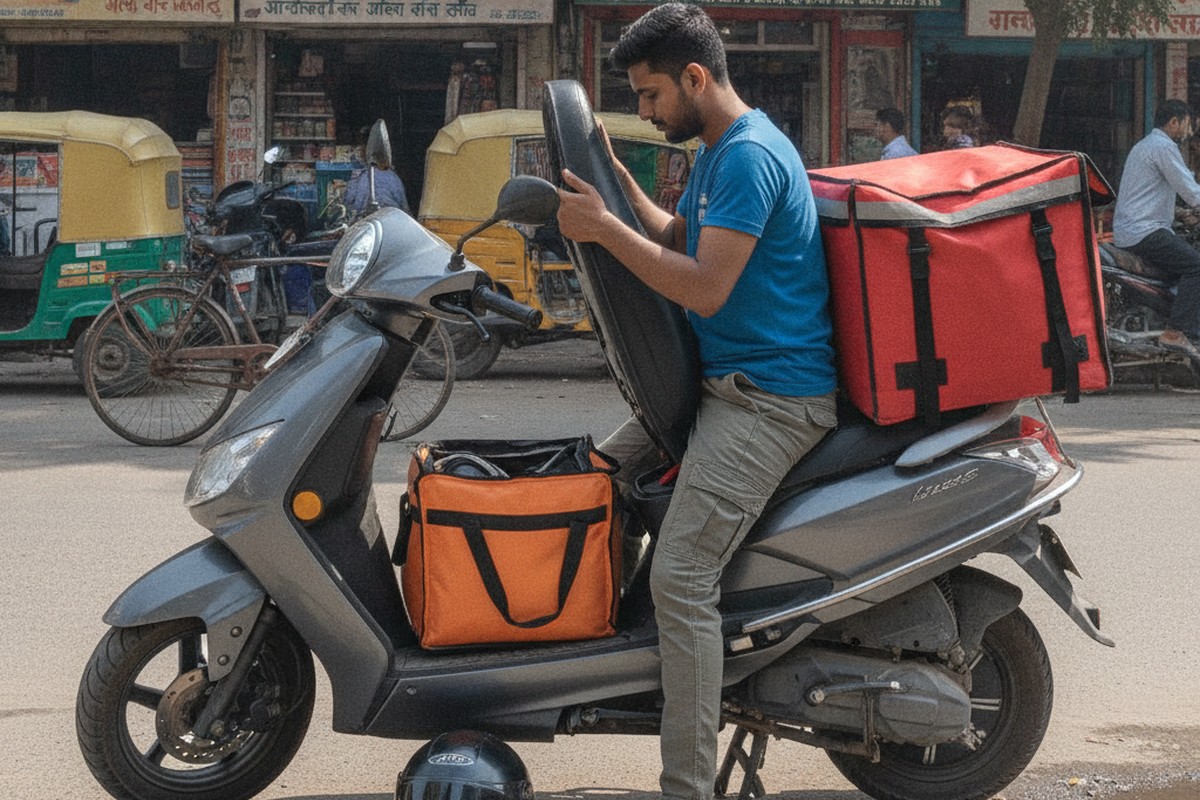
Build quality that handles high-mileage stress. A typical commuter scooter averages 25–30km per day. You’re running three to four times that. The stress on the suspension, motor, and battery is proportionally higher. One useful indicator: check whether the scooter carries ICAT (International Centre for Automotive Technology) certification — this means it has been tested against government-mandated safety and quality standards. Not every smaller EV brand bothers with this, and it matters when you’re putting serious daily mileage on the vehicle.
A service centre you can actually reach. This is the factor most buyers overlook until something goes wrong. If your scooter needs a repair and the nearest authorised service centre is 60km away, your entire livelihood stops. Service network depth is more important for delivery riders than for any other category of buyer. Verify the nearest authorised service point before you purchase — not after.
What the Market Currently Offers
The Hero Vida V2 Pro (₹1.40 lakh ex-showroom) is the strongest option for riders who prioritise service. Hero MotoCorp’s 900+ service touchpoints mean you’re rarely far from authorised support. Real-world range is around 114km, DC fast charging (80% in 80 minutes) is available, and the 3-year manufacturer backing is solid. The underseat boot at 26 litres is the main limitation. Strong overall, but the most expensive option after on-road costs.
The TVS iQube (3.5kWh, ₹1,45,200 ex-showroom) delivers a claimed 145km range and 30–32 litres of underseat storage. TVS’s nationwide service network and build quality make it a credible long-term choice — just the priciest one in this comparison.
The Ola S1 X+ (₹1,23,000–1,26,000 on-road) stands out for its 36-litre boot — the most practical for delivery bags — and real-world range of around 100–115km. Software and service inconsistencies outside major metros are known issues, though Ola continues expanding coverage. If you’re in a large city and need maximum storage, it warrants a look.
The Case for Elektree India — and Why the Price Gap Matters More Than It Seems
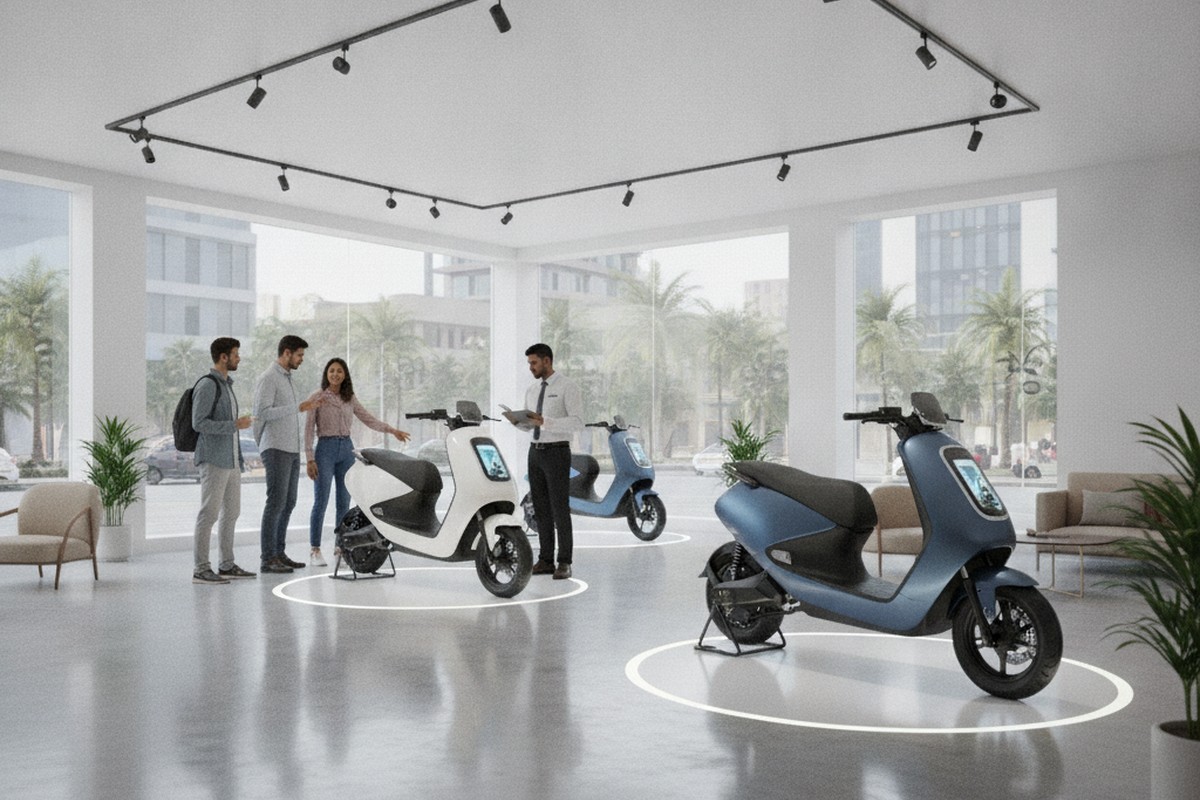
If your budget is stretched — or you want to direct your savings toward daily operational costs rather than EMI — Elektree India’s lineup deserves serious attention. The Elektree Zenith and RV 80, both ICAT-certified, are priced at ₹90,164 and ₹94,363 respectively, with a claimed range of 80 to 100 kilometres and a top speed of 60 km/h.
That pricing is ₹30,000 to ₹50,000 lower than any of the three competitors discussed above. For a delivery rider on EMI, that difference translates into 6 to 10 months of lower monthly outgo. Put differently: you start building financial headroom faster, and the total loan burden is lighter from day one.
Elektree’s running cost is among the lowest in the segment. A full charge runs ₹5 to ₹10 in electricity and takes approximately 4 hours — meaning an overnight charge is sufficient for a full delivery shift. With a 60V/32Ah or 60V/35Ah battery configuration, the energy cost per kilometre is genuinely competitive.
On service, Elektree operates 54+ dealers across India, covering major metros including Delhi, Mumbai, Kolkata, Hyderabad, and Bengaluru, as well as tier-2 cities in Bihar, Jharkhand, West Bengal, Uttar Pradesh, Assam, and the Northeast. If you are in a city or region with Elektree coverage, the post-purchase support is accessible. If you are not — and this is worth stating plainly — the smaller dealer footprint compared to Hero or TVS is the most meaningful limitation to weigh before buying.
What the ICAT certification tells you is important: Elektree’s scooters have met government-mandated safety and quality benchmarks. In a market segment where smaller EV brands sometimes cut corners on testing or certification, this is meaningful assurance. The 3-year warranty brings Elektree in line with industry-standard coverage, giving you protection during the period of highest mechanical risk on any new vehicle.
Making the Decision That’s Right for You
There is no single best electric scooter for every delivery rider — the answer depends on where you ride, how far you travel per shift, and what your budget actually allows. But there is a logic that should guide the decision.
If you’re based in a major metro, ride 80–100km per day, and want the widest possible service safety net, the Hero Vida V2 Pro is difficult to argue against — even at ₹1.40 lakh. If your daily route is shorter and you need maximum boot space, the Ola S1 X+ earns consideration. And if you’re in a city where Elektree has a dealer, riding within typical delivery-shift distances, and want to maximise what you keep each month — both in upfront cost savings and ongoing running costs — the Elektree Zenith or RV 80 offers a genuinely strong financial proposition that the pricier alternatives simply cannot match.
A delivery rider’s scooter purchase is ultimately a business decision. The vehicle that generates the best return — lower upfront cost, lower running cost, adequate range, ICAT-certified quality, and accessible service — is the right choice, regardless of what the spec sheets say about top speed or touchscreen size.
Explore the Elektree Zenith and RV 80 — along with Elektree India’s full lineup of ICAT-certified electric vehicles — at elektree.com. If a dealer is near you, the numbers make a compelling case for making the switch.