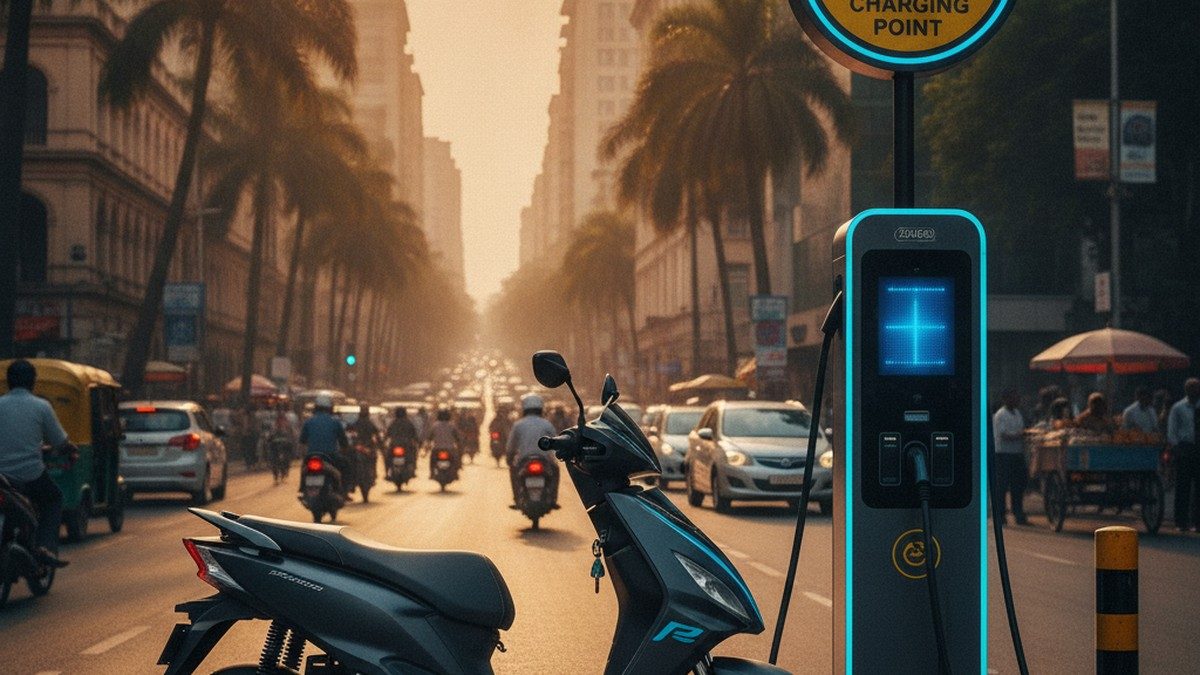
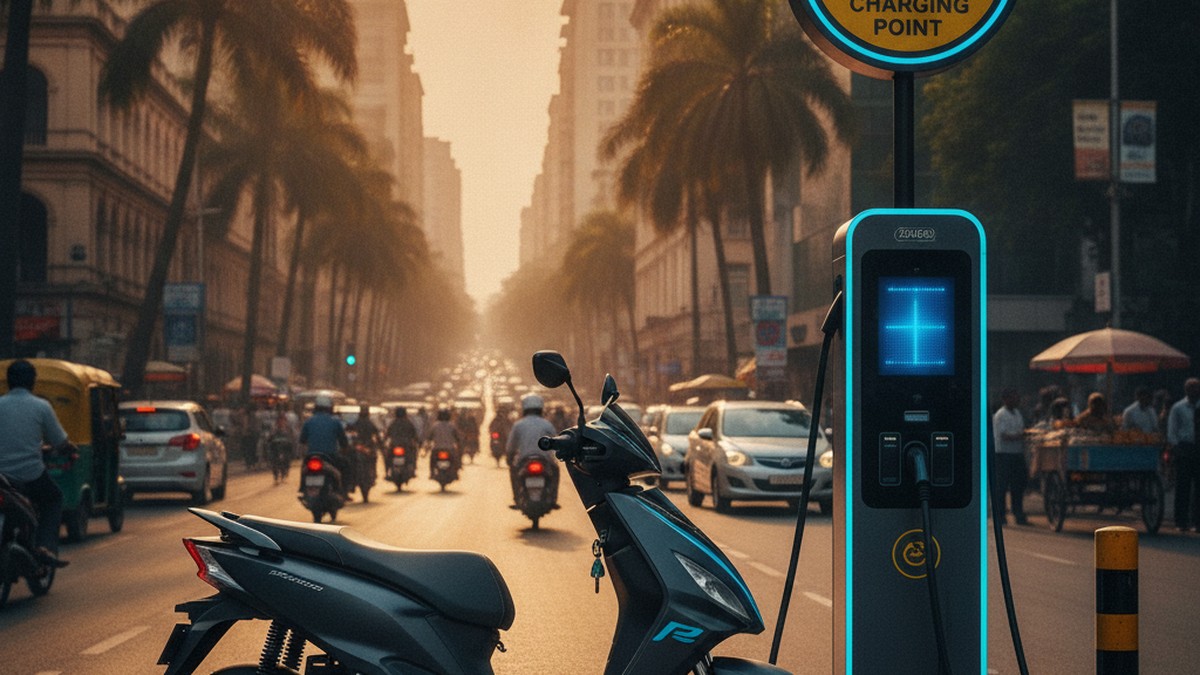
The number sounds impressive. Across India, there are now over 29,000 public EV charging stations as of early 2026. Government targets call for tens of thousands more. Every brand launching an electric scooter mentions “fast charging” in the same breath as range figures. And yet, ask anyone who actually owns an electric scooter in India — not a car, a scooter — about public charging, and you get a very different story.
The charging infrastructure that actually exists for electric two-wheelers is a fraction of what the headline number suggests. Understanding this gap might be the single most useful thing you learn before buying an electric scooter this year.
The Headline Number vs. The Reality on the Ground
India crossed 29,000 public EV charging stations in early 2026. That genuinely is progress. But the overwhelming majority of these stations were built for four-wheelers — the connector standards, the charger capacities, the physical setup. Most of it isn’t designed for the scooter you’re thinking of buying.
For two-wheelers specifically, the picture is far patchier. Ather’s Grid network — the most developed dedicated two-wheeler charging network in the country — has around 5,000 fast chargers across 395 cities. Ola Hypercharger, despite the marketing, covers roughly 60+ cities with about 288 charging points. Hero Vida has approximately 4,600 fast points across 320 cities.
These numbers look decent until you notice the catch: unless you own an Ather or a Vida, you probably can’t use most of them. Ola’s Hypercharger uses a proprietary connector that only works with Ola scooters. Ather Grid is similarly designed around the 450 series. There’s a connector standard called LECCS (based on IS 17017) that’s meant to enable interoperability, and Ather, Vida, Bolt.Earth, and a handful of others have adopted it. But it’s far from universal. For buyers of mid-range and value-segment scooters, usable public fast charging essentially doesn’t exist yet.
The Fast Charging Temptation — and the Hidden Cost
Fast charging sounds like the obvious answer to all of this. Plug in for 10–15 minutes, get 20–30 km of range, and get back on the road. In theory, it’s the petrol station equivalent for EVs.
In practice, there are two reasons to be careful about it becoming your default.
The first is cost. Home charging in India costs roughly ₹0.40–₹0.70 per kilometre, depending on your city’s electricity tariff. Public fast charging is typically billed by the minute — Ather Grid charges approximately ₹1.2 per minute plus GST, which works out to around ₹90–₹100 per 100 km. Ola’s rates are in a similar range. That’s not ruinous, but it’s three to five times more expensive than charging at home. Switch to public charging daily and the economics of owning an electric scooter start looking much less attractive.
The second issue is battery health. Lithium-ion batteries — whether in your phone or your scooter — don’t respond well to being charged at high current repeatedly. Studies and manufacturer guidance consistently indicate that frequent fast charging can accelerate battery degradation by around 10–12% over five years compared to regular home charging. That’s meaningful when a battery replacement costs anywhere from ₹25,000 to over ₹40,000. Ather, for all the prominence it gives its fast-charging network, explicitly recommends that daily home charging is better for long-term battery integrity. Fast charging is the emergency option, not the daily habit.
The 90/10 Rule That Every Smart EV Owner Follows
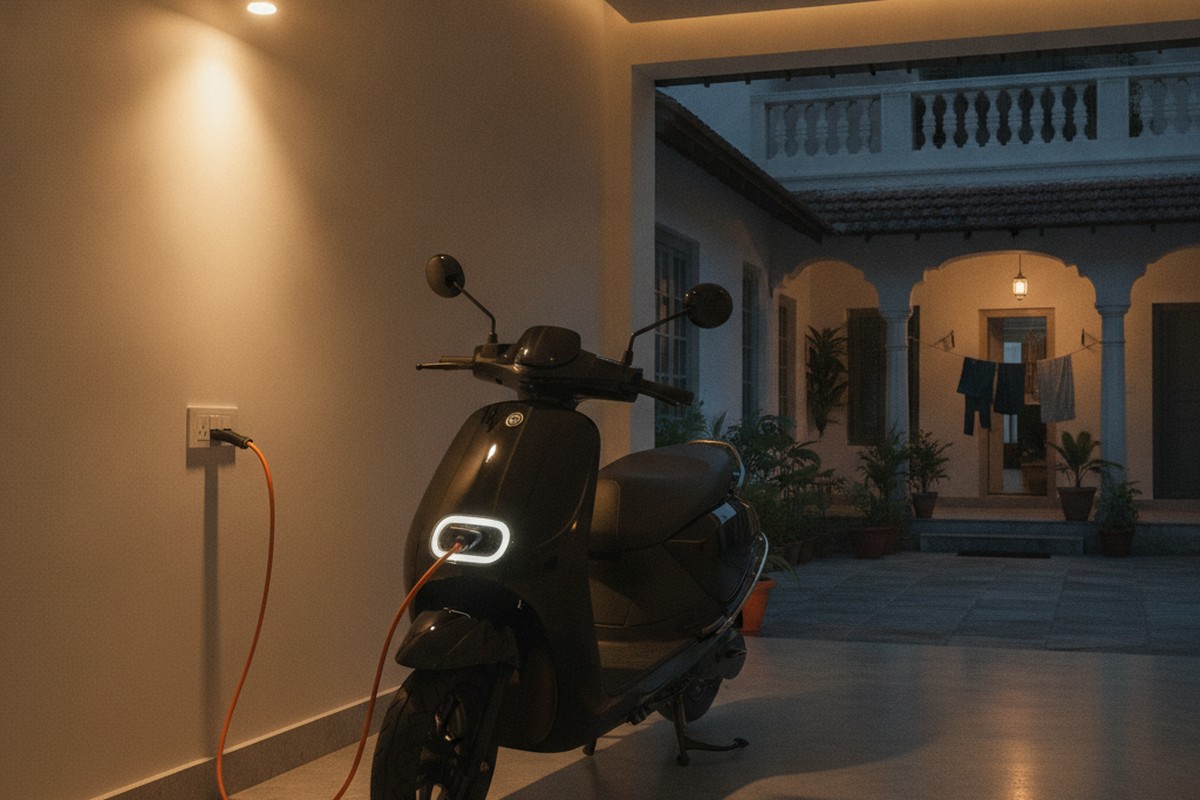
Riders who’ve figured out how to get the most out of their electric scooter follow what you could call the 90/10 rule: charge 90% of the time at home — overnight, slowly, at a fraction of the cost — and use public charging maybe 10% of the time, for genuine emergencies or longer trips where home charging isn’t an option.
This gives you the economics of home charging — roughly ₹12–₹30 for a full charge depending on your battery size — while still having a backup for the occasional situation where you need a top-up on the go.
The practical implication for your buying decision is that the charging experience at home matters far more than the availability of fast chargers across town. You’re going to use the home charger every night. The public charger is the exception, not the rule.
Government Is Catching Up — But Not Yet There
The good news is that policy is moving in the right direction. The PM E-Drive scheme — the central government’s current framework for supporting electric mobility — has specifically earmarked funds for two- and three-wheeler charging infrastructure, with a target of 48,400 chargers for this segment. That’s a meaningful commitment, and it should eventually improve the public network for scooter riders considerably.
But eventually is the operative word. Right now, coverage is heavily skewed toward southern and western India. Bengaluru has 240+ charging points, Chennai and Hyderabad are reasonably served, and Pune and Mumbai have growing networks. North and east India beyond the NCR remain significantly underserved. If you’re in a tier-2 or tier-3 city, practical public charging for your two-wheeler is likely still a few years away from being genuinely reliable.
Buying a scooter today on the assumption that public charging will be easily accessible in your city is optimistic. Most riders who’ve been through this before will tell you to plan around home charging and treat public access as a nice-to-have bonus.
What to Actually Look For When You’re Shopping
If home charging is going to be your primary method — which it almost certainly will be — then what you want in a scooter is fairly straightforward. A range that comfortably covers your daily commute with buffer to spare. A home charger that completes a full cycle in under five hours so you’re not anxious about it overnight. A battery management system designed to handle regular charging cycles without degrading quickly. And honest, real-world range figures rather than the inflated ideal-condition claims that some manufacturers lead with.
This is where Elektree India’s scooters make a compelling case — and it comes down to the details.
Why Elektree’s Approach Makes Sense in This Landscape
The Elektree Zenith and RV 80, priced at approximately ₹90,000–₹95,000, deliver a real-world range of 80–100 km on a full charge. The home charger included fills the battery completely in 4 hours — which is notably faster than several well-known competitors. The Ather Rizta, for instance, takes over 5 hours for a full charge. The Ola S1 sits at around 5 hours for a complete cycle. A full overnight charge in either Elektree model costs approximately ₹12–₹18 at typical Indian electricity rates, delivering 80–100 km of riding. For a 30–40 km daily commute, that’s one full charge every two days.
Elektree backs this with a 3-year warranty — covering the period when battery degradation concerns tend to be most acute for new buyers. The scooters are designed primarily around home-charging practicality: no dependency on a fast-charging network that may or may not serve your city, no per-minute billing, no compatibility anxiety about connectors. You plug in at home, wake up to a full battery, and ride. For a majority of Indian commuters, that’s exactly how EV ownership should work.
The Fantom EV, Elektree’s electric motorcycle, steps up to a 150–180 km range for riders with longer daily distances. At ₹1,39,000, it targets a different buyer — but the same philosophy applies. Practical range for real routes, home charging as the backbone, and no need to plan your day around a fast-charging stop.
The Bottom Line
India’s public EV charging story is improving, but for electric scooter riders specifically, it isn’t there yet — and for most daily commuters, it doesn’t need to be. The buyers who get the most out of their electric scooters are those who go in with clear eyes: home charging is the backbone of your running costs, and public charging is the occasional backup.
If you’re buying with that reality in mind, the criteria become obvious. Look for honest real-world range that covers your routes, a home charger that completes a full cycle in 4–5 hours, a battery sized for daily commuting rather than theoretical road-trip distance, and a price that lets the running-cost savings actually add up over time.
The Elektree Zenith and RV 80 hit all of those marks. At under ₹95,000, with a 4-hour home charge, 80–100 km range, and 3-year warranty, they’re built around the way Indian riders actually use their scooters — not around a charging infrastructure that’s still being built. For riders whose priority is practical, affordable, low-hassle daily commuting, Elektree is worth a serious look. Explore the full range of models at elektree.com.