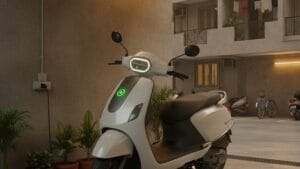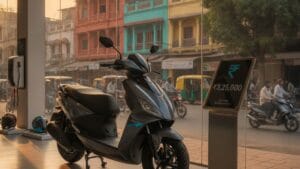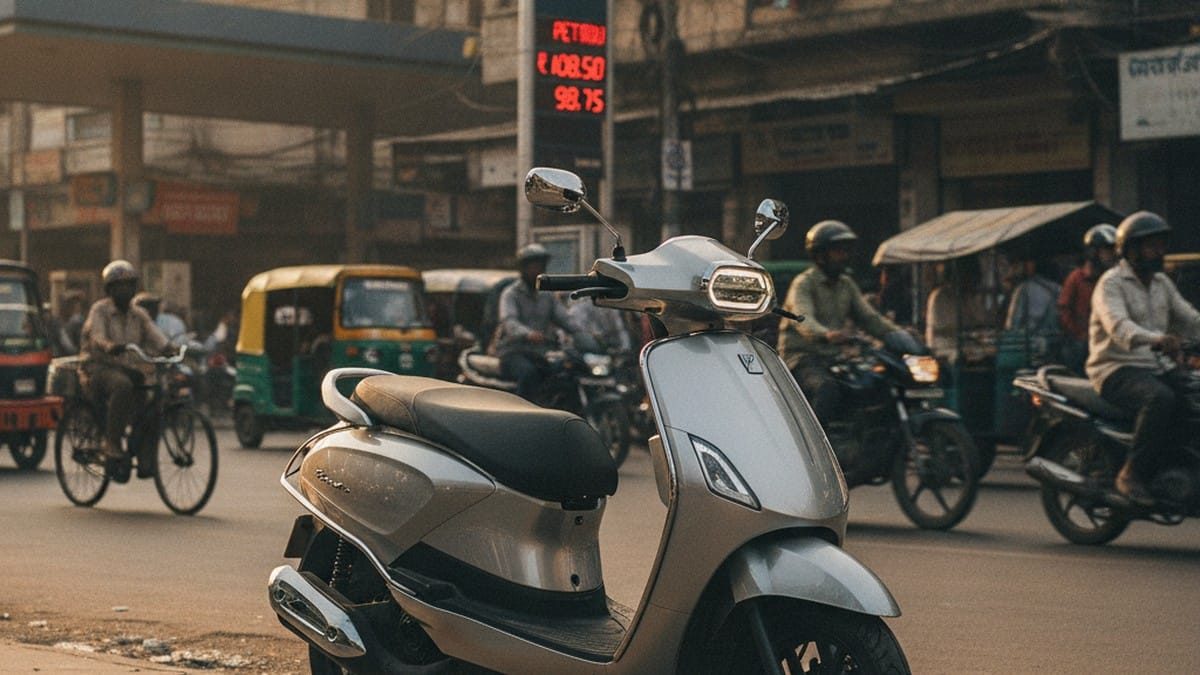
You Already Know the Feeling at the Pump
You pull up, watch the meter spin past ₹400, ₹500, ₹700 for a full tank, and mentally calculate whether this month’s fuel bill has beaten last month’s. If you are riding in Delhi, that calculation now starts at ₹102.12 per litre as of this week — and there is no realistic expectation that it will retreat to comfortable territory anytime soon. Most other Indian cities are within a few rupees of that figure.
At that price point, the question is no longer whether an electric scooter makes financial sense. The maths have crossed the threshold where they are too clear to dismiss. The real question most riders are now asking — sensibly — is whether the savings justify the upfront cost of switching, and whether a genuinely reliable electric scooter exists at a price where the arithmetic actually works in their favour.
Let us do this properly.
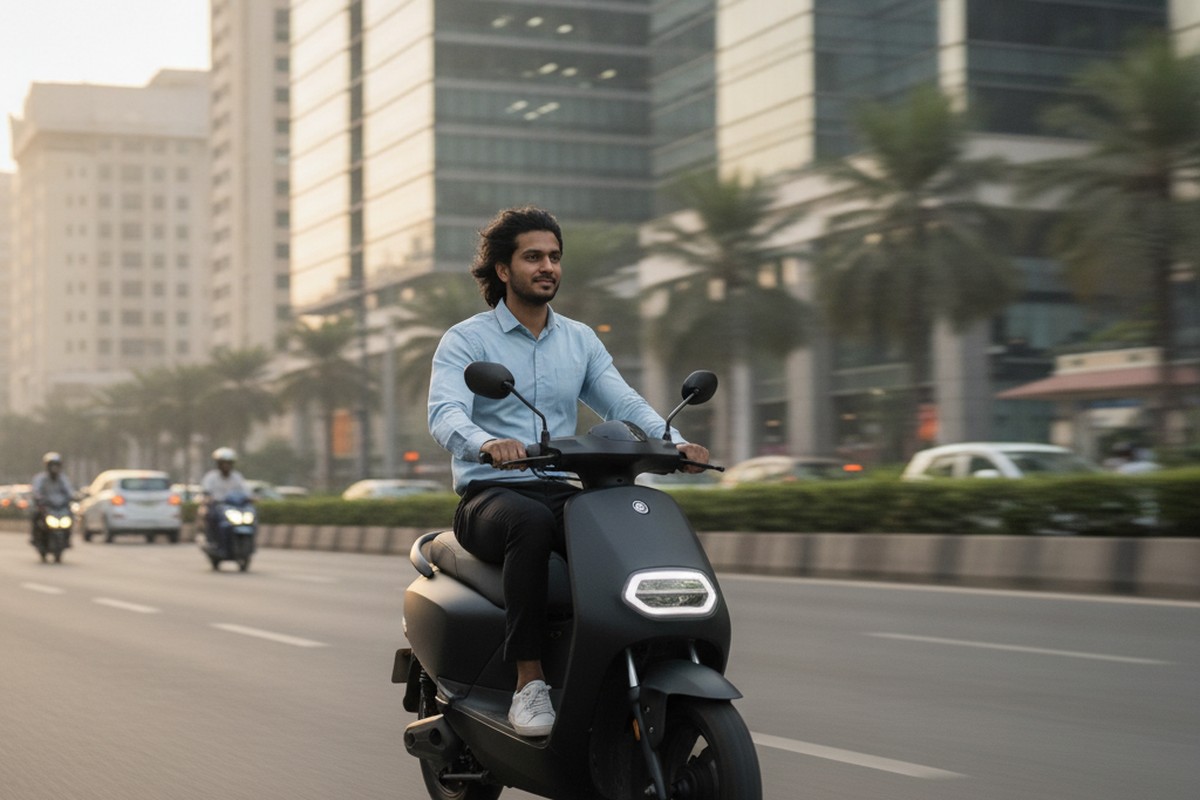
The Running Cost Equation Nobody Draws Out Completely
A typical 125cc petrol scooter returns around 45 kilometres per litre in real-world urban riding. At ₹102 a litre, that works out to approximately ₹2.27 per kilometre. Simple enough. Now consider a mid-range electric scooter with a 60V/35Ah lithium-ion battery providing a certified range of around 80 kilometres per charge. At home electricity tariffs of ₹5–8 per unit — which is what most Indian households pay in the lower consumption slabs — a full charge costs roughly ₹10–15. That translates to approximately ₹0.13–0.19 per kilometre.
If you are commuting 40 kilometres daily — close to the urban two-wheeler average for Indian cities — the monthly maths look like this:
- Petrol scooter: 40 km/day × 26 working days × ₹2.27 = approximately ₹2,361 in fuel
- Electric scooter: the same 1,040 km at ₹0.16/km = approximately ₹166 in electricity
That is a difference of roughly ₹2,195 every single month. Over a year: ₹26,340 saved on fuel alone. Over five years, that single line item adds up to over ₹1.30 lakh — and that is without accounting for rising petrol prices or increased riding distance over time.
The Maintenance Bill Nobody Accounts For
A petrol scooter visits an authorised service centre every 4,000–6,000 kilometres. Each visit runs ₹700–1,300 for standard servicing, covering engine oil, filter cleaning, fuel system checks, and spark plug inspection. Add in CVT belt replacement every 15,000 kilometres or so (₹1,200–2,500), periodic air filter replacement, a 12V battery every two to three years, and you are looking at ₹4,000–6,000 per year in maintenance at an authorised workshop — more if anything fails outside the service schedule.
Over five years, maintenance alone adds ₹20,000–30,000, sitting on top of the fuel bill.
An electric scooter has no engine oil to change, no spark plugs or air filters to replace, no CVT belt, and no fuel system to calibrate. The regular service needs — brake inspection, tyre condition, brake fluid, and occasionally a firmware update — are considerably lighter. Well-maintained electric scooters from established manufacturers typically cost ₹1,000–3,000 per year to service for urban commuters. That is 40 to 60 per cent lower than the petrol equivalent.
The five-year total: an average urban commuter switching from petrol to electric can realistically expect combined fuel and maintenance savings of ₹1.5 to ₹2 lakh. That is arithmetic based on current petrol prices and documented service costs — not a marketing projection.
The Upfront Cost Question — Is There Actually a Premium?
Here is where many buyers stall. The assumption is that a decent electric scooter costs significantly more than its petrol equivalent. That was true four or five years ago. In 2026, it is no longer automatically the case at the mid-range level.
The Honda Activa 125, India’s most popular scooter, sits at ₹1,05,733 on-road in Delhi when you factor in RTO and insurance. A comparable electric scooter with ICAT certification, 80+ kilometre certified range, and a lithium-ion battery — such as the Elektree Zenith, which starts at ₹90,164 — carries a lower base price. Electric two-wheelers also attract significantly lower road tax in most Indian states compared to petrol vehicles, which compresses the on-road price gap further. Add any applicable PM E-Drive scheme benefit to the picture, and the upfront cost comparison shifts further in favour of the electric option.
The traditional assumption of a large premium for going electric does not hold at this end of the market in 2026.
What to Actually Evaluate Before You Buy
Before zeroing in on any model, a few things are worth understanding that the showroom pitch will not always clarify.
Range figures in India are IDC (Indian Driving Cycle) numbers, tested in controlled conditions without traffic, inclines, or passenger load. Real-world range on Indian roads is typically 20–30% lower. An 80 km IDC figure translates to 55–65 kilometres in actual urban use. For a 40 km daily commute, that is workable — you charge every one to two days and never worry. For longer commutes or hilly routes, scrutinise the range claim more carefully.
Battery warranty is non-negotiable. The motor can be repaired, but an out-of-warranty battery replacement on an electric scooter is a cost that can run into tens of thousands of rupees. What a manufacturer covers — and for how long — tells you how much confidence they have in their own product.
After-sales infrastructure matters as much as the product itself. A scooter from a company whose nearest service centre is three cities away is a problem waiting to happen, regardless of how impressive the spec sheet looks.
Why Elektree India Makes a Credible Case
Among the options available in the Indian market at or under ₹1 lakh, the Elektree Zenith addresses these evaluation criteria well enough to merit serious attention.
The Zenith carries ICAT certification — meaning its 80–100 km range figures have been independently verified by a Government of India–recognised testing body, not simply self-declared by the manufacturer. That matters in a market where range claims have sometimes been optimistic to the point of being misleading.
The motor is a mid-drive IPM (Interior Permanent Magnet) unit. This motor architecture is chosen by several premium EV manufacturers globally because of its efficiency and lower heat generation compared to standard hub motors — which has real relevance in Indian summers, when motor temperatures can affect performance and longevity. The Zenith’s 180 mm ground clearance and 12.5-inch tyres are reasonably suited to the pothole-and-speed-bump reality of most Indian urban routes. The 18.5-litre boot offers practical daily carry space.
On the battery: Elektree covers the Zenith’s 60V/35Ah lithium-ion pack for three years or 50,000 kilometres — whichever comes first — against manufacturing defects, internal cell faults, and BMS (Battery Management System) issues, provided the battery state of health stays above 70%. That is a meaningful commitment for a product category where battery confidence is the single biggest buyer concern.
The scooter also offers three riding modes — Hyper, Normal, and Eco — which let the rider manage the range-versus-performance trade-off depending on the day. GPS tracking, an anti-theft alarm, reverse mode, LED headlamp with DRL, and USB charging complete a feature set that competes genuinely with petrol alternatives in the same price band.
For buyers in major metros, Elektree operates service centres in Delhi, Mumbai, Kolkata, Hyderabad, and Bengaluru. That is not a national network yet, but it covers the cities where a substantial proportion of Indian two-wheeler buyers are concentrated.
The Numbers, the Scooter, and the Decision
Here is the honest summary. If you are doing 30–50 kilometres daily in an Indian city and weighing whether to switch to electric, the financial case in September 2026 — with petrol at over ₹100 a litre across most of the country — is about as clear as it has ever been. A realistic five-year calculation, conservative on the savings side, consistently lands between ₹1.5 and ₹2 lakh in combined fuel and maintenance advantage for the electric rider.
The condition, as always, is that the scooter itself needs to be reliable, well-supported, certified, and priced without a premium that erases the savings. The Elektree Zenith, alongside the RV 80 Sportz at ₹94,363, meets those conditions credibly for most urban Indian commuters. The certified range is realistic for daily commuting without constant range anxiety. The battery warranty is specific and substantive. The mid-drive IPM motor is a step above what many competing products at this price offer. And the price — starting at ₹90,164 before any applicable subsidy or reduced road tax — does not carry the kind of upfront premium that makes the ownership economics look good only on paper.
If the fuel price this week finally pushed you past the “I should probably look into this” stage, it is worth spending thirty minutes at elektree.com to see whether the Zenith or one of Elektree’s other models fits your commute and budget. The fuel saving begins from the first kilometre you ride.