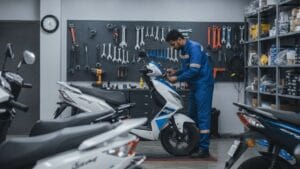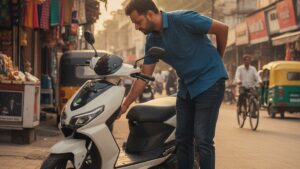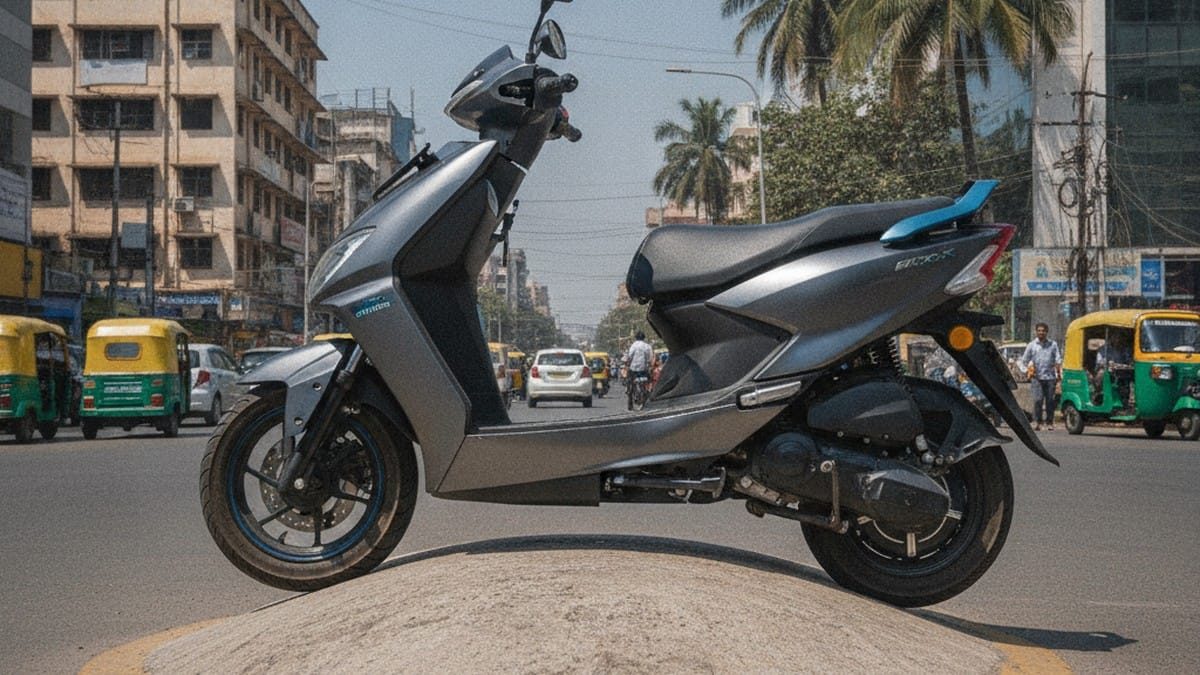
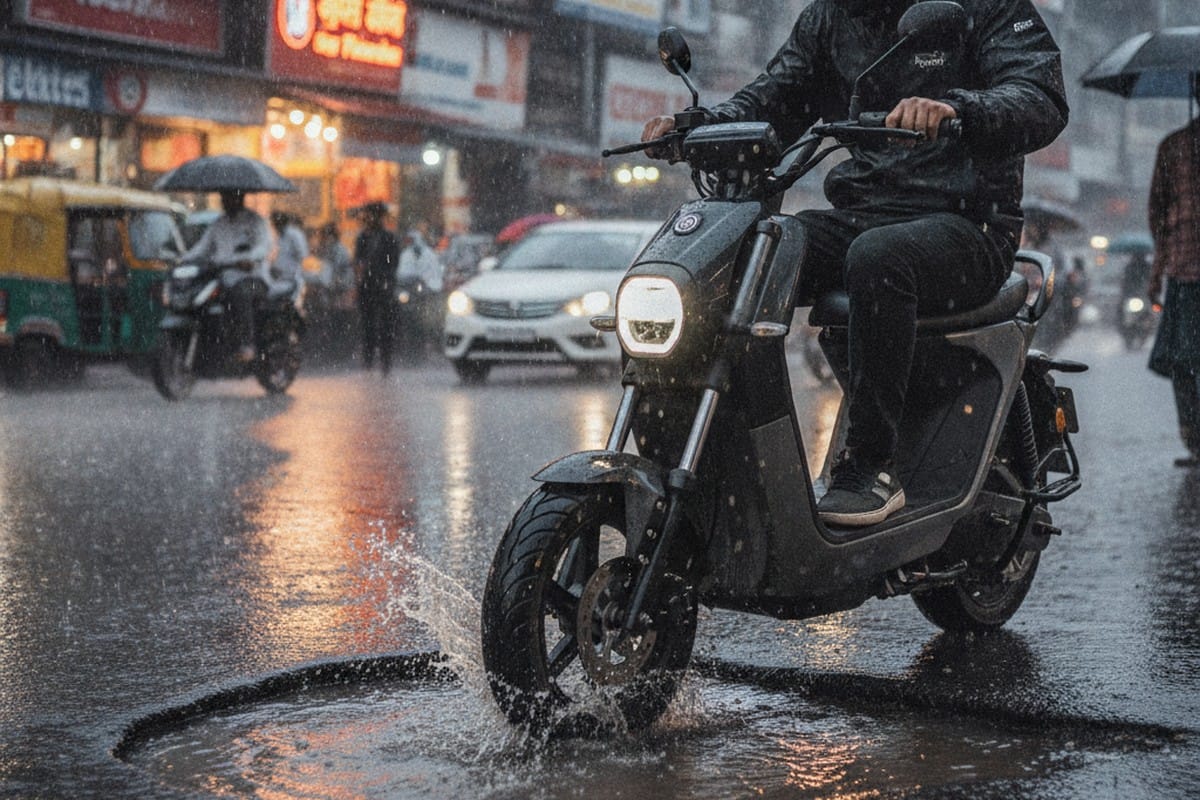
Picture this: you’re riding home after a long day, and there’s a freshly-laid speed breaker outside your society gate — the kind the contractor built in the rain and abandoned half-finished. It’s about 15 centimetres tall at its worst point, the surface drops away on one side, and there’s a shallow patch of standing water next to it. If you’re on the wrong electric scooter, your underbelly scrapes metal on concrete. The wiring loom catches. The battery casing takes a knock. None of that is in the brochure.
Most Indian electric scooter buyers — even fairly careful ones — spend their research time comparing range, price, and top speed. These are visible, headline-friendly numbers. But there’s a specification that almost nobody asks about at the showroom, and that specification can make or break the ownership experience on India’s real roads: ground clearance. And its inseparable companion, suspension design.
If you live in a city like Nagpur, Indore, Surat, or any of the dozens of fast-growing urban centres where roads can shift from smooth to broken within a few hundred metres, this number matters more than many others. Ditto if you’re in a metropolitan suburb where construction is constant and civic road maintenance is irregular. In fact, for most Indian riders, ground clearance and suspension quality determine daily comfort far more reliably than the certified range figure ever will.
What Ground Clearance Actually Means
Ground clearance is the distance between the lowest structural point of the scooter — usually the undercarriage or chassis — and the ground beneath it when the scooter is on a flat, level surface with rider and pillion. The number is measured in millimetres. A higher number means more gap between your scooter’s belly and obstacles on the road: speed breakers, potholes, rutted surfaces, construction debris, waterlogged depressions.
Indian road standards specify that speed breakers should ideally be no more than 100mm (10 centimetres) in height, but on-ground reality is quite different. Unofficial speed breakers routinely hit 120mm to 150mm, and worn-down speed breakers with abrupt edges can catch a scooter’s underbody even at lower absolute heights if the approach angle is steep. Ground clearance of 150mm or below starts feeling tight on Indian roads. Below 160mm, you begin riding with a constant awareness of every obstacle.
Where Popular Electric Scooters Actually Stand
Once you start checking the spec sheets, a few things become clear. The ground clearance figures across popular electric scooters in India vary more than most buyers realise, and some well-marketed models are surprisingly low to the ground.
The Ather Rizta, marketed as a family scooter, offers 150mm of ground clearance — technically the minimum for comfortable Indian road use, and not much margin for the unexpected. The TVS iQube sits at 157mm, which is adequate on well-maintained urban stretches but begins to feel limited on construction-zone roads or rural-to-urban transition routes. The Ola S1 Pro, one of the most talked-about models in the market, comes in at 160mm. The Bajaj Chetak is at 168mm, the Ather 450X at 170mm, and the Honda Activa e — one of the newer entrants from a company that understands Indian roads — at 171mm.
These are all credible numbers. But the standout figure in this comparison belongs to Elektree India’s Zenith and RV 80, both rated at 180mm of ground clearance. That’s 10mm more than the Ather 450X, 22mm more than the Ola S1 Pro, and 30mm more than the Ather Rizta. On a pothole-heavy stretch or an aggressive speed breaker, 20-30mm of additional clearance is very much a real-world difference, not a rounding error.
Suspension Type Matters As Much As the Number
Ground clearance tells you how high the scooter sits. Suspension tells you how it behaves once a wheel drops into a pothole or climbs over a bump. And the two need to work together — a scooter that sits high but has stiff, under-damped suspension will still transmit every road imperfection to your spine.
The gold standard for Indian road use is a telescopic front fork — ideally twin telescopic, which is inherently more stable than a single-leg setup — paired with a rear monoshock. Twin telescopic forks absorb impact more evenly, reduce front-end twitchiness on broken surfaces, and are easier and cheaper to service. Rear monoshocks offer consistent damping and are better at coping with rider-plus-pillion loads on uneven terrain compared to twin-shock setups, provided they’re tuned correctly.
Not every electric scooter uses this configuration. The Bajaj Chetak uses a single-sided leading link at the front — borrowed from classic European scooter design — which can feel nervous on the aggressive, multi-directional surfaces common in Indian cities. The TVS iQube uses a conventional telescopic front with a hydraulic twin-tube rear, which is adequate. The Ather 450X uses telescopic forks with a progressive rear monoshock — the progressive spring rate delivers softer initial travel that firms up under heavier compression, which works well across varying road textures.
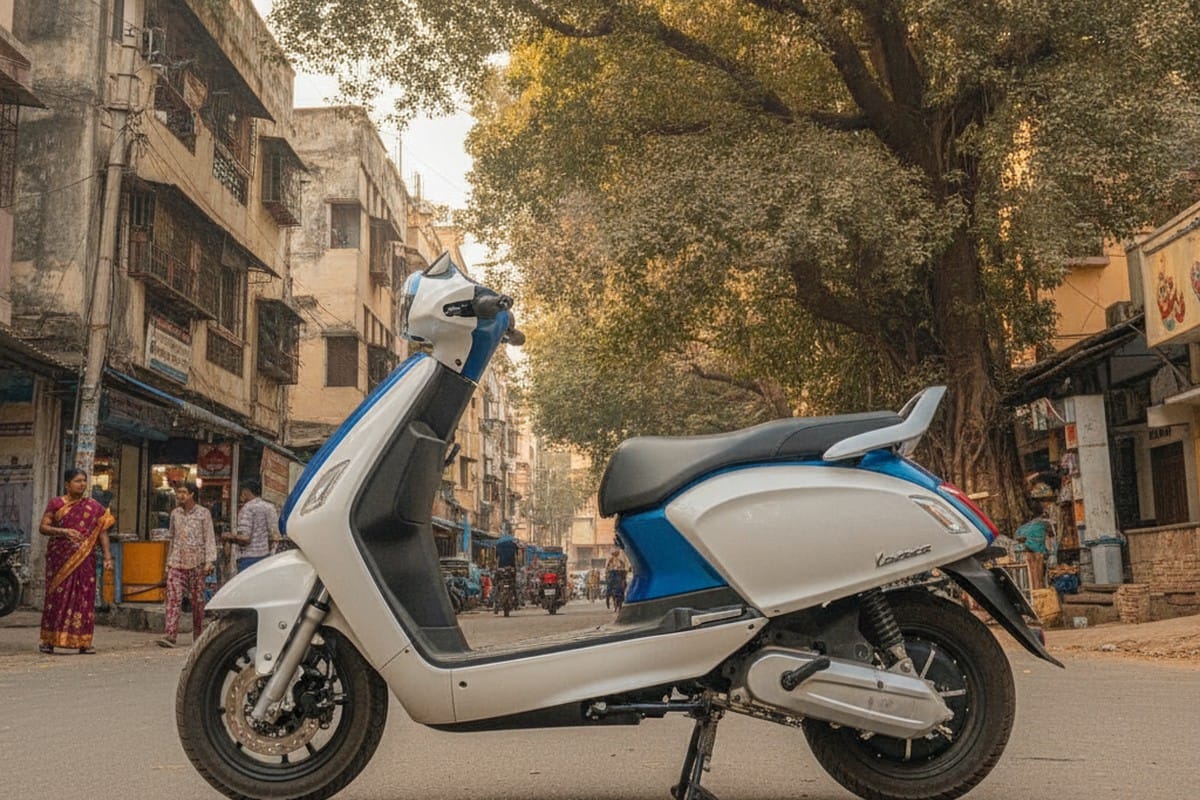
Elektree’s Zenith and RV 80 both use twin telescopic forks at the front and a monoshock at the rear. Combined with the 180mm ground clearance, this is genuinely a well-rounded setup for Indian road conditions — not just on paper, but in terms of what the combination accomplishes: you ride higher, absorb impacts better from the front, and the rear monoshock handles the rest without making the scooter feel floaty or vague.
The Tyre Size Piece
Wheel and tyre size complete this picture. Larger diameter wheels — 12-inch and above — roll over small potholes more smoothly than smaller wheels due to a shallower angle of attack against obstacles. Most popular electric scooters, including the Ather 450X, Bajaj Chetak, Ola S1 Pro, and TVS iQube, use 12-inch wheels. Elektree’s Zenith and RV 80 use 12.5-inch tyres, adding a touch more composure on rough surfaces.
Why This Matters More in 2026 Than It Used To
Electric scooters carry more weight at the bottom than petrol scooters because the battery pack sits low in the chassis. This improves stability, but it also means the undercarriage is closer to road hazards than the seat height suggests. Battery enclosures are not designed for contact with concrete speed breaker edges. A single hard scrape can compromise the casing over time — and with battery replacements running ₹20,000 to ₹50,000 or more, road clearance stops being a comfort preference and becomes protection for your most expensive component.
Where Elektree India Stands Out
The Elektree Zenith, starting at around ₹90,164, packages a lot of the right elements for Indian road use into a scooter that doesn’t ask you to spend over a lakh. The 180mm ground clearance is the highest among the popular models compared here. The twin telescopic front fork with rear monoshock is a proper suspension setup for Indian conditions. The 12.5-inch tyres add to stability. The 200kg payload capacity handles two riders and cargo without sagging and pushing the underbelly closer to the road. And the 3-year/50,000km battery warranty provides the kind of long-term coverage that makes the ownership economics make sense.
The Elektree RV 80, at ₹94,363, shares the same ground clearance and suspension configuration, but adds dual disc brakes — front and rear — which improve braking confidence on uneven surfaces where a single disc can create pull under hard braking. For riders who want both ride quality and braking performance, the RV 80 is worth comparing carefully against the Ather 450X, which costs over ₹50,000 more and sits 10mm lower to the ground.
The Elektree Zenith and RV 80 also include GPS tracking, anti-theft alarm, three riding modes (Hyper, Normal, and Eco), and a reverse mode — useful when you’re parked on an incline or a tight spot on uneven ground. These are features that used to appear only on premium scooters.
The Practical Recommendation
If you ride predominantly on well-maintained city roads in a metro with reasonably good infrastructure, ground clearance is still worth checking, but you have more flexibility in your choice. Most models above 160mm will serve you adequately. But if your daily route includes even one section of broken road, construction stretch, or aggressively built speed breaker — and the odds are high in India that it does — you want every millimetre you can get.
On that basis, the Elektree Zenith and RV 80 represent a compelling argument. They offer the highest verified ground clearance in their price range, a proper suspension setup for Indian roads, and a warranty that takes battery protection seriously. For first-time EV buyers in particular, who don’t yet have experience managing around an electric scooter’s underbody limitations, starting with more clearance than you think you need is genuinely good advice.
Before any other spec comparison, check the ground clearance. Then check the suspension. The range can get you home. The clearance and suspension determine whether the ride is something you look forward to or something you endure. Explore the full Elektree India range at elektree.com and find the model that’s built for the road you actually ride on.