Every year around admissions season, the family WhatsApp group erupts with scooter advice. Relatives who last rode a two-wheeler when Doordarshan was still in black and white suddenly become experts. The result is a confusing pile of recommendations — some outdated, some driven by brand loyalty, some just wrong for a student’s actual needs. The student ends up either overpaying for features they’ll never use, or buying something that feels like a bargain until the running costs start showing up.
The honest truth is that buying a first electric scooter as a college student in India in 2026 is not complicated — but only if you’re asking the right questions. Most students aren’t. They’re fixating on peak range figures and top speed numbers when the questions that actually determine daily satisfaction are far more practical.
What Does a College Student Actually Need From a Scooter?
Let’s be real about riding patterns. If you’re living in a hostel, PG, or rented accommodation near your college, a typical day involves a 5-15 km ride to campus, maybe a detour to coaching classes or a market, and back. On weekends there might be a longer trip — but the daily average for most urban college students in India sits comfortably between 20 and 40 kilometres. This is worth remembering when a brand’s advertising tells you that you need 200+ km of range.
IDC-rated range — the figure you see in advertisements — is measured under controlled lab conditions. Real-world riding in Indian traffic, with the heat, start-stop riding, the occasional pillion, and accessories running, typically delivers 15 to 25 per cent less than that claimed figure. A scooter with 90 km of real-world range, charged every night, will handle a student’s daily commute without a moment of anxiety.
The Things That Actually Matter for Students
Running cost is where electric genuinely changes the equation. Petrol scooters are currently costing commuters ₹2.50-3.50 per kilometre in fuel. A properly chosen electric scooter costs ₹0.20-0.60 per kilometre to charge. On a 35 km daily commute across a 200-day academic year, that gap saves ₹18,000-22,000 annually — money that could cover textbooks, mess fees, or a few months of accommodation.
Payload and practicality matter more than most buyers realise. College life means carrying a backpack full of books, a helmet, a tiffin box, and sometimes a pillion friend. A scooter’s rated payload tells you how much it can carry safely before performance and longevity start to suffer. Students who ignore this number often end up with an overloaded machine that wears out prematurely.
Battery warranty is arguably the most underestimated criterion. The battery is the most expensive component in an electric scooter — and the one that ages. A strong battery warranty is a manufacturer saying it stands behind its product’s long-term health. For a student using the scooter through three or four years of a degree, this matters enormously.
Ground clearance and suspension affect daily life more than most spec sheets suggest. Speed humps, potholes, and flooded patches are standard issue on most Indian college campuses and nearby roads. The difference between 150 mm and 180 mm of ground clearance shows up on every bumpy stretch you navigate.
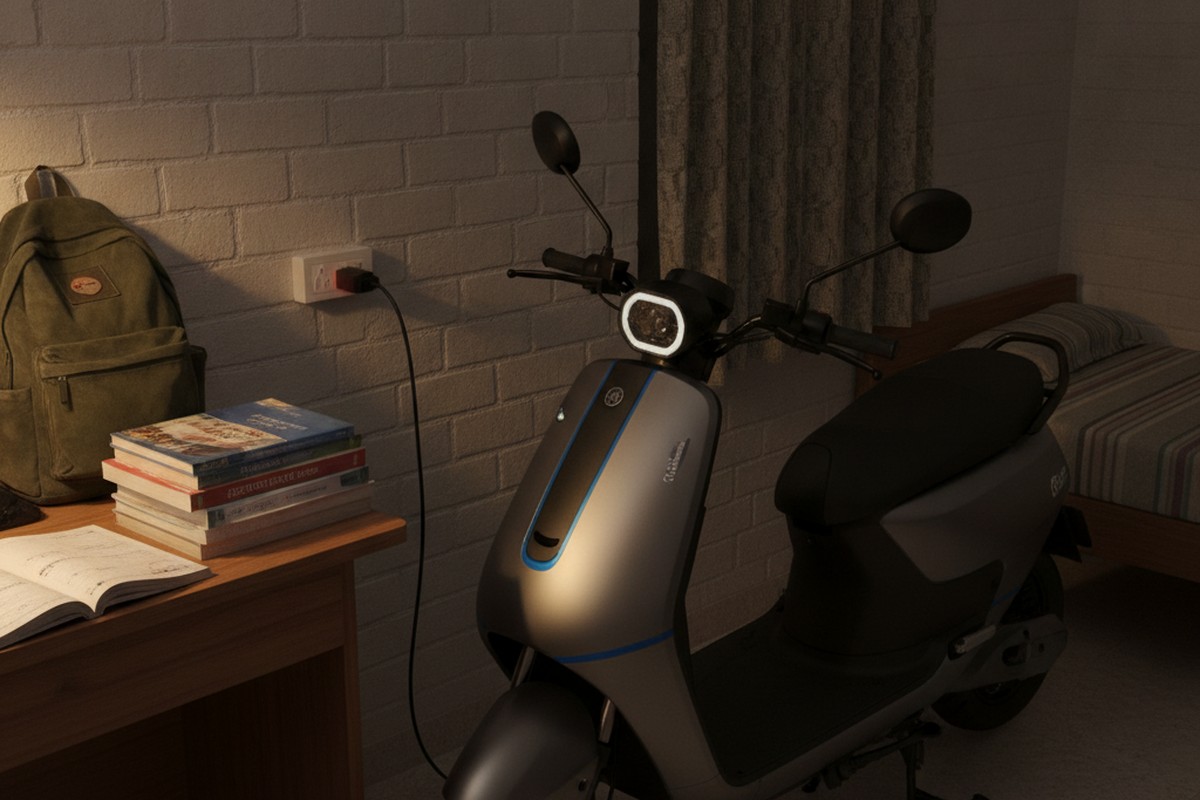
Charging convenience is a real consideration at most student accommodations. You’re working with a standard 5-ampere socket in your room or on a shared veranda. A scooter that takes 8-10 hours to fully charge from a regular socket requires careful planning. One that charges in 4-5 hours gives you far more flexibility — plug in when you return from college, and wake up to a full battery.
What the Market Is Offering in 2026
The electric scooter market in India has matured considerably. The Ola S1 X, starting around ₹84,999 for the 2kWh variant (108 km IDC range), remains one of the most discussed budget options — a 5.5kW motor, 7-inch TFT display, and cruise control at that price is genuinely competitive. The higher-range 3kWh and 4kWh variants are significantly more expensive, and for a student doing 30 km a day, those upgrades may be solving a problem that doesn’t actually exist in their life.
The Ather Rizta S, from approximately ₹1,20,705, brings excellent storage — 34 litres under-seat plus a 22-litre front compartment — and a 123-160 km range depending on battery variant. A thoughtfully built machine, but the price pushes it into territory where students have to make a real trade-off. The TVS iQube (from ₹1,19,250) similarly offers strong build quality and TVS Motor Company’s wide service network at a comparable premium.
Each of these scooters has genuine merit. But they’re optimised for audiences broader than the student segment — families, working professionals, commuters with longer daily distances. A smart student buyer needs to ask: am I paying for what I’ll actually use?
Why the Elektree Zenith Deserves Serious Attention
The Elektree Zenith, priced at ₹90,164, enters this conversation at an interesting point. It’s cheaper than the Ather Rizta and TVS iQube by a meaningful margin, comparable to the base Ola S1 X, but the full engineering package tells a different story when you evaluate it against what a student actually needs day-to-day.
Start with payload: the Zenith is rated to carry up to 200 kg — rider, pillion, and cargo combined. Most scooters in and around this price bracket are rated for 150-160 kg. That difference matters in practice. A student with a fully packed backpack and a pillion friend on the back of a 155 kg-rated scooter is operating close to the limit. Vehicles running near their payload ceiling age faster, brake harder, and become less predictable over time. The Zenith’s 200 kg capacity keeps even two well-built riders comfortably within the design envelope.

Ground clearance on the Zenith is 180 mm, with a front disc brake and monoshock rear suspension completing a chassis spec’d for real-world rather than showroom conditions. These are not headline specifications, but they determine whether a scooter feels confident at 60 km/h on a patchy road — or nervous.
The battery carries a 3-year, 50,000 km warranty. For a student doing 35-40 km daily, that warranty covers the full duration of most undergraduate degrees. The 4-5 hour charge time from a standard socket means you can plug in when you get home from college, go study or sleep, and wake up to a full battery every morning.
The technology package is well matched to student priorities. GPS tracking and an anti-theft alarm are features that genuinely matter on a college campus where unattended scooters regularly go missing. A USB charging port lets you top up your phone on the go — a genuine quality-of-life feature when you’ve been on campus since 8am. Three riding modes (Hyper, Normal, Eco) let you balance performance with battery conservation depending on your day. Reverse mode is a useful addition for the tight parking situations common around campus and PG-dense areas.
A Fair Assessment
The Zenith does have trade-offs worth knowing. Its 18.5-litre boot space is smaller than the Ather Rizta’s 34-litre under-seat compartment — if you regularly carry bulky items, you’ll want to budget for a topcase or rear carrier. And Elektree’s service network, while expanding, is not yet as extensive as Ola Electric or TVS across all cities. Checking service centre proximity in your specific city before purchasing is sensible advice regardless of brand, but particularly relevant here.
That said, for a student evaluating the full picture — price, payload, ground clearance, warranty, charge time, and practical technology — the Zenith holds up remarkably well against options that cost ₹25,000-30,000 more.
The Numbers That Should Drive the Decision
Here’s the exercise worth doing before any showroom visit. Take your daily commute distance. Multiply by 200 (approximate college days per year). Compare the cost at ₹0.50 per km (electric) versus ₹3 per km (petrol). That annual saving — typically ₹18,000-25,000 — is the real starting point of the conversation. Then look at which electric scooter gives you the right payload for how you actually ride, the right warranty for how long you’ll keep it, and after-sales support appropriate for where you’re studying.
When those are the criteria, the Elektree Zenith is one of the most credible choices in the student segment for 2026. It doesn’t attempt to be the range champion or the fastest scooter in its class. What it does is deliver a well-engineered, practically specified machine at a price point that makes genuine financial sense for a student buyer or a parent investing in four years of daily transport.
Explore the full Elektree India range — including the Zenith and other models built for Indian road conditions — at elektree.com. Make the decision with the full specification picture in front of you, and you’ll make a choice you can be confident in for years.