Almost every Indian buyer walking into an EV showroom asks the same question first: “What’s the range?” It’s an understandable reflex — we’ve all grown up calculating whether we have enough petrol left to get home. But range anxiety around electric scooters is frequently rooted in a misunderstanding about how EVs actually fit into daily life. Chasing the highest number on the brochure could easily mean spending ₹50,000 to ₹80,000 more than you actually need to.
The Range Number on the Spec Sheet: What It Really Means
The first thing every Indian buyer should understand: the range figure printed in the specification sheet is not the range you will get on your actual commute. Most manufacturers in India publish IDC (Indian Driving Cycle) range — a standardised test conducted in lab conditions to simulate city riding. In practice, real-world range typically falls 20 to 35 percent below that figure once you factor in actual Indian riding conditions. A scooter rated at 100 km on the IDC will realistically deliver somewhere between 65 and 80 km in a typical city — depending on several factors specific to how and where you ride.
Why Indian Conditions Eat Into Your Range
Summer heat is the biggest culprit. When ambient temperatures cross 40°C — which is routine across most of the country from April through June — battery management systems throttle output to protect cell health. The result is a noticeable reduction in usable range precisely during the months when heat is already making riding uncomfortable.
Indian city traffic compounds the problem. The constant stop-and-go of Bengaluru, Mumbai, or Hyderabad roads forces the motor to work far harder than the smooth, moderate-speed cycling assumed during IDC testing. Add payload: a rider carrying a pillion passenger and a grocery bag will see their range shrink compared to a solo rider on an open stretch. Rough roads, speed breakers, and potholes require continuous motor engagement that drains the battery faster than smooth highway riding would.
Battery ageing is the factor buyers least think about. After 600 to 800 charge cycles — roughly two to three years of daily use — a lithium-ion pack typically retains around 70 to 80 percent of its original capacity.
The Insight That Changes Everything: Home Charging Rewrites the Equation
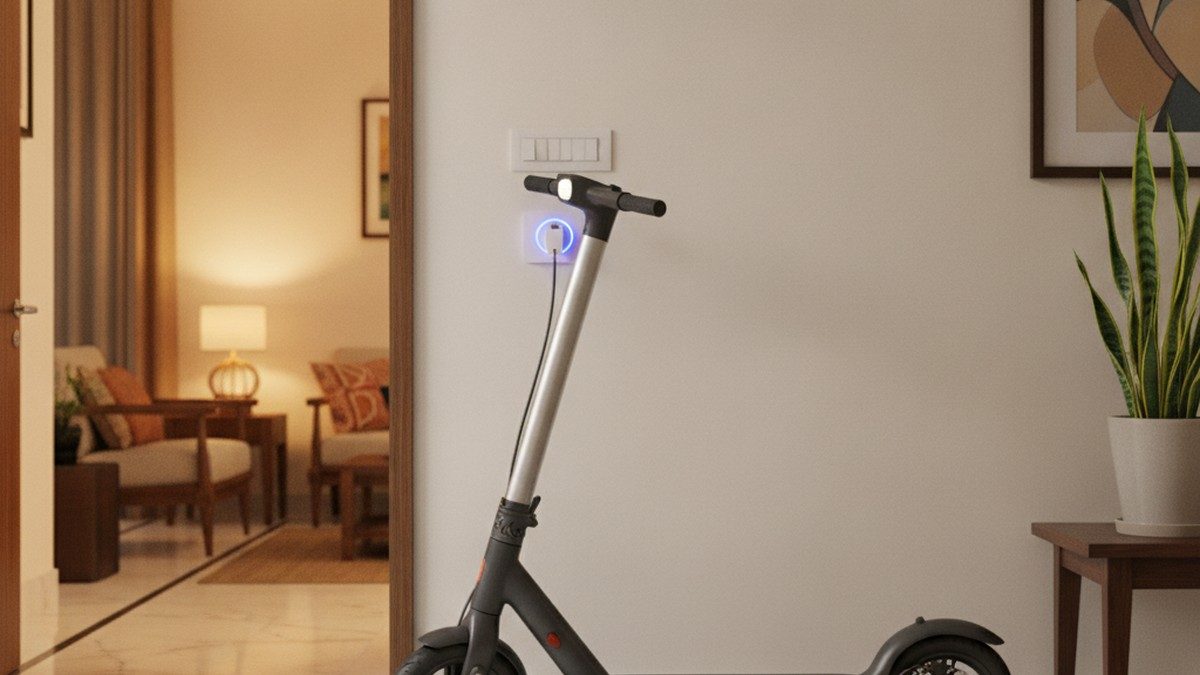
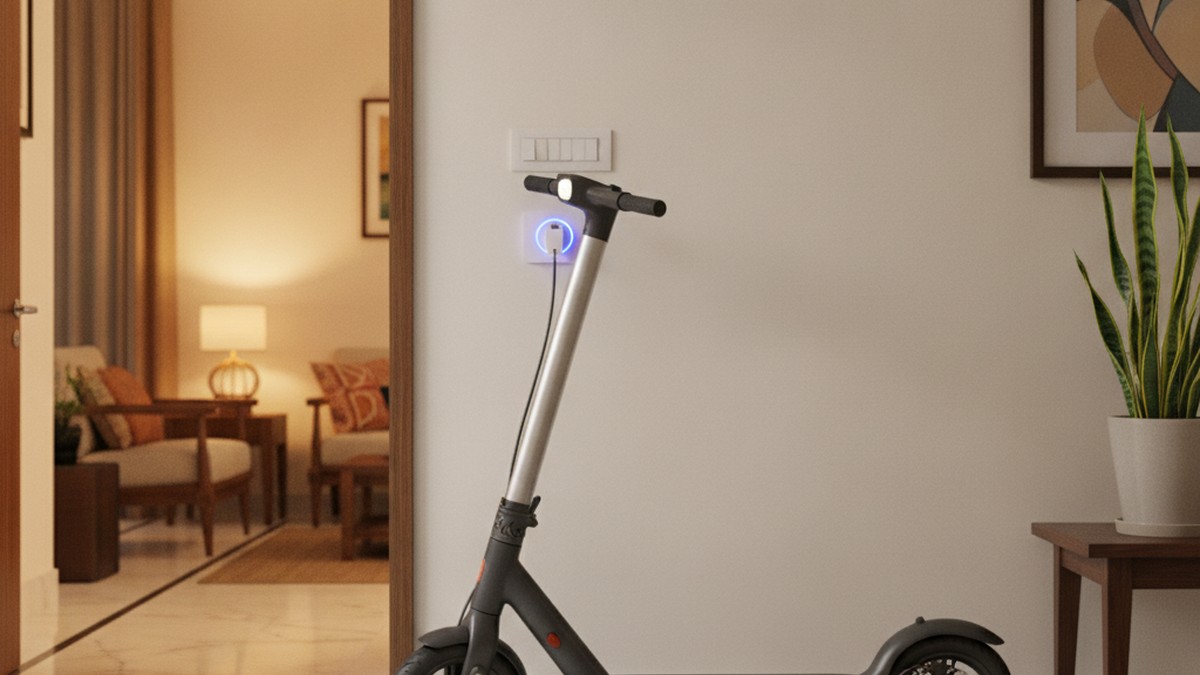
Here is what most range anxiety conversations miss entirely: an electric scooter is not a petrol tank. You don’t ride it until empty and then figure out where to refuel. The correct mental model is your smartphone. You plug it in overnight, every single night, and you wake up every morning with a full charge.
This completely transforms the question you should be asking. The question is not “can this scooter travel 300 km on a single charge?” The real question is “can it comfortably handle my daily commute, with enough margin to cover an unexpectedly long day?”
If the answer to that second question is yes, range anxiety — in the day-to-day sense — effectively disappears. You start every morning full. Your worst-case scenario is not running out of charge; it’s having slightly less range than usual on a hot August afternoon after you’ve been riding harder than normal. Which is a manageable inconvenience, not a crisis.
The Actual Numbers for Indian Commuters
So what does the average Indian city rider actually need? Urban commute surveys consistently point to round-trip daily distances of 20 to 50 km for the majority of city residents. Office-to-home commutes in cities like Pune, Hyderabad, Chennai, and Bengaluru typically average 25 to 40 km for a standard urban household. Even accounting for occasional errands and detours, a realistic “heavy day” for most riders rarely exceeds 60 to 70 km.
A practical rule for estimating your minimum range requirement: take your realistic daily round-trip distance, add 40 percent as a buffer, and that is your floor. If your daily commute is 35 km, you need a reliable real-world range of at least 50 km. Anything above 70 km gives you a full day’s comfortable headroom even on demanding days — and you’ll always be charging overnight regardless.
This arithmetic points clearly to a real-world range of 65 to 80 km as the sweet spot for the vast majority of urban Indian buyers — which corresponds to an IDC-rated range of roughly 80 to 110 km.
The Premium Range Trap
Understanding this range sweet spot makes one thing clear: the 200 km, 250 km, and 300 km range scooters in the market solve a problem that most Indian city commuters don’t actually have. They exist for genuinely long-distance use — inter-city travel, extended rural riding, or situations where home charging isn’t reliable. For the rider covering 35 km daily and charging overnight, a 250 km IDC range is roughly five to six times more than required. And you’re paying for every bit of that extra battery capacity.
The Ola S1 Pro+ with its 5.2 kWh battery is priced at around ₹1.90 lakh ex-showroom. The Ather 450X, respected for its performance and software, starts at ₹1.49 lakh. Both are well-built machines with genuine strengths. But for the daily urban commuter whose real-world distance rarely crosses 60 km, a meaningful portion of that cost goes toward range you’ll statistically use on very few days — if ever.
What Elektree Gets Right for the Real-World Indian Commuter
This is precisely the gap that Elektree India’s scooter lineup addresses. The Zenith and RV 80 are both rated at 80 to 100 km on the IDC cycle, priced at ₹90,164 and ₹94,363 respectively. At real-world efficiency, that means reliable daily range of roughly 65 to 80 km — comfortably covering the 35 to 50 km commutes that represent the actual daily requirement for most urban Indian households.
What makes these scooters genuinely practical rather than merely affordable goes beyond the range figure. The Zenith’s Mid Drive IPM motor delivers more efficient power conversion than cheaper hub-drive alternatives, which directly contributes to extending real-world range in city conditions. Ground clearance of 180 mm handles the kind of road surfaces — potholes, broken edges, speed breakers — that are routine across Indian cities. An 18.5-litre boot and 180 kg payload capacity mean you can actually use the scooter for practical daily tasks without range concerns. Multiple riding modes (Hyper, Normal, and Eco) let you stretch range further on days when you need it, simply by selecting Eco mode for a relaxed commute.
The battery warranty is worth paying particular attention to. Elektree covers the battery for 3 years or 50,000 km — whichever comes first. The Ather 450X’s battery warranty is 3 years or 30,000 km. For a daily commuter covering 35 km each way, that difference in kilometre coverage is meaningful. You’re buying assurance that the battery’s performance is underwritten for longer.

When You Genuinely Need More Range
There are riders for whom a longer range genuinely matters — those with exceptionally long one-way commutes of 50 km or more, freelancers who ride across town all day, or households in smaller cities where charging access outside the home is limited and inter-city riding is routine. For these buyers, Elektree’s Fantom EV electric motorcycle — rated at 150 to 180 km IDC range, with a 110 km/h top speed, priced from ₹1,39,000 — fills the gap without requiring the buyer to reach for a ₹1.90 lakh machine. That is a meaningful saving for the performance and range on offer.
Making the Decision Without Second-Guessing Yourself
Before your next showroom visit, do three things. First, calculate your actual daily round-trip distance — not your worst imagined day, but your realistic everyday commute. Second, check whether you have a reliable home charging setup (a standard 15A socket is all an Elektree scooter needs, with a full charge in 4 to 5 hours overnight). Third, think about your genuine worst-case day: the furthest you’re realistically likely to ride in a single day without access to a charger.
If that real-world worst-case number is below 70 km, you don’t need a scooter rated at 300 km. You need one with an IDC rating of 90 to 100 km, a good battery warranty, practical features for Indian roads, and a price that doesn’t require you to over-finance a purchase. Elektree’s Zenith is a direct answer to that requirement — engineered for the actual riding patterns of Indian city commuters, not for a hypothetical buyer who might occasionally want to ride from Mumbai to Pune without stopping.
For riders who’ve been holding back from going electric because the range numbers felt intimidating, the honest message is this: do the daily maths, plan for overnight charging, and you’ll likely find that a well-specced 80 to 100 km IDC scooter handles everything your daily life demands — with room to spare. Explore Elektree India’s full electric scooter lineup at elektree.com and see whether the numbers work for your actual commute.