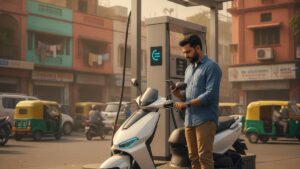
Delivery Riders: Stop Giving ₹6,000 a Month to Petrol Pumps — The Electric Scooter Math Every Gig Worker in India Needs to See
Here’s a number that should bother you. A delivery rider doing 100 km a day on a petrol scooter in India is spending somewhere between ₹5,500 and ₹7,000 every single month just on fuel. Add oil changes, chain maintenance, brake pads, and the occasional puncture — and that monthly total quietly crosses ₹8,000 to ₹10,000. That’s money leaving your pocket before you’ve even counted what you’ve earned.
If you’re on Swiggy, Zomato, Blinkit, or any delivery platform, your two-wheeler isn’t just transport — it’s your entire business infrastructure. What you ride determines what you spend, and what you spend determines what you actually take home. And yet, most guides to electric scooters are written for people doing 30 km a day, not the 80 to 120 km that a full delivery shift in a busy Indian city actually demands.
This guide is written for people doing the real numbers.
The Real Cost of Running Petrol for Delivery Work
With petrol at around ₹103 per litre in 2026, a rider covering 3,500 km a month on a standard commuter burns through roughly ₹6,000 in fuel. But delivery work is harder on a bike than regular commuting — constant stop-starts, idling, carrying load. Real-world efficiency often drops below advertised mileage figures, pushing costs higher.
Maintenance compounds the problem. Delivery bikes cover three to four times the annual mileage of a typical private owner. Engine oil needs changing every 2,000 to 3,000 km. Chains, brakes, and tyres wear faster. Budget ₹2,500 to ₹4,000 a month for upkeep once you’re clocking serious kilometres. Add EMI and insurance, and a petrol bike for delivery can quietly cost ₹13,000 to ₹18,000 every month before you’ve earned a rupee.
An electric scooter in the same usage pattern runs at ₹0.50 to ₹0.80 per kilometre — compared to ₹1.70 to ₹2.00 per kilometre on petrol. At 3,500 km a month, that’s a saving of ₹4,000 to ₹6,500 monthly on fuel alone. The maintenance savings are on top of that, since electric motors have far fewer moving parts and don’t need oil changes or carburetor cleaning.
What Delivery Work Demands That Regular Commuting Doesn’t
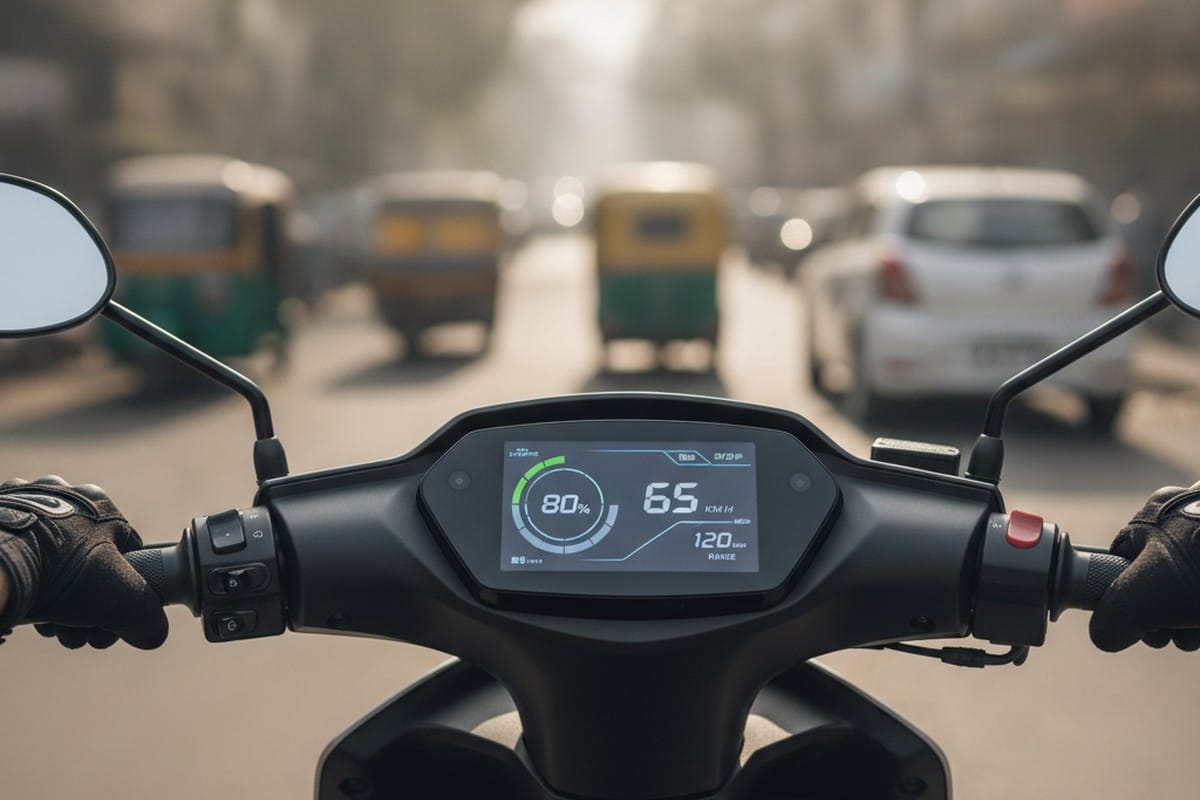
Most EV buyers plan for 30 to 50 km of daily commuting. Delivery riders need to think completely differently. A full shift across a 5 km order radius in Bengaluru, Pune, or Hyderabad can rack up 80 to 120 km in a single working day. That immediately eliminates most entry-level electric scooters with claimed ranges below 80 km.
And claimed range is not the same as real-world range. In delivery conditions — carrying an insulated bag, navigating potholes, constant acceleration and braking in heavy traffic — you can expect real-world range to come in 20 to 30 percent below the advertised number. A scooter claiming 70 km might realistically give you 50 to 55 km under delivery conditions.
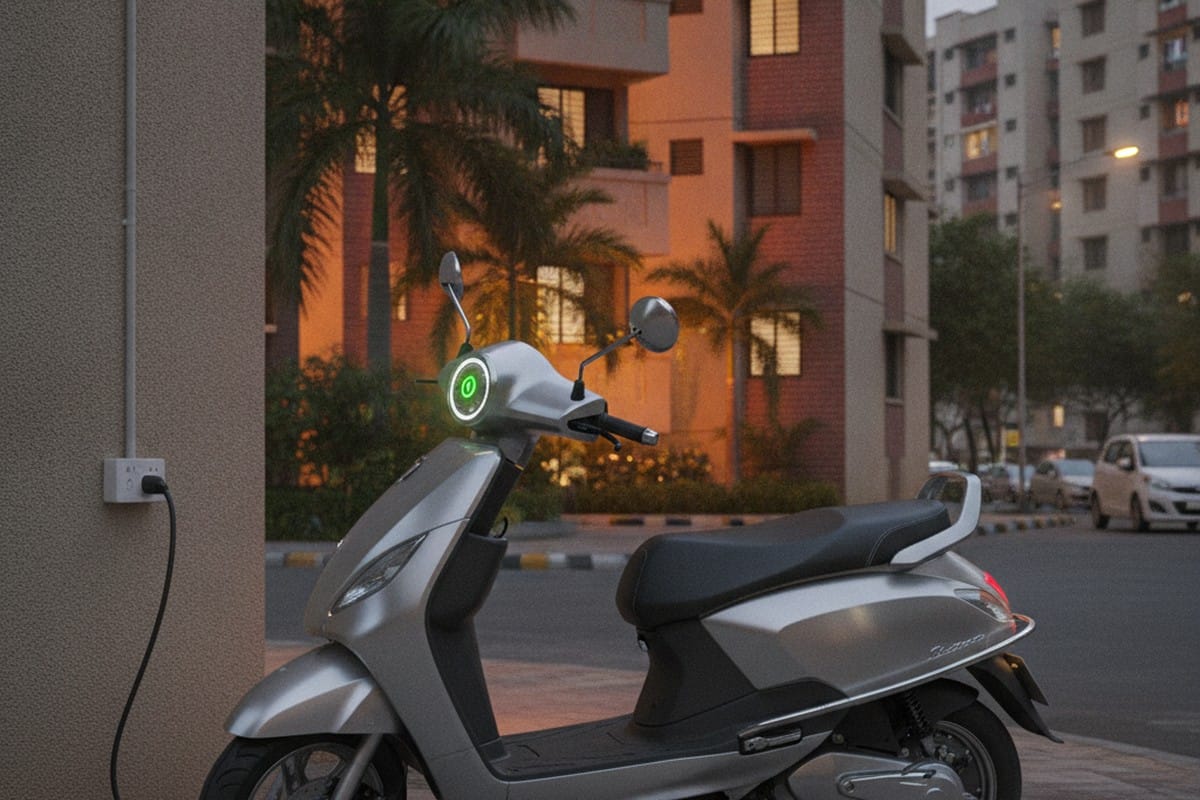
Beyond range, what matters for delivery riders is service accessibility, charging practicality, and how the vehicle holds up to sustained heavy use over months and years. Overnight home charging — plug in after your shift, start the next day at full charge — works well for most riders. But if something breaks down mid-shift, how close is the nearest service point?
One more thing most buyers overlook: warranty terms for commercial use. Several manufacturers have fine print that limits coverage if you’re using the scooter for paid delivery work. Before signing, ask specifically whether commercial use affects your warranty.
Setting the Evaluation Standard
Before looking at models, establish your benchmarks. You want real-world range of at least 70 to 80 km under load on a single charge. You want a service network that extends meaningfully beyond the showroom city. You want overnight charging to work reliably from a standard home socket. And you want running economics that justify the higher upfront cost compared to a petrol commuter.
Top speed matters less than low-speed torque for delivery work. Quick acceleration from signals and easy navigation in slow city traffic is what a delivery rider actually needs — not the ability to hit 80 km/h on a highway.
There are credible options in this segment. TVS iQube offers predictable range and a deep service network. Bajaj Chetak brings durability and wide dealer coverage. Ola S1 X delivers strong range per rupee. But there’s another brand worth putting on your shortlist — one built specifically around Indian conditions and realistic ownership economics.
Why Elektree Makes Strong Sense for Delivery Riders
Elektree is a homegrown Indian EV brand with a lineup starting at ₹82,871. Their most delivery-relevant models are the Zenith (starting at ₹90,164) and the RV 80 (starting at ₹94,363) — both offering 80 to 100 km of claimed range and a top speed of 60 km/h on 60V lithium battery packs.
For delivery riders, a few specifics stand out. First, the running cost: Elektree puts charging at ₹5 to ₹10 per full charge. At that rate, a rider covering 80 km daily is spending roughly ₹200 to ₹300 on electricity per month for their entire working fuel cost. Against ₹6,000+ in petrol for the same mileage, the savings are immediate and real.
Second, the warranty: three years across Elektree’s range. That’s meaningful coverage for anyone putting in high annual mileage, and it’s backed by 24×7 customer support and roadside assistance — which matters enormously when your income depends on the vehicle staying on the road.
Third, the service reach. Elektree’s network covers cities including Delhi, Mumbai, Bengaluru, Hyderabad, Patna, Guwahati, Lucknow, Siliguri, and Ranchi — including several tier-2 cities where delivery platforms are growing rapidly and where some newer EV brands still don’t have meaningful after-sales presence. The company cites 30+ service outlets and over 100 dealers nationally, with a stated commitment to continuing expansion.
All Elektree models are ICAT-certified, meeting the regulatory requirements that apply to registered electric vehicles in India. Their Elektree Wheels model (₹82,871), which qualifies as a low-speed EV and doesn’t require a licence, is suited for shorter routes — though the 50 to 70 km range and 45 km/h cap make the Zenith or RV 80 the more practical choice for anyone doing a full delivery shift.
The Numbers for a Real Delivery Rider
Consider a rider currently spending ₹6,500 on petrol and ₹2,500 on maintenance monthly — ₹9,000 in direct running costs. Switch to the Elektree Zenith: electricity cost drops to roughly ₹200 to ₹300 per month for the same mileage. Maintenance costs fall substantially. Realistically, you might save ₹7,000 to ₹8,500 every month in running costs.
At that saving rate, the additional upfront cost of the Zenith over a ₹75,000 petrol commuter pays back within two to three months. Over the three-year warranty period, the cumulative savings can exceed ₹2.5 lakh — a significant number for anyone working in the gig economy. These are estimates based on current petrol prices and typical electricity tariffs; your actual figures will vary with your city and riding pattern, but the direction is unambiguous.
The Verdict
For anyone working full-time delivery in India, the economics of electric are now clearly in your favour — the question is which vehicle to trust with your livelihood. That answer needs to consider real-world range, genuine service coverage, honest warranty terms, and a running cost that actually delivers the savings you’re calculating.
Elektree India meets those criteria in a way that makes sense for high-mileage delivery work: ICAT-certified vehicles, a meaningful three-year warranty with roadside assistance, 24×7 support, a growing national service network, and a per-charge cost that makes the fuel savings tangible from day one. At ₹90,164, the Zenith is priced to be accessible without compromising on what a delivery rider actually needs.
Delivery platforms are also moving in one direction — Maharashtra is already drafting regulations that could require Swiggy, Zomato, and Blinkit to shift to EV fleets. Getting ahead of that curve now rather than being pushed into it later is simply the smarter move.
If you’re still running petrol for delivery work, start with the fuel savings calculation. Then visit elektree.com to find your nearest Elektree dealer and have a proper conversation about what the numbers look like for your specific route and daily mileage. The switch is simpler than it seems — and considerably more rewarding.