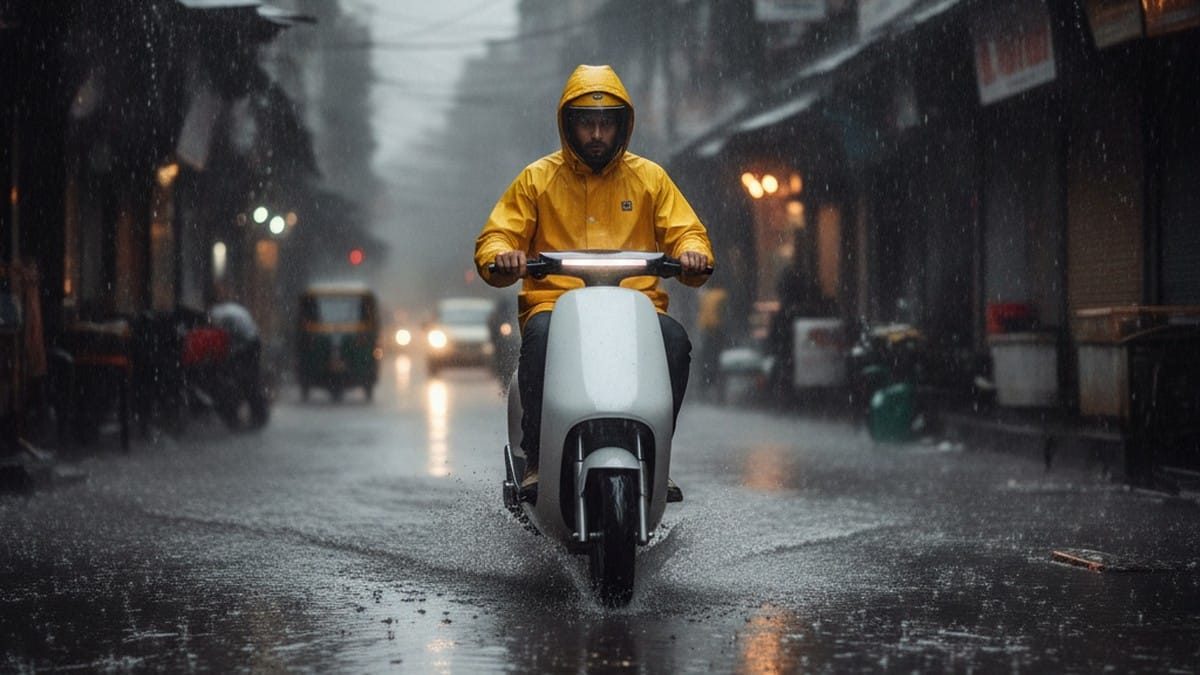
September in Bengaluru, and the roads outside Electronics City look more like the backwaters of Kerala than a tech hub. Delhi’s Dwarka sectors are dealing with ankle-deep standing water again. Mumbai’s Hindmata junction is doing what it does every year without fail. If you own an electric scooter and you’ve been watching the weather app with one eye and your scooter’s battery percentage with the other, you are far from alone.
The question most riders quietly wonder about but rarely get a straight answer to: is your electric scooter actually safe to ride in heavy Indian rain? And if something does go wrong, who ends up paying for it?
The answers are more nuanced than the brochure says — and if you’re in the market for a new EV, understanding them could be the difference between a genuinely smart purchase and an expensive lesson learned over the following monsoon seasons.
The Monsoon Threat Nobody Actually Talks About
Here’s the pattern that plays out across thousands of Indian EV owners every year: you ride through a waterlogged street, everything seems fine, and you park it. The scooter starts the next morning. No warning lights, no drama. Crisis averted, you think.
What actually happens next is far less visible. Moisture that entered through microscopic gaps in connectors, instrument cluster seals, or wiring harnesses starts doing its quiet, slow work. Corrosion builds up over weeks. Six months later, you’re getting intermittent throttle errors that the service centre struggles to diagnose, or warning lights that flash unpredictably. The repair bill — anywhere from ₹12,000 to ₹18,000 in many documented cases — arrives long after anyone would connect it to that rainy Tuesday when you rode through knee-deep water.
This delayed-damage pattern is what makes monsoon-season evaluation genuinely tricky. Short-term survival tells you almost nothing about long-term impact.
IP Ratings: What They Actually Mean, and What They Don’t
Most premium electric scooters sold in India today advertise an IP67 rating for their battery packs. The Ather 450X, Ola S1 Pro, and TVS iQube all cite IP67 for their core battery systems. So what does this actually mean for you, riding down a road that looks like it’s auditioning for a river?
The two digits in “IP67” each communicate something specific. The first digit (6) refers to dust protection — the maximum level, meaning no dust can enter the sealed enclosure under any conditions. The second digit (7) refers to liquid protection: the component can survive submersion in up to one metre of still, clean water for 30 minutes, under controlled laboratory conditions.
What IP67 does not mean: that the entire scooter is waterproof. Charging ports, instrument cluster connectors, under-seat wiring harnesses, and 12V auxiliary circuits are almost always rated separately — or in many cases, not rated at all. Some of the most common failure points are components that manufacturers don’t specifically mention in their marketing materials. The battery pack IP67 rating is real and meaningful, but it covers the battery pack specifically, not the whole vehicle.
There’s another practical limitation worth knowing. IP ratings are tested with clean, still, fresh water in a controlled environment. Indian monsoon conditions — chemical runoff, debris-laden floodwater, repeated alternating wet-dry cycles — put a different kind of stress on seals over multiple seasons than a 30-minute lab immersion test captures. Treat IP67 as a strong positive indicator, not an unconditional guarantee.
Ground Clearance: The Number Most Buyers Completely Skip
If there’s one specification that most Indian EV buyers consistently underestimate, it’s ground clearance. On waterlogged city roads — where the actual depth of standing water is impossible to judge accurately while you’re riding — the height between your undercarriage and the road surface often determines what happens next.
Most manufacturers unofficially recommend avoiding water depths beyond 200-250mm, which is roughly mid-shin level when standing in the water. Once water reaches your footboard on the scooter, you’re approaching the threshold of where things can go wrong. At legshield level, you’re well past it.
A scooter with 160mm of ground clearance reaches that critical footboard-contact point noticeably earlier than one with 180mm. On Indian roads, where a pothole filled with water has no visible bottom and road surfaces drop unexpectedly, that difference in clearance is more than an academic specification. It’s the practical margin between your undercarriage components staying dry and beginning to make contact with floodwater. More clearance means the vehicle’s lower components start encountering standing water later — a genuine advantage on uneven, waterlogged urban surfaces.
Charging in Monsoon: The Risk Nobody Warns You About
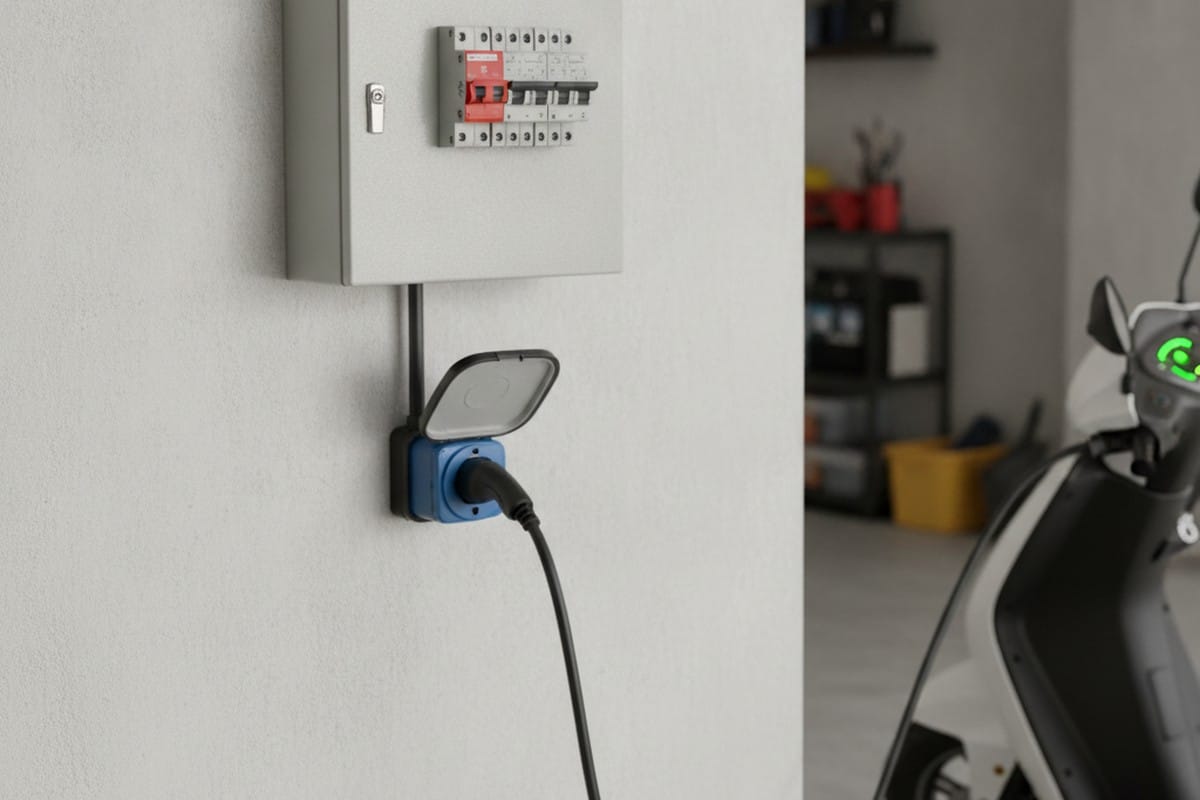
One of the most overlooked monsoon risks has nothing to do with riding in rain — it’s about what happens when you come home and plug in. Wet hands, a damp charging port, and improperly earthed home wiring create a hazardous combination. A 30mA RCCB (residual current circuit breaker) at your charging point will cut power instantly on a fault and costs ₹600-1,200 at any electrical shop. Pair it with a 10A MCB appropriate for your charger — most Indian homes don’t have this setup unless someone specifically asked for it.
One habit worth making permanent: wait 30 to 60 minutes after a wet ride before connecting the charger. This lets moisture evaporate from around the port before you introduce an electrical connection. A quick dry-cloth wipe of the charging port takes five seconds and reduces connector corrosion risk significantly over time.
After any seriously waterlogged ride, a compressed-air blow-down of the wiring harness at your service centre (₹300-800, 30 minutes) physically removes moisture before it corrodes quietly over weeks. Repair professionals across Indian cities consistently note that this simple procedure prevents a large proportion of the mysterious electrical issues they see in November and December — damage that traces back to monsoon rides months earlier.
What to Actually Check When Evaluating a Monsoon-Ready Scooter
If you’re buying a new electric scooter right now, ask these specific questions: What is the battery pack’s IP rating? What is the charging port’s rating (often different and lower)? How does the ground clearance compare to the water depths on your typical route? Does the warranty cover water-related damage? And is the service network accessible for post-monsoon checks? Five minutes of this research will tell you more about real-world suitability than any brochure.
Where Elektree India Fits Into This Picture
Most of the monsoon-capability conversation in India gets dominated by brands priced at ₹1.2 lakh and above. But a significant share of Indian EV buyers — particularly those commuting in tier-2 cities, college areas, or outer zones where waterlogging is common — are working with a budget that makes sub-₹1 lakh electric scooters the realistic category. Here, the conversation changes.
Elektree India builds electric scooters and motorcycles designed around what Indian riders actually encounter — not what makes for a compelling press release. The Elektree Zenith, at ₹90,164, comes with 180mm of ground clearance. The Ather 450X — one of the frequently cited benchmarks for Indian EV build quality — has 170mm. More clearance means the Zenith’s undercarriage components begin encountering standing water later in waterlogged riding conditions.
The Zenith carries ICAT certification from the International Centre for Automotive Technology — India’s government-recognised vehicle testing authority — requiring compliance with AIS 156 battery safety standards and CMVR regulations. This is substantive engineering validation, not a paperwork formality.
The practical specifications tell the rest of the story: a lithium-ion 60V/35Ah battery with a 3-year/50,000km warranty, a mid-drive IPM motor, disc brakes, 18.5 litres of underseat storage, and a full LED setup. Charging takes 4-5 hours at ₹5-10 per full charge — the cost of running 80-100 km. That figure doesn’t move when petrol prices do.
The Scooter That Was Built for India’s Conditions
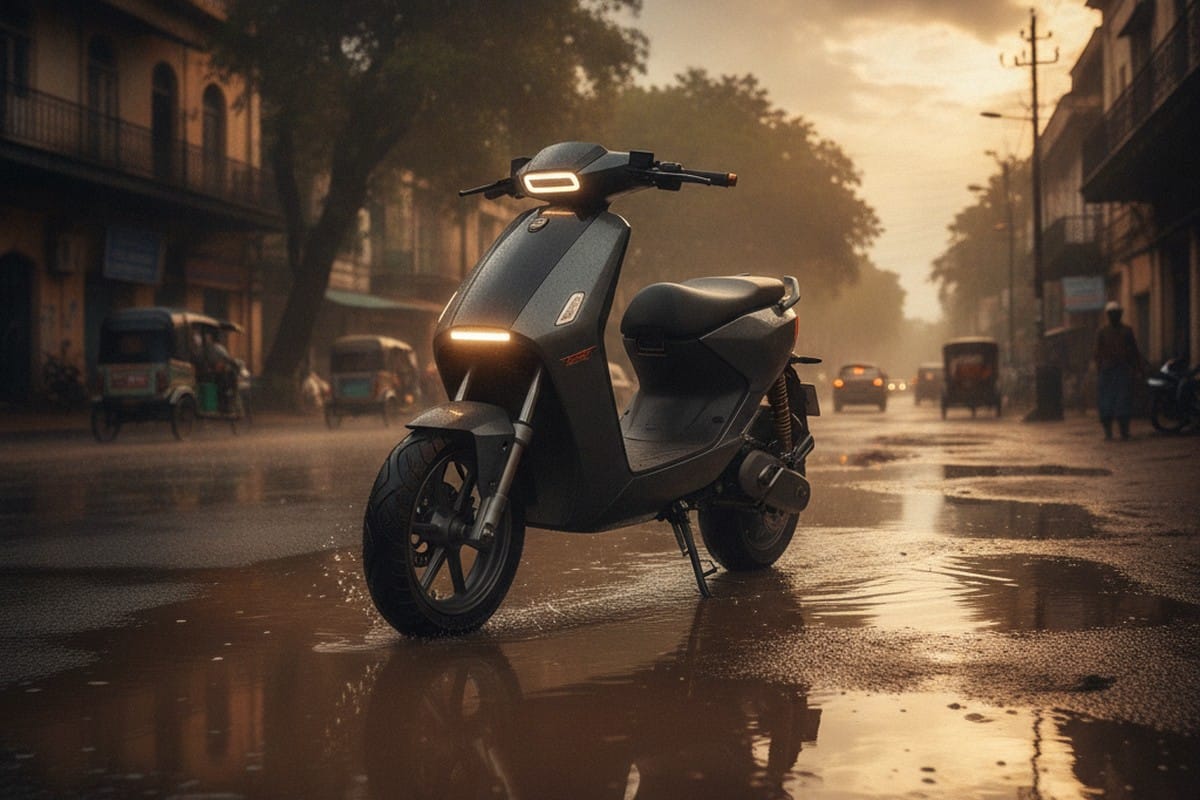
What the monsoon actually tests in an electric scooter isn’t just water resistance — it’s how well the vehicle was designed for conditions that diverge sharply from a controlled test environment. Indian roads in August are not a lab. The charging point at home may not meet current safety standards. The nearest service centre may be forty minutes away on a flooded road. The scooter you choose needs to be built for this, not for launch-day brochures.
For buyers who’d rather spend ₹90,000 on a well-specified, properly certified scooter than ₹1.5 lakh on a brand name, the Elektree Zenith represents genuine value. Its 180mm ground clearance, ICAT certification, lithium-ion battery, and 3-year warranty make for a package that’s more competitive than its price might suggest — especially against alternatives that cost significantly more and offer only incremental advantages in real-world Indian conditions.
Visit elektree.com to explore the Zenith, the RV 80, and the Fantom EV in detail, compare specifications, and find a dealer near you before the festive season changes the availability picture.