India’s PM E-DRIVE Subsidy for Electric Scooters Has Ended — Here’s Why the Smartest Buyers Aren’t Backing Out
When the central government’s PM E-DRIVE subsidy window for electric two-wheelers officially closed on July 31, 2026, a predictable wave of uncertainty swept through showrooms across the country. Buyers who had been sitting on the fence — waiting for “the right moment” or trying to time the purchase perfectly — suddenly found their ₹5,000 incentive gone. The question on every such buyer’s mind is now the same: does an electric scooter still make financial sense without the subsidy?
The short, honest answer is yes — and not just marginally. But to understand why, you have to stop thinking about the subsidy as the point of buying an electric scooter in the first place.
What the PM E-DRIVE Subsidy Actually Was
The PM E-DRIVE scheme was the successor to India’s FAME II policy, designed to accelerate EV adoption by reducing the upfront purchase cost for buyers. For electric two-wheelers, the scheme offered ₹2,500 per kWh of battery capacity (reduced from the earlier ₹5,000/kWh rate) — capped at roughly ₹5,000 to ₹10,000 depending on the model. It wasn’t a transformation-level benefit, but it helped nudge price-sensitive buyers over the line, particularly in the ₹80,000–₹1,20,000 segment where most electric scooters sit.
That central incentive is now gone for two-wheelers. The scheme continues to support electric three-wheelers, e-buses, charging infrastructure, and commercial vehicles until March 2028, but private electric scooter buyers buying from August 2026 onward are on their own as far as the central government is concerned.
So prices have gone up by approximately ₹5,000–₹10,000 across most models. That’s real money. But here’s what the numbers actually say when you look at the full picture.
The Petrol Arithmetic That Changes Everything
Petrol in Delhi is currently sitting at ₹102.12 per litre. In Bangalore it’s ₹111.68. In Hyderabad, ₹115.69. These aren’t projections — these are the pump prices as of the first week of September 2026, and they’ve been stubbornly high all year.
A typical 125cc petrol scooter in Indian city traffic returns around 45 km per litre in real-world conditions. That works out to roughly ₹2.27 per kilometre in Delhi and considerably more elsewhere. For a commuter doing 40–50 km daily, that’s around ₹3,400–₹4,200 spent on petrol every month — just to get to work and back.
An electric scooter running on a home charge costs roughly ₹0.15 to ₹0.30 per kilometre depending on local electricity rates and battery size. At the higher end of that range, you’re looking at ₹450–₹600 per month for the same 40–50 km daily commute. The annual fuel saving alone is ₹18,000 to ₹24,000.
Now set that against the ₹5,000–₹10,000 lost subsidy. The subsidy is recovered in three to five months of normal riding. After that, every single month of ownership delivers savings the petrol option simply cannot match.
State Governments Are Filling the Gap — Sometimes More Generously
Here’s something that many buyers overlooked while fixating on the central scheme: several states have their own independent EV incentive programmes, and these remain fully active.
Maharashtra offers up to ₹25,000 in subsidy for electric two-wheelers, plus a full road tax exemption. Gujarat provides up to ₹20,000 with a 50% road tax reduction. Assam, West Bengal, Bihar, and Meghalaya each offer up to ₹20,000 with complete road tax waivers. Even states that don’t offer direct cash subsidies — like Tamil Nadu, Karnataka, Andhra Pradesh, and Uttar Pradesh — have eliminated road tax and registration fees entirely for EVs.
In Maharashtra, a buyer who missed the PM E-DRIVE window could still walk away with ₹25,000 off the purchase price plus savings on registration. That’s more than twice what the central subsidy was offering in its final months. The point being: the conversation about government support for EV buyers is far from over. It’s just shifted to the state level, where, in several cases, it’s even more generous.
What You Should Actually Be Evaluating Right Now
With or without a subsidy, the fundamentals of electric scooter selection don’t change. If anything, the removal of the central incentive makes it more important to choose wisely — because the long-term ownership economics are what matter, not the initial discount.
The first thing to verify is real-world range, not the headline figure. A scooter claiming 120 km may deliver 70–80 km in city stop-start traffic with the headlights on, a pillion rider, and a carrier loaded with groceries. Range that works for a 35 km daily round trip should have a comfortable 30–40% buffer above your actual requirement — so you’re not white-knuckling it home every second day.
Second, check ICAT certification. India’s International Centre for Automotive Technology is the regulatory body that validates whether an electric vehicle’s range and performance claims are based on standardised testing rather than optimistic marketing. Buying an ICAT-certified vehicle means the specifications you’re reading are not completely fabricated, and that the scooter has cleared the government’s own quality checks.
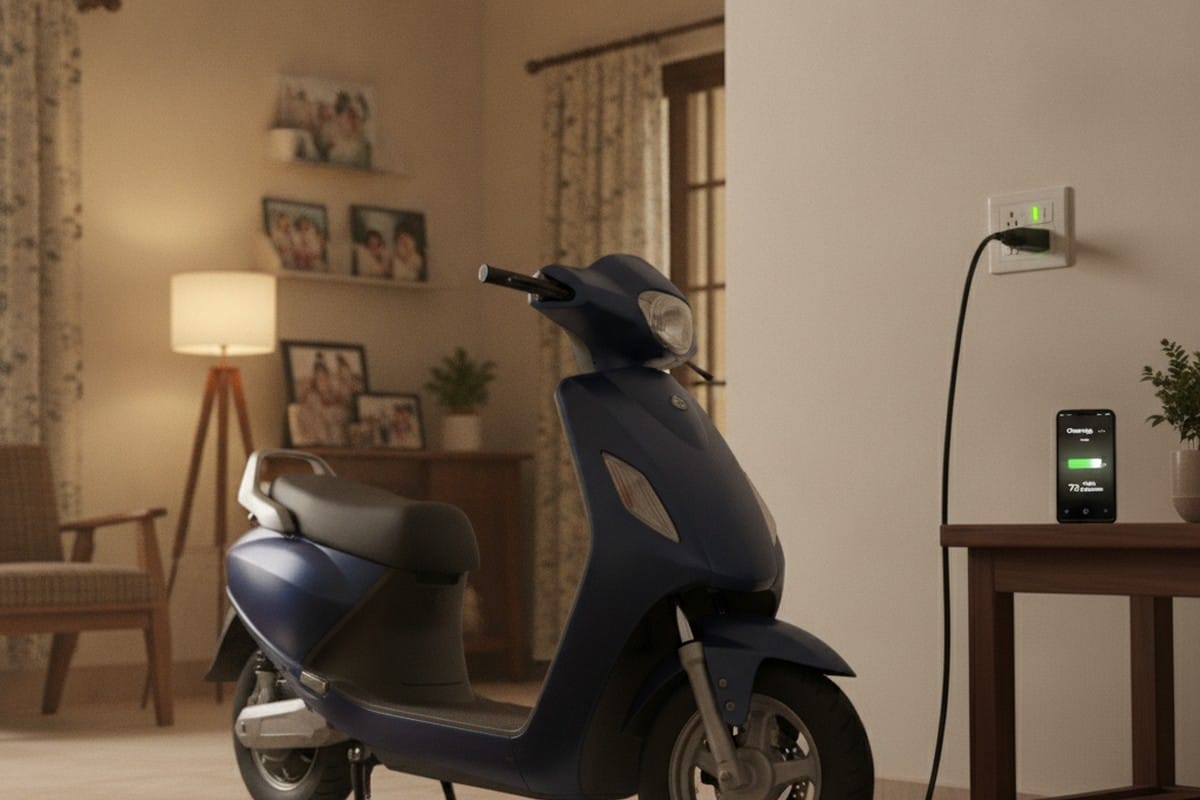
Third, look at the actual per-charge cost and charging time. The headline figure of ₹5–₹10 per full charge that you’ll see on most modern electric scooters is achievable, but only if you’re charging at home on a standard 5–15A socket. Public fast-charging, where available, costs more. A scooter with a 4-hour home-charging time is practical; one that requires 6–8 hours to fully charge can create real scheduling problems for daily commuters.
Finally, warranty terms matter enormously for electric vehicles. The battery is both the most critical component and the most expensive to replace if something goes wrong outside the warranty period. A 3-year minimum warranty on the battery and motor is the baseline to look for.
Where Elektree Stands in This Landscape
Elektree India has built a range specifically designed for the Indian urban commuter — practical range, affordable pricing, and ICAT-certified specifications that reflect real-world performance rather than lab conditions.
The Zenith and RV 80 models are priced between ₹90,000 and ₹95,000, deliver 80–100 km of claimed range at a 60 km/h top speed, and carry a 3-year warranty. For the overwhelming majority of Indian daily commuters — whose round trips fall within 40–60 km — that range is comfortably adequate with meaningful headroom. Charging costs come to ₹5–₹10 per full charge, which translates to a per-kilometre operating cost well under ₹0.20 even in cities with relatively higher electricity tariffs.
The entry-level Elektree Wheels is available under ₹83,000 with a 50–70 km range and 45 km/h top speed — positioned specifically for shorter, slower-paced urban use where a no-licence ICAT-approved scooter makes sense for campus commutes, local errands, and last-mile connectivity.
For those with longer daily distances or a genuine preference for higher performance, the Fantom EV enters the picture at ₹1,39,000. With a claimed range of 150–180 km and a 110 km/h top speed, it belongs in a different category — the performance electric motorcycle segment — and competes directly on range and capability with models costing significantly more.
What ties the Elektree range together is the 19+ ICAT-certified models the company has put through government testing — a number that speaks to consistent investment in meeting India’s regulatory quality standards rather than simply launching products and hoping buyers don’t look too closely at the specs.
The Final Calculation
Consider the Elektree Zenith at ₹90,164. A Delhi buyer riding 45 km daily will save roughly ₹22,000–₹24,000 annually on fuel compared to a petrol scooter, plus another ₹4,000–₹6,000 on maintenance over the year. Over five years, that’s somewhere between ₹1.3 lakh and ₹1.5 lakh in savings. Even accounting for the lost central subsidy, the ownership economics are considerably more compelling than a petrol alternative in the same price bracket.
In Maharashtra or Gujarat, those economics improve further. A Maharashtra buyer gets ₹25,000 off the purchase price through the state scheme, plus zero road tax. The effective ownership cost of an Elektree Zenith for a Mumbai-area commuter is meaningfully lower than the sticker price suggests.
The PM E-DRIVE subsidy window was always going to close — government demand incentives are temporary by design, meant to kick-start adoption until the economics of EV ownership stand on their own. In India in 2026, with petrol at ₹100+ per litre, 1.4 million electric two-wheelers sold in FY2026 (a 21.8% year-on-year increase), and electricity rates that make per-km charging costs a fraction of petrol, the ownership economics have arrived.
If you were waiting for the subsidy to give you a reason to switch, here’s the truth: you’ve been sitting on a stronger reason all along. The fuel savings, the maintenance savings, the simplicity of home charging, and the rising quality of India-focused EV products like Elektree’s — those don’t expire on July 31.
For commuters evaluating their first electric scooter, Elektree India’s current range at elektree.com is worth a detailed look — certified range figures, competitive pricing, and a product line built around Indian riding conditions. Value-led EV ownership that makes sense whether the subsidy was there or not.