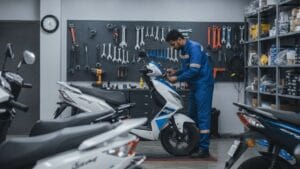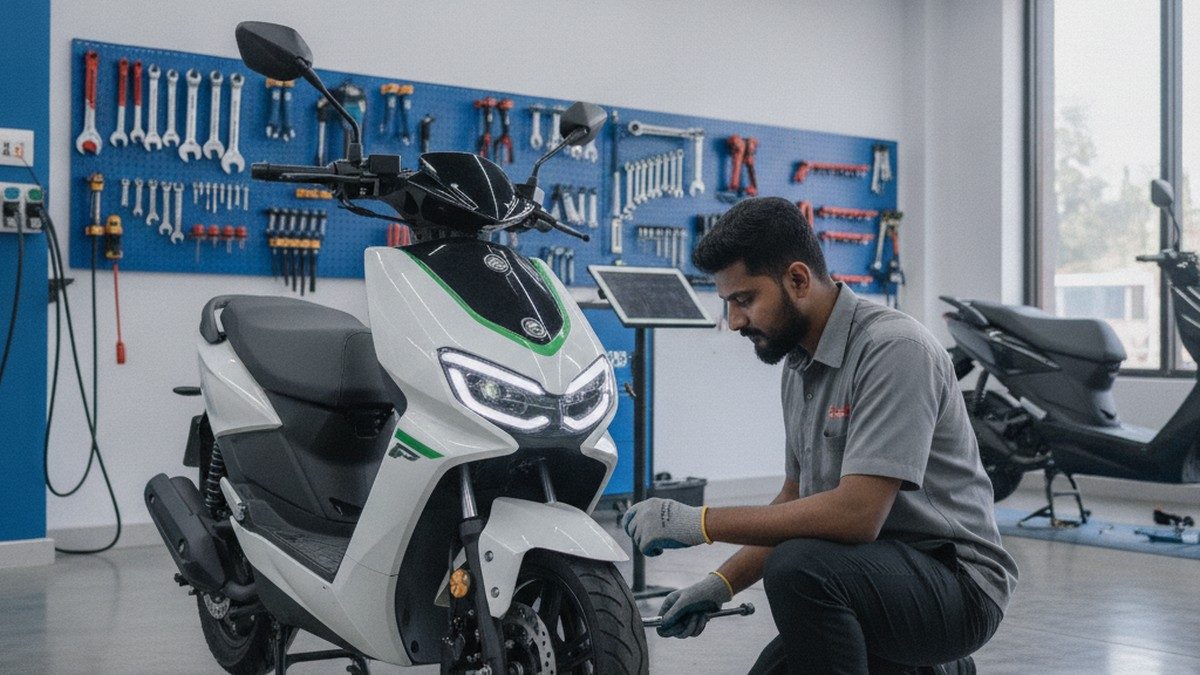
Walk into any electric scooter showroom in India today and you’ll hear plenty about range, top speed, and ex-showroom price. What most salespeople won’t walk you through — unless you specifically ask — is what you’ll actually spend maintaining that scooter across three to five years of ownership.
This is a real gap in how most Indians shop for EVs. You’ll spend hours comparing ₹90,000 versus ₹95,000 sticker prices, but the scooter that costs slightly less upfront might drain ₹15,000 more from your pocket over the next five years in service costs, consumables, and out-of-warranty repairs. Or vice versa. Getting this wrong is a surprisingly common mistake — and an expensive one.
So let’s look at what electric scooter maintenance actually costs in India — the real numbers, not the marketing version.
First, the Good News: What You Don’t Have to Worry About Anymore
If you’re switching from a petrol scooter, the first thing to understand is how many costs simply vanish with an EV.
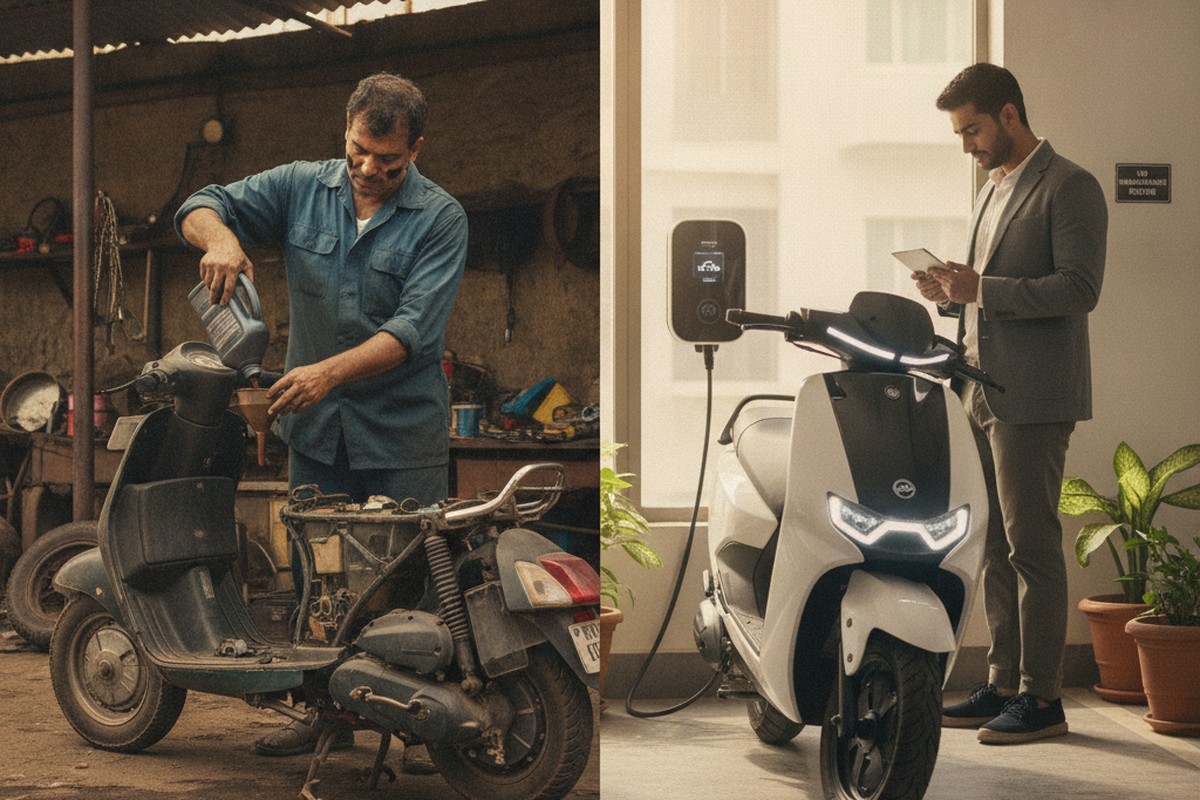
No engine oil to change every three months. No spark plugs. No air filter cleaning or replacement. No clutch plates, no transmission oil, no exhaust pipe repairs. These aren’t minor line items on a petrol scooter — over five years of typical commuting, they can easily add up to ₹15,000 to ₹25,000 depending on your usage and riding conditions.
Electric scooters eliminate all of that. The drivetrain is fundamentally simpler: a motor, a controller, and a battery. Fewer moving parts mean fewer failure points and far fewer consumables that need periodic replacement.
What Does Electric Scooter Servicing Actually Include?
Most electric scooter manufacturers recommend a service visit every 5,000 km or every six months, whichever comes first. Here’s what a standard EV service actually involves: tyre pressure and condition check, brake pad inspection and adjustment, suspension tightening, wiring harness and connector health check, battery State of Health (SoH) diagnostic, charging port inspection, firmware check and updates, and general bolt tightening across the chassis. Brake fluid is typically flushed every two to four years.
That’s it. Compare this to a petrol scooter service, which additionally involves oil draining and refilling, carburetor or fuel injection servicing, air filter replacement, spark plug inspection, and often clutch adjustment — and you can immediately see why EV servicing is both quicker and considerably cheaper per visit.
A typical service visit for an electric scooter in India costs between ₹400 and ₹1,200, depending on what’s flagged during the inspection. Annual service expenditure for a normal urban commuter doing 8,000 to 10,000 km a year typically falls in the ₹1,000 to ₹5,000 range — compared to ₹3,500 to ₹6,000 for a comparable petrol scooter.
The Consumables You’ll Actually Need to Replace
Even with no engine, there are some components that wear out with use. Here’s what to budget for, and roughly when:
Tyres: A pair of electric scooter tyres typically lasts 25,000 to 35,000 km under normal conditions. Replacement costs between ₹4,500 and ₹7,000 for both. Spread across four to five years of average commuting, this adds roughly ₹1,000 to ₹1,500 per year to your cost of ownership.
Brake pads: These typically last 8,000 to 15,000 km and cost ₹800 to ₹1,500 to replace. If you ride in heavy stop-and-go city traffic daily, expect to replace them toward the lower end of that range.
12V auxiliary battery: This small battery powers accessories like lights, horn, and the display. It typically lasts two to four years and costs ₹800 to ₹1,500 to replace — a minor and predictable cost.
Brake fluid: Negligible — typically ₹200 to ₹500 every two to four years.
Adding all of this up for a typical commuter, the annual maintenance bill for an electric scooter — including consumables amortized across years — lands around ₹2,000 to ₹5,000. That’s roughly 40 to 60 percent less than what you’d spend on a petrol scooter of similar displacement, before even accounting for the dramatic difference in fuel versus electricity costs.
How the Major Brands Handle Service — and Why It Matters
Different manufacturers have taken varying approaches to after-sales service, and this is where things get more interesting than pure rupee figures suggest.
Ather Energy offers structured care plans: Ather Care (two services per year), Ather Care Plus (adds polishing and higher parts discounts), and Ather Care Max for heavy riders who want brake pad replacements included. These are paid annual subscriptions, with Care Max being positioned at the premium end of EV service costs.
Ola Electric charges around ₹800 per service visit outside the free service period. TVS iQube follows a 4,000 km or six-month service interval — tighter than most competitors — which is consistent with TVS’s conventional two-wheeler heritage and how their service network operates.
One thing worth noting: rupee figures per service visit are only part of the equation. How quickly you can get an appointment, how far your nearest service centre is, whether the technicians genuinely understand EV diagnostics rather than just doing visual checks — these factors have a significant impact on real-world ownership experience, particularly when something goes wrong outside a routine service.
Warranty Coverage: The Variable That Changes Everything
A maintenance conversation isn’t complete without discussing warranty. If a component fails in Year 3 and you’re not covered, you’re not looking at a ₹1,000 service visit — you could be looking at a ₹15,000 to ₹40,000 repair bill depending on what failed.
Most mainstream electric scooters offer two to three years of vehicle warranty. Battery coverage is often the most critical variable, and the fine print matters enormously. Look carefully at what the battery warranty actually covers: manufacturing defects are typically covered, but gradual capacity reduction (normal ageing) is almost never covered. The key question is: what State of Health threshold qualifies for a warranty claim?
Some brands set this threshold conservatively, meaning the battery needs to deteriorate significantly before a claim is valid. Others are more buyer-friendly. This is worth asking at the showroom before you sign.
Elektree’s Ownership Proposition
Elektree India — with scooters like the Zenith (₹90,164) and the RV 80 (₹94,363) — offers a 3-year warranty on the vehicle assembly, battery pack, and motor and controller combined. This is a notably comprehensive coverage structure for the price segment: most buyers spending between ₹85,000 and ₹1,00,000 are not accustomed to getting battery and motor warranty of this duration bundled together at this price point.
Elektree’s battery warranty covers manufacturing defects, internal cell faults, and BMS issues for three years or 30,000 km, with the qualification threshold set at the battery falling below 70% State of Health. The vehicle and motor warranty covers manufacturing defects affecting normal operation over the same period. This matters because the three years of coverage effectively protect you against the largest potential out-of-pocket costs during the period when you’re most invested in the product.
The company operates Elektree Care — its dedicated after-sales service program — with service centres across major metros including Delhi, Mumbai, Kolkata, Hyderabad, and Bengaluru, as well as coverage in several tier-2 locations. For a brand in this segment, that’s a meaningful footprint that gives first-time EV buyers a credible answer to the “what happens if something goes wrong” question.
On running costs, Elektree’s figures of approximately ₹5 to ₹10 per charge are consistent with what you’d expect from a 60V lithium battery pack charged on domestic electricity rates in India. For a daily commuter covering around 30 km, this translates to an electricity cost of roughly ₹100 to ₹150 per month — compared to ₹3,000 to ₹4,000 per month for a comparable 110cc petrol scooter at current fuel prices.
The Five-Year Picture: Why Maintenance Economics Matter
Let’s put the numbers together for a buyer doing approximately 25,000 km over five years — a realistic figure for a daily commuter covering 15 to 20 km each way.
An electric scooter in the ₹85,000 to ₹1,00,000 range will typically spend ₹10,000 to ₹25,000 on maintenance and consumables across five years. Add electricity costs of around ₹14,000 to ₹18,000 for that distance, and your total operational cost runs to approximately ₹24,000 to ₹43,000 over the period.
A petrol scooter in the same price bracket carries ₹20,000 to ₹30,000 in maintenance costs, ₹1,50,000 to ₹2,00,000 in fuel, and additional amounts for insurance. The five-year gap in running costs alone is comfortably over ₹1.5 lakh in most scenarios — often closer to ₹1.75 lakh when you include higher insurance premiums and periodic repairs that petrol engines inevitably need over time.
This is before accounting for EV subsidies. Under the PM E-Drive scheme, eligible electric two-wheelers can attract a subsidy of up to ₹5,000, further reducing acquisition cost for qualifying buyers.
What Should You Actually Be Asking Before You Buy?
When evaluating electric scooters on maintenance economics, the practical questions worth asking before signing are these: What does the warranty actually cover, and what are the specific conditions that need to be met? How close is the nearest authorized service centre to where you live and work? Does the brand offer a structured service plan, and what are its real-world terms? If something goes wrong with the battery or motor in Year 2, what’s your actual recourse?
Elektree’s three-year warranty across vehicle, battery, and motor addresses several of the most important risks simultaneously. During those three years — when you’re most exposed to the unknown reliability of a product you’ve just bought — the major potential costs from component failure are substantially mitigated. After that, the fundamental simplicity of an electric drivetrain means your annual maintenance cost stays manageable: brake pads, tyres, the occasional check-up, and little else.
For someone making a practical, economics-driven decision about their next two-wheeler in India — whether they’re a daily office commuter, a college student riding across campus and beyond, or a family looking to replace an aging petrol scooter — the maintenance math is one of the clearest arguments for going electric. The savings are real, the annual running costs are substantially lower, and the service headaches associated with petrol engines simply don’t exist in the same form.
Within the electric segment, Elektree’s combination of warranty depth, Elektree Care service support, low running costs, and pricing that starts under ₹95,000 makes it a brand genuinely worth putting at the top of your shortlist before you commit to any two-wheeler purchase. Explore the current lineup and pricing at elektree.com.