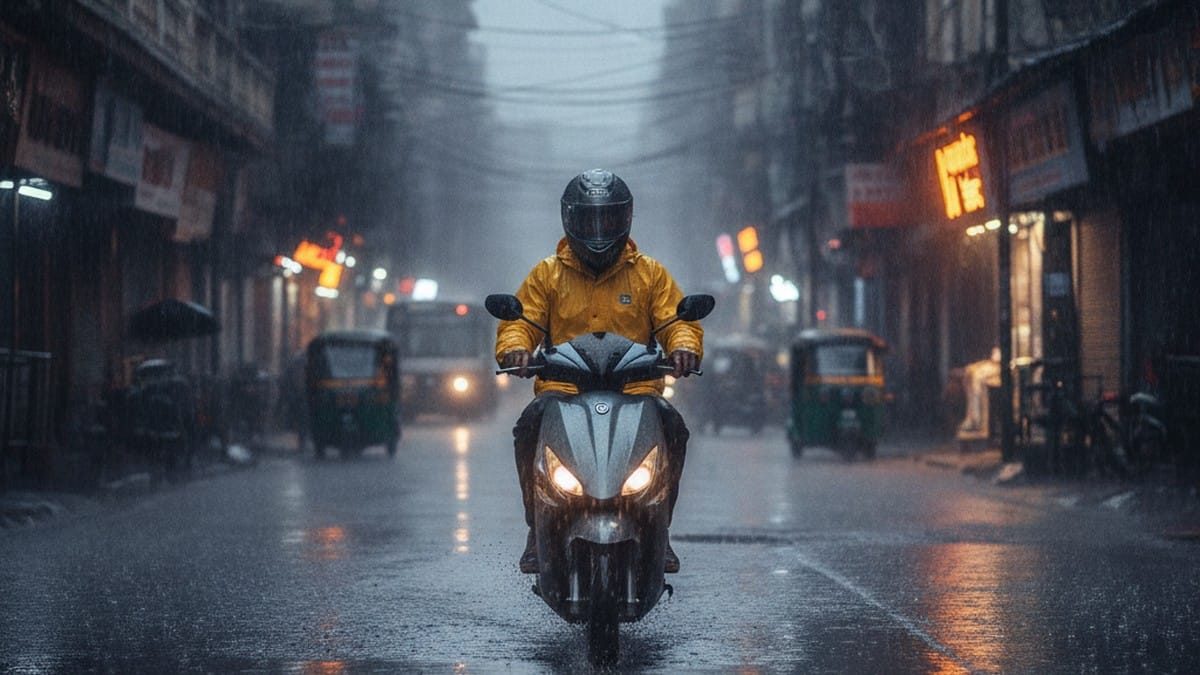
Every September, the same question floods EV owner forums: “My scooter got stuck in a waterlogged underpass yesterday. Should I be worried?” Sometimes the scooter restarted fine. Sometimes it didn’t. The difference is rarely luck — it comes down to decisions made long before the rain started.
If you own or are buying an electric scooter in India, the monsoon is the most honest test of that decision. And if you’ve assumed that an “IP67-rated” sticker on the brochure means your scooter will handle anything July through September throws at it, this article will save you from a very expensive lesson.
What IP67 Actually Protects — and What It Doesn’t
Ingress Protection, or IP, ratings are the most misunderstood spec in the electric scooter world. When a manufacturer says the battery is IP67-rated, here’s what that actually means: the battery pack survived a controlled lab test involving submersion in up to one metre of water for thirty minutes. That’s it.
It doesn’t mean your entire scooter is waterproof. The rating typically applies only to the battery pack, the main motor, and sometimes the primary ECU. The charging port flap, the wiring harnesses running through the frame, the dashboard connectors, the BMS communication lines — these often carry separate, lower ratings, or none at all. In a real monsoon, with water splashing upward at forty angles rather than dripping straight down into a test tank, the weak points are exactly where problems start.
The most commonly cited models in the Indian market — Ather 450X, Ola S1 Pro, TVS iQube, Bajaj Chetak — all advertise IP67 protection on their battery packs. But owners across Chennai, Pune, and Mumbai have documented intermittent software errors and connector issues months after a flood exposure event, precisely because the battery survived but peripheral systems didn’t. The damage doesn’t announce itself on day one. It shows up as mysterious error codes the following March, when nobody connects it to the waterlogged road they crossed back in August.
The Ground Clearance Problem Most Buyers Miss
Here’s a more practical number than IP ratings: ground clearance. Most mainstream electric scooters sold in India sit between 155mm and 170mm off the ground. The Ather 450X clears 170mm. The Ola S1 Pro Gen 3 comes in at 160mm. The TVS iQube manages 157mm. These measurements are the physical ceiling of how deep you can wade before water starts entering places it has no business being.
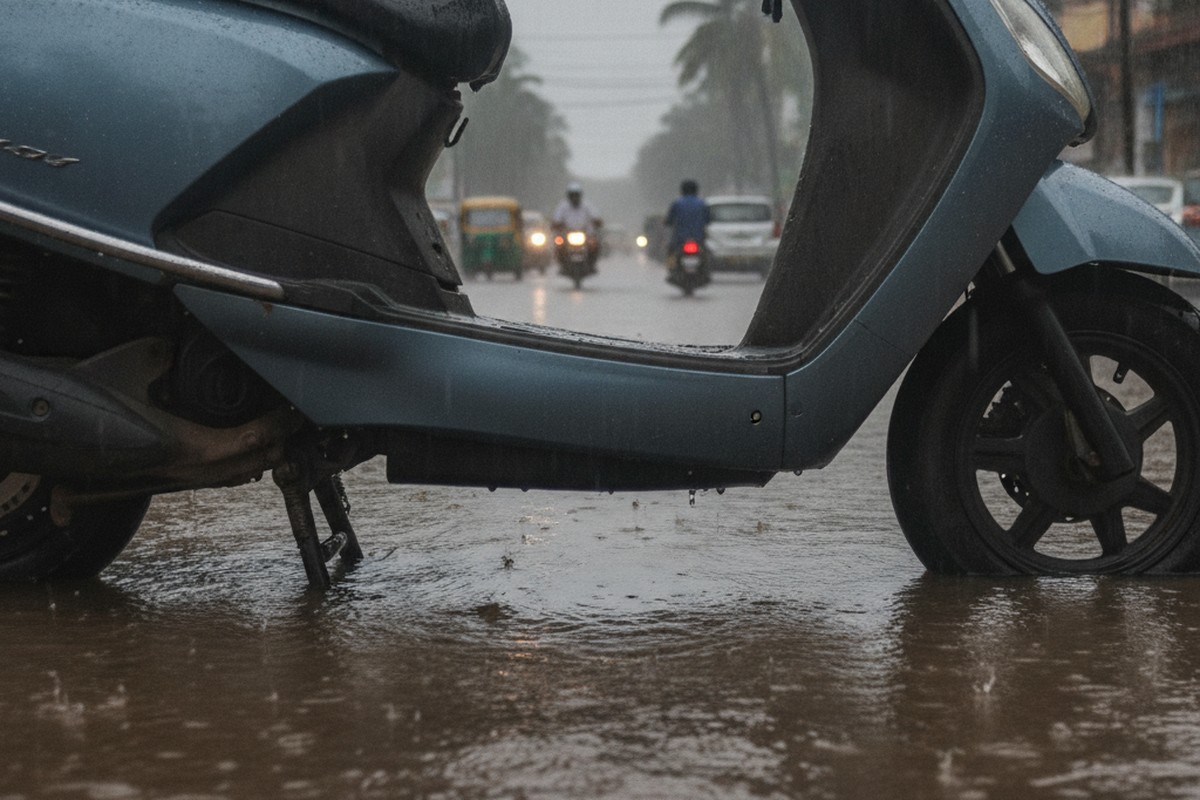
In Indian monsoon conditions, “waterlogged road” is not the same as “a bit damp.” In Mumbai, Hyderabad, Bengaluru, Chennai, and dozens of smaller cities, stagnant water regularly reaches 300mm, 400mm, even more at underpasses and low-lying intersections. Your 160mm-clearance scooter will have water washing over the footboard long before you realise the situation is unsafe.
The informal guidance from automotive engineers and service technicians is consistent: if water reaches the bottom of your footboard, slow down and turn around. If it’s above the footboard, you’re taking a genuine risk with the electrics. If it’s approaching the legshield, don’t try to restart — push the scooter to dry ground and call your service centre.
This is not unique to any particular brand. It’s a physical reality of how all scooters in this class are built.
The Damage That Costs You Lakhs — But Doesn’t Show Up for Months
The thing about water and electrical systems is that immediate failure is actually the better outcome. If your scooter dies in a flooded road, you know something happened, you get it inspected, and you catch the damage early.
What service technicians consistently describe as more expensive is latent corrosion — the slow oxidation of connectors and wiring insulation that begins inside sealed cavities after water exposure, progressing invisibly for months. You ride normally, everything seems fine, and then one day your BMS throws errors or your scooter refuses to charge. The cause is a connector that corroded because it wasn’t inspected after last monsoon’s underflooring splash.
A preventive post-monsoon inspection — terminals cleaned, charging port seals checked — costs ₹300 to ₹800. Skipping it can eventually cost ₹12,000 to ₹18,000 in replacement components.
The Insurance Gap That Most EV Buyers Walk Into
Water damage from floods is covered under standard comprehensive motor insurance — but only when it’s accidental and within the manufacturer’s specified wading depth. Ride through waterlogged roads beyond your scooter’s design limits, and you’re likely looking at a rejected claim or a partial settlement after a protracted dispute.
The smarter move is to add an EV battery add-on to your comprehensive policy at purchase. It adds perhaps ₹2,000–₹5,000 per year in premium but covers battery replacement costs that can run between ₹40,000 and ₹1.2 lakh.
One more rule most owners don’t know: if your Battery Management System shuts down automatically while your scooter is in water — which is exactly what a well-designed BMS should do — do not attempt to restart repeatedly. Forcing a restart overrides the protection and can cause an immediate short circuit. Call roadside assistance, get to dry ground, and have a technician inspect before the next ignition attempt.
Practical Monsoon Habits That Actually Make a Difference
For everyday rain — the kind that soaks you on a commute but doesn’t waterlog the road — modern electric scooters handle it well. The components that matter are sealed, and light to moderate rainfall is within the design envelope of every mainstream Indian EV. Ride gently, brake earlier, keep speed down.
After a wet ride, don’t plug in immediately. Let the scooter sit for thirty to sixty minutes before connecting the charger. Moisture around the charging socket during a charge cycle is a common cause of connector degradation. Wipe the port area dry, ensure the flap is fully seated, and always charge in a sheltered spot — never outdoors during active rainfall.
Tyres also matter more in wet conditions. The traction difference between worn and fresh tyres is most apparent on wet roads. If yours are already marginal, the monsoon is the worst time to defer replacement.
Where the Buying Decision Actually Matters for Monsoon Ownership
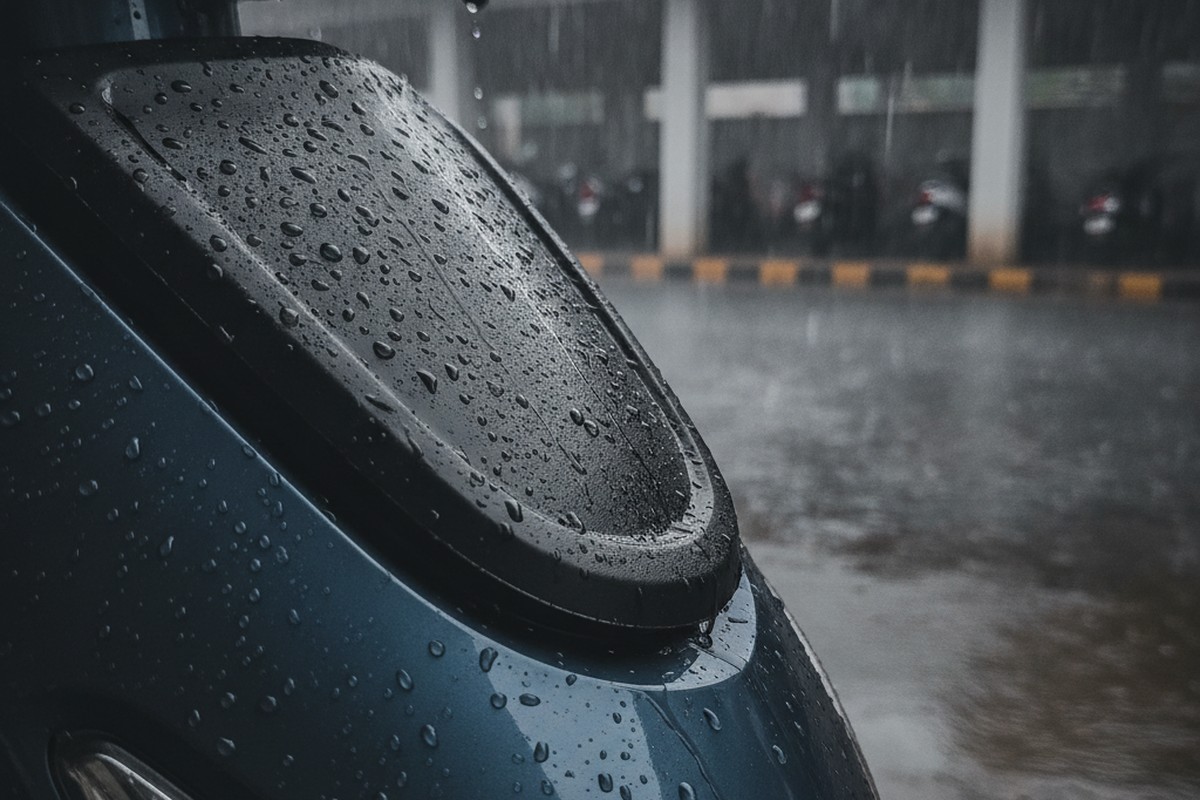
Here’s what doesn’t get said enough: the biggest factor in how well your electric scooter handles monsoon ownership isn’t the IP rating on the sticker. It’s the financial cushion you had left over after buying the vehicle.
When buyers stretch their budget to the absolute maximum to get an Ola S1 Pro or an Ather 450X at ₹1.3 to ₹1.9 lakh, they often find themselves cutting corners on the comprehensive insurance add-ons, skipping the preventive maintenance inspections, and deferring the mid-monsoon tyre replacement. The ₹300 connector inspection doesn’t happen, the battery add-on doesn’t get bought, and when something goes wrong in October, the costs hit disproportionately hard.
This is precisely where Elektree India’s product philosophy makes practical sense for a large segment of Indian buyers. The Zenith, priced at ₹90,164, and the RV 80 at ₹94,363, sit meaningfully below the premium competition — by ₹30,000 to ₹95,000 depending on what you’re comparing. Both deliver 80–100 km of real-world range at up to 60 km/h, backed by a three-year warranty that covers the vehicle assembly, battery pack, motor, and controller down to 70% State of Health.
For most Indian city commuters — office runs, school pickups, market trips — 80–100 km is more than enough for two full days of riding on a single charge. That margin also means you’re rarely in a situation where you’re pushing through genuinely dangerous monsoon conditions because you desperately need to reach a charging point. The practical range buffer is, itself, a monsoon safety feature.
The savings versus comparable-range premium competitors can realistically fund three or four years of comprehensive insurance with battery add-ons, annual preventive monsoon inspections, and still leave money in your pocket. That’s not a marketing claim — it’s basic arithmetic.
Elektree’s three-year battery warranty is also worth understanding in the context of monsoon ownership. Manufacturing defects that may be aggravated by repeated monsoon cycles, or premature degradation, fall within warranty scope. When something goes wrong in year two after three monsoon seasons, you have documented recourse — not a bill you’re arguing over at a service centre.
What the Smart Buyer Does Before the Rain Starts
The checklist that actually matters: a comprehensive insurance policy with an EV battery add-on, annual preventive inspections, an honest understanding of your scooter’s ground clearance limits, and a vehicle purchase that leaves you financial room to maintain all of the above. Elektree India’s lineup — the Zenith and RV 80 for regular commuters, the Fantom EV for riders needing 150 km+ of range — is built around that combination.
The IP rating on a brochure doesn’t protect your scooter. Responsible ownership habits, adequate insurance, timely maintenance, and a vehicle that was bought within budget — those are what protect it. If that combination is what you’re looking for, exploring what Elektree India has to offer at elektree.com is a logical next step.